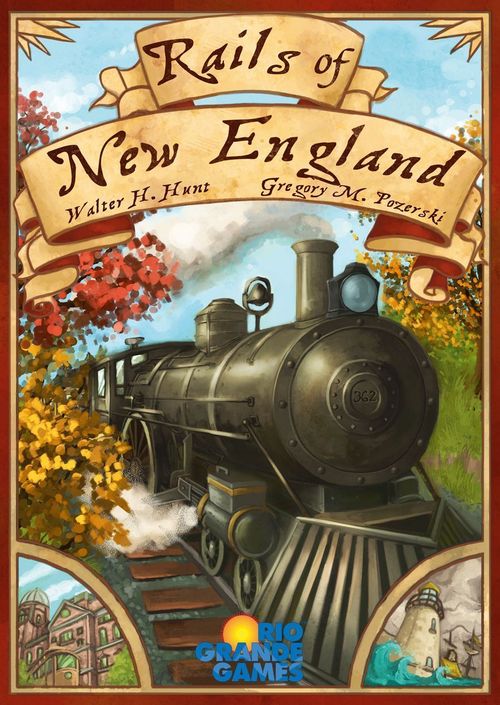
Rails of New England
Rails of New England Rulebook
Table of Contents
Table of Contents
Goal
To accumulate the most value in cash, depots, Businesses, Special Routes, and Special Subsidies.
Components
- 1 Game Board
- 5 Player Mats (1 for each starting state)
- 250 Cards:
- 35 'S' (Start) Businesses, 7 for each state
- 51 Period 'A' Cards (Businesses and Action Cards)
- 59 Period 'B' Cards (Businesses and Action Cards)
- 53 Period 'C' Cards (Businesses and Action Cards)
- 22 Economic Condition Cards
- 4 Required Event Cards
- 16 other Event Cards
- 6 Mail Contracts
- 4 State Subsidy Cards
- 175 colored cubes (35 each of 5 colors) for use as depots or other playing aids
- 10 white cubes
- 1 Start Player marker (white locomotive)
- 1 Turn marker (black locomotive)
- Loan tokens and Income Markers in three colors
- Bonus and Connected tokens
- Paper Money
- A 10-Sided Die
Preparation
Game Setup
Place the map so each player can place cards and a Player Mat.
Players now decide which Optional Rules will be used, if any, and whether cash is public or concealed. Randomly choose a first player. Distribute the states randomly or by agreement, each player placing a depot (a cube of his color) in the state capital of his starting State. It is helpful though not necessary for players to sit near their starting state.
- With two players use Connecticut and New Hampshire as starting states.
- With three players, add Vermont.
- With four players, add Maine or Rhode Island.
- With five players, use all five states.
If Maine is not in play, do not use the Maine Mail Contract or the Grand Tote Railroad Special Subsidy.
Each player receives $40 in starting capital and a set of colored markers.
Preparing the Cards
Lay out the first three Economic Condition cards in order (Start 1, Start 2 and the three Start 3 cards in a stack).
Sort and shuffle the remaining Economic Condition cards by type (Depression, Normal and Prosperity) and place them face up in separate stacks.
Lay out the Required Event cards in numerical order (1, 2, 3, _, 5) leaving a space for an event in position 4. Shuffle the non-Required Event cards into a face down stack. Draw the top card from this stack and place it in position 4. If it is a Flood, set it aside and draw another. Shuffle all drawn Flood events back into the stack. (This is the Event Card Display: a random non-Flood Event sits in position 4.)
Place the other cards as follows:
- Lay out the Special Subsidy and Mail Contract Cards where they will be accessible to all players. Note: with fewer than four players, do not use the Maine Mail Contract or the Grand Tote Railroad Special Subsidy.
- Sort the Period A, B and C cards into separate stacks. Shuffle the Period B and C stacks separately and set them aside.
- Shuffle the Period A stack and deal three Period A Business cards to each player. If a player receives an Action card draw a replacement and shuffle the Action card back into the stack. The Period A stack is now the current Business Deck.
- Deal each player the seven S Business cards for his state.
Each player now has ten Business cards, from which he chooses two to place face up in front of him. These are his starting Businesses, and are free. From the rest he chooses three to retain in his hand and discards the rest. Cards held in hand are secret; other information is public.
Shuffle the Period A Action cards and the discarded Period A Business cards back into the deck. Discarded S cards are removed from the game.
Preparing the Players
Players calculate their starting income (don't forget the Sheep Bonus) and mark it on their player mat as shown. Turn 1 is always the Normal Economic Condition, so players should use the gray coin markers.
Place the Turn Marker (the white engine) on Turn 1. Give the first player the First Player marker (the black engine).
Sample Start: $2 Normal Income + 5 sheep = $7 Income
See Businesses and Income for further information on how to calculate income.
Players are now ready to begin play.
Sequence of Play
Each turn in Rails of New England consists of three Phases: Economic, Development, and Bookkeeping. Each Phase has steps which must be followed in sequence. All activities are normally performed in player order, starting with the First Player and proceeding clockwise.
To speed play, many steps may be performed simultaneously when player order makes no difference (e.g., repaying loans). However, any player may require a step be done in turn order if it matters to him.
A brief summary of the Sequence of Play appears on the Player Mats and below.
- Economic Phase
- Resolve Economic Conditions (except Turn 1)
- Resolve Events
- Deal Cards
- Select Cards
- Development Phase
- Two rounds of one Action per player, in turn order
- Bookkeeping Phase
- Pay Loan Interest
- Income
- Loans
- Trade (optional)
- End of Turn
Economic Phase
Economic Conditions Step
In the Economic Phase, players determine the coming economic conditions, resolve Events, and draw new Business and Action cards from the current Business Deck.
In each turn except Turn 1, players will determine the economic conditions for the turn after next; e.g., players determine on Turn 2 the economic conditions for Turn 4. Seeing coming upturns and downturns in the economy allows the players to adjust their holdings.
Economic Conditions in the game will vary between Depression, Normal and Prosperity. In Normal economic times Businesses make money, in Depression many (but not all) Businesses will perform poorly and may even lose money, and Prosperity is boom times for all, with accordingly greater profits.
For each Economic Condition there is a separate deck of cards. When an Economic Condition is generated draw the top card from the corresponding deck. If a deck is exhausted, shuffle and reuse.
The Economic Condition is always Normal on Turns 1, 2 and 3. Starting on Turn 2, during the Economic Conditions Step, roll the ten-sided die and consult the Economic Condition card for the current turn. Draw the top card from the appropriate deck and place it to the right of next turn's Economic Condition. Thus there will always be three cards on display - the current turn and the next two turns.
In the example (die roll "8" = Prosperity), the current turn is Normal, and next turn will be Depression. The roll for Economic Conditions is 8; the turn after next will be a Prosperity turn. If the roll had been 1-3, it would have generated another turn of Depression; if 4-7, the economy would have returned to Normal. The first three turns are Normal to assure a smooth early game. The reason for the ranges and die rolls on the cards is to provide for a random but not chaotic economy; thus, Depression is more likely to be followed by Depression than by Prosperity.
Turn 3 is a special case. The economy for Turn 3 is always Normal, but there are three Turn 3 cards provided. When the Economic Condition for Turn 4 is generated (on Turn 2), choose the Turn 3 card that matches the Turn 4 Economic Condition. Use the card on the left if Turn 4 is Depression; the card in the center if Turn 4 is Normal; the card on the right if Turn 4 is Prosperity.
Thus:
- The Economic Condition on Turn 1 is always Normal; no roll is made.
- The Economic Condition on Turn 2 is always Normal; roll for Turn 4. Choose the appropriate Turn 3 card that matches the Turn 4 condition, as described above.
- The Economic Condition on Turn 3 is always Normal. Roll for Turn 5.
Events Step
Rails of New England has Events representing a variety of incidents, historical or otherwise, such as fires and floods, bad weather and shifting business conditions. Each turn, unless the current Economic Conditions card reads NO EVENT ROLL, the First Player rolls a ten-sided die to see if an Event takes place.
Three Required Events represent technological advances; a fourth, the disastrous effect on New England farms of a collapse of the wool market in Europe. The Economic Condition card for the current turn shows if an Event and/or Required Event occurs and/or should be rolled for. Some cards call for an Event or Required Event to occur automatically, and some cards may cause two Events to occur. As described above, there will be one random (non-Required) Event on display at the beginning of the game.
There will always be five Events on display. The Event farthest to the left will occur first. When an Event takes place - Required or non-Required - the four remaining cards are shifted to the left, and a new Event is added to the right. All Required Events are Events.
Note that when a Required Event is called for, the leftmost Required Event is resolved even if is not the leftmost Event. For example, this can occur when Sheep Boom Goes Bust reaches the second position and the current Economic Conditions card calls specifically for a Required Event. The leftmost Event is passed over. If a Required Event is specifically called for and there are none left, ignore this directive.
Flood Events
There are five Floods in the Event deck which can be highly destructive to the affected areas. Since an Event of this nature early in the game might ruinously affect one player by random chance, Flood Events cannot occur during Period A.
Sheep Boom Goes Bust
The Required Event Sheep Boom Goes Bust simulates the declining European demand for the wool produced by New England farmers as the century wore on. This Event begins in the rightmost position of the initial Event card layout. It has two effects:
- For the rest of the game, all Sheep icons on Businesses are ignored. Farms no longer receive bonus income for Sheep icons.
- The game immediately enters Period B, if it has not done so already. (See Game Periods, below.)
Deal Cards Step
The First Player now draws two cards per player from the current Business deck, laying them out face up. (It can be useful to use the white cubes to mark their locations on the map - especially for those not from New England.)
Each player may claim one of the face up cards. He may pay its Cost and play it immediately (thus saving himself an Action in the Development Phase) or hold it in his hand for future use. However, sometimes it is better to wait. There is no cost to take a card, only to play it.
- To play an Action card, pay $5 and follow the instructions on the card.
- Businesses and Actions may be placed in hand for future use.
- When playing the claimed Business Card the player may sell his in play Businesses back to the Bank at the same time. He receives one-half of a Business's Cost (rounded up). If a player already has the maximum number of Businesses in play, he must sell at least one of his Businesses to make room. All sold Businesses are discarded from the game. Any cards not chosen are discarded.
Development Phase
In the Development Phase players may play cards from their hand, claim Special Subsidies, Mail Contracts or Special Routes, and build depots on the map. The Development Phase consists of two rounds; in each round, players may perform one Card Play or Build Action.
Card Play Action
There are many different Card Play options. Note that any Card Play may be combined with selling one or more Businesses in play to raise cash.
Play a Business. A player brings a Business into play by paying its Cost and placing it face up in front of him. Adjust Income on the Player Mat. When playing a Business card, one should consider not only its Cost but also its location, as well as the current and upcoming Economic Conditions. No more than eight Businesses may be in play during Periods A and B and no more than ten in Period C.
Play an Action Card. Action cards can affect the player or his opponents. To play an Action card pay its cost ($5) and follow the instructions. An Action card played defensively (either to negate another Action card or to raise money to pay a debt) may be played out of turn and does not count as an action. Note that the Action card Unexpected Inheritance may be played for cash at any time and does not count as a Card Play.
Important: Action cards cannot Close depots in a Market City or State Capital. They can Close individual Businesses in those cities, and depots in Mail Cities not in the state Capital.
Claim a Mail Contract. A Mail Contract can be claimed by any player with a depot in at least half of the Mail Cities in that state, including the state capital. It is possible to claim a Mail Contract belonging to another player (See Mail Contracts). Adjust Income on the Player Mat. Mail Contracts do not count toward the Business limit.
Claim a State Subsidy. A State Subsidy can be claimed by any player who fulfills the conditions specified on the card. State Subsidies provide benefits (but no income) to their owner and remain with the player for the rest of the game. The Hoosac Tunnel has a Cost of $10; the other State Subsidies have no Cost. State Subsidies do not count toward the Business limit.
Claim a Special Route. A Special Route can be claimed by any player fulfilling the conditions specified. See Special Routes, below. Special Routes provide income to their owner and remain with the player for the rest of the game, though their income may have to be shared with other players who also claim them. Special Routes have no Cost; some have a value at the end of the game. Adjust Income on the Player Mat. Special Routes do not count toward the Business limit.
Draw a Card. In Period B or C, a player may draw the top card of the current Business Deck. This card may be retained in hand, discarded or played at once, paying its Cost.
Sell to the Bank. Businesses may be sold to the Bank for one-half their Cost, rounding up. This Action may be combined with any other Card Play Action (but not with a Build Action.) Adjust Income on the Player Mat.
Build Action
A player builds depots in cities and mileposts on the map to Connect Businesses and increase their profits. Businesses almost always generate more income when Connected; a Business is Connected when the player has built a depot in the city where the Business is located and in at least one Market City (Boston, New York or Montréal).
To build a depot in a city, pay the cost of all track sections between that city and his nearest depot plus $3 for the depot itself. Place a colored cube on the city to indicate the presence of a depot. Each additional depot built after the first in the same Action costs $3 more than the previous depot; thus, the second depot built in an Action costs $6, the third $9 and so forth.
Note that the track sections belong to no one; so, to later build a depot between two existing depots requires the payment of the track cost again.
Important: a player may build as many depots along as many track sections in a turn as desired, but must start at a particular depot and build in only one direction. It is not necessary to build a depot in each intermediate location.
Build Example. As an example of a Build Action, a player wishes to build from his depot in Gorham, NH toward Montréal, Connecting his Businesses in Bretton Woods, St. Johnsbury and Johnson along the way. He could do it in three Actions, building to Bretton Woods ($6 track + $3 depot), then St. Johnsbury ($4 + $3), then Johnson ($8 + $3) for a total of $27. Alternatively, he could do it in one Action, spending the same amount of money for track but $9 more for the depots ($3 + $6 + $9) for a total of $36. Cash-poor players must balance cost against time.
Building Restrictions
- Cities can hold a maximum of two depots, except for Market Cities and State Capitals, which can hold any number.
- Track sections across Estuaries do not exist until the Improved Bridge Building Techniques Required Event occurs. These track sections are marked with a Bridge symbol.
- Some Events may constrain or prohibit building in certain areas of the map.
Bookkeeping Phase
In the Bookkeeping Phase, players pay interest on loans, receive income, and obtain and retire loans.
Loan Interest
Players must pay interest on loans before receiving income for the turn. Each loan of $20 requires an interest payment of $4 per turn. To cover a debt, he must sell Businesses for half their Cost to cover the debt (or uses an Unexpected Inheritance card.)
Income
Players now collect income from Businesses, Mail Contracts and Special Routes that are not Closed. Note that for a player to collect Connected income from a Business there must be a non-Closed depot in the city where the Business is located and a depot in at least one Market City. See Businesses and Income below.
Loans
After the Required Event Second Bank of the United States Is Chartered has occurred, players may take out one $20 loan each turn. A player can have up to five loans outstanding. Players keep track of their interest (and hence the number of $20 loans) on the Company Display. Players may retire any number of outstanding loans at this step by paying $20 per loan back to the Bank.
Trade (optional)
See the Trade optional rule below.
End of Turn
After the Bookkeeping Phase is complete perform the following steps.
- Discard the current Economic Conditions card.
- Return all Closed Businesses and depots to normal status.
- Discard cards in hand in excess of 5.
- Pass the First Player Marker clockwise.
The game ends automatically at the end of Turn 16. It may end earlier if all Mail Contracts, State Subsidies and Special Routes have been claimed. See Ending The Game below.
Game Periods
Rails of New England is divided into three Periods - A, B and C. Businesses in each period correspond to the economy of the time:
- Period A businesses are primarily early industry, crafts and farms.
- Period B businesses introduce heavier industries such as machinery, shoes and textiles;
- Period C has more specialties.
Both Period B and C add luxury Hotels which can earn high income if Connected, particularly during periods of Prosperity. When a Period is completed, the Business Deck is discarded and replaced by cards of the next Period.
The table below summarizes the three Periods, their boundary conditions, and special features.
| Period | Beginning Condition | Special Features |
|---|---|---|
| A | Period A begins on Turn 1. | Use the Period A Business Deck. Players may have a maximum of 8 Businesses in play. Before proceeding to Period B, retire two Businesses. |
| B | Period B begins when the Required Event Sheep Boom Goes Bust occurs, or at the start of Turn 6, whichever comes first. | Use the Period B Business Deck. Players may draw the top card of the Business Deck and play it, discard it or retain it in their hand for future use. Players may have a maximum of 8 Businesses in play. Before proceeding to Period C, retire two Businesses. |
| C | Begin Period C at the start of Turn 11. | Use the Period C Business Deck. Players may draw the top card of the Business Deck and play it, discard it or retain it in their hand for future use. Players may have a maximum of 10 Businesses in play. |
Retiring Businesses
As the Nineteenth Century progressed some enterprises became outmoded and unprofitable. Whenever a new game Period begins, each player must immediately choose two of his Businesses in play to retire. Set them aside. They no longer count toward the Business limit, and produce no further income. They cannot be affected in any way by game events or Action cards. Retired Businesses will be worth their full Cost at the end of the game.
Retired Businesses can be tucked face down under the Player Mat.
Businesses and Income
Businesses are at the heart of Rails of New England. During the course of the game, players will acquire Businesses in order to maximize their profits during various economic conditions. Businesses range from common farms and factories to unusual, one of a kind concerns, many of which are still in operation today.
Each Business is represented by a card. The card shows the Cost, Income values, additional Sheep Bonus income, and the Period in which the Business appears. At the top of each Business card is the business type and location; in the example the Business is a Dairy which is located in Pittsfield, Massachusetts.
- Each business has a Cost - the amount of money required to put it into play ($4 in this case).
- There are six values for Business income: two for each of the three Economic Conditions. The left column is the income when the Business is Unconnected; the right column is the income when the Business is Connected. (See Connection below.)
- Some Businesses receive additional income while the Sheep Bonus is in effect: $1 for each Sheep icon on the card. In this case, the Business has a $2 Sheep Bonus.
- At the bottom of the card is the Period in which the business appears.
- Some businesses have icons indicating the Events which affect them.
Each player starts the game with two Businesses in play. Additional Businesses can be brought into play during the Select Cards step of the Economic Phase or the Card Play step of the Development Phase (either by the Play a Business Card Play or by the use of certain Action Cards. In Periods B and C, a player may also draw the top card of the current Business Deck and, if it is a Business, bring it immediately into play.) Also, Businesses in play or held in the hand by other players can be acquired in the optional Trade step.
Businesses in play can be lost due to the use of Action cards, by being sold back to the Bank, or by being sold or traded to other players during the optional Trade step. Players may have a maximum of 8 Businesses in play during Period A and Period B and a maximum of 10 in play during Period C.
Income
To produce income, a Business must be in play and not Closed by Actions or Events. By Connecting a Business a player increases his income for that Business. This represents three things: collecting shipping fees for his own railroad, reducing the Business's transportation costs by changing from oxcart to rail, and delivering the goods to the more profitable market of a major city.
To calculate total income, determine if each Business is Connected or Unconnected, then cross-index that column with the row for the present Economic condition (Depression, Normal or Prosperity). The entry at the intersection is that Business's income for this turn. Connected Businesses also earn $1 for each additional Market City in which a player has a Depot.
The Sheep Bonus
Early 19th century New England had a booming trade exporting wool to war-torn Europe, and an equivalent bust when wars ended. This is represented in the game by adding $1 income for every Sheep icon on a Business card - until the Sheep Boom Goes Bust Event occurs.
Connection
The best-paying destination for the products of Businesses are the Market Cities of New York, Boston, and Montréal. Unconnected Businesses deliver their goods locally, but the Market Cities will provide larger and richer markets. In Rails of New England this is represented by the higher Income in the Connected column of the Business card. Place a Connected marker on the card to indicate this.
A Business is Connected to a Market City if its owner has a depot in the city where the Business is located and in one or more Market Cities. Certain Events can Close Market Cities, which will affect a Business' income.
For example, using the Pittsfield Dairy Business shown above, the table below lists the possible incomes for the Business. With Sheep applies while the Sheep Bonus is still in effect; Without Sheep applies afterward. Note that if a Market City is Closed by an Event, it does not contribute to the income of the Business.
| Condition | With Sheep | Without Sheep |
|---|---|---|
| Closed | $0 | $0 |
| Unconnected, Depression | 3 | 1 |
| Unconnected, Normal | 3 | 1 |
| Unconnected, Prosperity | 4 | 2 |
| Connected, Depression | 5 | 3 |
| Connected, Normal | 5 | 3 |
| Connected, Prosperity | 8 | 6 |
| If Connected to 2 Market Cities | 9 (+1) | 7 (+1) |
| If Connected to 3 Market Cities |
Inability To Pay A Debt
A player unable to pay a debt must sell Businesses to the Bank for 1/2 their Cost until the debt is paid. A player may also voluntarily sell Businesses for 1/2 their Cost in the same manner as part of a Card Play (even when playing an Action Card). Sold Businesses are discarded from the game.
Special Routes, State Subsidies and Mail Contracts cannot be sold to the Bank.
Events
Events will occur during Rails of New England that affect the course of the game. There are four Required Events and sixteen other Events, which occur when called for by the current Economic Condition card (see Economic Phase, above). Most information on the effects of Events are listed on the cards. For clarification, the table below lists which cities are affected by Flood Events. Flood Events close Businesses and depots in the affected cities.
| River | Flood Effect | Cities Affected |
|---|---|---|
| Androscoggin | Businesses and depots in the Androscoggin River Valley are Closed. The Grand Tote Railroad is Closed. | Bath/Brunswick ME, Lewiston/Auburn ME, Livermore ME, Rumford ME, Bethel ME, Gorham NH. |
| Lower Connecticut | Businesses and depots in the Connecticut River Valley from Greenfield MA south to the coast are Closed. | Greenfield MA, Northampton MA, Springfield MA, Hartford CT, Middletown CT, Old Saybrook CT. |
| Upper Connecticut | Businesses and depots in the Connecticut River Valley from Brattleboro VT north to the Canadian border are Closed. Special Routes from Boston and Portland to Montréal are Closed. | Brattleboro VT, Rockingham VT, Claremont NH, Windsor VT, White River Jct VT, Woodsville VT, Lancaster NH, Stratford NH. |
| Kennebec | Businesses and depots in the Kennebec River Valley are Closed. The Grand Tote Railroad is Closed. | Bath/Brunswick ME, Augusta ME, Waterville ME, Skowhegan ME, Bingham ME. |
| Merrimack | Businesses and depots in the Merrimack River Valley are Closed. | Newburyport MA, Haverhill MA, Lawrence MA, Lowell MA, Nashua NH, Manchester NH, Concord NH, Franklin NH. |
Closings
Businesses, depots and locations may be Closed by Action or Event cards. A Business that is Closed generates no income. A depot that is Closed makes any Businesses at that location Unconnected, and track cannot be built from or through it. A location that is Closed Closes both Businesses and depots, and track cannot be built from or through it. Depots cannot be built in a Closed location, and track cannot be built through a Closed location. Businesses in a Closed location generate no income.
A Mail City that is Closed generates no mail income, but does not affect other Mail Cities (even if it is the state capital). The Mail Contract is not surrendered even if the condition to claim it is temporarily not met.
Market Cities and State Capitals can never be Closed by Actions, only by Events. However, any individual Businesses may be Closed by Actions or Events.
Businesses and depots return to normal status during the End of Turn Phase, as described above.
Special Routes
Special Routes represent unique local traffic: the movement of wealthy tourists between their resorts on Cape Cod, Newport and the Berkshires, of passengers between Market Cities, and the shipping of Canadian products from Montréal to Portland (since Montréal was icebound in winter). Special Routes provide income and, in two cases, improved income for Hotel Businesses. Special Routes can be claimed by more than one player.
Special Routes cannot be affected by Action Cards, but they cannot be operated and generate no income in any turn in which a necessary depot is Closed. Some Events also Close Special Routes.
Special Routes can be claimed as a Card Play by any player who meets the necessary conditions. To claim a Special Route, place a colored cube on the leftmost available space on the display on the game map. All players claiming that route should read the space to the right of all cubes to determine their income for that route.
Special Routes cannot be sold or traded. Some Special Routes have value at the end of the game.
The routes between the Market Cities can be claimed by all players. The Montréal to Portland route, however, may only be claimed by two players, since only two depots may be placed in Portland. Hotel bonus routes may also only be claimed by two players. The following table summarizes the Special Routes.
| Special Route | Requirements | Players Allowed | Income | Value at End |
|---|---|---|---|---|
| Boston to Montréal Passengers | Depots in Boston and Montréal | Up to 5 | $5/$3/$2/$2/$2 | $15/$10/$8/$8/$8 |
| Boston to New York Passengers | Depots in Boston, New York, Hartford and Providence | Up to 5 | $6/$4/$3/$3/$3 | $15/$10/$8/$8/$8 |
| New York to Montréal Passengers | Depots in New York and Montréal | Up to 5 | $7/$4/$2/$2/$2 | $15/$10/$5/$5/$5 |
| Boston to White Mountains: The Grand Hotels | Depots in Boston, a White Mountain Hotel Location, and Wolfeboro NH or Laconia NH | Up to 2 | $3/$2, +$3 for each Connected Hotel | $5 per Connected Hotel |
| Cape Cod to Berkshires: The Social Register |
Hotel Special Routes
The two Hotel Special Routes provide income during the game, and also a +$3 bonus income for any Connected Hotel Businesses for the player claiming the route. To indicate such a Bonus, place a Bonus marker on the card beside the Connected Marker.
Note 1: Locations eligible for the Boston to White Mountains Hotel Bonus are: Bethel ME; Bretton Woods NH; Conway NH; Lincoln NH; Peterborough NH.
Note 2: Locations eligible for the Cape Cod to Berkshires Hotel Bonus: Great Barrington MA; Harwich MA; Manchester VT; Provincetown MA.
Mail Contracts
Mail Contracts are an award for the transportation of a variety of state services and materials to the company best able to ensure delivery. In Rails of New England there is a Mail Contract for each of the six New England states.
A Mail Contract may be claimed as a Card Play by any player with depots in at least half of a state's Mail Cities, one of which must be the State Capital. The player with the Mail Contract collects $2 Income for the State Capital and $1 for each Mail City in that state in which he has a depot that is not Closed. Use a colored cube to mark Income on the Mail Contract card.
Mail Contracts cannot be sold or traded but may be stolen (as a Card Play) by any player with a depot in a greater number of that state's Mail Cities (including the State Capital). Mail Contracts have no value at the end of the game.
State Subsidies
Some States offered subsidies to favored railroads. Historically these were financed by state loans which were seldom repaid (and perhaps not intended to be, considering the corruption of the times). A State Subsidy may be taken as a Card Play by any player who meets the listed conditions. Only one player may claim each State Subsidy. State Subsidies are not affected by Action Cards. They may not be traded or sold. Some State Subsidies have value at the end of the game.
Ending the Game
The game ends at the end of any turn in which all Mail Contracts and Special Subsidies have been claimed, and all Special Routes have been claimed by at least one player. (Note that in the 2- and 3-player game the Grand Tote Railroad Special Subsidy and Maine Mail Contract are not used.) Otherwise:
- At the end of Turn 14, the game ends if all but one of these are claimed.
- At the end of Turn 15, the game ends if all but two of these are claimed.
- At the end of Turn 16, the game ends.
At the end of the last turn each player adds all assets, subtracting $20 for each remaining loan. Assets counted at the end:
| Asset | Value |
|---|---|
| Cash | Total cash on hand |
| Businesses | Total Cost, including Businesses retired during the game |
| Depots | $3 per depot |
| Special Routes | Total Value (see above). |
| Special Subsidies | Total Value (see above). |
| Hotels | $5 per Connected Hotel, if the player has claimed the corresponding Special Route (see Hotel Special Routes above). |
Convert all assets into cash. The player with the most money wins. In case of a tie the player with the greatest value in Business Cards wins.
Optional Rules
Friendly Competition
The game can be played with less "take that" by removing certain cards from the Business decks. The downside is that it will be more difficult to overtake a player with a commanding lead. Still, attacking leaders costs Actions, which are the most valuable commodity.
To play a more friendly game, remove the following cards: A Friend in Need is a Friend Indeed (2), Bankruptcy, Business Spy, Embezzlement, Insider Trading (2), Long Live the Revolution!, Pinkerton's Detective Agency (2), Safety Inspection, Unexpected Inheritance (2), Warehouse Arson (2), Watered Stock (4).
We think that removing these cards will make the game more bland but it will be a more friendly experience.
Improved Business Climate
In the Select Cards step of the Economic Phase, after all players have selected their card, each player may, in player order, pay $5 to claim a second card from the cards available. He puts it in his hand or and puts it into play like any other card.
Fast Starts
The following "fast start" conditions can be applied. Players may choose to give a "Fast Start" to one or more states.
- Connecticut Fast Start. The Required Event Improved Bridge Building Techniques starts in play. Replace this Event with a randomly-drawn non-Required event; if it is a Flood, set it aside as described in Game Setup above. Shuffle all Flood events back into the Event Deck before starting.
- Maine Fast Start. The Maine player may place an additional depot in Portland, ME at the start of the game.
- New Hampshire Fast Start. The New Hampshire player may start with three Businesses in play and two in his hand.
- Rhode Island Fast Start. The New Hampshire player may start with three Businesses in play and two in his hand. (Printed as such in the rulebook.)
- Vermont Fast Start. The Vermont player may place an additional depot in White River Junction, VT at the start of the game.
Trade
With this option, players may trade or sell any cards in their hand or any Businesses they have in play during the Trade step of the Bookkeeping Phase. Cards in hand go to the receiver's hand; cards already in play remain in play for the recipient. Update Income on the Player Mats accordingly. State Subsidies, Special Routes and Mail Contracts may not be traded. Depots may not be traded.
We recommend that trading be limited to two minutes.
Errata
Cards
- The Augusta, ME Potatoes Business should have a Fire icon.
- The Canaan, CT Wine Business should have a Fire icon.
- The Concord, NH Carriages Business should have a Flood icon.
- The Kingstown, RI Fish Business does not require a Storm icon.
- The Middlebury, VT Marble Business should have a Snow icon, and should be assigned to the "A" Business Deck (instead of "S").
Revisions from v 1.0 Rules
- Economic Condition cards are now placed in face up stacks.
- Action cards played defensively now cost $5.
- When drawing a card in Period B or C, you may now retain it in your hand, play it or discard it.
Frequently Asked Questions
Several of the Depression Economic Conditions say 'Economic Recovery!', does this have a game effect? No, it's flavor text. This just indicates a strong likelihood that the Depression will end.
If one of the Economic Conditions stacks (Depression/Normal/Prosperity) needs to be reshuffled, are the Economic Condition Start cards shuffled into the appropriate stacks? No, the Start cards are removed from the game once used.
Given that you can play Action cards defensively out of turn to cancel another Action, can you use (yet) another Action card to cancel the first? No. A defensive card (i.e., Pinkerton Detective Agency) can't be countered.
Can loans be taken at any time once Second Bank of the United States has occurred? Loans may only be taken in the Bookkeeping Phase. If a debt cannot be paid, the player must sell Businesses in order to obtain cash (or use an Unexpected Inheritance card, which may be played at any time.) Loans cannot be taken to pay a debt.
If I can build in a Market City do I have to build a depot in every location along the way? No. In order for a location to be considered Connected, all that is required is a depot in the location and a depot in at least one Market City. You do not have to build a depot in every intermediate location.
If a Business is sold during the Period it appeared (i.e., a Period 'B' Business sold during Period 'B') is it discarded or out of the game? Sold Businesses are removed from the game regardless of the Period.
How should players mark or denote temporary changes to income (due to Events or Actions)? Push the Connected or Bonus marker off the card or turn it sideways, or turn the entire card sideways.
How do depots, which are part of a Mail Contract, affect the Mail Contract when they are closed by Events or Actions? Closed depots only affect the income received from Mail Contracts. Mail Contracts can be claimed even if some or all of the depots necessary to meet the requirements are temporarily Closed. Mail Contracts only pay for open depots, so if a depot in a State Capital is Closed due to an Event (such as the Nor'easter closing Boston) or Action, then the player would receive $2 less for their Mail Contract (and an additional $1 less for every other Closed depot in the Mail Contract).
Can a player claim Special Routes or State Subsidies when a necessary depot is Closed? Yes. Similar to the Mail Contracts, you may claim a special subsidy or route regardless of the status of the depots. However, income may be affected or nonexistent because of the event.
Grand Tote Railroad: The player receives +3 income for Connected Lumber and Paper businesses in Maine. Does this only apply to businesses owned by the owner of the subsidy? Yes, the card says "+3 income for each of this player's Connected Lumber and Paper Businesses in Maine."
It looks as though Boston is a dual-color city: both a Capital and a Market City. Is this intentional? Yes. Boston is the capital of Massachusetts, which matters for the Massachusetts Mail Route, and Boston is one of the three Market Cities (in addition to New York and Montréal) for Connection purposes.
Is the game component limited? No. Players may have as many cubes in play as needed.
When the event roll does not generate an event, is the leftmost event discarded, or does the event stay in the queue until triggered? No, the event is not discarded. However, it would make an interesting variant to discard any events which did not take place.