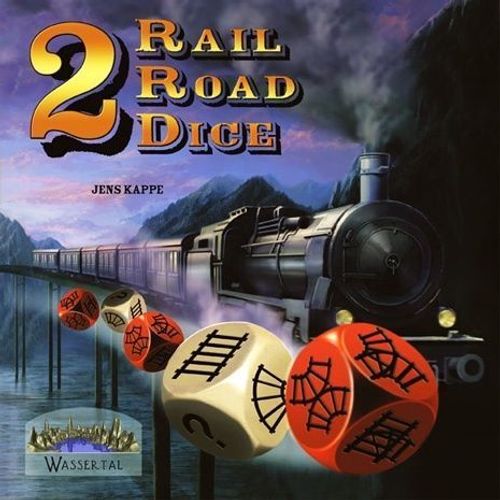
Railroad Dice 2
Railroad Dice 2 Rulebook
Table of Contents
Table of Contents
Setup
If you are new to the game, lay out the map tiles as shown in the rulebook illustration. Experienced players take turns placing one map tile each. The only rule: each tile must touch the tiles it borders along at least four squares ("they must touch along at least four squares along the edges of each tile").
Place all discs and dice where every player can easily reach them. The discs are both money and passengers. A large disc is worth 5 dollars/passengers.
Stack the locomotive tiles in order from smallest to largest, so that the smallest (2) is on top of the stack. In a 2-player game, first remove one locomotive each of value 2, 3, 4, 5 and 6 (so in a 2-player game there is no locomotive of value 6).
Each player receives 10 dollars (2 large discs), one station (die) and a station tile of the same color. Each player also receives gray stations (dice), the number depending on the player count:
- 2 players: 4 gray stations each
- 3 players: 3 gray stations each
- 4 players: 2 gray stations each
The player who most recently rode a train is the starting player. If there are several, one who travelled in a sleeper compartment beats one who travelled in a reserved-seat car, and so on by carriage class. In fact (and in any dispute) the starting player is determined randomly.
Starting with the starting player, each player places their station on a map tile not yet occupied by another player's station (original: "on a tile separate from other players"). Players may not place their stations on water or on the edge of a tile.
Once everyone's own stations are placed, players take turns placing one gray station each. Gray stations must be placed at least two squares away from any other station. They still may not be placed on water or on the edge of a tile. Because of this restriction, not all stations may be able to be placed on the map. Continue placing stations around the table as long as possible or until players run out of gray stations.
After all stations are placed, place passengers next to each map tile. Each tile receives 5 passengers per station. So if a tile has 2 stations, place 2 large discs (10 passengers) next to it.
Turn Overview
On their turn a player may perform the following actions:
- roll the track dice and build railroad
- buy a locomotive
- transport passengers
A player may perform any of these actions in any order, as often as they like, except rolling the dice: the dice may be rolled only once per turn. Other restrictions on these actions are described below.
Rolling the Track Dice
If the player chooses to roll dice and build track, they get 4 "dice points" and may spend them as they wish. The player may take any combination of simple (white) and complex (orange) track dice, where a simple die costs 1 dice point and a complex die costs 2. The available combinations are therefore:
- 4 simple dice
- 2 simple dice and 1 complex die
- 2 complex dice
If you rolled track, you may place it on the map in any configuration of your choice, paying for it if necessary (see below).
If a question mark is rolled, you may choose any face of that die and perform its action.
If you rolled a locomotive face, you may restock the passengers at all stations on any one tile. For each station on that tile, place 5 passengers (1 large disc) next to it. You may also do this if a "?" is rolled on a simple or complex die (even though the complex die has no locomotive face).
A player may also decline to roll the dice. Then they may take a complex die and place it on the map with the face of their choice, or the player may choose to restock all the stations on the board with passengers (original: "Additionally, he may choose to restock all of the stations on the board with passengers instead of rolling the dice.").
Building Railroad
After rolling the dice, a player may build railroad from their station to other stations, but all track built by a player must connect directly to their home station. A player may not build track to a gray station and then continue the track onward from that station.
Building track is free on ordinary flat terrain, but difficult terrain costs extra:
- building in the mountains: 1 dollar
- building over water: 2 dollars
A simple track die is placed directly on the map, but a complex track die must replace a simple track die. A complex die is never placed on an empty square of the map. When placing a complex die, observe these rules:
- Players must preserve the integrity of the routes they alter. If the simple piece being replaced is a straight section, the complex die replacing it must also have a straight section there. You may not break or interrupt any existing track on the map when placing a complex die.
- Any new track built by replacing a simple die with a complex one must be connected to your station. You may not place a crossing where there is no track to connect to the crossing. Likewise, you may not place a "back-to-back" siding (tracks that run side by side without crossing) so that one of the track segments on the placed die is not connected to any track at either end (both ends dangling).
- Replacing track is always free, regardless of the terrain beneath it.
When you replace a simple die with a complex one, the simple die returns to your hand, and you may place it elsewhere. But you may not flip it to another face or re-roll it.
Under no circumstances may a simple or complex die be placed so that the railroad leaves the map, or so that a track ends against a complex track without connecting to the complex track (original: "or so that it ends against a complex track without connecting to the complex track").
You are not required to use all the dice you rolled. If you cannot or do not want to build track with the remaining dice, you may return them to the bank.
If, while building railroad, you complete a connection to a station, you immediately receive 5 dollars from the bank. If you connect to a gray station, only you receive the income; if you connect to another player's station, that player also receives 5 dollars from the bank. Note that you receive income only on the first connection to a station. If you bring another track to the same station, you receive nothing.
Buying Locomotives
You may buy any number of locomotives at any time during your turn, but you must buy them strictly in ascending order of number, and while locomotives with a lower number have not all been bought, locomotives with a higher number may not be bought.
Note that when any player buys the first locomotive numbered 4, everyone discards their locomotives numbered 2. This is the only moment in the game when players lose their locomotives.
Transporting Passengers
Players may transport passengers from a departure station to their home stations by taking the corresponding number of passengers from the stack at the edge of the corresponding tile and placing those coins in their personal stack. Players must always make change when it is necessary ("Players must always make change when it is necessary").
Players are limited in how many passengers they can carry and how far. This depends on their locomotives:
- Speed: the number on your locomotive is the farthest distance that locomotive can travel. Count the number of tiles (not map squares or dice) the railroad connecting the departure station and your station passes through. If the number of tiles is less than or equal to the number on the locomotive, you may transport the passengers. If it is greater than the number on the locomotive, you cannot transport passengers, even though the departure station is connected to your station.
- Capacity: the number on your locomotive is also the number of passengers you can transport with that locomotive. You may transport a number of passengers less than or equal to the number on your locomotive, but not more.
On their turn a player may use all of their locomotives, but each locomotive only once per turn. Also, passengers may not be transported from the same station more than once per turn. If at any moment after transporting passengers at least three tiles on the map have no passengers left beside them, all stations on the map are restocked with passengers. This happens even if you have not finished your turn (and passenger transport in particular). Place passenger discs next to the tiles at 5 passengers (1 large disc) per station.
End of the Game
The end of the game is triggered when at least one of the following conditions is met:
- one or more players have built track to all stations on the map
- only one complex die remains in the bank
- two or fewer dice of any kind remain in the bank
- there is no money left in the bank
As soon as one of these events occurs, all stations are refilled with passengers one last time, and players may now only buy locomotives or transport passengers. All the usual restrictions on buying locomotives and transporting passengers remain in force.
Once all passengers have been transported, or it is no longer possible to transport them, the game ends. The winner is the player who has earned the most money. A tie is broken in favor of the player who connected the most stations, then in favor of the player with the most powerful locomotive.