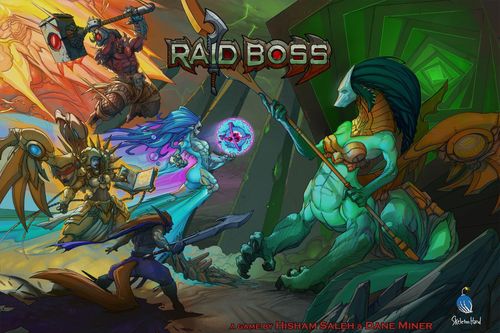
Raid Boss
Raid Boss Rulebook
Table of Contents
Table of Contents
- Game Primer
- Component List
- Game Setup
- Winning the Game
- Losing the Game
- Hero Cards
- Heroes and Premade Teams
- Card, Turn and Ability Sequencing
- Position Tiles
- Boss Cards
- Boss Deck Cards
- Challenge Cards
- Last Stand
- Gameplay
- KO'd (Knocked Out) Heroes
- Charms: Boosters and Temporal Shards
- Glossary
- FAQ
- Quick Setup
Game Primer
Raid Boss is set in the world of Incarnate, where Tyr rules as its brutal Creator. An unknown force, outside of Tyr's control, has opened a gate from the void itself, corrupting this universe and peaking the interest of Tyr's brothers and sisters.
You are Incarnates, Heroes who have passed through that gate returning from the void and must band together to survive in this unforgiving world.
You and your team are battling a Boss who the game controls through their Boss Deck. On your turn, you flip over a Boss Card to reveal the Boss's attack, and roll dice to use your Heroes unique abilites. The abilities you choose on your turn can be used to defend your allies or to defeat your enemy, and on other Hero's turns you can use your Hero's unique Instant to jump in and assist.
Component List
- Heroes x 12 (Archon, Blink, Construct, Dragoon, Forsaken, Hel Ursa, Judge, Lux, Nizari, Talus, Titan, Voidwatcher)
- Hero Token x 12
- 10 mm Ability Dice x 16 (4 sets of 4 dice)
- 12 mm Hero Dice x 12 (4 sets of 3 dice)
- 10 mm Bonus Dice x 8
- Ability Tokens x 10 -- Left to right: Titan's Challenge x 1, Dragoon's Clutch x 1, Lux's Lock x 4, Forsaken's Instant Refresh x 1, Dragoon's Uplift x 3, Archon's Genesis x 1, Blink's Instant Refresh x 1
- Booster x 4
- Temporal Shard x 8
- Triple Shield x 10, Single Shield x 12
- Triple DMG x 5, Single DMG x 10
- Stat Trackers (red x 5, blue x 5, white x 10)
- Game Board x 1
- Turn Phase Tracker x 1
- KO Tracker x 1
- Position Tiles x 4
- Boss Deck Reminder x 1
- Boss Level Reminder x 1
- Bosses x 6 (Akeri, Berdea, Reika, The Fates, Tyr, Vrykolakas)
- Boss Decks x 6 -- 144 cards total (2 cards each deck -- Left to right: Encounter Card x 1, Vanquish Card x 1, Challenge Card x 1, Last Stand x 3, Boss Deck Cards x 18)
- Player Turn Reference Cards x 4
- Triple Boss Effect x 6, Single Boss Effect x 12
- Healing Restricted x 1, Movement Restricted x 1, Cleansing Restricted x 1
- Challenge KO Token x 1
Game Setup
First Game Setup
- Place the Vrykolakas Boss Card on the Boss Space in the center of the board.
- Get the Vrykolakas Boss Deck. (You will set it up in the Boss Setup section)
- Set the Movement Restricted Token next to the board and put away the other restriction tokens.
- Set up the Position Tiles and Hero Tokens: a. Place the Titan Hero Token on the Position Tile under Position 1. b. Place the Judge Hero Token on the Position Tile under on Position 2. c. Place the Nizari Hero Token on the Position Tile under on Position 3. d. Place the Forsaken Hero Token on the Position Tile under on Position 4.
- Give each player their Hero(es): a. Normally you can play whatever Heroes you want but we recommend starting with this balanced team if this is your first game of Raid Boss. b. Take the Titan, Judge, Nizari, and Forsaken Hero Cards and decide who will control them (Note: A player can control more than one Hero if they please but there are always 4 Heroes).
- Read the back of your Hero Card. It has lore, Hero specific rules clarifications, strengths, weaknesses, and some advice on tactics.
- Some Heroes have Ability Tokens to track aspects of their abilites and others don't. a. Give the Titan their Challenge Token. b. Give the Forsaken their Instant Refresh Token.
- Give each player a red, white and a blue tracker for each Hero they control and an extra white tracker if they have a Talent Bar.
- Give players their dice: a. Give each player one set of 4 Ability Dice and 4 matching Hero Dice for each Hero they control. (one set per person in a 4 player game) b. You begin the game with 2 Ability Dice to use on their turn and the team earns one more to give out to a Hero each time they deal enough damage to the Boss to put their HP marker under a +1.
- Give each player 2 Temporal Shards and 1 Booster. (these are one time use each game so use them wisely)
- Give each player a Player Turn Reference card.
- Set the Boss Level Reminder token near the discard pile.
Battle Area Setup
- Select a Boss, and place them on the center space.
- Place a Phase 2 Blocker at 60 HP (unless the card indicates otherwise).
- Place the Phase Tracker above Round Start.
- Place Damage Trackers on both 0 positions.
- Place the KO counter on the first spot.
- Make piles out of the following tokens and place them next to the board: a. Boss Effects, Shields, Power Tokens as well as the specific Restricted Tokens that the Boss needs as indicated on the front of the Boss and place them in piles next to the board.
Boss Setup
Grab the Boss Deck for the Boss you chose and make sure you have the correct number of each card type:
- There are 25 Boss Deck Cards broken down into five different categories. a. 1 Encounter Card (to be read before the epic battle commences) b. 18 total Easy, Medium and Hard Boss Deck Cards (each Boss Deck may have a different number of these cards than other Bosses). c. 1 Champion (Skull Icon) Boss Deck Card. d. 4 Last Stands. e. 1 Vanquish Card (to be read after you have defeated your enemy)
- Shuffle the Boss Deck Cards specified in the Setup box of the Boss Card together (for example Easy and Medium) to form the Boss Deck and put it face down beside the Boss.
- Pull out and read the Encounter Card for the Boss and their flavor text (found on the back of the Boss Card).
- Set the Vanquish Card to the side to be read after you have defeated your enemy!
- Place leftover Boss Deck Cards (Easy, Medium or Hard) in the Holding Pile face down.
- Shuffle the Last Stands together and place them face down in the Last Stand Pile.
- Draw and Place a Boss Card, without examining it, face down above each Hero on their Position Tile. These cards are considered Hidden while they are face down.
- Take out any Restriction Tokens the Boss has depicted on the back of the Boss Card.
- Some Bosses have a Boss Skill that is tracked. Set the Boss Skill and Max Skill according to the Boss Setup box on the Boss Card (if they have it).
Turn Order & Positioning
Raid Boss is designed to be played with 4 Heroes, with each player controlling one or more Heroes. The active turn is determined by which leftmost Hero has a revealed and unresolved Boss Card. Typically, the first turn goes to the Hero in Position 1 and continues in order of position.
If nothing the Boss or players do changes the Heroes' positions, turns will go from left to right. However, there are many abilities and Boss cards that move and swap Heroes' positions, so remembering that the next turn is always the left most hidden Boss Card will always clarify turn order.
Heroes are adjacent to the other Heroes beside them. The Hero in Position 1 is not adjacent to the Hero in Position 4, or vice versa.
Hero and Team Setup
- Position Tiles: Place the four Position Tiles under the Boss in each of the positions.
- Hero Tokens: Place your Hero Tokens on the Position Tiles and place them in your desired turn order from 1-4 (Position 1 will go first).
- Base HP: Place a red tracker (HP marker) on the Hero's Base HP (designated with an orange box on the HP track).
- Max HP: Place a blue tracker (Maximum HP marker) on the first blue box, just to the right of the HP marker. a. The Max HP tracker is always placed 1 above your current maximum HP. If you have 12 Max HP, place the marker on the MAX slot.
- Skill: Place a white tracker (Skill marker) on the the value marked with a white outline on the Hero's Skill Bar.
- Talent: Some Heroes have a Talent Bar at the top of the Hero Card. Place a white tracker (Talent marker) on the slot of the Hero's Talent Bar with a white outline.
- Ability Dice: Take a set of 4 Ability Dice of the same color and set aside 2 of them to start the game. Heroes can gain additional Ability Dice by dealing DMG to the Boss.
- Hero Dice: Take a set of four Hero Dice that match your Ability Dice. Some Heroes have passive abilities that require a roll and others cause multiple Heroes to roll Hero Dice.
- Temporal Shards and Boosters: Give each player 2 Temporal Shards and 1 Booster.
Winning the Game
Raid Boss is a cooperative game, and as such, you and your team share in the glory of your victories.
- If at any point the Boss takes 120 total DMG or more, the Last Stand replaces the next Hero's Boss Card (or the first Hero in the next round). a. Reveal then resolve Last Stand at the Boss Action phase the same way you would a Boss Card. Heroes win when the Last Stand card is fully resolved and their KO count is low enough for victory!
- Levels of Victory: a. 0 KOs -- Legendary Victory! Celebrate, you can officially say that you have mastered this boss...with this set of Heroes! b. 1 KO -- Heroic Victory! Well...your victory does come with an asterisk, but you can always challenge the boss again with a new team or even a new set of starting positions for your team. c. 2 KOs -- Victory! You didn't lose and, most of the time, that's a lot to celebrate!
Losing the Game
- If at any point the Hero team has more than three KOs, the Heroes lose. Better luck next time!
- If at any point all Heroes are down at the same time, the Heroes lose. Impressive! This can be a feat in and of itself, so relish in that!
Hero Cards
Hero Card Front
A. Skill Reset Property
Skills can have one of three Skill Reset Properties:
- No Reset: Skill doesn't reset at Round End.
- Round Reset: The Skill resets to its base value at Round End.
- On Use: The skill tracks your bonus dice (which are expended when they are used).
B. Hero Skill Bar
The bar used to track each Hero's Skill.
C. Skill Name
The name of each of your skills. When Skills are referenced on the Hero Card they are italicized so they are easy to spot.
D. Hero Name
Your Hero's name.
E. KO Indicator
Once a Hero's HP goes below 1, they are considered KO'd. Move their HP tracker onto the KO Indicator.
F. Hit Points (HP) Bar
The bar used to track your Hit Points (HP) and Maximum Hit Points (Max HP).
- You start the game by putting your HP tracker at your Base HP (represented by the orange space) and your maximum HP blocker on the first blue space.
- When you are dealt DMG, you slide your HP tracker to the left.
- When you heal HP, you slide your HP tracker to the right.
- You cannot raise your HP above your Max HP.
- Your Max HP cannot be lower than 1.
G. Base Hit Points (Base HP)
The starting value of your HP tracker at the beginning of the game, and when you are revived.
H. Maximum Hit Points (Max HP)
The highest value your HP can be. The Max HP blocker sits one number above your Max HP and represents the highest value your HP tracker can be.
I. Talent Name
When Talents are referenced on the Hero Card they are italicized so they are easy to spot.
J. Talent
Every Hero has a Talent that is unique to their kit:
- Talents are always active unless the Hero is KO'd.
- The Hero does not need to pay anything to use them, and they will activate whenever their description allows it (including on other Hero turns).
K. Talent Bar
The bar used to track a Hero's Talent.
- Some Heroes have nothing to track and so will not have a Talent Bar.
- Some Heroes have a Talent Bar connected to their Talent description to track their Talents in the same way that Skills are tracked.
L. Instant
Heroes have an Instant that is unique to their kit:
- You can use your Instant at almost any time. During other players' turns, in level changes, or between packets of DMG being dealt. (see page 11 for more)
- When you use your Instant action, rotate your Hero Token ninety degrees to indicate that it has been expended. This is known as 'tapping' (or, 'to tap'), and a rotated Hero Token is considered tapped.
- Some Individual Instant skills do have timing restrictions.
M. Core Ability Cost
The cost of each Core Ability is marked in the colored box next to the ability.
- During the Ability Roll, the current Hero rolls their Ability Dice then assigns them during Assign Dice to pay for Core Abilities (aka "Abilities").
- Each die can pay for up to one Ability whose core ability cost is less than or equal to its value. (unless otherwise stated)
- Multiple dice can be combined to pay for Abilities, but a single die cannot be split to pay for more than one ability.
N. Core Abilities
Each Hero has three Core Abilities:
- Core Abilities can only be paid for and used during a Hero's Assign Dice phase.
- Core Abilities can be used as many times as a Hero can pay for them and in any order.
- When referring to an Ability on the Hero Card, the color of the text will match the Core Ability the text is referring to (green, blue and red).
Hero Card Back
A. Role Description
A description of what the Hero generally does, and the role that they play in most teams.
B. Character Lore
A peek into the backstory of the Hero. To learn more about a Hero, head to www.raidbossgame.com.
C. Hero Guide
A quick reference for the Hero that covers most of the basic questions about rules interactions or niche scenarios. If you are still stuck, you can generally find the answers in the FAQ.
D. Hero Tokens
Some Heroes have tokens that are used to track when they have activate their abilities or Instants. If you need tokens for the game, they will be found here.
E. Hero Stats
Heroes have things that they excel at, and other things that they are not as good at. Keep in mind that these are how they perform in general, but there might be some synergy to find with other Heroes or even different positioning. Here is what each of the stats mean:
- Attack: The Hero's ability to deal damage (DMG).
- Defense: The Hero's ability to mitigate damage (by shielding, reducing, or avoiding it).
- Healing: The Hero's effectiveness at healing themselves and their allies.
- Chance: How much luck or randomness factors into a Hero's ability to be effective.
- Tactics: The complexity of a Hero and how hard it is to learn the probability and sequencing that leads to making impactful decisions. More bars means the Hero is more complex.
Heroes and Premade Teams
Teams
Raid Boss is all about teamwork, and a big part of that is your team composition. All Heroes can deal DMG and have some unique utility that makes them useful in different situations. Finding Heroes that are strong against particular Bosses, or that synergize well with other Heroes is what Raid Boss is all about! Here are two things to think about when choosing a group of Heroes early in your Raid Boss career:
- Do we have someone to stop DMG? a. Raid Boss is unforgiving, and the Bosses hit very hard, sometimes for as much DMG as most Heroes have HP. What can really help are shields, armor, and DMG mitigation (like the Dragoon for example). Without someone in this role, the game can be extremely challenging.
- Do we have someone to fix our bad rolls? a. Early on, it is really nice to have a Hero like the Forsaken to turn those ones into something that you can use. While you have Boosts and Temporal Shards, those are only once per game, and so having a Hero to dice fix can also be very useful.
Card, Turn and Ability Sequencing
It's important to understand how the game treats things that might at first seem simultaneous (healing when you take DMG for example). Nothing in Raid Boss is simultaneous, everything is sequential and on a stack. Simply put, this means if you announce you would like to do something "before" something else, you can.
- Phases are on the stack just like everything else. a. Whenever you are entering a new phase (moving from Assign Dice to Boss Action for example) you can interrupt to use an Instant or Talent without a timing restriction. This can be useful when dealing with a Boss Cards, which typically trigger at Boss Action, because you can heal or prevent DMG right before it is dealt to the team.
- Boss Cards and Abilities are sequential and can be interrupted. a. Each time there is a comma, another target or a 'then', Heroes can interrupt with their Instant.
- DMG dealt to multiple targets is dealt one "packet" at a time starting with the current Hero and going right (in turn order) and then wrapping if need be. Example: The Hero is position 2 has a Boss Card that reads "All Heroes are dealt 3 DMG". a. The Hero in position 2 would be dealt 3 DMG first, then the Hero in positions 3, 4, and finally 1. b. Each of those "packets" of DMG can be interrupted to give a shield or heal etc.
- The Ability Roll itself can be interrupted. a. Heroes can adjust dice with Temporal Shards, Boosts, or their Instants to trigger Talents or adjust the ability roll to be more beneficial to the team.
- Things that trigger on the same event (Turn Start for example) have a specific order: a. First Heroes trigger in turn order starting with the current Hero and going right (in turn order) and then wrapping if need be. b. Then Boss Abilities, then Boss Cards.
Position Tiles
Positioning
Hero Position and Adjacency
Hero Tokens are placed on Position Tiles to represent their Hero's position in the turn order, which Heroes they are adjacent to and which ones they are to the right and left of.
- Position: Your Hero's position is determined by the marked position their Position Tile is below on the game board.
- Adjacent: Heroes are adjacent to the Heroes whose Position Tile touches their Position Tile. a. Adjacency does not wrap. The Hero in Position 1 is not adjacent to the Hero in Position 4, and vice versa.
- Left and Right: Heroes to your left have a position that is less than your position, and Heroes to your right have a position that is more than your position. a. Example: Position 3 is to the right of positions 1 and 2 and to the left of position 4. b. Position 1 is the leftmost position and Position 4 is the rightmost position.
Move and Swap
Whenever you move or swap your Position Tile and everything on it go with you.
- Move: When you move your Hero to a position, take the Position Tile you are on and slide the other Position Tiles to the right and left to make room for it. a. Example: A Hero at position 1 moves to position 3. The Heroes in position 2 and 3 would slide left one position each. b. Example: A Hero at position 2 moves to position 4. The Heroes at position 3 and 4 would slide left one position each.
- Swap: When you swap your Hero with another Hero, take your Hero and the Hero you are swapping with and switch positions. a. Example: A Hero at position 3 swaps to position 4. The Hero at position 4 would swap to position 3 and the the Hero that was at position 3 would swap to position 4.
Position Tile Sections
Position Tiles track persistent, round, single turn effects and Hero Instants where players can see them.
- Turn (Hero): This section tracks buffs and debuffs that only affect this Hero and only for the current turn. Tokens: Used for buffs and debuffs that last one turn.
- Turn (Team): This section is to help more easily track buffs and debuffs that affect the whole team but only need to be tracked for the turn. Tokens: Used for Boss Restriction Tokens and quickly tracking group shields.
- Boss Card: This section is for the Boss Deck Cards, Challenge Cards and Last Stands. Tokens: Used for shields and for DMG Tokens on the Challenge Cards.
- Hero Token: This section is reserved for the Hero Token and any Ability Tokens that go on the Hero. Tokens: Titan Challenge and Dragoon Clutch are placed on the Hero Token the turn they are active.
- Round: This section is for buffs and debuffs that last for the entire round. Tokens: Used for Boss Effects, Restrictions, Armor and certain Hero abilities.
- Persistent: This section is for buffs and debuffs that either last until they are used or until they are removed. Tokens: Used for Boss Effects and certain Hero abilities.
Boss Cards
Boss Card Front
A. Boss Abilities
Bosses have one or more Abilities that explain keywords (such as Weak) for their Boss Deck Cards and may have abilities that interact with their Skill Bar (if they have one).
B. Boss Setup
Each Boss has a Setup which will give instruction as to which Boss Deck Cards to shuffle into the starting Boss Deck. It will also tell you where to place the Max Skill blocker as well as the starting value of the Boss' skill (if they have one).
C. Boss Level
Bosses have one or more Levels. These levels indicate a change in the Boss behavior and the makeup of the Boss Deck. (more info on page 20)
- Boss Level Change happens if the Boss has been dealt enough DMG.
- Boss Level is changed at Turn End.
- By default, if there is no HP threshold listed for Level 2, it is half of the Boss' HP.
D. Damage Bar (on Game Board)
Damage dealt to the Boss is tracked with the Damage Bar adding DMG as it's dealt (1's along the left, 10's along the bottom).
E. Ability Dice Award Indicator
Whenever the tracker you are using on the Damage Bar moves over or passes a die symbol, the team must award a Hero with a permanent Ability Dice at Turn End.
- The Hero that is awarded must have or be tied for the least amount of Ability Dice currently.
- By default, dice are award at: 10, 20, 30, 40, 50, 60, 70, 80, 90, and 100 damage.
- The team can award more than one die at Turn End if enough DMG has been done.
F. Boss Skill Bar
Some Bosses have a skill (for example The Fates have Trance) that's tracked in addition to their HP. The name of the Skill is at the top right corner of the Boss Card. The Boss Skill Bar is where it is tracked.
Boss Card Back
A. Battle Description
A description of the Boss fight, and the challenges teams will usually have to contend with.
B. Boss Stats
Bosses have things that they excel at, and other things that they are...not so good at, that's what keeps things balanced! Here is what each of the stats mean:
- Difficulty: How challenging players should consider the Boss.
- Tactics: How complex the Boss' Abilities and Boss Deck Cards are.
- Chance: How much randomness and volatility there is when playing against the Boss.
C. Boss Lore
A peek into the backstory of the Boss. More story about the Bosses can be found on the Encounter and Vanquish cards and at raidbossgame.com/story.
D. Boss Guide
A quick reference for the Boss that covers most of the basic questions about rules interactions. If you are still stuck, you can find the answers in the FAQ.
E. Boss Tokens
Some Bosses have special restriction tokens (for example Heal Restriction). If you need tokens for the game, they will be shown here.
Boss Deck Cards
Boss Deck Cards control the way the Boss attacks your team. There are several types of Boss Deck Cards, each with different properties and activation timing. The difficulty of cards you have in the Boss Deck is determined by the Boss and Boss Level.
A. Boss Name
The name of the Boss Deck this card belongs in.
B. Card Name
The name of the Boss Deck Card. This is sometimes referenced on the card.
C. Card Difficulty
There are five difficulties of Boss Deck Cards: Easy, Medium, Hard, Challenge, and Last Stand.
- Easy, Medium and Hard: The Boss' setup and Boss Level will determine which of these to shuffle into the deck. (See Page 14)
- Challenge Cards are optional, and can always be shuffled in or out depending on the level of difficulty the team is looking for.
- Last Stand: Last Stands are the Boss' final attacks and will replace the next Boss Card when the Boss has no HP left. (See Page 17)
D. Card Type
There are four types of Boss Deck Cards: Boss Action, Interrupt, Last Stand and Constant.
- Boss Action: Boss Action cards make up the majority of most Boss Decks. They are triggered at the Boss Action Phase.
- Interrupt: Interrupt cards are triggered at the Interrupt phase before the Ability Roll.
- Last Stand: Last Stands are triggered at the Boss Action phase on the turn after the Boss has been dealt enough DMG to trigger it.
- Constant: Challenge Cards have a constant ability that is active until they have no more HP.
E. Card Text
Bosses have one or more Abilities that use keywords (such as Weak) in their Boss Deck Cards, and may have abilities that interact with their Skill Bar (if they have one). (For more on sequencing see Page 11)
Challenge Cards
Challenge Cards are special Boss Deck Cards that until they are dealt enough DMG can have a continuous debuff effect on the team or make the Boss more powerful and difficult to take down.
A. Constant Ability
Challenge Cards have hit points like a Hero or a Boss and their Constant Ability will be active until they have lost all of their HP (marked by the heart with a number inside of it).
B. Hit Points
- You can target and DMG Challenge Cards in the same way that you would a Boss. They are considered a Boss for the purposes of Hero Instants and abilities.
- When you deal DMG to a Challenge Card, place a DMG Token on the card to mark your progress.
- Once you have dealt as much DMG as the Challenge Card has HP, place a KO Token over the Challenge Card's HP.
Last Stand
It's up to the team if they play with a Last Stand (we recommend it after the first game) and how they choose it. The Last Stand represents the Boss' final attack on the team. Each Last Stand is different and difficult in its own way. Some are easier than others and some might feel like they are targetting your team's weaknesses.
A. The Final Turn
The Last Stand is triggered when you have dealt the Boss enough DMG to KO them (usually 120 DMG). Draw a Last Stand card and get ready!
- Once the Last Stand has been triggered, all the team has to do is survive with as many Heroes standing as possible to keep their KO count down.
- Replace the Boss Card in the leftmost position with the Last Stand card and then remove the rest of the Boss Cards.
- The next Hero is the one who has the Last Stand as their Boss Card.
- That Hero gets to take their turn as normal, though protecting your team becomes much more important than dealing DMG to the Boss (keep that in mind when you are considering when to trigger the Last Stand if you can control it).
- If the Last Stand is triggered at the end of a round, it will be the Boss Card for the Hero is position 1 at the next Round Start.
Gameplay
Raid Boss is broken into rounds, during which each Hero will take one turn. On their turn, each Hero will go through the six phases -- Turn Start, Reveal Card, Interrupts, Ability Roll, Assign Dice, Boss Action, and Turn End and may interrupt any phase with their Instant Ability:
Round Start
- Each Round consists of one turn per Hero. a. Apply any 'Round Start' effects, start with Heroes first in position order and then the Boss. b. Ready all Hero Tokens. c. If there are any KO'd Heroes, they must be revived by expending an Instant. (See Section 11) [Editor's note: the printed cross-reference says Section 11; the revive rules are numbered 10 in this rulebook.] d. Draw and place a Boss Card face down, without examining it, above each Hero on their Position Tile. These cards are considered Hidden while they are face down. i. If there are no cards left in the Boss Deck and a Hero needs a Boss Card, shuffle the Discard Pile and it becomes the new Boss Deck.
Turn Phases
-
Turn Start: Apply any 'Turn Start' and 'start of turn' effects (Heroes in position order and then the Boss).
-
Reveal Card: Reveal the Boss Card on the active Hero's Position Token. Do not resolve the Boss Card at this time, unless it says Interrupt.
-
Interrupts: If the Boss Card says Interrupt- Deal DMG and apply its effects. a. That card is now resolved, unless it also has a Boss Turn effect. b. Heroes may use Instant Abilities after the Boss Card is revealed but before its effects are applied. (See page 11 for more on Instants)
Note: The default target for each Boss Card is the active Hero (the Hero whose turn it is) unless otherwise written.
-
Ability Roll: The active Hero rolls their Total Dice, which are all of your Ability Dice, plus any Bonus Dice. a. Bonus Dice MUST be rolled during a Hero's Ability Roll and once they are assigned (in the Assign Dice phase) they are expended (and lost).
Note: Temporal Shard, Boost Tokens and some Heroes can affect the value of dice rolls and some passive abilities check the value of Ability Dice rolls. (See page 11 for more on sequencing)
-
Assign Dice: Spend dice to pay for your Core Abilities and apply the effects one at a time and in any order. a. Each die can pay for an Ability whose cost is equal to or less than the roll. b. Multiple dice may be combined to pay for an Ability. c. Bonus Dice must be returned to the supply after they are assigned.
Note: You may not split a die's roll to apply it to more than one Ability.
-
Boss Action: If an ability or card says Boss Action, Constant, or Last Stand -- trigger them. a. Abilities: If there are abilities that trigger at 'Boss Action', they trigger in the following order: i. Hero Abilities in turn order starting with the active Hero and wrapping if needed. ii. Constant Abilities from Challenge Cards. iii. then Boss Abilities. b. If the card says Boss Action: Deal DMG and apply any effects on the Boss Card. i. Once you have applied all of the card's effects, it is considered resolved. ii. Mark that it is resolved by placing your Hero Token on top of it. c. If the card says Constant: If the card is a Challenge Card (it will say Constant) and has HP remaining (see page 17 for more details), and has a 'Boss Action' trigger, then apply the effects. d. Last Stand: If you survive the Last Stand, you win! (see page 7 for more details)
KO'd (Knocked Out) Heroes
- If at any point a Hero's HP is 0 or less, they are considered KO'd.
- Flip over the Hero Token to designate being KO'd.
- Increase the KO count. If this is the third KO, the team has lost and the game ends.
- Reset any permanent effects the Hero has gained or lost (including Bonus Dice and Max HP).
- Being KO'd does not affect a Hero's Instant (whether it was ready or expended does not change).
- Limited Actions. a. The Hero does not roll for Abilities during the Ability Roll phase. b. They may only Instant to revive themselves, and only if it's ready. c. They cannot use their Talents, and their Talents do not trigger. d. They cannot be targeted by other Heroes except to be revived. e. They cannot receive damage. Damage targeting a KO'd Hero is lost. f. They can have their position switched by a Boss Card that affects another Hero; e.g., 'swap with the Hero to your left'.
- KO'd Heroes can be revived at any time by expending any Hero's Instant (including their own if it is ready). a. The revived Hero resets their Max HP to its original value and starts at their Base HP. b. Flip the revived Hero's Token back to its active side. c. All Heroes must be revived at the Round Start (by expending their own Instant if they were not revived by another Hero).
Charms: Boosters and Temporal Shards
Each Hero begins the game with 1 Booster (the teal brain token) and 2 Temporal Shards (the pink crystal token). Each can be used once per game, instantly (like a Hero's Instant), to do the following:
- Booster: Add +1 to any die you rolled. Move the expended token back to the box after use.
- Temporal Shard: Re-roll a die you rolled. Move the expended token back to the box after use.
Charms have a variety of uses for players to discover. Most basically, they can be used to even out an extremely unlucky turn, but clever players will find ways to break the odds in their favor or modify their character's kit. Because they can be used instantly, remember that players can choose to use their effects in response to revealed information, like die rolls and Interrupt Boss Cards.
Players only get 1 Booster and 1 Temporal Shard when playing Adrenaline Mode see the back of the rulebook.
Glossary
- Ability Dice: The dice players roll at the start of their turn to enable and pay for their Hero's abilities. Each player starts with 2 dice, but can gain more over the course of the game.
- Ability Roll: The values of the Ability Dice rolled during your turn.
- Active Boss Card: The Boss Card which is revealed on the current Hero's turn.
- Adjacent: Other Heroes to the left and right of a Hero, those that touch their Position Tile, are considered adjacent. (see page 12)
- Armor: Armor reduces DMG the same way that Shield does, but is removed after Shields. Armor is removed at Round End if not otherwise expended.
- Base HP: The value marked on the Hero HP bar in orange.
- Bonus Dice: White dice that Heroes gain temporarily through various effects. Bonus Dice persist through turns and rounds, but must be rolled on the owner's Ability Roll. Bonus Dice are expended when they are assigned and the ability they are assigned to has resolved in the Assign Abilities phase (or by certain Instants). The number of Bonus Dice a player has can be referenced without spending any dice.
- Boss: The laminated card with the Boss's portrait, information, and markers.
- Boss Deck: The deck of Boss Cards that are drawn from at Round Start. Whenever a card needs to be drawn from this deck and no cards are available, shuffle the Discard Pile and create a new Boss Deck.
- Boss Card: Any one card from the Boss Deck. These are the cards placed above Hero Tokens on the Position Tiles.
FAQ
- Can a Hero deal DMG to themselves or other Heroes? a. No. But they can target them with things that say target (e.g. Archon's Shocks). b. However, some abilities force Heroes to deal DMG to other Heroes and there are even situations where it is a good idea. We recommend you discuss these plays and explain your reasoning!
- Do targets on a Boss Card persist if using Instants in response would otherwise change the targets? a. Targets are assigned when the card is revealed, but if Instant(s) are played in response, targets are will be checked again after the Instant(s) resolve.
- Titan - When using the Titan's Challenge Instant, if there is an effect on the Boss Card, does the Titan gain the effect instead of the original Hero? a. No, the Titan is simply taking all of the DMG for the Hero with his Instant, none of the effects.
- Titan - When using the Titan's Challenge Instant on a Hero in position 1 against Vrykolakas, does the Titan take the extra DMG from Weakness? a. Yes, the Titan is taking all Boss DMG for the Hero he is protecting this turn and so the extra DMG is first applied to the protected Hero and then transferred to the Titan.
- Forsaken - When using the Forsaken's Destiny Instant ability to change the value of a die in an Ability Roll, can that trigger the Archon's Passive Polarity (say you rolled a 4 and the Archon has 6 Charges and the Destiny roll is a 3 which brings the Ability Roll value to 7)? a. Yes it triggers Polarity but it will still never bring the Charge value higher than its max (8).
- Reika - When removing Roots and dealing 2 DMG to myself as the Voidwatcher, does Masochist trigger? a. Yes it triggers Masochist giving the Voidwatcher a Bonus Die! b. Titan's Juggernaut also shields the DMG to himself, but using Challenge to try to reduce the DMG to allies will not work because the self damage is not Boss DMG. c. Dragoon's Airborn does not reduce the DMG from removing roots, because it is not Boss DMG.
- Akeri - Akeri's Poison cannot be shielded does this mean Challenge doesn't work on Poison? a. No. Challenge still allows Titan to take the Boss DMG for another Hero. i. However, Juggernaut shields DMG and so all Poison DMG will be dealt to the Titan (he can still gain Rage as a result of the Juggernaut Roll). b. Dragoon's Airborn works just fine reducing the DMG from Poison. c. Construct and Lux's Armor is not considered shield so that does prevent the DMG from Poison.
- Hel Ursa - Can Hel Ursa make a die's value go above 6 on her Bladesong Roll to make a longer thread? How about lower than 1? a. Yes she can add to the value of any die in her Bladesong roll and the values can go above 6. b. No she is not allowed to make 0s or negative numbers for the roll (sorry, it would be too strong).
Quick Setup
Board Setup
- Set up the Position Tiles.
- Place Phase Tracker above Round Start.
- Place a Phase 2 Blocker.
- Place Damage Trackers on both 0 positions.
- Place the KO counter on the first KO spot.
- Make piles out of the following tokens and place them next to the board: Boss Effects, Shields, and Power Tokens.
Boss Setup
- Choose a Boss and grab its deck.
- Without looking at the cards, separate out the Last Stand and story cards.
- According to the Boss Setup on the Boss Card, prepare the Boss Deck and see where to set their Boss Skill and Boss Skill Max (if they have one).
- Check the back of the Boss Card to see whether you need restriction tokens.
- Set the Boss Level Reminder near the discard pile.
Hero Setup
- Choose 4 Heroes and grab their Hero Tokens.
- Give each Hero 3 trackers: one red HP tracker, one blue Max HP tracker, and one white Skill tracker (Give Heroes with a Talent Bar an extra white Talent tracker).
- Give each Hero 4 larger Hero Dice and 2 of their 4 smaller Ability Dice.
- Give each Hero 2 Temporal Shards and 1 Booster.
- Check the back of each Hero Card and give them any Ability Tokens they need (some Heroes don't need any).
- Place the Hero Tokens on Position Tiles in the order in which you want them to take their Turns (remember to pay attention to adjacency).
Adrenaline Mode
Adrenaline Mode is a more challenging and also faster paced version of Raid Boss. Attempt at your own risk--and reward.
- The team begins the game with the KO Token on 1 (instead of 0).
- Each Hero begins the game with 3 Ability Dice (instead of 2).
- Each Hero begins the game with 1 Temporal Shard and 1 Booster.
- Set the Boss DMG to 60 and check the Boss Level to see how to prepare the Boss Deck (some Bosses also have new abilities).