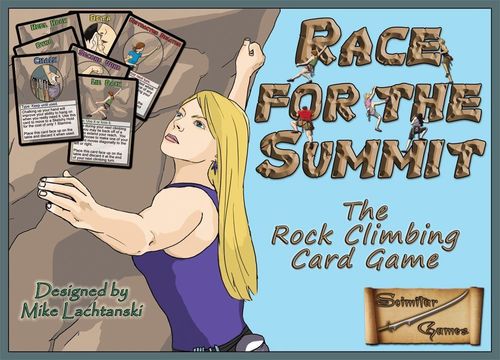
Race for the Summit
Race for the Summit Rulebook
Table of Contents
Table of Contents
Components
Rule booklet (v1.0) and 130 cards:
- 66 Hold Cards (6 x 11)
- 8 Character Cards
- 8 Climber Cards
- 8 Quickdraw Cards
- 28 Action Cards
- 6 Summit Cards
- 5 Environment Cards
- 1 Fatigue Card
Set-up
Hold cards: There are 6 colors of Hold cards. With 2-5 players randomly choose 1 color per player plus 1 additional color to use. With 6 players use all 6 colors. (Ex: In a 3-player game randomly choose 4 colors to use and set aside 2 colors.) Find the Hold cards labeled Start, one per chosen color, and place them face-up on the table in a row, each oriented with the word Start on the left.
Shuffle the remaining Hold cards by color. Above each Start Hold form a face-down column of matching color cards. (Color-blind players can sort the cards via the icon on the front right.) Each column will consist of a Start Hold with 10 randomized face-down Hold cards above it. The backs of the Hold cards share the same colors as some of the climbers - this is coincidental and has no bearing on the game.
Summit cards: There are 2 types of Summit cards, anchored and anchorless. Anchored cards contain an anchor graphic on both sides of the card, representing the end of the climb where you clip in to win the game! Shuffle the Summit cards and, without looking at the fronts, remove a few: For 4 players, remove 1 anchored Summit card. For 3 players, remove 2 anchored Summit cards. For 2 players remove 2 anchored and 1 anchorless Summit card. Shuffle the remaining Summit cards and place one face-down at the top of each column of Hold cards.
Environment cards: These cards determine the conditions for the climb. Shuffle these cards, draw the top card, and place it on the table. The remaining cards are no longer needed this game. If you play more than one game draw the top card for each new game and only re-shuffle the Environment Deck when exhausted.
Fatigue card: Place this card to one side with the Fatigue Line between two of the rows of face-down Hold cards as dictated by the Environment card chosen for this game. This card indicates the elevation at which the climbers will begin to tire during the current game.
Example layout (shown sideways) for a 2 player game: the source shows a diagram at this point.
Character cards: Each player selects a Character card and also receives the matching Climber card. The unassigned Character cards are shuffled and used later as a draw pile. The Climber card represents the climber on the spire while the Character card is kept in front of each player as a reference showing that climber's preferences for the various hold types in 4 different colors:
- Bomber holds are listed in green and are the favorite hold type of this climber. A climber pays 1 Stamina to move to a Bomber Hold and may clip in for free.
- Positive holds are listed in blue and are also liked by this climber. A climber pays 1 Stamina to move to a Positive Hold.
- Sketchy holds are listed in yellow and are not liked by this climber. A climber pays 2 Stamina to move to a Sketchy Hold.
- Heinous holds are listed in red and are hated by this climber. A climber pays 3 Stamina to move to a Heinous Hold.
Each climber also has a special ability that may be used once per game. Each player starts the game with their Character card face-up showing the special ability and then flips this card over after the ability is used.
Quickdraw cards: The Quickdraw is used whenever a climber chooses to clip in on a hold that is bolted or anchored. All players receive the Quickdraw card that matches the color of their climber. The unused cards are set aside along with the unused Climber cards. Climbers should clip in often to minimize the distance of their falls. Only one Quickdraw may be on a bolted or anchored location at any time.
Action cards: Set aside the Start Player card, shuffle the remaining Action cards, and place them face-down in a draw pile.
Starting the Game
The player who has most recently climbed something (be creative if you need to) is the starting player. Beginning with that player, and going clockwise around the table, all players select one of the Start Hold cards and place their Climber card on top of it. With 3 or more players the starting player receives the Start Player card. With 2 players the Start Player card is not used.
Game Rounds
Each round consists of 2 phases:
- Climbing Phase - Each player climbs in clockwise order beginning with the player with the Start Player card.
- Action Card Phase - Each player selects an Action card in counterclockwise order, starting with the last player to climb.
Climbing Phase
In clockwise order, beginning with the player with the Start Player card, each player completes their Climber Turn. A Climber Turn involves using available Stamina to make moves and/or clip in until either no Stamina remains, the climber chooses to stop, or the climber falls.
Climber Turn
Stamina: Below the Fatigue Line, climbers receive 3 Stamina to start their turn. Above the Fatigue Line, they receive 2 Stamina.
Continue to choose from the following 2 options until you either fall or decide to end your turn:
- Clip In
- Make a Move
Clip In: You may clip in if your current location is bolted or anchored and does not already have another climber's Quickdraw card on it. Clipping into a bolt or anchor has a cost of 1 Stamina, unless the hold is Bomber to you which allows you to clip in for no cost. You clip in by placing your Quickdraw card underneath your Climber card. Clip in often to limit the distance of any fall you might take. Bypassing too many bolts can lead to trouble.
Note: You MUST clip in on the first bolted hold that you reach and may not move away without doing so.
Make a Move: You may move to any unoccupied hold directly above or to either side by selecting the hold. If the selected hold is face-down then turn the card face-up. Resolve the move as follows:
- a) Pay 1 Stamina to move to the hold if it is either Positive or Bomber to you.
- b) Pay 2 Stamina to move to the hold if it is Sketchy to you.
- c) Pay 3 Stamina to move to the hold if it is Heinous to you.
If you are able to pay the required cost then move your Climber card to the new location; if not, then you fall!
You do not need to use all of your Stamina. You may choose to end your Climber Turn at any time and forfeit your unused Stamina.
Resting: At the beginning of your turn you may choose to rest. If you choose to rest you may not clip in or attempt a move, but you start your next Climber Turn with 1 extra Stamina.
Example Climber Turn: (The source shows a diagram with three steps.)
- River receives 3 Stamina to start her turn and selects the Hold card directly above her. She turns the card over to reveal an Undercling which is bolted.
- Since Undercling is Sketchy to River she subtracts 2 Stamina and places her Climber card on her new location. She has 1 Stamina remaining.
- This is the first bolted hold River has reached so she must clip in. She places her Quickdraw card underneath her Climber card. Her turn is now over.
Climber Turn Details
Selecting a Hold: When selecting a hold, the active player may only choose from unoccupied Hold or Summit cards immediately above, left, or right from his or her current location. No diagonals are allowed except via an Action card or ability. If the selected card is face-down then it is turned face-up. Since the climbers are scaling a vertical spire they are free to move from the left-most column directly to the right-most column and vice versa. (Using the example layout diagram shown earlier, a climber in the blue column may move left to the yellow column and a climber in the yellow column may move right to the blue column.)
Clipping In: Clipping in may only be done if the current hold is bolted or anchored and does not already have a Quickdraw card on it. All climbers MUST clip in on the first bolted hold that they reach during the game.
Special Abilities: Each climber has a special ability that can only be used once per game. When the special ability is used, flip the Character card over to indicate that it has been used.
Fatigue: The current location of the Fatigue card indicates the point in the climb where the climbers will begin to have less Stamina available each turn. The Fatigue Line should always be between 2 rows of Hold cards.
Bolted Holds: There are 6 bolted and 5 non-bolted holds in each column of holds. The bolted hold types vary in each column, although Jug and Arête are always bolted. Bolted holds have grey hold names (the color of the bolt itself) and non-bolted holds have brown hold names (the color of the rock.) Anchored Summit cards are treated identically to bolted holds.
Hold cards: Each hold card may be read as follows (the source shows a labelled card diagram):
- Hold name: Grey = bolted; brown = not bolted.
- Bolt: Marks a bolted hold.
- Bomber icon (green): The hold is Bomber to the climber(s) shown.
- Positive icon (blue): The hold is Positive to the climber(s) shown.
- Sketchy icon (yellow): The hold is Sketchy to the climber(s) shown.
- Heinous icon (red): The hold is Heinous to the climber(s) shown.
- Shape icon: Helps with sorting (for example, for colour-blind players).
- Hold explanation: Flavour text with no game impact.
The source's example card is the Crimper hold, which is bolted, Bomber to Granite, Positive to Bluffy, Gym and River, Sketchy to Crack, Gorge and Hannah, and Heinous to Hiro.
Note: Each colored column of holds has one each of the 10 hold types in addition to the Start Hold.
Falling
(There is an example fall after the rules explanation.)
You fall when you choose to make a move and lack the required amount of Stamina to resolve the move. Your fall is stopped by your Quickdraw and rope which leaves you hanging from the rope directly below the Quickdraw. Calculate that location as follows:
- Count the distance of the fall as follows: Starting from the hold you were attempting to move to when you fell, count the number of holds it takes to reach your Quickdraw. Do not count diagonally and be sure to include the hold under the Quickdraw card itself.
- Once you have calculated the distance of the fall in step 1, subtract one from it and place your Climber card that many holds directly below your Quickdraw card. (Exception: If you are directly below your Quickdraw when you fall just remain where you are.) If the Hold card at your new location is face-down then turn it face-up. If that hold is currently occupied then you must hang on your rope (explained below.) Your turn is over.
- If you fell below the Start Hold then you have decked (hit the ground) and must back off from this climb.
- a. Discard your Character card and draw a new one, along with the matching Climber and Quickdraw cards.
- b. Select an unoccupied Start Hold and place your new Climber card on top of it.
Hanging on your Rope: Falling may cause you to occupy the same location as another climber. In this case you must hang on your rope until the other climber moves on. In the next round if your turn comes before the other climber then it is delayed until immediately after the other climber's turn. Place your Climber card underneath the other Climber card at this location to indicate that you may not move before him/her.
Taking Chances: As in real lead climbing you must be extra cautious at the beginning of a climb because you run the risk of hitting the ground in a fall. You must clip in as soon as you reach your first bolted Hold card. After that it is up to you whether or not you want to climb cautiously and clip in often or take chances.
Example Fall: (The source shows a six-step diagram; the steps are described here.)
- Granite begins her second turn safely clipped in on a Gaston Hold. Since she is still below the Fatigue Line she will receive 3 Stamina to start her turn.
- She decides to move upward and reveals a Sloper. Note that this hold is bolted so she will have the option of clipping in after she completes her move.
- Granite completes the move by placing her Climber card on her new location. Since Sloper is Positive to Granite she subtracts 1 Stamina and now has 2 remaining.
- Granite decides to take a chance and does not clip in. Instead she chooses to make another move. She again selects the Hold card directly above her and turns it over to reveal an Undercling.
- Granite attempts her move but Undercling is Heinous to her and she only has 2 Stamina remaining. Granite falls! She calculates the distance of her fall by counting back to her Quickdraw on the Gaston Hold: a fall distance of 2.
- She subtracts 1 from the distance of the fall to determine how far below her Quickdraw she falls to. Granite falls back to 1 hold below her Quickdraw and her turn is over.
Action Phase
After all players have completed their Climber Turns then the Action Phase begins:
- Draw a number of Action cards equal to one less than the number of players (with a minimum of 2) and place them face-up on the table to form the Action Pool. With 3 or more players add the Start Player card to the Action Pool. If no Action cards remain in the draw pile then shuffle the discard pile to form a new draw pile and continue drawing to fill the Action Pool to the required number of cards.
- Beginning with the last player to climb and proceeding counter-clockwise, each player selects one of the cards from the Action Pool on the table and resolves it according to the instructions on the card. This means the first player to climb each round gets no choice in Action cards and must "select" the last remaining card on the table.
- In a 2 player game the Start Player card is not used, instead alternate the player who climbs first each round.
Action cards: There are 4 types of Action cards:
- Play immediately: You must resolve this type of Action card immediately if you select one. The action should be completed and the card discarded before the next player selects an Action card.
- Use it or lose it: These Action cards are climbing moves and may be used prior to any move you make during your next climbing turn. If you don't use it then you must discard it at the end of your next Climber Turn.
- Affects your next turn: These cards are in effect for your next Climber Turn whether you like it or not.
- Keep until used: These cards stay with you until you use them even across multiple Climber Turns. They may only be used once and then must be discarded.
Reaching the Summit
Summit cards are treated like Hold cards and moves to them are resolved in the same way. It costs 2 Stamina to move to a Sketchy Summit and 1 Stamina to move to a Positive Summit. Clipping in has a cost of 1 Stamina.
The source shows four Summit card examples, labelled Quantity 2, Quantity 1, Quantity 2 and Quantity 1 (the quantity of each card in the game).
The first climber to successfully move onto an anchored Summit card AND clip in is the winner!
Optional Rules
- During set-up lay out only 9 rows of face-down Hold cards instead of 10, removing the final card of each color from the game without revealing it. This rule makes it so that a climber can never calculate what the last remaining Hold card is in a certain column.
- Climbers may traverse (move sideways) to an already revealed Hold card for only 1 Stamina no matter the hold type. This rule makes it easier for a climber to navigate around a climber who has cut them off.
Glossary of Climbing Terms
- Belayer - The person who is belaying the climber and thus responsible for protecting the climber in the event of a fall.
- Belaying - The process of paying out the rope to the lead climber, or taking in the rope for a follower, while he/she climbs.
- Beta - Information about a route including watching another climber make the moves.
- Bomber - High quality and very secure. Can refer to a hold or even a piece of equipment.
- Carabiner - An oblong or D shaped metal ring with a spring gate.
- Choss - Poor quality rock, often loose and potentially dangerous.
- Clipping - The act of putting a carabiner into a bolt and/or putting the rope into a carabiner.
- Deck - The ground. To "deck" is to take a fall and reach the ground before being caught by your rope, often resulting in serious injury.
- Dyno - Short for dynamic movement. A move that involves leaping for a distant hold.
- Elvis Leg - Refers to the uncontrollable shaking of the leg while climbing. Usually due to tired leg muscles.
- Flash - Completing a first attempt at a climb with no falls or resting on the rope. May include the help of some beta.
- Hold - Any feature of the rock which affords the climber a place to grip with hands or step with feet.