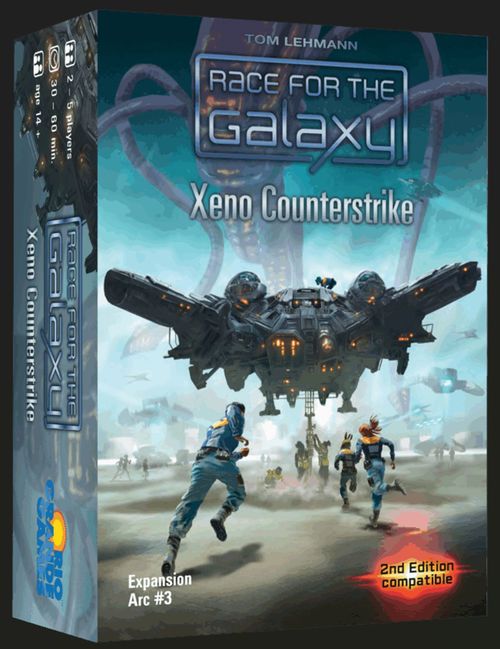
Race for the Galaxy: Xeno Counterstrike
Race for the Galaxy: Xeno Counterstrike Rulebook
Table of Contents
Table of Contents
Overview
Xeno Counterstrike is the sequel to Xeno Invasion, adding more start worlds and game cards, plus a new concept: frontier worlds. Together, these two expansions form the Race for the Galaxy Xeno Wars arc and should not be combined with any other expansions.
Up to 4 players can play Xeno Counterstrike without Xeno Invasion. With it, a 5th player can be added and the optional counterstrike game played. In it, after a successful repulse of the Xeno invaders, the empires then assault the Xeno satellite and hive worlds while the Xenos respond with desperate retaliatory strikes.
Contents
- 6 start world cards, numbered 10-15
- 26 game cards
- 18 Near Frontier cards
- 28 Far Frontier cards
- 5 Frontier/Conquest Settle cards
- 2 Frontier deck tiles
- 10 Xeno system cards
- 1 Xeno system deck tile
- 11 Xeno retaliation cards
- 1 Xeno retaliation tile
- 2 gold Xeno defense tiles
- 1 Xeno conquest track sheet
- 5 counterstrike summary cards
- 1 Successful Repulse card
- 2 counterstrike bonus tiles
- 28 VP chips (10 @ 1, 16 @ 5, 2 @ 10)
- 6 award chips (2 @ 1, 4 @ 5)
- 3 damage/award chips
Carefully remove the tiles and chips from their frames before play.
Adding Cards
Xeno Counterstrike cards have two red squares in their lower left corners. Before adding cards, remove any cards from other expansion arcs (with 1-3 gray marks or one gold mark).
Add only the 6 start worlds and 26 game cards to the Race for the Galaxy cards. Do not add the Frontier or Xeno system cards. These cards have different backs and are used differently.
Important. In this expansion, as in Xeno Invasion, all Explore actions are mix with hand. To do an Explore, draw cards, add them to your hand, and then discard the appropriate number from any of your cards in hand.
Tip: many players find it useful to quietly state aloud how many cards they need to discard before adding their Explore draws to their hands.
Example: Ann has 4 cards in hand and 2 Explore Draw+1 powers in her tableau. Ann calls Explore+1 and draws 5 cards. As she adds them to her hand, Ann reminds herself, "Discard 3", so she ends with 6 cards in hand.
Xeno Worlds. Many worlds are XENO military worlds, with a blue "fill" inside their defense numbers and a [Xeno icon] icon. XENO military worlds can be conquered normally, but cannot be settled using Pay-for-Military ([Pay-for-Military icon]) powers, such as the Contact Specialist's power.
Military vs. Xeno. Some powers provide specific Military vs. XENO worlds. This applies to Xeno military worlds and may be combined with other Military.
Damage/Repair World, Xeno Defense. These apply only in the counterstrike game. In the frontier game, some powers discard, instead of damaging, a world.
Anti-Xeno Keyword. Several 6-cost developments refer to ANTI-XENO, a term which appears in some card titles.
Frontier Worlds. Some powers refer to Frontier worlds. They are divided into Near and Far Frontier worlds in separate decks and need a Frontier settle to be placed. Frontier icons: [any Frontier icon] any, [Near Frontier icon] Near, [Far Frontier icon] Far.
Costly Developments. The Anti-Xeno Fleets and Armada have costs greater than 6. During scoring, these each count only 1 VP for Galactic Federation.
Powers. Most new powers are variations on existing powers. Those that are not have text descriptions and are described starting on page 9 (see New Card Powers below).
Frontier Game
The frontier game expands Race for the Galaxy with 2 differences:
- the Frontier Settle action enables players to settle Frontier worlds; and
- the game is extended by starting with more VP chips in the common pool (15/player, not 12) and ending on 15+, not 12+, cards in any tableau.
Setup
Add the 6 start worlds and 26 game cards before play. Set up the game normally, except put 15 VP chips/player (not 12/player) in the common pool. Give each player a Frontier/Conquest Settle action card.
Shuffle and set out the Near Frontier and Far Frontier decks. Put their summary tiles next to each deck as shown (no [counterstrike icon] icons). The Near Frontier tile shows cost 1-5 and defense 2-6; the Far Frontier tile shows cost 5-9 and defense 6-10.
Set aside the Xeno system, retaliation, Successful Repulse, and counterstrike summary cards, the Xeno conquest track sheet, and all other tiles and chips. These are used only in the counterstrike game.
Deal each player two start worlds to choose from, as described in Xeno Invasion or the Race for the Galaxy 2nd edition rules (page 8, sidebar).
Play
Play is as normal, except as modified below.
Frontier Settle. A player selecting Frontier/Conquest Settle must attempt to settle a Frontier world from a Frontier deck instead of placing a world from their hand. (Its Conquest portion applies only in the counterstrike game.) Other players who did not choose the Frontier Settle action may settle a world from their cards in hand normally during this Settle phase.
To do a Frontier settle, draw 3 cards from the Frontier deck of your choice: Near or Far. If your tableau has fewer than 5 cards, you must choose the Near Frontier deck. Each deck's tile shows the cost and defense ranges of the worlds in that deck. After examining your draws, choose 1 world to settle and discard the other 2 cards face down to the matching Frontier discard pile. Each Frontier deck has its own discard pile.
When you do a Frontier Settle, you do not receive a bonus card draw after successfully settling a world (instead, your bonus card is the world itself).
If you are unable or unwilling to settle any of the drawn worlds, keep 1 of them and discard the other 2 cards. You may place the card you keep with a later regular Settle action (and draw a bonus card) or you may spend it normally, discarding it to the matching Frontier discard pile (not the regular discard pile).
If more than one player chooses Frontier Settle, they simultaneously do this while resolving the Settle phase. If the needed Frontier decks do not have 3 cards for each player choosing Frontier Settle, then do this in player order, reshuffling discards as needed after each settle action.
If there are fewer than 3 cards in the needed Frontier deck (after reshuffling discards), then draw all its cards. If there are no Frontier cards left in either deck (or just the Near Frontier deck if your tableau has fewer than 5 cards), then replace the Frontier settle with a normal settle action (and draw a bonus card afterwards if you place a world).
Important. If you chose Frontier Settle, then — regardless of whether you placed a Frontier world — you may not choose Frontier Settle as your action next round. Tuck your Frontier Settle action card face up under your start world as a reminder and, after next round, return it to your action cards.
Thematically, this restriction represents the extra effort involved in reaching the frontier.
In the 2-player game for experienced players, you may attempt a Frontier Settle every round. Do not tuck your Frontier Settle card as above. If you choose both Frontier Settle and Settle as your actions, whichever Settle card is on top when your action cards are revealed is done first.
Game End
A Frontier game ends either after the common pool of 15 VPs in chips per player runs out (adding 10-VP chips, making change, and finishing that round normally) or if any player ends a round with 15 or more cards in tableau.
Three Far Frontier cards: Deep Space Terraforming, Federation Frontier HQ, and the Xeno-Embattled Colony can gain VP chips during the Settle phase. If this exhausts the VP chip pool, add the 10-VP chips, make change as needed, and the game will end after that round is done.
Counterstrike Game
The counterstrike game requires Xeno Invasion. It begins as a combined invasion and frontier game that transitions to a conquest stage once the Xenos are repulsed by exceeding their repulse value (ending early if the Xenos defeat the empires). It then continues until at least one counterstrike end condition is met:
- the much larger VP chip pool (30 VPs/player) is exhausted,
- all Xeno systems are conquered, or
- the empires' total military vs. Xenos exceeds the Xeno conquest value.
Important. Tableau size (12+ or 15+ cards) does not end the game.
This version is much longer than a typical Race for the Galaxy game. Do not attempt it until you have played several frontier games.
Setup
Set up an Invasion game as in the Xeno Invasion rules, except:
- put 30 VPs in chips per player in the common pool,
- set out the Frontier decks (as in the frontier game above), and
- give each player a Frontier/Conquest Settle card.
Play
Play initially proceeds as a combined invasion/frontier game. Continue this stage until either: the Xenos defeat the empires; the larger VP pool runs out (unlikely); or the empires repulse the Xenos (likely, see below).
In the first two cases, the game ends and is scored as the invasion game.
Play Notes. As worlds can be damaged and repaired in invasion/counterstrike games, two Far Frontier worlds, the Xeno-Embattled Colony and Xeno-Rebel Battleground, enter play damaged and two settle powers, on Run-Amok Robots and Scorched-Earth Defense, require damaging, instead of discarding, a world in your tableau to use them (see these cards).
Repulse
If the Xenos are repulsed, the game continues after a transition:
-
At the end of that round, award the two invasion bonus tiles (as per the invasion game rules). Shift all war contribution VP chips from players' bunkers to their other VP chips. Set out the two counterstrike bonus tiles.
-
Shuffle the Xeno retaliation cards to form the retaliation deck. Replace the invasion deck with the retaliation deck; the repulse tile with the matching gold Xeno defense tile (based on number of players); and the empire defeat tile with the Xeno retaliation tile ([crossed-out burst icon] side up). In a 2-player experienced game, flip the retaliation tile to its [burst icon] side.
Put the Successful Repulse card on top of the retaliation deck, using either its standard or 2-Player experienced side. Flip the Frontier deck tiles to their counterstrike sides ([burst icon]), to show that any failed Frontier settle increases all Xeno retaliation strengths that round by +4.
-
Extend the repulse track with the conquest track sheet. Shift the Xeno repulse arrow onto this track to become the initial Xeno conquest value. Either add 33, 42, 52, or 61, for 2-5 player games respectively, to its value or subtract the arrow's current offset from the initial repulse value (the war contributions previously made) from the respective printed conquest value. (The number to add is listed below each printed initial conquest value.)
Example. In a 3-player game, the initial 28 repulse value was reduced by 11 war contributions to 17. Shift the Xeno repulse arrow from 17 to 59 (17+42 or the printed 70−11) to be the initial Xeno conquest value. (The other arrow, marking total Military vs. Xenos, remains where it is.)
-
If playing with fewer than five players, separate the 5 Xeno Satellite and 5 Xeno Hive worlds and shuffle them facedown. For each fewer player, randomly return 1 Satellite and 1 Hive world to the box without looking at them. Shuffle the (remaining) Satellite and Hive worlds together to form the Xeno system deck and place its deck tile as shown on top of it.
-
Give each player a counterstrike game summary card.
Repulse "Breather". In the round after the Xeno invasion was repulsed, a Develop phase automatically occurs. During that round, no Xeno retaliation takes place (except in the 2-Player experienced version). Then, discard the Successful Repulse reminder card from the top of the retaliation deck.
Continue Play
Continue play with the following differences:
Terminology. Mentally replace all references (in rules, repair, and settle powers) to "invasion game", "Xeno invasion", and "Xeno repulse value" with "counterstrike game", "Xeno retaliation" and "Xeno conquest value", respectively.
Xeno Conquest. Players with at least 1 Far Frontier world or 16 cards in tableau may attempt to conquer a Xeno system world by playing their Frontier/Conquest Settle action card. Once any player meets either one of these conditions at the end of a phase, flip over the Xeno system deck tile and place it next to the deck.
Thematically, a Far Frontier world or a large enough tableau means the empire has sufficient supply to reach and attack Xeno systems.
A player with a tableau of 16 or more cards must attack a Xeno system world when they play their Frontier/Conquest Settle card; they can no longer attempt Frontier settles.
To attempt a Xeno conquest, draw 1 card from the Xeno system deck to attack (reshuffling if needed).
If several players choose Frontier/Conquest Settle, do this in player order. If you play Frontier/Conquest Settle and are eligible to do either one, choose which one you will attempt when you do your settle action.
If there are no Xeno systems left (after reshuffling), a player who chose Conquest may do either a standard settle (drawing a bonus card) or a Frontier settle (even if their tableau is 16 or more cards).
Xeno systems are either Satellite worlds, conquered like any other Xeno world, or Hive worlds, with defense listed as "?M+?X+#" ([Hive defense icon]), equal to your combined Military and Military vs. Xenos of 9 or more, plus the listed value.
To defeat a Hive world — provided your total Military and Military vs Xenos is 9 or more — you must add any mix of temporary Military or temporary Military vs. Xenos that equals or exceeds the listed value "#".
Thematically, Hive world defense represents the swarming tactics of massed Xenos defending their home worlds. The Xenos seek to evenly match and slightly outnumber all attacking forces and are therefore vulnerable to surprise maneuvers (temporary Military).
If a Xeno conquest succeeds, place the card in your tableau. Similar to Frontier settles, do not draw a bonus card. If a Xeno conquest fails, discard the Xeno system to that deck's separate discard pile and, if the Xenos retaliate this round, all retaliation attack strengths will be at +6.
Similar to Frontier settles, after a Xeno conquest attempt, tuck the Conquest Settle card under your homeworld. It is not available next round.
In the 2-Player experienced version, you may attempt a Xeno conquest each round. Do not tuck your Conquest Settle card as above.
If at least 1 Xeno system world is conquered this round, flip the Xeno retaliation tile over to its [crossed-out burst icon] side. No retaliation will occur this round.
Xeno Retaliation. This replaces the invasion step of the invasion game. Do it if the Xeno retaliation tile shows [burst icon] and the Xenos are not defeated. Xeno retaliation is performed as an invasion step except:
- it uses Xeno retaliation cards (not invasion cards);
- hand out these cards, high to low: the "M+X+#" card ([M+X+# card icon]), then the "#" card ([# card icon]), and then the "M+#" card ([M+# card icon]);
- these cards' attack strengths are +4 or +6 for all players if a Frontier settle or Xeno conquest failed, respectively, but never more than +6; and
- the awards differ (given in the same order as the cards were assigned).
When handing out retaliation cards, "M+#" ([M+# card icon]) is lower than just "#" ([# card icon]), as shown by the decreasing number of borders around the retaliation attack values. (This is the reverse of the invasion game assignment order.)
Some retaliation cards list "?M+?X+#" ([M+X+# card icon]), equal to your combined Military and Military vs. Xenos, plus the listed # value. To successfully defend against them, you must exceed the listed # using any mix of defense, temporary Military, and temporary Military vs. Xenos.
The awards for successful defense against retaliation differ from the invasion game. The highest admiral(s) receive extra defense awards if they successfully defend, as shown on the defense tiles.
Thematically, this represents a shift in public opinion, from valuing a weak military force that managed to defend against an invasion to valuing a strong military force that drives off a retaliatory strike.
Important. After either doing or skipping Xeno retaliation, always set the retaliation tile to its [crossed-out burst icon] side.
Game End
The counterstrike game ends either by exhausting the VP pool of 30 VPs/player or by defeating the Xenos. The Xenos are defeated either by equaling or exceeding the Xeno conquest value (similar to the invasion game) or by conquering all Xeno system worlds.
Neither tableau size nor failing to defend against Xeno retaliations can end the counterstrike game (unlike the Invasion game).
In all cases, finish the round and then award the counterstrike bonus tiles before determining the winner.
The Greatest Contributor bonus tile goes to the player with the most VPs in VP chips (not awards) at game end. (Once the conquest stage is reached, war contributions are not kept separate from other VP chips.)
Thematically, every economy is now on a war footing. While war contributions continue, consumption now represents mobilizing your populace to support the war effort.
The Greatest Conquerer bonus tile goes to the player who conquered the most Xeno system worlds ([Xeno system icon]).
In the case of ties for bonus tiles, each player tied for most receives the bonus VPs. Give the award tile to one of the tied players and 7 VP chips as needed to the other tied players.
Players total their VPs normally, including all award chips and tiles. War contribution VP chips (but not defense awards or bonuses) do count towards Galactic Renaissance. Damaged worlds do not provide VPs and do not count for any other card's VPs.
New Card Powers (by phase)
Upon Placement
Attribute, not power. Put a good on this production world when it is placed in your tableau. (The four attribute icons are the blue, brown, green, and yellow good kinds.)
II: Develop
- Draw After Placing Military. Draw 2 cards after placing a development that provides military (but not specific or temporary military).
- Replace World with Development. May discard a world, possibly damaged, from your tableau and replace it with a development with a printed cost < 6. This is not a Develop action. It cannot be combined with other Develop powers.
- Discard Good to Reduce Cost (-2 and -3). May reduce the cost to place a development by 2 (or by 3, on the -3 version) by discarding one good of the specified kind.
- Discount for Non-Military Worlds. Reduce the cost to place a development by 1 for every two non-military worlds in your tableau.
III: Settle
- Draw More During Frontier Settle (+1 and +3). When drawing Frontier worlds to settle, draw 3 plus the specified number of worlds to choose from (+1 or +3, as printed).
- Frontier World Settle Discount (-3). Reduce the cost of placing a Frontier world by 3.
- Gain VP Upon Frontier Settle. Gain 1 VP if one or more Frontier worlds were placed this round (by any player).
- Discard Good to Reduce Cost (-2). May reduce the cost to place a world by 2 by discarding 1 Genes good or, up to 3 times, any good.
- Reduce Cost to 0 and Gain 5 VPs. May discard a Near Frontier world from your tableau to place a world at 0 cost and gain 5 VPs. This power cannot place Alien ([Alien icon]) or Xeno worlds ([Xeno icon]).
- Gain 1 VP (during Settle). Gain 1 VP.
Discard Good for Temporary Military. These powers are printed on six cards:
- May discard one good of the specified kind to gain the listed temporary Military: blue good for +1 Military; brown good for +2 Military.
- May discard one good of the specified kind to gain the listed temporary Military vs. Xenos: blue good for +1; brown good for +3; Genes (green) good for +3; yellow good for +4.
- May discard up to 2 Alien Technology goods (yellow) to gain +1 temporary Military and +2 temporary Military vs. Xenos per good discarded.
Discard World for Temporary Military. May discard or, in counterstrike games, damage a world in your tableau to gain +6 temporary Military or +2 temporary Military vs. Xenos, respectively.
Military / Specific Military / Defense. These powers are printed on the following cards:
- [Non-military world icon] and [Frontier world icon]: +1 Military and +1 Military vs. Xenos for every two non-military worlds or each Frontier world in your tableau, respectively.
- Genes world icon: +1 Military vs. Xenos for each Genes world in your tableau.
- Genes world icon: +1 Military vs. Xenos and +1 Defense for each Genes world in your tableau.
- IMPERIUM icon: +1 Military and +1 Defense for each IMPERIUM card in your tableau.
- REBEL military world icon: +1 Defense for each REBEL military world in your tableau.
- Frontier world icon: +2 Defense for each Frontier world in your tableau.
Defense applies only in Invasion and Counterstrike games.
$: Trade
- Cannot Sell Good. A good on this world cannot be sold (using the Trade bonus). Consume powers, such as the Trade League's power, can be used. Trade League does score for this power.
IV: Consume
- All Goods. Discard all remaining goods for 2 cards or 1 VP and 1 card apiece, respectively.
V: Produce
- Cannot Produce. A good cannot be produced on this world. Neither the Produce bonus nor windfall production powers can produce a good on this world.
- Discard to Produce. May discard 1 card so that this world produces a good during Produce. If no card is discarded, this world does not produce a good. A player can discard a card gained from Diversified Economy to produce this good, but cannot gain a card for doing so (as one power cannot interrupt another power).
- Draw for Worlds / Imperium Cards. Draw 1 card for each REBEL military world, IMPERIUM card, Alien Technology world, or pair of Frontier worlds in your tableau, respectively. Frontier world pairs can be any mix of Near and Far Frontier worlds.
Counterstrike Game Summary
Counterstrike Game Summary (card).
- Setup: as Invasion game, except set out Frontier worlds and put 30 VPs in chips per player in the pool.
- After the Invasion game ends with a Xeno repulse:
- award invasion bonuses; set out new bonus tiles;
- replace invasion tiles with counterstrike tiles;
- replace invasion deck with retaliation deck;
- add conquest sheet; shift repulse arrow, offsetting it;
- prepare Xeno system deck: 1 hive & satellite/player.
- Round 1: a Develop phase automatically occurs.
- Frontier Settle: may not be done if you have a 16+ card tableau.
- Xeno System Conquest: requires a Far Frontier world or a 16+ card tableau.
- War Contributions & Repairs: as in Invasion game.
- Xeno Retaliation Step: see other side.
- Game End: empty VP pool; conquer all Xeno systems; or total Military vs. Xenos ≥ Xeno conquest value.
Retaliation Step (card). At the end of the round, after any hand limit discards:
- Update admiral disks, high to low.
- Check Xeno conquest. If total Military vs. Xenos is ≥ conquest value, the game ends; skip the rest of this step.
- Check Xeno retaliation. If the Xeno retaliation tile shows [burst icon], flip the tile to [crossed-out burst icon] and skip the rest of this step.
- Flip 1 retaliation card per player:
- Assign retaliation strengths by disks, high to low, [M+X+# card icon] before [# card icon] before [M+# card icon]. Then, move the bottom admiral disk in each stack to the top.
- If the strength (+4 or +6 (max.) with failed Frontier settle or Xeno conquest) is ≥ Military vs. Xenos, including any Xeno Defense and temporary Military, damage (flip over) 1 world.
- Otherwise, player receives 1-2 defense awards as shown on the defense tile.
Xeno System Defense Values and Retaliation Attack Strengths (card table).
| Card | Values |
|---|---|
| Xeno Satellite worlds | 10, 12, 14, 16, 18 |
| Xeno Hive worlds (*M+X ≥ 9) | M+X+2, M+X+2, M+X+3, M+X+4, M+X+6 |
| Xeno Retaliation [M+# card icon] | M+3, M+4, M+5 |
| Xeno Retaliation [# card icon] | 8, 10, 12 |
| Xeno Retaliation [M+X+# card icon] | M+X+2, M+X+3, M+X+4, M+X+5, M+X+6 |
"M+#" equals the player's Military+#, before adding any specific Military vs. Xenos. "M+X+#" equals the player's Military+# including any specific Military vs. Xenos. Neither includes temporary Military or, for retaliation, the player's Defense vs. Xenos.
To successfully defend, a player's total must exceed the Retaliation attack strength.
*To attack a Hive world, the player's Military plus Military vs. Xenos must be ≥ 9.