Qyshinsu: Mystery of the Way
Qyshinsu: Mystery of the Way Rulebook
Table of Contents
Table of Contents
The Board and Stones
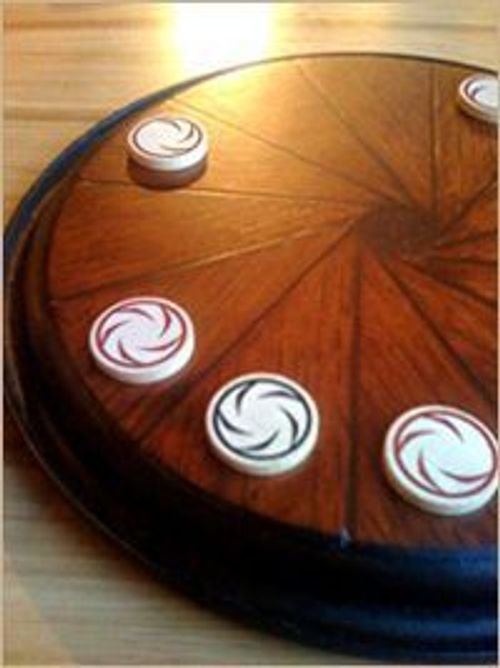
The board is circular, with twelve triangles aligning the inner core. Each triangle is a space on the board. There are two actions one performs in Qyshinsu: place a stone on the board, or remove a stone from the board.
There are a total of twenty four stones. Twelve of the stones are engraved with markings in ebony while the other half are more crimson in their hue. The distinction between them is further accentuated by slight variations in their design. There is a natural progression of the mark edges in terms of quantity and orientation. Overall, there are six unique kinds of stones that range in value and purpose. There is one pair of each of the five numbered kinds of stone per color, and one Old Stone per color.
Each stone, whether placed or removed, obliges the opponent to respond as described below. The consequence a stone engenders on one's opponent is consistent no matter what action one performs - placing or removing a stone. In every case the opponent's stone is placed or removed to the right or left of your stone, counting spaces around the board.
Courtesy of Removal
It is a courtesy in Qyshinsu to remove one's stone partially off its space to lean along the edge (the Old Stone's circle near the edge of the board is used for this). This allows one's opponent to see where a stone was removed and which kind it was, and ensures a certain rhythm is maintained between two people.
Stone of One
The Stone of One consists of a single engraved mark.
- When this stone is placed in a space on the board, your opponent must place or remove one of their stones one space away from it in either direction on the board - to the right or left of your stone.
- When this stone is removed from a space on the board, your opponent must place or remove one of their stones one space away from it in either direction - to the right or left of your stone.
Stone of Two
The Stone of Two consists of two engraved marks.
- When this stone is placed in a space on the board, your opponent must place or remove one of their stones two spaces away from it in either direction on the board - to the right or left of your stone.
- When this stone is removed from a space on the board, your opponent must place or remove one of their stones two spaces away from it in either direction - to the right or left of your stone.
Stone of Three
The Stone of Three consists of three engraved marks.
- When this stone is placed in a space on the board, your opponent must place or remove one of their stones three spaces away from it in either direction on the board - to the right or left of your stone.
- When this stone is removed from a space on the board, your opponent must place or remove one of their stones three spaces away from it in either direction - to the right or left of your stone.
The spaces that this stone designates are in direct alignment with one another. They form an axis across the board.
Stone of Four
The Stone of Four consists of four engraved marks.
- When this stone is placed in a space on the board, your opponent must place or remove one of their stones four spaces away from it in either direction on the board - to the right or left of your stone.
- When this stone is removed from a space on the board, your opponent must place or remove one of their stones four spaces away from it in either direction - to the right or left of your stone.
Stone of Five
The Stone of Five consists of five engraved marks.
- When this stone is placed in a space on the board, your opponent must place or remove one of their stones five spaces away from it in either direction on the board - to the right or left of your stone.
- When this stone is removed from a space on the board, your opponent must place or remove one of their stones five spaces away from it in either direction - to the right or left of your stone.
The Old Stone
One particular stone is unique. It consists of an engraved circle near its outer edge, and has a name - "the Old Stone".
- When this stone is placed in a space on the board, your opponent must also place one of their stones in the vacant space that is nearest to the Old Stone in either direction on the board - to the right or left of your stone.
- When this stone is removed from a space on the board, your opponent must remove one of their stones that is nearest to the Old Stone in either direction on the board - to the right or left of it. There is no other choice offered when removing this stone from the board.
The Old Stone is the only stone whose nature is determined by the proximity of other stones. At times it behaves as if it were a Stone of One, Stone of Two, etc. Unlike the other stones, when this stone is placed it offers no choice: the opponent must place a stone (not remove one).
The Intention
Your intention in Qyshinsu is to "return to the Way". This occurs when your opponent is unable to place or remove one of their stones.
The Precepts
There are three Precepts. Each Precept is a rule that underlies the nature of the play. It applies to both players and remains unchanged throughout the duration of the play.
- First Precept: One is not permitted to touch the opponent's stones under any circumstances.
- Second Precept: Only two of each kind of stone are allowed on the board at the same time. These two stones may be one's own, the opponent's, or a combination of both - one from each side. When two stones of one kind reside on the board, that kind of stone may not be placed on the board until either of the two has been removed.
- Third Precept: When one removes a stone from a space, that same kind of stone cannot be placed back in that same space on that player's very next turn.
Learning to "See": Ways of Returning
The booklet demonstrates the Precepts with an exercise. Three of the ebony stones are turned to their blank side and placed on the board in different places; they stand for the player's own stones, their kind being of no consequence. In one move, the player can place a stone on the board and return to the Way. There are six ways:
- A Stone of One placed in the space between the two closest blank stones. Its two spaces are occupied by stones the First Precept forbids touching, so the opponent cannot place or remove one of their stones.
- A Stone of Five, placed on the opposite side of the board. It and the Stone of One share the same "pattern".
- A Stone of Two.
- A Stone of Four, placed across the board opposite the Stone of Two. It shares the same "pattern" with the Stone of Two.
- A Stone of Three (the spaces it designates form an imaginary straight line across the board).
- A Stone of Three residing on the opposite side of the board from the space where it was placed in the fifth way.
Each of the five stones has a pattern associated with it, and some share it with other stones. If these stones were already on the board, removing them from the spaces explored above would equate to the same result - "returning to the Way".
The Old Stone: The Old Stone's way of returning differs. With the crimson stones placed in the board's spaces so that only one empty space remains ("one stone, one space"), placing the Old Stone in that space means the opponent, who must place a stone in the nearest empty space, has no space available and so cannot do so - the player has returned to the Way. Likewise, with the Old Stone on the board and the opponent having no stones on the board, removing the Old Stone means the opponent (who must remove their closest stone to it) has no stones to remove - again the player has returned to the Way.
The booklet leaves it to the player to discover how to return by way of the Second and Third Precepts.
Beginning Play
To initiate play, clear the board of all stones and align them to the sides of the board. (The arrangement of the stones at the sides is a personal matter; the booklet notes that some players' stones are placed together in no particular order.)
- It is customary in Qyshinsu that the one who partakes of the ebony stones goes first.
- The first stone is not to be placed on the board until after the 12th breath of the holder of the ebony marked stones. Each breath is concentrated with the attentive gaze given to a single space on the board at one time. This process honors the twelve years of Master Qy's reflections.
Play then alternates, each player answering the previous stone as it dictates.
Example of Play
The booklet follows a game between Li (ebony stones, moving first) and Hakummar (crimson stones):
- Li places her Stone of Two. Hakummar places his Stone of Three in one of the spaces designated by her Stone of Two (two spaces away).
- Li, who must now place a stone three spaces away from Hakummar's stone, places her Stone of One, a single space away from her Stone of Two. By the First Precept Hakummar may not touch her Stone of Two, so he is limited to only one space in which to place his next stone.
- Hakummar places his Stone of Two. There are now two Stones of Two on the board, so by the Second Precept no other Stone of Two may be placed until one of them is removed. Li must either place a stone two spaces away from his Stone of Two or remove her Stone of Two, which happens to be two spaces away as well.
- Li removes her Stone of Two from the board (leaning it at the board's edge as a courtesy). Hakummar now has no choice whether to place or remove; he must remove a stone and chooses which of his two stones to take away. He removes his Stone of Three.
- Li places the Old Stone. No other stones being in close proximity, Hakummar must place a stone a single space away (the Old Stone mimicking the Stone of One).
- Li removes her stone. The Third Precept now applies: Hakummar cannot place his Stone of Three back in the space it was removed from on his very next turn (and the same rule applies to Li). He places his Stone of Three in the other direction from the stone Li removed. Since the Old Stone happens to be three spaces away and the First Precept prevents Li from touching it, she has no choice but to go back to the same space from which she removed her own Stone of Three previously - and the Third Precept prevents her from putting a Stone of Three back in that same space, as it is her very next turn after the removal.
- Li selects her Stone of Five and places it in the space designated by Hakummar's Stone of Three. Both spaces five spaces away from her stone are occupied by her two other stones, so by the First Precept Hakummar is not permitted to touch them. He is unable either to place or to remove one of his stones, and Li has returned to the Way.