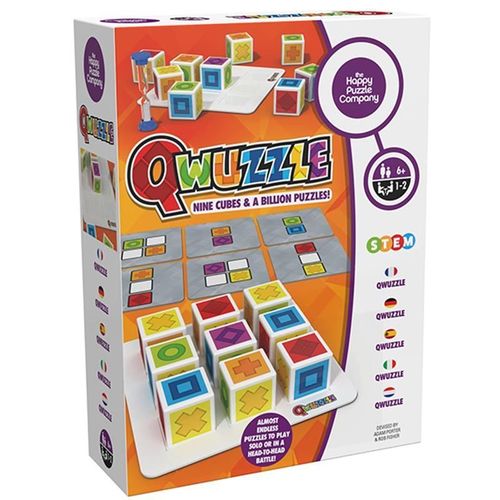
Qwuzzle
Qwuzzle Rulebook
Table of Contents
Table of Contents
Contents
- 2 x sets of nine identical Qwuzzle cubes.
- 2 x Qwuzzle grids.
- 89 cards, which include:
- 42 x 'basic' pattern cards (double sided). These have a grey background.
- 35 x 'advanced' pattern cards (double sided). These have a blue background.
- 12 x 'special shape' cards (double sided).
- 1 x sand timer (one minute).
- Various scoring tokens.
Overview
A 'Qwuzzle' is a quick puzzle and this game is jam-packed full of them… and you really will need to be quick because you have just 60 seconds to solve each one!
All you need to solve a Qwuzzle is nine Qwuzzle cubes and a Qwuzzle grid.
In each round of Qwuzzle, six random challenge cards are dealt, each displaying a unique arrangement of two or more cubes, which can be replicated using your Qwuzzle cubes. Your goal is to position your nine cubes in a 3x3 formation on the grid, to simultaneously fulfil as many of the six challenges as possible.
For every Qwuzzle you solve, you earn Qwuzzle points. The player with the most points after five rounds is the winner!
Setting up
Shuffle the deck of grey 'basic' challenge cards. They are double-sided so remember to flip some upside down to ensure a thorough mix. Place the cards in a pile in the centre of the play area and stand the sand timer beside them.
Give each player nine Qwuzzle cubes and a Qwuzzle grid. It doesn't matter how the cubes are shared out because every cube is exactly the same. Each side of a Qwuzzle cube shows one of the six Qwuzzle shapes in its designated colour.
Sequence of play
The game is played over a series of five rounds. At the start of each round, six challenge cards are dealt into the centre of the playing area and the 60-second sand timer is turned over.
Each challenge card displays a unique arrangement of two or more cubes. Players must work with strategy and speed to arrange their cubes on their grid, in a 3x3 formation, to simultaneously fulfil as many of the six challenges as possible.
Each cube arrangement can appear anywhere within the 3x3 grid and rotated in any direction. Any individual cube can be used to fulfil multiple challenges within a single round. An empty square on a challenge card denotes a location that can be filled with any cube face.
Some example challenge cards can be seen below.
(Diagram: example challenge cards A, B and C, with example 3x3 grids showing how each card can be met.)
Sometimes it will be possible to meet all six challenges simultaneously, but not always. If at any point you believe you have successfully met the maximum possible number of challenges, grab the timer, but keep it upright, so that the sand continues to flow. By taking the sand timer, you 'lock in' your solution and cannot touch your cubes again during this round. The other player can continue until the timer runs out. If no player grabs the timer, both continue playing until the timer runs out.
At the end of the round, each player scores one point for each of the six challenges that have been successfully matched within their grid. Only one point may be earned for each completed challenge card, even if the required cube arrangement appears multiple times within a single grid.
If either player grabbed the timer during the round, they earn one extra point if their opponent failed to fulfil more challenges than them. However, they lose a point if their opponent did manage to complete more challenges than them. The round number tokens should be used to record the points that each player has earned.
Then continue playing, round after round, each time dealing a new set of six challenge cards and turning the timer over.
The player who wins the most points in five rounds is the winner! In the event of a tie, play extra rounds until one player has won more points than the other.
Additional ways of playing Qwuzzle
The Advanced Version - For Serious Qwuzzlers!
If you enjoy a tougher challenge, you can progress to the advanced version of Qwuzzle. Shuffle the blue 'advanced' challenge cards, remembering to flip some of them upside down, and place them in a pile next to the 'basic' challenge cards. In each round, instead of only using the 'basic' challenge cards, deal out three 'basic' and three 'advanced' cards. Then turn over the timer and play the game in exactly the same way!
Below you can find explanations of the various different 'advanced' challenge cards.
1. These cards tell you exactly how many cubes you must have of the indicated colour. They may be placed anywhere in your grid, but you may not have more or less than the number shown.
(Diagram: two example 'advanced' cards showing a number with a colour, e.g. 3 of one colour and 1 of another.)
2. This card means that you must have the same number of cubes of both colours (for example, you might have two cubes of each colour), in your grid.
3. This card means that you must not have the same number of cubes of both colours (for example, you might have three cubes of one colour, and one of the other).
4. This card means that you must have at least one cube of the indicated colour in every column or in every row.
5. The remainder of the cards in the 'advanced' deck all contain patterns of three colours, as with the example on the right.
(Diagram: an example 'advanced' card showing a pattern of three colours.)
The Solitaire Version - For Solo Qwuzzlers!
For individual players, the solitaire version consists of seven rounds of Qwuzzle, with ever-increasing levels of difficulty.
Play the first round with six 'basic' challenge cards, recording your score at the end. In the second round, play with five 'basic' cards and one 'advanced' card. Now record your score and add it to your total from the first round. Keep repeating the process, adding one more 'advanced' card in place of one 'basic' card each time.
In the seventh and final round, all six cards will be from the 'advanced' pile. Add up your scores from all seven rounds to get your final score. The maximum possible score is 42. Keep a note of your score and see if you can beat it next time!
The Extreme Version - For Expert Qwuzzlers!
If you want to make things even trickier, the 'Special Shape' cards are just for you! Each card shows an alternative layout to the classic 3x3 formation. Players should therefore discard their grids, because the 'Special Shape' card will indicate the layout into which your dice must be arranged.
Shuffle the pile of 'Special Shape' cards, remembering to flip them too, and then select a card at random.
(Diagram: six example 'Special Shape' cards, each showing an alternative grid layout.)
The extreme version can be played using any combination of six 'basic' and 'advanced' challenge cards. It can be played as either a one-player or two-player game.
There are literally billions of different Qwuzzles to play, meaning endless hours of brain-bending family fun!
Happy Qwuzzling!