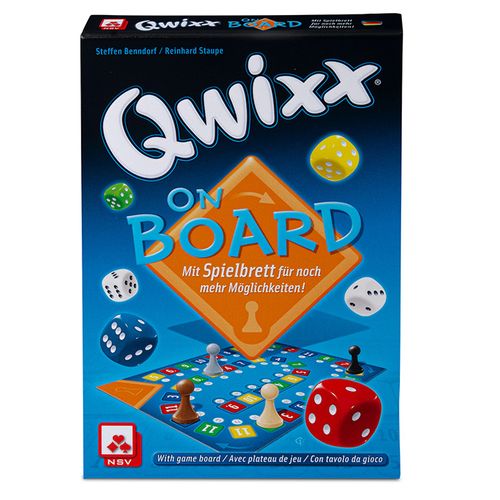
Qwixx On Board
Qwixx On Board Rulebook
Table of Contents
Table of Contents
Setting Up the Game
The players must first decide which side of the board they wish to play on. Each player receives a playing piece and places it in the "start" box on the board. Spare playing pieces are placed in the box. What's more, every player gets a piece of paper and a pen. During the game, each player crosses off numbers on their piece of paper – exactly as in the Qwixx original game.
When it comes to crossing off numbers on the piece of paper, this is done EXACTLY the same as in the original game!
Playing the Game
It is decided which player will go first as the active player. The active player carries out 3 actions, one after the other:
The active player rolls all six dice. Now, exactly as in the original game of Qwixx, action 1 (the sum of both white dice for all players) will be carried out without any changes, followed by action 2 (one white + one coloured dice – only for the active player), also without any changes. Now, the active player also has the chance to carry out an (optional) action 3, an opportunity available only to the active player (and the active player alone!):
Action 3: The active player may move their playing piece forward by 1-5 free spaces (but never backwards). Occupied spaces do not count; the player can simply jump over these. A maximum of one playing piece can occupy any one space at a time (players are not kicked off the board). The active player chooses how far they wish to move (1-5 spaces) and moves their piece forward accordingly.
When moving forward, the following requirement must be met: the active player must either use the number of the space to which their playing piece moves to place a cross on their piece of paper (according to the original rules for crossing off numbers) or have already crossed off said number – otherwise they may not move forward!
Example 1: Tim is the active player. As part of his action 3, he moves forward 5 free spaces from the "start" box and lands on the green 10. He crosses out the green 10 on his piece of paper.
Example 2: Later in the game, Linus is the active player. As part of his action 3, he moves his playing piece forward 4 free spaces onto the green 7. As Linus has already crossed off the green 7 on his piece of paper, this is allowed (even without crossing anything out).
Note: There is a number in a white circle displayed underneath each space. These are extra points which the player receives at the end of the game in accordance with the location of their playing piece. The further the playing piece travels, the more extra points are up for grabs (1-20).
The next player to the left of the first active player becomes the new active player. They then carry out the 3 actions as described above. Should they be able and willing to do so, the active player can cross off a number during each action, i.e. up to three numbers in total. Of course, the active player can also only cross off one number or two, in any combination of actions.
Mis-rolls: The active player is only classed as having a mis-roll when they have not crossed off any numbers in any of their last 3 actions. Note: The clever use of action 3 allows for mis-rolls to be avoided almost completely.
End of Game
The last round of the game is announced as soon as an active player reaches one of the last 5 spaces on the board. Following this, all of the other players are given one more turn as active player. Then the game is over and the points are added up.
Note: In accordance with the original Qwixx rules, the game can also finish at any time, i.e. when two colours have been completed or when a player has made 4 mis-rolls. If this is the case, the game is immediately over, no matter whether a playing piece has reached the end of the board or not.
Scoring: The 4 coloured rows are scored exactly as in the original game. What's more, each player also receives the number of extra points that are displayed beneath the space on which their playing piece is located (20 maximum). Whoever has the highest total number of points wins.
Original Rules
Each player tries to mark with a cross, on his card, as many numbers in the four colour-rows as possible. The player gets more points the more crosses he has in one colour-row. Whoever has the most points, in total, at the end wins.
Crossing Numbers
It is a basic rule that, in the course of the game, the numbers must be crossed out from left to right in each of the four colour-rows. But you do not have to begin with the number farthest on the left. You are allowed to leave out numbers (even several at once). Numbers that have been left out may not, however, be crossed out afterward.
Note: If one wishes, one can cross through those numbers that one has left out with (instead of a cross) a small horizontal line, so that they are not crossed out later by accident.
Example: In the red row first the 5 and then the 7 were crossed out. The red 2, 3, 4 and 6 may therefore no longer be crossed out. In the yellow row only the 11 and the 12 may still be crossed out. In the green row the player has to proceed rightward from the 6. In the blue row he has to proceed rightward from the 10.
The Way the Game Is Played
Each player gets a card and something to write with. Lots are drawn to decide which player first takes on the role of "active player". The active player throws with all six dice. The following two actions are now carried out one after the other: first the first action and only then the second one.
-
The active player adds the pips of the two white dice together and says aloud, and in a clear voice, the sum that thereby results. Each player may then (but is not obliged to!) cross out the number that the active player has spoken out in any colour-row of his choosing.
Example: Max is the active player. The two white dice show a 4 and a 1. Max says, loudly and clearly, "five". Emma crosses out, on her card, the yellow 5. Max crosses out the red 5. Laura and Linus prefer not to cross out any number.
-
The active player (but not the others!) may then (but is not obliged to!) add together the pips shown on just one white dice together with the pips shown on just one coloured dice of his choosing and cross out the number corresponding to this sum in the colour-row corresponding to the colour of the dice chosen.
Example: Max adds together the white 4 with the blue 6 and crosses out, in the blue colour-row, the number 10.
Very important: If the active player crosses out a number neither in the first nor in the second action, he must make a cross in the column "Misthrows". The non-active players do not need to mark a misthrow, regardless of whether they have chosen to cross out a number or not.
Now the next player clockwise becomes the new active player. He takes all six dice and throws. Then the two actions described above are carried out, one after the other, and the game goes on in this way.
Finishing a Row
If a player wishes to cross out the number at the extreme right end of a colour-row (red 12, yellow 12, green 2, blue 2) he must first have made at least five crosses in the colour-row in question. If he makes a cross on the number on the extreme right, then he should also make a cross on the field directly next to it which shows a lock symbol. This latter cross will also be counted in the final calculation of total crosses! This colour-row is now finished and closed off for all the players and no more crosses can be made in this colour in any of the subsequent rounds. The dice of the colour corresponding to it is immediately removed from the game and is no longer needed.
Example: Laura crosses out the green 2 and, after it, the lock symbol. The green dice is removed from the game.
Please note: If a player crosses out the number at the extreme right end of a colour-row, then he must announce this loudly and clearly, so that the other players know that this colour-row is now out of the game. If the closing-off of a row occurs during the first action, it is possible that other players may, at the same time, also conclude and close off the same colour-row and cross out the lock symbol at the end of it. But if a particular player has hitherto made less than five crosses in the colour-row in question, he shall not have the right to make a cross in the extreme-right field, even if the row has been closed off by another player.
End of the Game
The game ends immediately as soon as someone has marked his fourth misthrow. It also ends immediately as soon as two colour-rows have been completed and closed off (regardless by which players) and dice of two colours have consequently been removed from the game.
Note: It may occur (during the first action) that a third row is closed off simultaneously with the second row.
Example: The green row was already closed off. Emma now throws two 6's with the white dice and says "twelve". Max crosses out the red 12 and thus finishes the red row. At the same time Linus crosses out the yellow 12 and finishes the yellow row.
Scoring
Beneath each of the four colour-rows there is indicated how many points are awarded for how many crosses within each row. Every misthrow means five minus-points. Each player enters his points for his four colour-rows and the minus-points for his misthrows in the appropriate fields at the bottom of the card. The player with the highest total result is the winner.
Note: In the original game, this space is left empty. In Qwixx On Board, this is where the extra points are entered.
Example: In red, Laura has 4 crosses, which gives her 10 points; in yellow, she has 3 (= 6 points); in green 7 (= 28 points); and in blue 8 (= 36 points). For her two misthrows she must subtract 10 minus-points. This means that Laura's total result is 70 points.