Qwirkle
Qwirkle Rulebook
Table of Contents
Table of Contents
Components
- 108 tiles (3 of each of the 36 possible tiles)
- 1 bag
- 1 scoring track
- 4 scoring markers
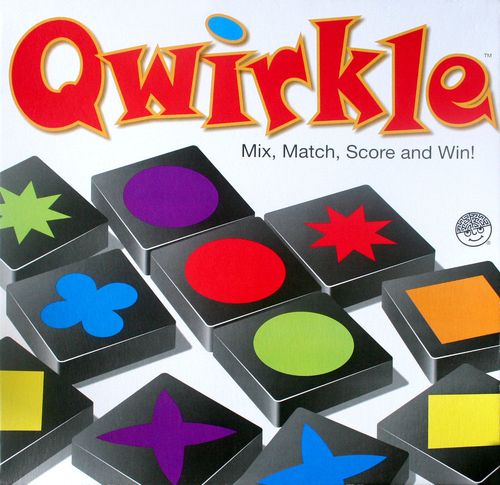
The six shapes are: circle, four-point star (X-shape), eight-point starburst, square, diamond and clover. The six colors are: red, orange, yellow, green, blue and purple. Each of the 36 shape/color combinations appears on 3 identical tiles.
Playing time: 30 – 60 minutes. Players: 2 to 4. Ages: 6 and up.
Object of the Game
Make lines of tiles that are either all one color or all one shape. Points are scored for every tile played. The player with the most points wins the game.
Setup
Place all the tiles in the bag. Each player takes a scoring marker and places it next to the scoring track. Qwirkle does not use any boards — the boards are only used for the Qwirkle Connect and Qwirkle Select variants.
Starting the Game
Each player draws six tiles to create a hand. Stand the tiles up so that only you can see the printed side.
Each player declares the largest number of tiles in their hand that are all one shape or all one color. Do not count duplicate tiles. The player with the most matching tiles (not counting duplicates) plays those tiles to start the game. If there is a tie, the oldest player in the tie starts the game. Play then proceeds clockwise.
Playing the Game
On your turn:
- Place one or more tiles.
- Move your marker ahead on the scoring track by the points you score.
- Draw tiles from the bag to bring your hand back up to six.
If you can't or don't want to place any tiles, you may discard instead. Discarding counts as your entire turn and you do not score any points. Set aside all the tiles you want to discard, then draw the same number of replacement tiles. You cannot discard more tiles than are left in the bag. After you have drawn, mix the discarded tiles back into the bag.
Placing Tiles
You may play multiple tiles on your turn as long as all the tiles you play are the same color or the same shape and are placed in the same line. You cannot play two tiles that are exactly the same.
At least one of the tiles you play must touch (side to side) a tile that has already been played, and must match that tile in color or shape. Any tiles that touch each other are part of a line. Lines are either all one shape or all one color, without any duplicates.
The tiles you play must all be added to the same line, but they do not have to touch each other. You can even add a tile to both ends of a line in one turn.
There cannot be duplicate tiles in a line. For example, a line of squares can only have one blue square. A line can never be longer than six tiles.
As the game progresses, spaces will be created where no tile can be played.
Scoring
One point is scored for each tile in a line that you create or add to.
A single tile can score twice if it is part of two lines — once for each line. For example, a tile placed at the intersection of a color line and a shape line scores points for both lines.
Qwirkle
Whenever you complete a line of all six colors or all six shapes, it is called a Qwirkle. A Qwirkle scores 12 points: six for the tiles in the line, plus six bonus points.
Ending the Game
When there are no more tiles to draw from the bag, play continues as before, but players do not replenish their hands. The first player to run out of tiles scores six bonus points and ends the game. The player with the highest score wins.
Strategy Tips
- Play your tiles so that they are part of more than one line.
- Save tiles that can help you make a Qwirkle.
- Avoid creating places for other players to make a Qwirkle.
- Remember that there are three of each type of tile.
Sample Game
This example follows a game between Anna, Chris, Sally and Dave to illustrate how tiles are placed and scored across many turns.
- Anna plays three red tiles to start the game. She scores 3 points.
- Chris scores 4 points for the red line and 3 points for the square line. 7 points total.
- Sally scores 2 points for the circle line and 2 points for the blue line. 4 points total.
- Dave scores 2 points for the green line, 2 points for the clover line and 2 points for the diamond line. 6 points total.
- Anna scores 4 points for the green line and 3 points for the circle line. 7 points total.
- Chris scores 4 points for the horizontal square line and 2 points for the vertical square line. 6 points total.
- Sally scores 3 points for the starburst line. 3 points total.
- Dave scores 3 points for the orange line. 3 points total.
- Anna scores 2 points for the yellow line, 4 points for the diamond line and 4 points for the circle line. 10 points total.
- Chris scores 4 points for the starburst line and 5 points for the red line. 9 points total.
- Sally scores 6 points for the red line plus 6 points for making a red Qwirkle. She also scores 3 points for the blue line and 3 points for the criss-cross line. 18 points total.
- Dave scores 5 points for the horizontal square line, 2 points for the vertical square line and 2 points for the second horizontal square line. 9 points total.