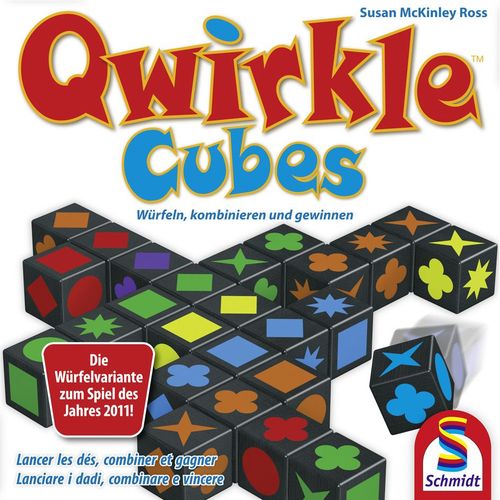
Qwirkle Cubes
Qwirkle Cubes Rulebook
Table of Contents
Table of Contents
Object
Strategically use your cubes to build lines of color and lines of shape. Score points for each cube in a line that you create or expand.
Setup
You will need pencil and paper to keep score. Place all the cubes in the bag. Each player draws six cubes and rolls them to create their hand. Everyone plays open-handed with all of their cubes showing at all times.
How to Play
On your turn:
- Choose which cubes to re-roll, if any, and roll.
- Add cubes to the grid. All of the cubes you play must share a single attribute, either color or shape. Your cubes must be added to the same line, but they do not have to touch one another.
- Record your score.
- Draw cubes to bring your hand up to six. Roll these new cubes and add them to your hand.
If you are unable to play, you must re-roll all of your cubes until you can play.
Starting the Game
The oldest player goes first. On the first turn only, after rolling, the first player is required to play the most cubes they have that share a single attribute. If the first player cannot play more than one cube to start the game, they must re-roll all their cubes until they are able to play more than one cube. Play continues clockwise.
Rolling the Cubes
At the beginning of your turn, you can re-roll any of your cubes. Each time you re-roll, you have the potential to change the shapes on your cubes. Rolling the cubes will never alter the colors of your cubes.
At the end of your turn, draw replacement cubes from the bag and immediately roll them before adding them to your hand.
Adding to the Grid
Players take turns adding to the grid. All cubes must connect to the grid orthogonally; there are no diagonal connections.
Two or more cubes that touch, create a line. A line is either all one shape or all one color. Cubes that are added to a line must share the same attribute as the cubes that are already in that line.
Line Restrictions
A line of shapes can have only one cube of each of the six colors. For example, a line of squares can have only one blue square.
A line of color can have only one cube of each of the six shapes. For example, a line of yellow can have only one yellow circle.
When you play multiple cubes, all of the cubes must share one attribute and be added to the same line. However, they do not have to touch one another.
Because each cube must share one attribute with every cube it touches, it is not unusual to have places where no cube can be played.
Scoring
When you create a line, you score one point for each cube in that line. When you add to an existing line, you score one point for each cube in that line, including cubes that were already in that line. One cube can score two points if it is part of two different lines. See Examples of Play.
You score an additional six-point bonus whenever you complete a line of six cubes — this is called a Qwirkle. A Qwirkle is worth twelve points — one point for each of the six cubes and six points for the bonus. The six cubes must be either six cubes of the same color, each a different shape, or six cubes of the same shape, each a different color. Lines of more than six cubes are never allowed.
The player who ends the game scores a six-point bonus.
Ending the Game
When there are no more cubes in the draw bag, play continues as before, but players do not replenish their hands. The first one to use all of his or her cubes, ends the game and scores a six-point bonus. The player with the highest score wins.
Examples of Play
The rulebook illustrates the rules with a running four-player example (Jessica, Chris, Andrew, and Sally), showing each player's hand of cube icons before and after re-rolling, the cubes played to the grid, and the resulting score. The play-by-play below transcribes that worked example.
Round 1
- Jessica's original hand is dealt. She re-rolls 2 cubes. She plays 3 stars and scores 3 points. She draws and rolls 3 cubes to refill her hand.
- Chris's original hand is dealt. He re-rolls 5 cubes. He plays 3 squares and scores 7 points. He draws and rolls 3 cubes to refill his hand.
- Andrew's original hand is dealt. He re-rolls 3 cubes. He plays 2 diamonds and scores 8 points. He draws and rolls 2 cubes to refill his hand.
- Sally's original hand is dealt. She re-rolls 5 cubes. She plays 3 green cubes and scores 8 points. She draws and rolls 3 cubes to refill her hand.
Round 2
- Jessica re-rolls 5 cubes. She plays 1 red diamond and scores 5 points. She draws and rolls 1 cube.
- Chris re-rolls 5 cubes. He plays 3 stars and scores 15 points, including the 6-point Qwirkle bonus. He draws and rolls 3 cubes.
- Andrew re-rolls 5 cubes. He plays 2 red cubes and scores 8 points. He draws and rolls 2 cubes.
- Sally re-rolls 3 cubes. She plays 3 diamonds and scores 7 points. She draws and rolls 3 cubes.
Round 3
- Jessica re-rolls 4 cubes. She plays 3 orange cubes and scores 9 points. She draws and rolls 3 cubes.
- Chris re-rolls 5 cubes. He plays 2 green cubes and scores 12 points, including the 6-point Qwirkle bonus. He draws and rolls 2 cubes.
- Andrew re-rolls 6 cubes. He plays 3 circles and scores 9 points. He draws and rolls 3 cubes.
- Sally re-rolls 4 cubes. She plays 3 diamonds and scores 12 points. She draws and rolls 3 cubes.