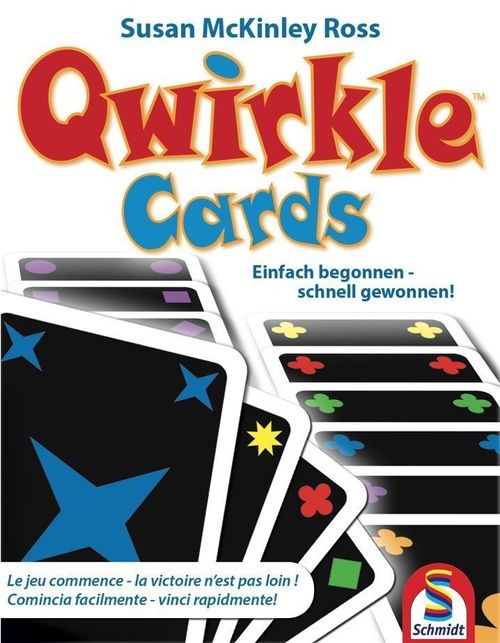
Qwirkle Cards
Qwirkle Cards Rulebook
Table of Contents
Table of Contents
Contents
- 108 playing cards: three sets of six shapes with six different pip-counts/colors.
Object
The object of the game is to make the most Qwirkles. A Qwirkle is a run of six cards that are either all the same pip-count/color or all the same shape, without any duplicates.
Setup
Shuffle the cards thoroughly. Deal nine cards to each player. Put the remainder of the deck to one side of the play area. The player with the largest set of cards that are all one shape or all one pip-count/color, without duplicates, goes first. If there is a tie, the oldest player in the tie goes first. The first player does NOT have to play his or her largest set. Play continues clockwise. If none of the players have a set of at least three cards to start the game, all the cards are reshuffled and dealt again.
Playing Cards
On your turn you can start a new set, add to an existing set, or switch cards to make new sets. You can do more than one of these things on your turn. For example, you can start a new set and also add a card to an existing set. Or you can add cards to several existing sets. A set consists of at least three cards that share one attribute, either shape or pip-count/color. There cannot be duplicate cards in a set. For example, a set of squares cannot have two 1-pip/red squares in it. (Two of the same card are NOT allowed in one set.)
Starting a New Set
To start a new set, play at least three cards that share a single attribute, without duplicates. You must play at least one card per turn if you are able. If you are unable to play anything from your hand on your turn, play passes to next player.
You may start a set with less than three cards if you are able to switch cards from another set to meet the three card minimum. See Switching Cards.
Adding to a Set
To add to an existing set, the cards you add must have the same attribute as all the cards in the existing set, and there cannot be duplicates.
Examples (illustrated): adding to an existing set based on shape; adding to an existing set based on pip-count/color.
Adding Cards to Make a Qwirkle
When a Qwirkle is completed by adding the correct cards to finish a set of six, it is removed from the play area. The player that completed the Qwirkle keeps it near him or her so they can count their Qwirkles at the end of the game.
Example (illustrated): adding three diamond cards to an existing set to create a Qwirkle.
Switching Cards
To switch cards around, add your card or cards to the play area and then rearrange, combining cards that are already in the play area with the cards you played. When you are finished switching, all the cards in the play area must belong to a set of at least three cards.
Example (illustrated): For two new squares to be played, a 5-pip/blue square can be moved from an existing set to make a three square card set.
Note: If you're doing some complex switching, you may want to switch the cards in the play area before you play cards from your hand.
Be sure to maintain sets with a minimum of three cards. (A second illustrated example shows a switch in two steps.)
Switching Cards to Make a Qwirkle
As well as rearranging cards to make sets, you can also rearrange cards to make a Qwirkle. (Illustrated example.)
Claiming a Qwirkle
Whenever you make a Qwirkle, remove the Qwirkle from the play area. Set the cards to your side so that you can count how many Qwirkles you made at the end of the game. All players are allowed to look at the completed Qwirkles at any point in the game. If you find you need to refer to them often, you may want to fan them out so that they can be easily seen.
Drawing
At the end of your turn, draw until you have nine cards in your hand.
Ending the Game
When the last card is drawn, each player gets one more turn. The player who drew the last card will have the last turn.
Winning the Game
The player with the most Qwirkles wins the game. If there is a tie, the tied players shake hands and agree to a rematch in the future.