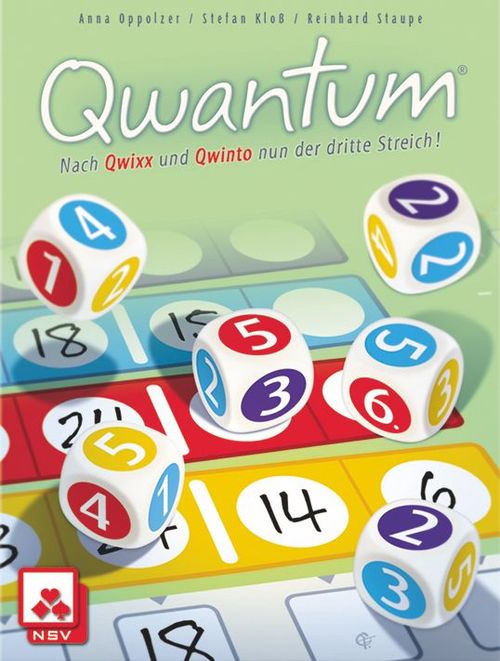
Qwantum
Qwantum Rulebook
Table of Contents
Table of Contents
The Dice
There is one totally normal white dice (with the numbers 1-6) and six special coloured dice. Each coloured dice shows the numbers from 1 to 6 in the four colours red, yellow, blue and purple. However, the numbers on the coloured dice don't always go from 1 to 6, they are distributed differently.
Entering the Numbers
During the game, every player enters numbers in the four coloured rows on their scorecard. The numbers always have to be entered from left to right in each coloured row – gaps are not allowed. The numbers within each coloured row always have to be higher from left to right but only up to the thick line and then from there on they have to get lower. Every player can decide for themselves when they enter numbers into the coloured rows. For example, you can enter a number in the yellow row first, then a number in the purple row, then another number in the yellow row, then another number in the yellow row, then a number in the red row, etc.
Example: Tim has already entered 6 numbers on his scoresheet. The numbers always get higher from left to right in each coloured row.
Once a player has completely filled in one vertical column, they receive the second lowest value in the column as points and write it in the white box underneath.
Note: If there are several numbers with the same lowest value in one vertical column, then they score the next highest value as points.
Example: Tim has already gone over the thick line in the purple and red rows. The numbers after the thick line must always get lower. Tim has already completely filled in the first two vertical columns. In the first column, the second lowest value is 4, this means he scores 4 points. In the second column, the second lowest value is 10, which gives a score of 10 points.
Rare special case: If a player has entered the same value four times in a vertical column, then they score this value as points. For example, if a player has the number 6 four times in the first column, they receive 6 points for this column.
Playing the Game
Each player has a scorecard and pen. Lots are drawn to see who takes the first turn. The first player carries out the three steps as follows:
A) The player takes all seven dice and takes their first turn. If they are happy with this, they simply don't throw the dice again. If they are not happy with the score, they can take a second throw by throwing all seven dice or as many dice as they want. Note: The player may hold the individual dice and look at which colours are on the dice before their second throw. Example: Sarah leaves four dice after her first throw and throws the other three again.
B) The player sorts the dice by colour and places the white dice a bit further away. Now the player may (but doesn't have to) select one colour and enter the total for the dice in this colour on the corresponding coloured row on their scoresheet (the other players are not allowed to enter anything).
Very important: The score on the white dice is always added to each of the four colours.
Example: It is Sarah's turn. After her second throw, she has the following options and can select one of them. She could enter a 6 in red. She could enter an 8 in yellow. In purple she could enter a 6. In blue she could enter a 13. Sarah opts for the purple 6 and enters this in her purple coloured row.
C) To make things clearer, the player places the coloured dice for the colour they have just entered to the side. Now every player can (but doesn't have to) enter any one of the remaining three colours on their scoresheet. The white dice is also added to every colour's total here too. It is allowed for several players to choose the same colour and enter this in the corresponding coloured row. Note: If the active player did not enter a number in step B (also see "Caution, misthrow"), then all four colours are available for every player to choose from in step C.
Example: Sara used the purple dice in step B and places this to the side. Just three colours are available for every player now: red, yellow and blue. Sara enters the yellow 8. Tim and Emma both enter the red 6. Linus enters the blue 13.
Caution, misthrow: If the active player has not entered a number in step B or step C, they have to cross a misthrow on their scoresheet. The other players never have to cross a misthrow. The first misthrow counts as -1, the second misthrow as -2, the third misthrow as -3, etc.
Now the game moves clockwise to the next player who takes their turn as described (first A, then B, then C). The game moves around the players in this way.
What Happens if a Colour Is Not Thrown?
If a player has finished their turn (2 throws at the most) and one colour (or several) is not available, then the white dice counts as the score for the missing colour.
Example: It is Linus' turn. After 2 throws he has not thrown a red or purple. He can enter one of the following numbers in step B: a 3 in red, an 8 in yellow, a 3 in purple and a 19 in blue. Linus opts for the purple 3 and enters this on his scoresheet. All players then have the remaining colours red (3), yellow (8) and blue (19) available in step C.
Playing technique advice: The highest score that can theoretically be achieved in every colour is (with the white dice already added) 33 points – this is extremely rare though. Every player should therefore not let the numbers get too high in the first three columns. It's not actually that easy to achieve a score over 15 or even 20 in one colour.
End of the Game and Final Scores
The game ends when one player has completely filled in all four coloured rows on their scoresheet. If they already finish with step B, then step C no longer applies. The game also ends after step C if the player has crossed their fifth misthrow on the scoresheet. Every player now adds up all their points on their completed vertical columns (there are not any points for incomplete columns). The minus points for misthrows are dedicated from this. Whoever has the most points is the winner.
Example: Emma has completely filled in all 4 coloured rows (= end of the game). She scores 57 points (6+8+12+16+11+4) with her six completed columns. She receives 6 minus points in total for her three misthrows (-1, -2, -3). Emma's total score is therefore 51 points.