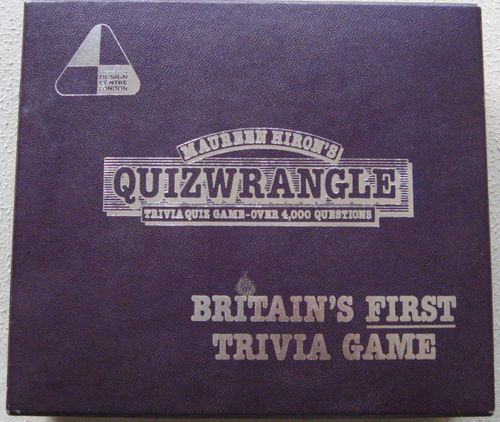
Quizwrangle
Quizwrangle Rulebook
Table of Contents
Table of Contents
Question Categories
- General knowledge.
- Mainly historical.
- Mainly geographical.
- Literature, mythology and the Bible.
- Sport.
- Entertainment.
- People, pastimes and art.
- Music.
- Loosely, science and natural history.
Question Cards
One question in each section appears on the front of each card and the answers are on the reverse.
The questions range from 'what you know' to 'what you probably know but can't quite remember' to 'what you didn't know but are pleased that you know now', to 'what you are amused to know and will bring up in conversation at the earliest opportunity'.
The answers are on the back of each card, so don't make it too easy for your opponents by holding the question card in the air! However, try not to be too pedantic. If the question is 'The Great Pyramid of Egypt contains 2,300,000 limestone blocks. On average, what did each weigh?' and the answer is 'about 2½ tons', then be reasonable and accept any answer between 2 tons and 3 tons.
But 'How many legs has a shrimp?' Answer – 10, and 'about 9' will not do!
Setup
Place the QUIZWRANGLE board so that the dark squares at each end face the players. THE GAME IS WON BY THE FIRST PLAYER OR TEAM TO GET 4 PIECES INTO THE DARK SQUARES NEAREST TO THEM.
Each team takes a tray of questions from the box.
Place one counter on each of the central numbered spaces.
Turns
Both teams take turns to roll three dice. Either the original roll may be accepted or the team can leave down [as printed; the photo is ambiguous, probably "lay down"] any number (or none) of the dice and re-roll the others. (Only one re-roll is allowed.)
At each turn three questions are attempted by a team, the questions being determined by the dice. You automatically move one square in the appropriate three lanes, and one extra square in the appropriate lane for each question correctly answered.
If your three dice show three different numbers (say 1, 5 & 6) your opponent will take the first card from his tray and ask you questions 1, 5 and 6 on that card. For correct answers, remember, move two squares towards you. For incorrect answers or 'don't know's, move just one.
If you throw a zero – tough, you miss a question! If your dice include the same number two or three times you only get to answer the question once – but if correct you move three (or two) extra squares (e.g. throw 2, 2 & 2, correct answer gives a total move of four squares in lane 2).
After a question card has been used for a turn it is placed at the back of the pack in the tray.
First Roll Handicap
In order to nullify the advantage of having the first roll, the starting team roll only two dice and are not allowed a re-roll. After this three dice are used throughout by both teams.
Transcriber Notes
- The rules sheet says the game is won by getting 4 pieces into the dark squares nearest the player. The box back blurb says the object is to get three counters into your home area. Both are transcribed as printed; the rules sheet is the governing text for play.
- The photo reads "leave down" in the re-roll sentence. This is transcribed as printed, with the probable intended word ("lay down") noted in brackets.