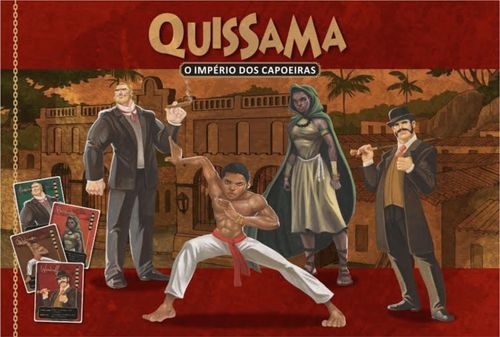
Quissama
Quissama Rulebook
Table of Contents
Table of Contents
- Components
- Objective
- Setup
- Let the Game Begin!
- Conquering the Characters of the Gallery
- Know the Characters
- Characters' Abilities
- Conquering Characters in an Opponent's Play Area
- Ministry
- Businesses (Comércios)
- Coins
- Market
- The Capoeiras and the Squares
- Attacking Squares and Businesses
- The Cabeça de Porco
- Special Cards
- Advanced Rules
Components
- 8 character cards
- Board
- 80 markers, also called meeples: 30 black Capoeira meeples and 10 coloured meeples for each player (yellow, white, green, red and purple)
- 100 cards. The manual shows these counts: 10x Nagoa (1), 5x Nagoa (2), 10x Guaiamum (1), 5x Guaiamum (2), 15x Coin (1), 5x Coin (2), 12x Liberty, 12x Bourgeois, 6x Crown, and a second row of 6x, 5x, 2x, 2x, 1x, 1x, 1x, 1x, 1x special cards (see Special Cards below; the manual does not label the counts per card).
- 10 coin tokens, +1 on the front and +2 on the back
- Organizer mat
Objective
Conquer at least 1 character card and accomplish the objective written on it. Players use their turns to combine cards and place their meeples on the board in order to obtain benefits that improve their performance in the game. A meeple can be a Minister, a Merchant or an Influence meeple.
The Ministry gives the player more cards and therefore more possibilities; the Squares (praças) provide workers for the Businesses (comércios), which in turn give the player more money; the Cabeça de Porco makes it possible to steal cards from opponents; the Market (off the board) allows card exchanges. The way to win is determined by the characters conquered during the game, through the Influence meeples, which are the meeples placed on the character cards. Each player may have more than one character, and whoever first achieves the objective of one of his characters is the winner.
Setup
- Place the board in the centre of the table.
- Spread the organizer mat beside the board.
- Open the Market: shuffle all the cards and turn the first three face up, placing them in the space designated on the mat.
- Place two Capoeira meeples (black) on each of the four squares (praças).
- The remaining Capoeira meeples are placed in the space on the mat called the Senzala, for later use.
- Form the Gallery with the eight characters beside the board, side by side and face up.
- Each player chooses a colour and takes the 10 meeples of that colour, forming his play area: the area in front of each player where his meeples and, later in the game, his character cards will be.
- Next, deal 5 cards to each player. Players play with their cards in hand, hiding them from the others.
- With the rest, form the draw deck, face down, and place it in the space designated on the mat.
- Place the coins, +1 side up, in each business (comércio).
(Note: the setup illustration is arranged for 5 players.)
Let the Game Begin!
Draw to see who will be the 1st player. Players take turns starting from the 1st and proceeding clockwise.
In the first turn, after looking at their cards, each player chooses one of the ten businesses available and places one meeple of his colour in one of the business's spaces.
The board is divided into two predominant areas: a Guaiamum (red) area and a Nagoa (blue) area. Analyse your cards to decide on which side you will open your 1st business. Then, on each play, the player combines the cards in his hand to place or move meeples on the board.
In each turn, players follow this order of play:
- If you have one or more ministers in the Ministry, draw one card for each of your ministers at the start of each new turn.
- Use the Abilities of your characters.
- Build combinations of cards, with or without use of the Market and with your eventual extra Coins.
- Finish your play by discarding unwanted cards and completing your hand to 5 cards, ending your turn.
It is not permitted to end the turn with more than 5 cards. If necessary, discard until you again have five. Whenever the draw deck runs out, shuffle the discard pile, form a new draw deck and keep playing.
Conquering the Characters of the Gallery
The game has eight characters, each with a different ability that can be used only once in each play, and an objective that allows you to win the game.
Conquered characters go to the players' play area. To do this, the player must be the first to place two of his meeples on that card, which may be in the Gallery or in an opponent's play area. Yes, you can capture opponents' characters (see the section "Conquering Characters in an Opponent's Play Area")!
To place a meeple, check the Influence cost for the specific character, shown by icons in the top right corner of the character cards. To pay the Influence cost, discard the necessary cards.
Until a character is conquered with two meeples, there may be meeples of the other players on it too. Thus, after placing his second meeple, the player removes all the meeples (his and his opponents') on the character and brings the character to his play area; he can use its abilities only from his next turn. The removed meeples are returned to the respective players. If a player conquers a character and already has that character's objective fulfilled, he wins the game.
Influence cost
- Quissama: Five Nagoas (add up the Nagoas on the cards)
- Woodruff: Five coins (add up the coins of the cards and of your business(es) token(s))
- Bernardina: Three identical cards
- Alemão: Four Guaiamuns (add up the Guaiamuns on the cards)
- José de Alencar: Two Crowns
- Imperador: A Nagoa, a Bourgeois and a Guaiamum
- Princesa: Three Liberties
- Araújo: Two Bourgeois
Example: To place a meeple on the Princess, discard 3 Liberties.
Know the Characters
Quissama
Ability: Draw a card and place it, face up (with its icons visible), under Quissama, or rescue all the cards that are there, bringing them to your hand.
Objective: Win the game by bringing Bernardina to your play area.
Note: If there are cards under Quissama when he is conquered by an opponent, those cards must be discarded.
Illustration of your play area, e.g.: 2 rounds after conquering Quissama.
Woodruff
Ability: Choose a player and swap one card from your hand with one of his. Examine the player's hand and decide which card of each hand will be swapped.
Objective: Win the game by bringing Bernardina to your play area.
Note: You may decide not to swap any. However, that does not give you the right, in the same turn, to choose another player to see his hand.
Tip: Use the value of the cards and of the coins generated through your full business to pay Woodruff's influence cost.
José de Alencar
Ability: Place a minister paying only two of the three items of the normal cost (crown, money and bourgeois).
Objective: Win the game by having two of your ministers in the Ministry and two of your businesses full.
Example of two full businesses (illustration).
Combinations: see the card combinations possible, using José de Alencar's ability, to place a minister (illustrated with two-card combinations, e.g. any two of Bourgeois, Crown and Coin).
Alemão
Ability: Steal cards according to the number of spaces your Guaiamuns occupy in the Cabeça de Porco. Thus, the attacked opponent will play with fewer cards in his next turn.
Objective: Win the game by filling the Cabeça de Porco with Guaiamuns.
Note: If there is more than one opponent, the player must alternate the stealing of cards on his turn. Example: with 2 opponents and 2 capoeiras in the Cabeça de Porco, choose an opponent and, without seeing his hand, take a card from him. Then steal the second card from the other opponent. With 2 opponents and 3 capoeiras, steal 2 cards from one and 1 card from the other.
Example: 3 capoeiras, steal 3 cards from the opponent(s).
Araújo
Ability: Count one extra coin for each of your full businesses. That is, each business becomes worth two coins, not one. To do this, flip your coin so that the +2 side is up.
Objective: Win the game by having four full businesses.
Note: If Araújo is conquered from an opponent, the player who conquered him will start using the coin(s) on the +2 side for his business(es), and the opponent who lost Araújo returns to using his coin(s) at the value +1. If Araújo receives an influence meeple while he is in a player's play area, that player can no longer use the +2 side of the coins, only the +1 side.
Illustration: with Araújo / without Araújo.
Imperador
Ability: Replace an opponent's meeple with one of yours, discarding the cost of that meeple.
Objective: Win the game by having four of your ministers in the Ministry.
Example: If there is a white meeple in a business, the yellow player (with Imperador) can discard a bourgeois and two coins to remove that white meeple and place one of his own, yellow, in its place. If there is a white meeple as a minister, the yellow player can replace it with his own meeple by discarding 1 Bourgeois, 1 Crown and 1 Coin.
If a business of the Araújo player (therefore using the +2 coin) is conquered by a player with the Imperador, the coin passes to the latter's play area, who will use it on its +1 side.
Princesa
Ability: On your turn, place only one capoeira on the square, discarding the card of the respective capoeira.
Objective: Win the game by filling three squares with capoeiras.
Note: If the card has two capoeiras, the other may be used for another normal play in the same turn, that is, combining it with other cards.
Tip: Combine the Princesa's ability + 1 Liberty card to free 2 capoeiras in the same play.
Bernardina
To place a meeple on Bernardina, the player must have in his play area a freed character (that is, one without meeples on it). You can conquer Bernardina even if she is not the objective of the character in your play area.
If there is an opponent's meeple on her, before placing your meeple, remove it by paying the influence cost, that is, three identical cards. In this case, you will pay the cost twice in two rounds: in the first round to take off the opponent's meeple, and in another to place yours.
If Bernardina is already in an opponent's play area, do not forget to add a Bourgeois to the cost.
If a player uses the Colar card to place his meeple on Bernardina and there is already an opponent's meeple there, use the Colar to remove the opponent's meeple instead of placing yours. It is not necessary to add a Bourgeois to use the Colar in the opponent's area.
(Illustrations: 3 non-identical cards / 3 identical cards.)
Important: Bernardina is the only character for whom the contest to conquer her works differently from the other characters. There cannot be more than one meeple on her; that is, if there is an opponent's meeple on her, before placing your meeple, remove it by paying the influence cost, that is, three identical cards.
Characters' Abilities
The ability of each character can be used only once per turn, but if a player has more than one character in his play area, he can use the abilities of each of them in the same turn and will win through any of the objectives in his possession. The abilities and objectives of the characters are described on the character cards themselves.
Conquering Characters in an Opponent's Play Area
To place a meeple on a character that is already in an opponent's play area, add a Bourgeois to the Influence Cost. A conquered character that has an opponent's meeple on it cannot be used, neither for ability nor for victory. The player who has an opponent's meeple in his play area can remove it by paying the same Influence Cost (without having to add a Bourgeois) and returning it to the opponent.
Example: To place a meeple on Quissama in an opponent's area, pay five Nagoas and a bourgeois.
Ministry
The Ministry is composed of six ministers. Each Minister gives the player the right to draw a card at the start of his turn.
To place a minister, discard a Bourgeois, a Crown and a Coin and place a meeple in the Ministry space marked with the number 1.
If there is already a minister in space 1, move the previous minister to space 2, placing the new minister in space 1. Do this successively; that is, whenever a new minister tries to occupy a space that is already occupied by another, move the previous one to the next space. If a minister is in space 6 and has to be moved, he leaves the Ministry, returning to the corresponding player's area.
Attention: move a minister only when necessary. Example: spaces 1 and 3 are occupied and space 2 is free. This happens because the minister in space 2 was removed by a Scandal. Move the minister from space 1 to 2, creating room for the new minister, but the one in space 3 stays where he is.
Influence cost: Bourgeois + Crown + Coin. Scandal: see Special Cards.
Businesses (Comércios)
The map has 10 businesses, delimited by three spaces: one for a bourgeois and two for capoeiras.
The capoeiras employed in a business necessarily come from the corresponding square, connected to it by a road.
To establish a business, acquire it with a Bourgeois card and two Coins and place the meeple of your colour in one of the 3 spaces, symbolizing the Bourgeois, owner of the business.
To employ a capoeira in the business, pay two Coins and a Capoeira of the respective gang (malta) and move a capoeira from the square to the business. The business must already have a Bourgeois!
A player can start a new business without having filled his existing businesses, but a business can never have only capoeiras.
A full business gives you the right to a +1 coin.
Tip: Combine the value of the cards and of the coins generated through your full business to acquire new businesses or employ capoeiras.
(Illustrations: Acquiring a Business / Employing a Capoeira.)
Coins
A full business (that is, with 1 merchant and 2 capoeira workers) generates extra money.
For each full business, take a coin token and place it in your play area, +1 side up, to use it together with your card combination, from the next turn.
For example, if the player who already has a full business wants to place a minister, he can use a Bourgeois, a Crown and a Coin token (as if it were a card)!
The token stays in your play area, for use in other turns.
Whenever the rule refers to coins, they can be added up from cards and tokens. "Two coins", therefore, can mean 2 cards of 1 coin, 1 card of 2 coins, or also using coin(s) coming from the business(es).
Value of cards and coins
- A card with 1 coin = a +1 token.
- A card with 2 coins = two +1 tokens = one +2 token.
Market
The market always has 3 cards on offer. To use it, exchange one card from your hand with any one of those there.
Only one action in the market is allowed per turn.
Whenever the Market has 3 identical cards, renew it. To do this, discard those 3 cards and replace them with 3 new ones from the draw deck.
The Capoeiras and the Squares
The map is divided into Nagoa (blue) and Guaiamum (red) regions. Each region has two squares where free capoeiras gather. The squares supply workers to the businesses connected to them (see the roads that link them).
To place a capoeira on the square, the player must discard a Liberty and a Capoeira of the respective gang (Nagoa or Guaiamum) and place the capoeira meeple on the corresponding square (coming from the senzala, that is, from off the board). With cards of double capoeiras, you will need two Liberties, or else you will free only one capoeira.
Whenever the rule refers to capoeiras, they can be Nagoas or Guaiamuns and can be added up from the cards. For example: three cards of one Nagoa correspond to one card of one Nagoa and another of two.
(Illustrations: Freeing one capoeira / Freeing two capoeiras.)
Attacking Squares and Businesses
Players can attack opponents' squares and businesses. To attack, discard cards totalling 3 capoeiras of the same gang and attack the square or business of the opposite gang. Thus, to attack a square or business in the Nagoa region, the player discards, for example, a card with two Guaiamuns and another with one Guaiamum.
The player removes a Nagoa from the attacked square or business and removes it from the board (it returns to the Senzala).
If you attack with more capoeiras (two cards of two, for example), the additional capoeira can be used in the same turn for another play, but if you do not use it, what is left at the end of the turn is wasted.
A business can only be attacked if its square is empty. Thus, the first target is always the square.
Exception: the Blessing of Peito card allows removing a capoeira from anywhere.
(Illustration: Guaiamum attack. Remove a capoeira from any one of the Nagoa squares and place it in the Senzala.)
The Cabeça de Porco
It is the tenement that serves as the base for Alemão Muller, commander of the Guaiamuns, who steals and increases his power.
The player with the Alemão card can steal cards according to the number of spaces his Guaiamuns occupy in the Cabeça de Porco.
Place Guaiamuns in the available spaces in the Cabeça de Porco by recruiting them from the squares, in the same way as is done with a business (paying two Coins and a Guaiamum).
The Cabeça de Porco can be attacked in the same way as a business. One of the Guaiamum squares must be empty. Because it is made up of Guaiamuns, the Cabeça de Porco can only be attacked by Nagoas.
(Illustrations: Nagoa attack / Recruiting a capoeira.)
Special Cards
Escândalo (Scandal)
Choose a minister and return the meeple to its owner. It does not matter what position in the Ministry the meeple is in. After using the card, remove it from the game. However, the card can merely be discarded without taking effect. In that case, it stays in the game to be used later.
Bênção Imperial (Imperial Blessing)
Choose only ONE of the icons shown on the card; that is, it works as a wild card. Example: using the Liberty function of the card to free a Nagoa from the senzala to one of the Nagoa squares.
Bênção de Peito (Blessing of Peito)
Choose any capoeira and remove it from the board, returning it to the senzala. The capoeira can be from a square, from a business or from the Cabeça de Porco. Example: remove a capoeira from an opponent's full business to take away the +1 Coin advantage even with a capoeira on the respective square.
Fuga (Escape)
Take a capoeira from the Senzala (off the board) and place it on any one of the four squares.
Colar (Necklace)
Place a meeple on Woodruff. If you have Woodruff, place a meeple on Bernardina. It is not necessary to add a Bourgeois to use the Colar in the opponent's area.
Malta
Remove a marker from Alemão or place one on Quissama. It is not necessary to add a Bourgeois to use the Malta in the opponent's area.
Cabeça de Porco
Move a Guaiamum from the square to the Cabeça de Porco or vice-versa.
Burguesia
Place a meeple on Alencar or Araújo. It is not necessary to add a Bourgeois to use the Burguesia in the opponent's area.
Família Imperial (Imperial Family)
Place a meeple on the Imperador or the Princesa. It is not necessary to add a Bourgeois to use the Família Imperial in the opponent's area.
Advanced Rules
Once you are well familiar with the game, try the variants below. Use them separately or combine them as you find most interesting!
- Reduce the initial number from 2 to 1 capoeira in each square.
- A player can conquer only 1 character during the whole game, thus limiting his objective and ability. The rule about blocking an opponent's character remains.
- Shrink the Gallery. Form it with Quissama, Bernardina and draw the other characters according to the number of players. Example: a 3-player game could be played with Alemão, Imperador, Araújo, besides Quissama and Bernardina. Ideal for varying the strategy.
- Control the Scandals, using one card more than the number of players. Example: with 2 players, use 3 Scandals.
- Control the Imperial Blessings, using the number of cards corresponding to the number of players. Example: with 2 players, use 2 Imperial Blessings.
- To make the game faster, make as many exchanges as possible in the Market. When three identical cards appear, do not renew the Market.