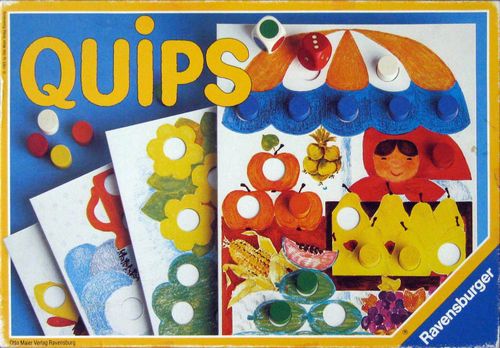
Quips
Quips Rulebook
Table of Contents
Table of Contents
Contents
- 4 player boards
- 1 color die
- 1 number cube from 1 to 3
- 90 wooden pieces in 6 colors
- 1 cloth bag
Dear Children
The butterfly flies across the meadow, the boy blows up a balloon, the children let their kites rise, and the bears pour out paint. Which board do you want to play with? All of the pictures are missing circles of color! Can you roll the dice and put in the right pieces?
Game Idea 1: Hidden Colors
Game with dice for 2 to 4 children from 3 years.
The aim of the game is to cover all the spaces on the board with matching colored wooden pieces. Whoever manages this first wins the game.
Preparation
Everyone takes a board. The rest are put back in the box. Place all wooden pieces in the cloth bag. Use the number die.
Here We Go!
The youngest player starts and rolls both dice. Play continues in a clockwise direction. The number die shows the number of pieces the player should take from the bag. Place the pieces in the matching color spaces on the player's board. A red piece is placed in a red space, a blue one in a blue space, etc. Pieces for which there is no free space are placed back into the bag. Then it is the next player's turn!
Note: If a child can not put all the pieces on their board, they may give them away to other children.
Encourage your child to talk while playing. For example: "I put the green piece in the tree."
End of the Game
The game ends as soon as one player has completely covered their board with wooden pieces in the correct colors. This player has won!
Game Idea 2: Color Magic
Game with colors and dice for 2 to 4 children from 4 years.
The aim of the game is to cover all the spaces on the board with matching colored wooden pieces. Whoever manages this first wins the game.
Preparation
Everyone takes a board. The rest are put back in the box. Place all wooden pieces in the box lid, so that everyone can see them. Use both dice.
Here We Go!
The youngest player starts and rolls both dice. Play continues in a clockwise direction. The color die shows which color pieces to take, and the number die shows the number of pieces to take from the box lid. Place the wooden pieces in the spaces of the board so that the color of the piece matches the color of the space.
Example: You roll red and two. Now you can take two red pieces from the box lid and place them in two red spaces on your board.
Stones for which you can no longer find a free space go back into the box lid. Then it is the next player's turn!
Note: If a child can not put all of the stones on their board, they may also give them away to other children.
End of the Game
The game ends as soon as one player has completely covered their board with wooden pieces in the correct colors. This player has won!
Game Idea 3: Crazy Color Swap
Game with colors and dice for 2 to 4 children from 5 years.
The aim of the game is to cover all the spaces on the board with matching colored wooden pieces. Whoever manages this first wins the game.
Preparation
Everyone takes a board and the matching wooden pieces. The rest of the boards and pieces are put back in the box. Place all wooden pieces in the box lid, so everyone can see them. Use both dice.
Place all wooden pieces in the color matching fields of your board. When you are ready, exchange your filled boards with another player. Everyone now rearranges the pieces so that there are none left in the correct space. Return the boards to their original owners. Now you can start the game.
Here We Go!
The youngest player starts and rolls both dice. Play continues in a clockwise direction. The color die shows which color pieces to move, and the number die shows the number of pieces to move.
Example: You roll blue and three. Place three blue pieces on three blue spaces. The pieces you remove from the blue fields are then placed in the vacant spaces.
Watch out! Sometimes it happens that when you swap pieces, the colors match. If there are fewer pieces to move than the die allows, the rest of the moves are forfeited.
End of the Game
The game ends as soon as all of the wooden pieces are in the matching color spaces on a player's board. This player wins!
Further Ideas
Many ideas can be used with the colorful Quips stones. It is possible to play a modified form of the well-known "Montagsmaler" game. One child lays a piece, others try to guess the move.