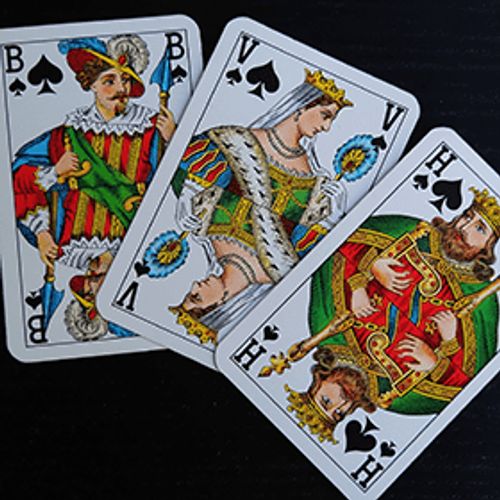
Quintus
Quintus Rulebook
Table of Contents
Table of Contents
Base Game
Objective of the Game
All players seek to score as many points as possible, over a given number of hands. These points are earned by winning certain cards in tricks.
Deal
At the start of every hand, all cards are dealt out by the dealer, in clockwise order. As such, all players receive eight cards. The dealer should deal the cards in such a way that all players receive the same amount of cards after one go around the table. It is inappropriate to pick up the cards before all have been dealt.
Choosing the Trump Suit
After dealing, the player to the right of the dealer – this is the fifth player – becomes the quintus. He plays against the other four players, who partner up in teams of two, sitting crosswise at the table. The quintus is the player to the right of the dealer. The dealer plays together with the third player (counting from the dealer, in clockwise fashion); the second team consists of the second and the fourth player. Note that every player only ever teams up with the two players sitting across the table.
Before playing any trick, the quintus picks a suit as the trump suit. He may also choose to play without a trump suit; this is called sans atout (SA).
Nil Game
Having determined the trump suit, the quintus may opt to play a nil game. Doing so is an intent to take no jack, queen, king or ace in tricks. Winning any pip cards (fives through tens) has no influence on making or failing nil. If the quintus makes nil, he receives additional points; if he fails, he receives a penalty. The exact amounts of points are listed in the Point Count section.
For increased points (and increased risk), the quintus may also choose to play open nil. This is a special nil game where the quintus reveals his hand before trick play commences.
Playing the Tricks
Subsequently, the quintus leads to the first trick with a non-trump card. The eight tricks are played in clockwise order. Following suit is mandatory, if possible; otherwise any card may be played. The trick is won by the player who played the highest trump card, or, when no trump was played, the highest card of the led suit. The winner of the last trick must lead to the next trick.
Claiming Premiums
In addition to the points from cards and nil, bonus points – called premiums – can be earned by winning one of two combinations of cards in a trick. There are two combinations which earn premiums:
- court: jack, queen and king of the same suit (not necessarily the led suit);
- straight: five through nine of the same suit (the ten does not count).
As soon as the trick has been played and one of these card combinations is on the table, the winner of the trick must explicitly meld the combination in order to earn the premium. If he forgets to do so, the premium does not count. The exact scoring for combinations are listed in the Point Count section.
Signalling
During trick play, signalling between the team mates is allowed, to a limited extent. At any moment during a trick, a player who is not the quintus and moreover has not yet played a card to this trick, may
- signal up by showing a thumb pointing up;
- signal down by showing a thumb pointing down;
- ask his team mate to give a signal. This may be done verbally, or through a gesture that was communicated beforehand to all other players.
Every signal must be observable by all players. (Nonetheless, it's a player's own fault if he does not pay attention and therefore fails to notice an observable signal!)
An up signal in principle communicates either strong cards or cards of high point value. A down signal shows weak (or low-value) cards. In case players wish to deviate from this principle, this should be made clear to all players before the start of the game.
Point Count
After all tricks have been played, the team mates combine their won tricks, and the points are counted. The quintus counts his points as follows:
- −1 for every five, six, seven, eight, nine or ten;
- +10 for every jack, queen or king;
- +40 if he played and made nil (+70 for open nil);
- +10 premium for every court;
- +25 premium for every straight.
The other players count the following points:
- −1 for every five, six, seven, eight, nine or ten;
- +5 for every jack, queen or king;
- +50 if the quintus played but failed nil (+70 for open nil);
- +10 premium for every court;
- +25 premium for every straight.
Aces are not worth any points.
The team mates both add the points made by their team to their individual total. The quintus only scores his own points.
End of Game
In principle, the number of hands played is free to choose; as such it is up to the players to determine when the game ends. However it is recommended to play a multiple of five hands, so that every player gets to play as the quintus equally often.
Bidding Variant
In the bidding variant, the game described above is expanded by a bidding round before trick play, in which the quintus is determined. As such, the quintus is no longer by default the player to the right of the dealer. The quintus now has the objective to win the amount of points in tricks which he bid during the auction. In this variant, the game points are accredited depending on whether the quintus made his bid or not, and on the points the two teams made relative to each other.
Choosing the trump suit, playing the tricks and melding premiums goes as in the base game.
Bidding and Determining the Quintus
After dealing, the bidding round starts with the player to the left of the dealer. Every player may, in turn, make a bid or pass. A player who has passed can no longer bid in this round. Every made bid must be
- 30 or higher, and at most 120;
- a multiple of 2;
- higher than any previous bid.
As soon as four players have passed, the remaining player becomes the quintus. He plays against the others as usual, and may choose the trump suit (or sans atout) and announce nil if he so wishes.
If all five players pass, a new hand is dealt by the same dealer.
Point Count
Firstly, there are a few changes with respect to the base game regarding the valuation of nil games:
- (closed) nil counts for +38 (instead of +50);
- open nil counts for +46 (instead of +70);
- if the quintus announces nil but fails, he scores zero card points regardless of the cards and premiums he won in tricks. In this case, the other players do not receive +50 points as in the base game.
Remark: negative card points and premiums are taken into account when determining whether the quintus has made a nil bid. For example, imagine the quintus bids 38 and announces nil; if he then makes nil, yet takes a trick containing only pip cards, he has won 38 − 5 = 33 card points, which is insufficient to fulfill the contract. If however these five pip cards are five through nine of the same suit, meaning the quintus scores premium points for a straight, the final result becomes 38 − 5 + 25 = 58 which is enough to make the bid.
The final scoring is now as follows. If the quintus won at least as many card points (including points for nil and premiums) as his bid, he earns his bid as game points, which are subtracted from the other player's score. If he did not make enough points to reach his bid, he pays game points to the other players. The amount of game points paid either by or to each team is determined by the card points won by the teams. To this end, the following calculation is used.
- Each team divides their scored card points (including nil and premiums) by the total of the card points scored by both teams, and multiplies this number by the bid.
- The smallest of these two numbers is rounded to the closest multiple of 2.
- If the quintus made his bid, the two players on the team that made the most card points each pay the quintus half of this smallest number in game points. The other two players pay the rest of the game points (both pay half).
- If the quintus did not make his bid, the players on the team that won the fewest card points each receive half of this smallest number in game points from the quintus. The other players are paid the rest of the game points (half each).
Example. The quintus bid 40. Team A won 8 card points, team B 13. This totals to 21. The calculation yields 8 / 21 × 40 ≈ 15, and this is rounded to 16. The quintus made his bid, the players on team B each pay 16 / 2 = 8 game points to the quintus, and the players on team A each pay (40 − 16) / 2 = 12 game points. If the quintus did not make his bid, the players on team B get 12 points each, and the players on team A each receive 8 from the quintus.
End of Game
Just as in the base game, it is up to the players to choose after how many hands the game ends. Since however the quintus is determined by the bidding round instead of being the player to the dealer's right, the recommendation to play a multiple of five hands no longer applies.