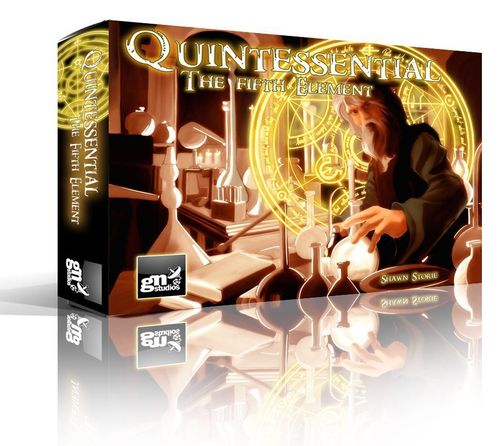
Quintessential: The Fifth Element
Quintessential: The Fifth Element Rulebook
Table of Contents
Table of Contents
Game Objective
Quintessential is a two-to-five player game where the players begin as apprentice students of alchemy competing to become the next master alchemist by mastering the fifth element and crafting the elusive Philosopher's Stone.
To accomplish this, each player must use their lab assistants to transmute "common" elements (fire, air, earth, and water) and achieve the ultimate alchemical recipe. This requires careful planning and formulation within your own laboratory and the competitive common laboratory all players share, while continually impressing the current master alchemist with the results of your labor and earning favors such as new formulae for your Personal Lab.
In the end, it's up to you to determine how best to combine the elements that are available, manage your own assistants and formulae, and become the next master alchemist.
Game Contents
Quintessential contains the following materials needed to play the game:
- 80 six-sided dice (10 red, 10 green, 10 yellow, 10 blue, 15 black, 25 white)
- 25 Lab Assistant tokens (5 black, 5 yellow, 5 green, 5 red, 5 blue)
- 51 game cards
- 1 Starting Player token
Game Overview
The race to the Philosopher's Stone will require each player to control five copies of the fifth element and one anti-element, and then use them to Claim the Philosopher's Stone formula, winning the game.
Elements are represented by dice. The four common elements of Fire, Water, Air, and Earth are represented by red, blue, yellow, and green dice. There are also two more exotic elements: the anti-element, represented by black dice, and the crucial fifth element, Aether, represented by white dice.
Aether (white dice) is the most perfect element. Not only can it be used in place of any element, but it can never be destroyed, regardless of how it is used. Each player will be racing to create five copies of the fifth element and one anti-element in order to fuel the ultimate formula of the Philosopher's Stone, and win the game.
The only way to create a white aether die is to use a forge. There are three forges that a player can use: their personal Multi-Forge in their own lab, and a shared Multi-Forge and Mono-Forge in the Public Lab which only one player per round can Claim.
Additionally, secret alchemical laws prevent the accumulation of too much of the fifth element. No matter what, a player cannot have more than five white aether dice in their personal element pool.
A Multi-Forge requires one of each of the four common elements (fire, water, earth, and air), destroying them and returning them to the shared stockpile of elements. The Mono-Forge requires four of the same kind of element to fuel its reaction, destroying them and returning them to the stockpile. Though black anti-element dice can be used in forges, white dice cannot be.
Anti-elements (black dice) are the alchemical equivalent of anti-matter. They are as versatile as the fifth element, but imperfect and highly unstable. They can also be used in place of any element, but when used in a formula they will immediately explode. In addition to five copies of the fifth element (aether), one anti-element is also required to create the Philosopher's Stone.
Game Setup
Anti-elements (black dice) are created when a player needs to collect a common element from the element stockpile (as a result of Activating or Claiming a formula), but the necessary element is not available in the stockpile; the player collects an anti-element instead. Additionally, if a player loses a Bid (detailed later on), the master alchemist takes pity on them and rewards them with a free black anti-element die. (A black die can also be purposefully created by claiming the Trade-Transmutus card, detailed later in the rules.)
To begin the game, all dice should be separated by color and placed within easy reach of all players to form the element "stockpile". Each player will then select their player color (red, blue, yellow, green, or black), and collect all five Lab Assistant tokens for their color, placing them near the player's "personal lab area". Each player's Personal Lab represents their own alchemical workshop, an area to house the alchemical formulae which only they have access to and will accumulate as the game progresses.
Each player will begin their starting Personal Labs by collecting a personal Multi-Forge card and a Dismiss card, along with one pair of starting formula cards. To select a pair of starting formula cards, the players should remove from the formula Draw Deck all cards with a number and color icon in the bottom right corner. Each player will select one set of two cards corresponding to their color, and the set numbers must match (both 1s, 2s, or 3s). If a player has selected black as his color, that player gets to select one matched set of any color, but only after all other players have selected their starting formula sets.
Any starting formula cards not chosen by the players are shuffled in with the other formula cards to create the Draw Deck. This is placed aside, and will next be used to help populate the Public Lab.
Each player will finish their Personal Lab by taking one fire (red), one water (blue), one air (yellow), one earth (green), and one aether (white) element die from the element stockpile to start their personal element pool. During the game, all formulae and bidding actions must use dice that are in a player's personal pool.
Finally the players will setup the Public Lab area by taking the Philosophi Lapis (Philosopher's Stone) card, the six claimable cards, the three biddable cards (those with a darker card background), and three formula cards from the Draw Deck and setting them up as shown in the diagram below.
The cards of the Public Lab represent publicly available formulae and forges that can be Claimed by one player, once per turn (the cards on the top row), and the special boons that can be granted as players bid against each other to impress the master alchemist (the cards on the bottom row). The players finalize the setup of the Public Lab by taking one of their five Lab Assistant tokens and placing it on the Extra Action card.
The source shows a layout diagram of the Public Lab here; it is not reproduced in this text.
Gameplay
As the game begins, gather one lab assistant token from each player and then randomly pick one. This player begins the game with the Starting Player token (the gathered lab assistants are then returned to their players).
The game consists of a series of rounds where players will take turns assigning their lab assistants to perform various actions which are detailed later on in the rules. Each round is broken into three phases of play: Phase 1 – Gather and Roll, Phase 2 – Turn Actions, and Phase 3 – Lab Cleanup.
Phase 1 – Gather and Roll
At the start of each round, all players will gather all the dice in their personal element pool and roll them (for the first round, this will be the five dice they start with). The rolled value of each die represents the quality of the elements they have refined, and can be used during the round to impress the master alchemist through the Bid turn action (detailed later on).
As the game progresses, each player's personal element pool will fluctuate as they add dice and destroy dice by using formulae. But at the start of every round, each player will roll all of the dice currently in their personal pool.
Phase 2 – Turn Actions
This is the critical phase of each round, where players will enact the strategies and planning efforts used to win the game. During the Turn Actions Phase, players will use their Lab Assistants to perform actions: Activate, Bid, Claim, or Dismiss. Each of these actions is detailed below.
Beginning with the player who has the Starting Player token and moving clockwise, each player will assign a single lab assistant and resolve its action, continuing in this fashion until all lab assistant tokens have been placed. Once all lab assistants for all players have been assigned, Phase 2 is complete.
Activate – Turn Action
By placing one of your lab assistants on the card, you may Activate a formula in your Personal Lab. This also requires you to also place all required element dice from your pool into the appropriate colored flasks on the card. The required dice flasks will have either a Return symbol or a Destroy symbol. (Source typo fixed: the source reads "will have either have".)
Dice placed on a Return symbol remain on the card until Phase 3, when they are returned to the player's personal pool. Dice placed on a Destroy symbol are immediately destroyed and returned to the element stockpile. (Unless it's a white aether die, which cannot be destroyed. In that case, it remains on the card and returns to the player's personal pool during Phase 3 – Lab Cleanup.)
Each formula card will also contain a colored flask with a Create symbol, which is the end result of the formula. When all required dice are placed on the card, the created die is immediately taken from the element stockpile and placed in the Create flask. (If the created element is not available in the stockpile, then a black anti-element die is created, instead.) However, the created element die does not have to stay on the card!
When a die is created through a formula, the player may immediately remove that created die from the card and roll it, then choosing to either add it into their remaining personal pool of elements, or "free place" it onto another formula card in their Personal Lab.
This is the only way a player can place dice onto a formula card without assigning a Lab Assistant token to the card, and is a key element of strategy in the game of Quintessential, allowing players to chain together formula effects into an "engine" of creation that can create multiple results beyond basic Lab Assistant Activation.
It may also be possible through free placement for a player to create an "infinite creation loop" of formula reactions within their personal lab; chaining together the same cards in a single Activation. This infinite loop represents an alchemical secret harnessed by the players, allowing them to ultimately refine the quality of the produced element as they re-create and re-create the same die.
When a player is able to Activate an infinite creation loop, they stop the loop at any point and pull the created die, automatically facing it to a side of their choosing and placing it in their personal element pool (or free placing it, as normal). This trick can give a player the element purity needed to win Bids by adding high value dice to their pool.
Example (from the source): the player wants a third yellow die for his pool, but his only formula card to create a yellow die (Geo-Ignis Nebula) requires a red die and a green die – which he doesn't want to tie up in the formula right now. So he decides to activate the Geo-Ignis Nebula card with "wild" aether and anti-element dice. He places one of his Lab Assistants and the white and black dice from his pool onto it. The required die flasks have Return symbols. Normally, he would return both dice to his pool at the end of the round but the black anti-element die is unstable, and will be immediately destroyed by activating the formula. So, the white die stays on the card (to be collected at the end of the round), the black die is destroyed, and a yellow die is created.
Example (from the source): the player wants a fourth blue die for his pool, but his only formula card to create a blue die (Aero-Frigo Convertus) requires a yellow die – which he doesn't have. So he decides to activate his Geo-Ignis Nebula card, placing one of his Lab Assistants and the required red and green dice from his pool onto it. The required die flasks have Return symbols, so the two dice remain on the card (and will return to his personal pool at the end of the round). He then takes the created yellow die and immediately free places it onto the Aero-Frigo Convertus card, which has a destruction symbol, destroying the yellow die, but creating the blue die he wants, which he immediately rolls and then places into his personal pool.
Example (from the source): the player has multiple complex formula cards in his Personal Lab, and is going to use free placement to build a simple engine that will earn him an extra die. On his first turn during the round, he places a Lab Assistant and the required green and red dice on the Geo-Ignis Nebula card, immediately free placing the created yellow die on the Aero-Turbis Novis card. On his second turn, he Activates his Geo-Frigo Nebula card with a Lab Assistant and required green and blue dice, free placing the generated yellow die on the remaining open slot of the Aero-Turbis Nova card. Now fully powered (no open required dice slots), the Aero-Turbis Nova card immediately creates a red die, which the player rolls into his personal pool, and at the end of the round, the player collects the two created yellow dice back into his pool (as they were placed on Return symbols). The player generated three new dice by only using two Lab Assistant Activations!
Note: card names are transcribed as printed. The source spells one card both "Aero-Turbis Novis" and "Aero-Turbis Nova" within the same example, and its final example uses "Geo-Frigo Nebula" where the earlier examples use "Geo-Ignis Nebula"; these inconsistencies are in the source and have not been corrected.
Bid – Turn Action
The bottom row of the Public Lab contains six cards that can be Bid upon as a turn Action. These bottom row cards represent favors and special formulae controlled by the current master alchemist, and the Bid action represents the fledgling alchemist players attempting to impress the master by showing him the quality of their work – in order to be rewarded with these bottom row boons. In bidding, the color of dice used doesn't matter, only the numerical value of the dice, which represent the purity and quality of the refined element.
As an action, a player may assign one of his Lab Assistants beneath a biddable card, along with one or more dice from his personal pool of elements, as shown in the example below. If a bid is already on the card, the player's bid dice total must exceed the value of the highest bid already on the card. If a player is out-bid, they may use another action on another turn that round to bid on the card again – but this requires placing a new Lab Assistant and new dice from his pool. (A player cannot "add" to a bid already on the card; additional bids are entirely separate bids).
At the end of the round (during Phase 3 – Lab Cleanup), the player with the highest bid claims the effect of the biddable card. Even if a player has multiple Lab Assistant tokens and bids on a card, only the highest bid wins, and the card effect is only claimed once at the end of the round.
All Lab Assistant tokens and bid dice are returned to each player's personal element pool (even black dice, which were not used in a formula, and thus are not destroyed). Any players who lost a bid on a card gain pity from the master alchemist, and are rewarded with a free black anti-element die for their personal pool. (This only occurs once for each card, even if a player had multiple losing bids on a single card.)
Each of the six biddable cards in the bottom row provides a unique effect if won. These cards and their unique effects are detailed below.
Formula Cards (Bottom Row)
The three formula cards in the center of the bottom row are the most straight-forward of the biddable cards. These are formulae owned by the master alchemist, and players are bidding to add these formulae cards to their own Personal Labs.
Each of these cards is bid on individually, and the player who wins a card gets to add it to their Personal Lab. Any formula cards not bid upon are discarded during Phase 3 – Lab Cleanup. This means that a fresh set of three new formulae will be available as biddable cards each round of the game.
Extra Action Card
The player who wins the bid for the Extra Action card will claim their fifth Lab Assistant token from the card. This extra Lab Assistant is placed at the bottom of the player's Dismiss card and remains there until it is used.
In future turns, a player may elect to assign his extra Lab Assistant at the start of his turn, and then assign his normal Lab Assistant token for that turn – essentially getting two full actions on a single turn. However, once the extra Lab Assistant is used, it is returned to the Extra Action biddable card during Phase 3 – Lab Cleanup.
A player cannot bid on the Extra Action card unless they have their fifth Lab Assistant token on the card.
Starting Player Card
The player who wins the bid for the Starting Player card will claim the Starting Player token. However, they are not required to keep it. They may give it to any other player (or keep it for themselves). The player holding the token is the starting player in the next round, and remains the starting player each round, until the token is reassigned.
Draw Card
The player who wins the bid for the Draw card will get to draw a random formula from the top of the formula Draw Deck.
This occurs during Phase 3 – Lab Cleanup before the deck is used to re-populate the biddable formula cards on the bottom row.
Claim – Turn Action
For the most part, the Claim action functions like Activate – except that the player is not activating a card in their Personal Lab, but in the Public Lab.
Five of the six Claimable cards in the top row of the Public Lab are formulae that are usable by any player. A player may assign one of their Lab Assistant tokens to one of these cards along with any required element dice, complete the formula, and gain the created die. These created dice may even be rolled and free placed to a card in the player's Personal Lab or into the player's pool, just like activated formulae in the player's Personal Lab. Each of the six claimable cards are detailed below.
Transmutus Cards
The claimable Multi-Transmutus and Mono-Transmutus cards are not as efficient as normal formulae cards, but are much more versatile.
Multi-Transmutus requires three different elements to power it, creating a fourth, different element (the color not used in the formula). For example: a yellow, red, and green would create a blue. The Mono-Transmutus card requires three of the same color of element, and creates a fourth die of that same color. White and black dice can be used as normal in these cards, representing any color the player chooses. (Black dice are still always destroyed when used in a formula, as normal.)
The unusual Trade-Transmutus card works differently from any other formula, and requires two dice to power it: a white fifth element die and second element of any color. The fifth element die "powers" the reaction, destroying the second die and creating a new die of a different color. Trade-Transmutus is also the only formula card that can be actively used to create a black anti-element die, regardless of element availability in the stockpile. In other words, a player can Claim the card and elect to produce a black die as the formula result, even if all 4 common elements are available.
Forge Cards
The publicly claimable Multi-Forge and Mono-Forge cards are explained earlier in the rules, requiring four different elements or four of the same kind of element (respectively) to fuel their reactions. The scarcity of forges makes these claimable cards hotly contested.
During Phase 3 – Lab Cleanup, the white die (placed on the card's Return symbol) is returned to the player's pool.
Black anti-element dice can be used in a Forge to represent any color, but remember – a white die cannot be used in a forge.
Discard Card
The Discard card is the only claimable card that is not a formula, and requires no dice to Claim; only the assignment of a Lab Assistant token on the card. During each round's Phase 3 – Lab Cleanup, all biddable formula cards in the bottom row that received no bids will be discarded and placed underneath this Discard card. After this occurs, the player who claimed the Discard card that round will sift through the accumulated discarded formulae and select one card to add to his Personal Lab.
Dismiss – Turn Action
The last action a player can take with one of their Lab Assistants is to Dismiss them; sending that assistant back to the Personal Lab to work on increasing the quality of the player's existing personal element pool.
A player taking this Action places their Lab Assistant token for that turn on their Dismiss card. In return, the player may immediately reroll any of the element dice remaining in their personal element pool. However, they must take the results of any reroll, even if it is worse than the original value on the die.
Sometimes, a player's only option will be to Dismiss, especially if they are completely out of elements in their personal pool, if the dice remaining in their pool cannot outbid anyone, or if their remaining dice cannot complete any formulae.
Phase 3 – Lab Cleanup
In this final phase of the round, the players will claim rewards, clean public and private labs, and prepare for the next round of play. Players will perform the following four steps, in order:
- Players clean their Personal Labs. This means removing any Lab Assistant tokens from formula cards and returning any element dice on Return symbols back to your personal element pool.
- Players clean the bottom row of the Public Lab (the biddable cards). The Draw card, Starting Player card, and Extra Action card effects are resolved, if won. Any biddable formula cards that were not bid on are immediately discarded and placed beneath the Discard card; while won biddable formula cards are taken by the winning player and added to their Personal Lab.
- Players clean the top row of the Public Lab (Claimable cards). This means removing any lab assistant tokens from formula cards and returning any element dice on a Return symbol back to your personal element pool. Any claimer of the Discard card will then select a discarded formula for their Personal Lab.
- Finally, three new cards are drawn from the Draw Deck to replace the three biddable formula cards on the bottom row of the Public Lab, and any Extra Action Lab Assistants used this turn are returned to the Extra Action card.
Winning the Game
The goal of the game of Quintessential is to supplant the current master alchemist by being the first to craft the Philosophi Lapis (Philosopher's Stone) card. This special card is placed near the top row of the Public Lab, and functions like a claimable card. It requires a Turn Action to activate.
The Philosopher's Stone card requires the normal placement of a Lab Assistant token, along with six required dice: five copies of aether and one anti-element.
The first player to Claim this card will immediately win the game, becoming the next master alchemist!
Phases of Each Round
Phase 1 – Gather and Roll
- Every player gathers all the dice in their personal element pools and rolls them.
Phase 2 – Turn Actions
- From the Starting Player, moving clockwise, each player assigns one of their four Lab Assistants, continuing until all Lab Assistant tokens have been assigned.
- Assign a Lab Assistant to do the following Actions:
- Activate formula in your Personal Lab
- Bid on bottom-row cards in the Public Lab
- Claim top-row cards in the Public Lab
- Dismiss your Lab Assistant
Phase 3 – Lab Cleanup
- All players return their Lab Assistant tokens and any dice still in play to their Personal Labs.
- Bids are resolved, formula cards not bid on are discarded, three new formulas are drawn into the bottom row of the Public Lab, and used Extra Action Lab Assistants are returned to the Public Lab.
Winning the Game
- The first player to Claim the Philosopher's Stone wins the game!
Remember the Golden Rules
Anti-Element Instability
Black dice are "wild" but unstable. They are always destroyed when used – unless used to Bid.
Conservation of Perfection
A fifth element cannot be used to create a fifth element. In other words, you can never use a white die in a Forge card.
Also, a player may never have more than five white dice in their personal element pool.
Free Placement
When a die is created, it may be immediately rolled into your personal element pool – or – placed into any card in your Personal Lab that has room for it.
Infinite Creation Loop
If a player activates an infinite loop of element creation through Free Placement, they may pull the created element die out of the loop at any point, and automatically face it to a side of their choosing.
The Master's Pity
For each Bid a player loses, they are rewarded with a black anti-element die during the Lab Cleanup Phase.
Note: the Master's Pity golden rule says "for each Bid a player loses", while the Bid section above says the free black anti-element die is awarded "only once for each card, even if a player had multiple losing bids on a single card." Both are transcribed as printed; this prototype text does not resolve the conflict.
Note: the source does not state how a tie for the highest bid on a card is resolved, and no tie rule has been added.