Quintazone
Quintazone Rulebook
Table of Contents
Table of Contents
Setup
Original Version
Give each player pyramids from a different stash:
- 2 players: a whole stash each
- 3 players: 9 pyramids each (3 of each size)
- 4-5 players: 6 pyramids each (2 of each size)
Set aside all the Action cards from the deck; they will not be used. If you are playing with the newer 80-card Aquarius deck, also set aside the 10 diagonal Element cards, one full-panel card of each Element, and the Wild Card.
Place a four-panel Element card face-up in the middle of the table (it doesn't matter which one). Shuffle the remaining 39 Element cards and deal a hand of 5 to each player. Shuffle the 5 Goal cards and deal 1 to each player. Players may look at their Goal cards but should keep them hidden from the others until game end.
Alternate Version
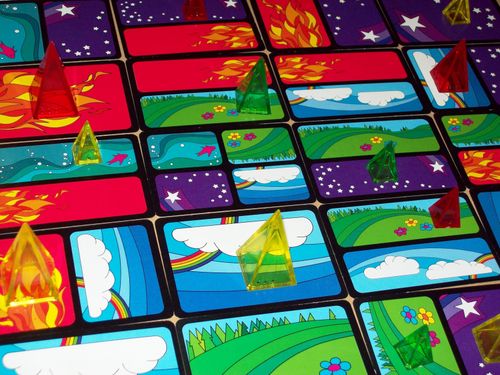
Completed game of Quintazone with 55-card deck (Cyan defeated Pink)
If you have the newer 80-card Aquarius deck, you can choose to play with all 55 of the Element cards (omitting the Wild Card). In that case, use pyramids as follows:
- 2 players: a whole stash (five trios) each (15 pyramids)
- 3 players: four trios each (12 pyramids)
- 4 players: three trios each (9 pyramids)
- 5 players: two trios each (6 pyramids)
Place a four-panel card on the table, and deal five Element cards and a Goal card to each player, as before.
Playing
The player whose age is closest to a multiple of 5 goes first. Play continues clockwise around the table. A turn consists of the following two actions, in either order:
- You must place a card.
- You may place a pyramid.
At the end of your turn, draw an Element card from the deck, if there are any remaining.
Placing a card
Cards are placed face up in the center of the table according to standard Aquarius placement rules (see the legal and illegal placement diagrams at the Looney Pyramid Games Wiki, wunderland.com/LooneyLabs/Aquarius/gifs/LegalPlays.gif and IllegalPlays.gif):
All players build on the same playing field. Each Element card must be played so that one of the elements on it matches up with a card already in play. Diagonal connections don't count. Cards cannot be placed skewed or perpendicular to one another.
Placing a pyramid
A Zone is a connected set of one or more panels of the same element. A pyramid may be placed in any Zone that does not already contain a pyramid. Zones containing pyramids may become merged into a single Zone through later card placement, but at the time of pyramid placement the Zone must be empty. Pyramids are never moved or removed after they are placed.
Game end and scoring
The game ends when all Element cards have been placed. All Goal cards are then revealed, and every pyramid scores points for its owner: its size (1, 2, or 3) multiplied by the size (number of cards) of its Zone, doubled if the element of the Zone matches the player's Goal card. The player with the most total points wins.