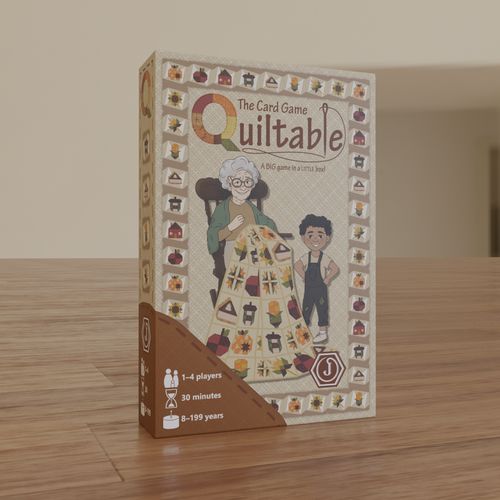
Quiltable: The Card Game
Quiltable: The Card Game Rulebook
Table of Contents
Table of Contents
Object
Score points by creating a unique 4x4 quilt.
Setup (Step 1)
Shuffle all pattern cards. Remove cards from the deck based on the number of players before dealing anything out:
| Players | Cards removed | Cards remaining |
|---|---|---|
| 1–2 | 48 | 48 |
| 3 | 24 | 72 |
| 4 | 0 | 96 |
(See page 14 rules below for a 1–8 player variant using two copies of the game.)
Place the remaining pattern cards into 4 roughly equal draw piles. Then flip 12 cards to their quilt-block side and arrange them around the 4 draw piles to form the Pattern Area.
The player with the most colorful socks begins the game. Give this player a turn-marker card; play proceeds clockwise from there.
Your own quilt begins as an empty 4x4 grid that you fill in as you play.
Taking Your Turn (Step 2)
On your turn, take up to 2 actions. You may take the same action twice (see the clarifying rules in Additional Rules below). Then pass the turn-marker card to the next player.
The 3 available actions are:
- PLAN — Choose 1 available pattern card and place it face up near your quilt.
- CHOOSE — Take 2 or 3 connected quilt blocks from the Pattern Area and add them to your quilt. Immediately refill the Pattern Area (see Refilling the Pattern Area below).
- RETURN — Move 1–4 connected cards from your quilt to the outside ring of the Pattern Area (see Returning Cards below).
Ending the Game (Step 3)
You trigger the end of the game when either condition below is met. If you trigger the end of the game, finish your turn, and then each other player takes one final turn.
- All 4 pattern draw piles are empty before your turn.
- Your quilt is complete after your turn.
Scoring and Victory (Step 4)
You score points in the following ways:
- For each pattern card, multiply its listed point value by the number of times that pattern is completed in your quilt, counting each block only once per completion of that particular pattern.
- Add 1 point for each premium quilt block (blocks marked with a "1" in the corner) in your quilt.
- Add a 5 point bonus if you fully completed your 4x4 quilt.
Total your points from each category. The quilter with the most points wins. In case of a tie, the player later in turn order wins.
Scoring Example
For an example finished quilt, a player's score might break down as follows: 11 points for premium blocks, 12 points for a first completed pattern (shown in white), 6 points for a second completed pattern (shown in yellow), and a 5 point bonus for finishing the quilt, for a total of 34 points.
Additional Rules
Completing Patterns
Each block counts toward a given pattern only once per completion of that pattern. A cluster of 4 blocks that satisfies a pattern in two overlapping ways scores for both completions.
Letters. Many patterns contain letters, which may represent any type of block but must follow the specified pattern. For example, A-A-A indicates any set of 3 adjacent matching blocks, while A-B-C indicates any 3 adjacent blocks that are all different from one another. A single letter pattern may match different block types on different instances of scoring — for example, an A-A pattern could score once for 2 adjacent pumpkin blocks and again for 2 adjacent sunflower blocks in the same quilt. When scoring, patterns may be rotated as needed. The pattern-card types are:
- Specific Pair — 2 specific blocks that must be adjacent (may score up to 8 times in a single quilt).
- Specific Square — 4 specific blocks that must be adjacent (may score up to 4 times in a quilt).
- Partial Square — 1 specific block next to 3 adjacent letter blocks; any letter block may match the first block (may score up to 4 times in a quilt).
- Partial Short Line — 1 specific block adjacent to 2 letter blocks; a letter block may match the first block (may score up to 5 times in a quilt).
- Partial Long Line — 1 specific block adjacent to 3 letter blocks; any letter may match the specific block (may score up to 4 times in a quilt).
- Long Line — 4 letter blocks that must be adjacent (may score up to 4 times in a quilt).
- Unique Arrangements — 4 letter blocks with a unique arrangement in a 9-square portion of your quilt; instances of the pattern may overlap with other instances as long as each lettered spot is counted only once (may score up to 2 or 4 times, depending on the pattern).
Each pattern card shows its pattern and its point value for finishing on the front, and an icon on the back indicating the block type it becomes once flipped to its quilt-block side.
Connected Cards Rule
You may CHOOSE or RETURN blocks only if they are connected by a flat edge to one another — blocks connected only diagonally do not count as connected. When you place a group of blocks into your quilt, they must remain joined to each other in the same way they were connected in the Pattern Area, though the whole group may be rotated as desired.
Single Quilt Rule
Your quilt must always remain a single connected group. Any time quilt blocks are added or removed, every remaining quilt block must still be connected to the rest of your quilt by a flat edge. Your quilt may never exceed the limits of a 4x4 square.
Refilling the Pattern Area
When quilt blocks are taken with the CHOOSE action, immediately refill the emptied spots from the nearest pattern draw pile. If multiple spots must be refilled from the same pile, the active player decides which card goes where. Blocks on the outer edge that were placed there by a RETURN action are not replaced.
Whenever a pattern draw pile itself empties, immediately refill that spot with a quilt block taken from an adjacent pattern pile. This keeps expanding the block options available to players as the draw piles run down.
Returning Cards
When you RETURN cards, you may split the group up and place the cards anywhere on the outside edge of the Pattern Area. Returned cards become available for any player to CHOOSE.
If a returned card ends up stranded in a corner once other blocks are chosen around it, move it so that it stays connected to the main Pattern Area.
Terms
- Pattern card — A card showing a pattern, a block type, and points for finishing. One side is the pattern side (used for scoring); the other is the quilt-block side (used when placed in a quilt or the Pattern Area).
- Quilt block — A pattern card flipped to its quilt-block side.
- Patch — The small decorative patch design printed on each quilt block, used in the Advanced Game.
- Patch type / patch position — The patch's design and its position on the block, both used when matching patches in the Advanced Game.
- Premium block — A quilt block marked with a "1" in the corner, worth 1 point at the end of the game regardless of pattern.
The 8 quilt-block types are: corn cob, pumpkin, sunflower, leaf, acorn, pie, apple, and cottage.
Advanced Game
Below are 3 extra modules that can be added for an advanced game. All 3 can be used together, or you can pick just 1 or 2 if you prefer.
Patches
Each quilt block carries 1 of 4 patch types in 1 of 3 possible positions, and the same patch is repeated on both sides of the block. As you place blocks into your quilt, try to match the patch on each new block with patches already on blocks in your quilt.
At the end of the game, score 3 extra points for every pair of adjacent patches that match in both type and position. A perfectly matched quilt could score as much as 72 extra points this way.
Symmetry
A symmetrical quilt is difficult to achieve, but scores 15 extra points if you manage it. A quilt is symmetrical if, when folded vertically, horizontally, or diagonally, every block type lines up with a matching block type on the other side of the fold.
You may score the symmetry bonus even if your quilt is not finished, as long as the empty spaces could have been filled to match the rest of the quilt.
Quilting Assistants
Each player randomly takes an assistant card, then chooses 1 of its 2 sides to use for the rest of the game. Place 1 additional assistant card in the center of the playing area. During any one of your actions in a turn, you may instead trade your current assistant for the one in the center.
The assistants and their abilities are:
- Big Billy (once per turn, for 1 action) — You may CHOOSE 1–4 connected cards instead of the usual 2–3.
- Gifted Gladys (for 1 action) — You may CHOOSE and RETURN unconnected blocks. As you CHOOSE blocks they must remain in the same relative position to each other. After this action, your quilt must still be a single connected piece.
- Granny Smith (once per turn, for 1 action) — Without looking at the other side, you may flip 1 of your quilt blocks back over and place it with your other pattern cards.
- Mayhem Maddie (once per turn, free) — You may flip the assistant card of 1 other player. That player may immediately give you any 1 pattern card to undo the flip.
- Planning Peter (ongoing) — The Single Quilt Rule does not apply to you; the 4x4 size limit still applies, but you may leave gaps in your quilt as you CHOOSE or RETURN cards.
- Sneaky Sally (for 2 actions) — You may spend both of your actions to PLAN by taking 3 patterns instead of 2 (these can come from different piles).
- Swap Shop Sandra (once per turn, for 1 action) — You may trade 1 block from your quilt for a single quilt block from the Pattern Area.
- Terrific Tim (up to twice per turn, free) — You may donate 1 pattern card to another player and receive a third (or fourth) action that turn.
- Tricky Travis (for 1 action) — You may switch assistant cards and their associated abilities with another player.
- Uncle Sam (once per turn, for 1 action) — You may flip 1 of your pattern cards and add it to your quilt, or take a pattern card and flip it immediately.
Variations
All Cards
Instead of removing cards based on player count, use all the cards in the box. The extra cards give you more time to PLAN patterns and more opportunities for high scores.
Symmetrical Race
Build the Pattern Area just as in the regular game, but in this variant don't use patterns, premium blocks, patches, or points.
Object: Be the first to complete a Qualifying Quilt. A Qualifying Quilt must be symmetrical — vertically, horizontally, or diagonally — meaning that when the quilt is folded over along that line, all block types match. Quilts are still 4x4. Remember that on a diagonally symmetrical quilt, any block type can go down the center line, since a block always matches itself.
Each turn, take 2 actions split between CHOOSE and RETURN; the PLAN action does not apply in this variant. The RETURN action is especially important here, since pivoting your strategy mid-game is often the key to winning, and the number of returned cards surrounding the Pattern Area is not limited.
Ending the game: As soon as a player completes a Qualifying Quilt, the game ends immediately. If a player finishes their quilt but it is not symmetrical, the game continues until someone successfully assembles a Qualifying Quilt.
Quick Start Game
Setup
Place the pattern cards into 4 piles and give each player a pile. Each player chooses 1 pattern card from their pile to use for the whole game, and returns the rest of that pile to the table. Flip 3 cards from each pile to their quilt-block side and arrange them around the pattern piles to form the Pattern Area. The player with the most colorful socks begins.
Taking Your Turn
On your turn, take 1 of the 2 actions below, then pass the turn-marker card to the next player.
- CHOOSE — Take 2 or 3 connected quilt blocks from the Pattern Area and add them to your quilt. Refill the Pattern Area from the nearest pile.
- RETURN — Move 1–4 connected cards from your quilt to the outside ring of the Pattern Area.
Ending the Game
Once a player completes a 4x4 quilt, give each other player 1 more turn, and then end the game.
- Count the points for your pattern card once for each time it appears in your quilt.
- Add 1 point for each premium quilt block (blocks marked with a "1" in the corner) in your quilt.
- Add a 5 point bonus if you fully completed your 4x4 quilt.
Solo Game
For 1 player.
Pick a Quilting Master (QM) to compete against, from the list below. Designate a turn marker as the QM card and place it by any corner of the Pattern Area.
You go first and take your turns according to the normal rules. On the QM's turn, move cards to a QM Scoring Stack as follows:
- Take quilt blocks, moving clockwise starting from the QM card, and add them to the QM Scoring Stack.
- Move the QM card to the next available block.
- Refill the Pattern Area.
The QM difficulty levels, and how many blocks the QM takes each turn, are:
- Granny Smith (easy) — Take 1 card in the basic game, 2 with advanced modules.
- Terrific Tim (medium) — Take 2 cards in the basic game, 3 with advanced modules.
- Gifted Gladys (hard) — Take 3 cards in the basic game, 4 with advanced modules.
- Big Billy (extreme) — Take 4 cards in the basic game, 5 with advanced modules.
The usual criteria end the game, but you take the last turn. Flip the QM Scoring Stack over to the pattern side and tally the QM's points from that stack, with each pattern scoring exactly once. Then add up your own points as normal. If you have the most points, or tie the QM, you win.
5–8 Players (Mini)
5–8 players, 1 copy of the game.
With a single copy of the game, you can play a mini game with 5–8 players. Shuffle in 12 cards per player. Most rules remain the same, but you build a 3x3 quilt instead of a 4x4 one, and you may not use the PLAN action to take any Long Line or Partial Long Line patterns. Play with the basic rules or the advanced modules, but do not use quilting assistants.
5–8 Players (Full, 2 Copies)
With 2 copies of the game, you can play a full game with 5–8 players. Shuffle in 24 cards per player. Most other rules remain the same, and duplicate patterns may now be claimed by more than one player. If you use quilting assistants, 2 players may choose the same assistant.
Basic games usually take about 15 minutes plus 5 minutes per player; advanced games can take slightly longer.
5–8 Players (Speed, 2 Copies)
With 2 copies of the game, you can also play a speed game. During setup, shuffle in 24 cards per player. Set up 2 separate Pattern Areas, with 2 turn markers to distinguish the areas, then assign the other 2 turn markers to the players sitting crosswise from each other.
When you are holding a turn marker, take your turn using that Pattern Area. With 2 players taking turns at once, Tricky Travis and Mayhem Maddie may not target the other currently-active player. A turn marker skips a player if it comes back to them while they are still in the middle of using the other turn marker.
Separating Cards
If you combine 2 copies of the game to play with more players, you'll need to separate the cards back into 2 sets afterward. See the online product page for a video demonstration.
- Sort the quilt block cards by type. Each copy of the game has 12 cards of each of 8 types, so a 5–8 player game may have up to 24 cards of a given type mixed together.
- Slide the cards so the edge of each card is visible, then remove any cards where the patch type and position match one already set aside — these duplicates go into the second copy's set.
- Verify you have 12 of each block type, then set aside 1 of each quilting assistant, 2 turn-marker cards, and 2 reference cards to go back in the original box.
Additional Resources
Optional printable scoring sheets and rules videos are available on the product page. Scoring sheets aren't required, but can help in games with high player counts or multiple advanced modules in play.
Product page: CircleJGames.com/product/quiltable-the-card-game
Contact: [email protected]
Design by Jared & Madeline Richardson. Art by Abby Jones & Hanna Beach.