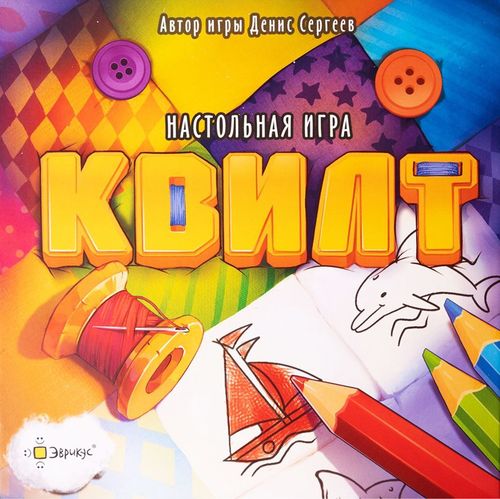
Квилт (Quilt)
Квилт (Quilt) Rulebook
Table of Contents
Table of Contents
Components
- 5 notebooks with game boards (1)
- 24 pencils (4 sets of 6 pencils in different colours) (2)
- 6 patch tokens (3)
- 5 needle holders for the pencils (4)
- 1 pencil bag (5)
- 1 first player token, shaped as a button (6)
Before the first game, assemble the needle holders as shown in the assembly diagram.
Components may differ from those shown in these rules.
Setup
Before the game, prepare the needle holders and pencils according to the number of players (see the table below). Return any pencils that are not used in this game to the box; they do not take part in this game.
| Players | Needle holders | Pencils (set of 6 pencils of different colours) |
|---|---|---|
| 2 | 3 | 2 sets: 12 pencils |
| 3 | 4 | 3 sets: 18 pencils |
| 4 | 5 | 4 sets: 24 pencils |
- Put all the prepared pencils into the bag and mix them.
- Place the needle holders in the centre of the table so that all players can reach them easily.
- Place the 6 patch tokens next to the needle holders.
- Each player tears off one game board sheet from any notebook and places it in front of them.
- The player who most recently sewed something receives the first player token.
You are now ready to play.
Goal
During the game, colour the picture cells on your game board to score as many victory points as possible by the end of the game.
Victory points are scored for:
- coloured quilt cells;
- coloured appliqués;
- the collection of thread spools;
- the collection of buttons.
Game Board
Each player receives a game board showing a quilt. The game has 5 quilt designs: transport, animals, plants, gemstones and desserts. The game boards differ only in their pictures, and players may use different boards in the same game.
The game board is labelled as follows:
- Appliqués (the three pennant markers at the top, showing +3, +5 and +7);
- Quilt (5 rows of cells);
- Space for recording victory points (the column on the right of the quilt);
- Spools (the threads row);
- Embroidery (the three embroidery patterns);
- Buttons (the button collection).
Quilt cell: a picture, the victory points printed in the bottom left corner, and a bonus printed in the corner of the cell, if the cell has one.
Gameplay
The game is played over a series of rounds. Each round is divided into 3 consecutive phases:
- Choosing a patch.
- Distributing pencils.
- Colouring the game board.
Phase 1: Choosing a Patch
Starting with the first player (the holder of the first player token) and proceeding clockwise, each player chooses one patch and places it in front of them.
The colour of the chosen patch is the player's bonus colour for the current round. If a player colours a quilt cell with a pencil of their bonus colour, they may colour the cell completely (picture and background). At the end of the game, each such cell is worth 1 additional victory point.
Phase 1 ends when every player has taken one patch. The remaining patches stay in the centre of the table until the next round.
Phase 2: Distributing Pencils
Starting with the first player and proceeding clockwise, each player must perform one of the following actions:
- Place two pencils on the needle holders; or
- Place one pencil on a needle holder, and then take a needle holder with pencils; or
- Take a needle holder with pencils.
Placing a pencil on a needle holder: the player draws a pencil from the bag without looking and places it on any needle holder of their choice. If the player needs to draw two pencils, they draw them one at a time and may place both on the same needle holder or on different ones.
Important: each needle holder may hold a maximum of 3 pencils. If every needle holder already holds 3 pencils, this action cannot be chosen.
Taking a needle holder with pencils: the player takes one of the needle holders that holds at least one pencil and places it in front of them. Once they have taken a needle holder, the player takes no further actions in Phase 2 and waits for the next phase to begin.
Important: the player who first takes a needle holder with pencils immediately receives the first player token. They are now the first player.
Phase 2 ends when every player has taken one needle holder with pencils. One neutral needle holder remains in the centre of the table. Players must fill it completely with pencils (3 pencils).
Phase 3: Colouring the Game Board
In this phase, players use the pencils they have received to colour their game boards. Players may colour their boards at the same time; they do not take turns.
Important: when learning the game, we recommend taking actions in turn order, so that you can learn all the game effects and the order in which they are applied.
A pencil can be used in one of three ways:
- A. Colour a quilt cell.
- B. Colour an appliqué.
- C. Colour the threads on a spool.
A player may use the pencils on their needle holder in any order, but each pencil may be used only once.
Colouring a quilt cell can give a bonus that allows the player to take new pencils. In this way a player may use more pencils than were on their needle holder. Additional pencils are used under the normal rules.
A player may use all or only some of the pencils they have received. Unused pencils are not kept for later rounds.
Phase 3 ends once all players have finished using their pencils, including any pencils gained from bonuses.
A. Colour a Quilt Cell
The player takes any pencil from their needle holder and colours the picture in one quilt cell with it.
Important rules for colouring:
- Pictures in quilt cells are coloured strictly from left to right, starting with the first uncoloured cell.
- Cells of the same row may be coloured in only one colour.
- Row colours must not repeat across the quilt; each row has its own colour.
- The player colours only the picture in the cell, not its background. However, if the colour of the pencil used matches the player's bonus colour, the cell is coloured completely (picture and background). Such cells score 1 additional victory point at the end of the game.
- When a player colours a cell that has a bonus, they receive the effect of that bonus immediately (see the Bonuses section).
B. Colour an Appliqué
The player takes any pencil from their needle holder and colours one appliqué of their choice.
An appliqué may be coloured only if the column it points to still has no coloured cells.
Each coloured appliqué scores points at the end of the game if every cell in the column it points to has been coloured. However, if any cell in that column is still uncoloured at the end of the game, the player receives penalty points for the appliqué (with a minus sign).
C. Colour the Threads on a Spool
The player takes any pencil from their needle holder and colours the threads on the first uncoloured spool in the row.
Important rules for colouring:
- Threads on the spools are coloured strictly from left to right, starting with the first uncoloured spool in the row.
- At the start of the game, only the first 2 spools are available to the player. The other 5 spools become available through a bonus.
Bonuses
Bonus description: if a quilt cell that has just been coloured shows a bonus, the player receives its effect immediately. The player is not obliged to use the bonus, although it is usually useful.
The bonuses are:
Extra pencil of the matching colour (shown as the six coloured pencils): the player takes an additional pencil of the corresponding colour. The pencil may be taken from the bag, from the neutral needle holder, requested from another player, or the player may reuse one of their own pencils. The pencil is used immediately under the normal rules and then returned to its place. It cannot be set aside and used later.
Pencil from the neutral needle holder (shown as a needle holder): the player takes one of the 3 pencils on the neutral needle holder. The pencil is used immediately under the normal rules and then returned to its place. It cannot be set aside and used later.
Exchange pencils (shown as the pencil bag): the player may exchange 1 or 2 unused pencils from their own needle holder for the same number of pencils from the bag. Pencils received through bonuses cannot be exchanged.
Exchange rules:
- The player chooses the pencils they plan to exchange.
- They draw the same number of new pencils from the bag and add them to their needle holder.
- They put the chosen pencils into the bag.
Important: if several players receive this bonus in the same round, the player holding the first player token performs the exchange first (or the player nearest to them clockwise).
Make a new spool available (shown as a spool): the player circles the spool with a pencil and colours the spool itself, without touching the threads on it. The spool is now available, and threads can be coloured on it.
Button (shown as a button): each button on a coloured quilt cell scores victory points at the end of the game (see the Scoring section).
Embroidery stitch (shown as a cell with a stitched line): after colouring a quilt cell with this bonus, the player may use the same pencil to colour one part of any embroidery.
There are 3 kinds of embroidery on the game board: embroidery of 5 parts, of 3 parts, and of 2 parts. As soon as all parts of any embroidery are coloured, its effect is triggered:
- Embroidery of 5 parts: the player takes 2 pencils from the neutral needle holder and/or from the bag (without looking) and immediately uses them under the normal rules. After use, return the pencils to their original place.
- Embroidery of 3 parts: the player takes 1 pencil from the neutral needle holder or from the bag (without looking) and immediately uses it under the normal rules. After use, return the pencil to its original place.
- Embroidery of 2 parts: the player gains the right to colour the background of those quilt cells in which they have already coloured the picture during the current round.
End of Round
All pencils are returned to the bag and mixed. Players return the needle holders and the patch tokens to the centre of the table. A new round begins with Phase 1.
End of Game
The game ends at the end of the round in which one of the players has met one of the following conditions:
-
All cells of any 3 rows of the quilt are coloured.
or
-
All cells of any 2 rows of the quilt are coloured, and the threads on all spools are coloured.
Players finish the round under the normal rules and then proceed to scoring. The winner is the player with the highest total of victory points.
If several players have the same total, the winner is the player whose single quilt row scored the most victory points.
Scoring
Players count their victory points in each row of their game board and write them in the rightmost column. Then they add up the points and determine the winner.
Example of scoring:
1. Appliqués
A coloured appliqué scores its victory points with a plus sign if every cell in the column it points to is coloured. If at least one cell in the column is not coloured, the points are recorded with a minus sign.
In the example, the player scores 3 victory points for the first appliqué (+3), but loses 7 victory points for the third appliqué (+7).
The player did not colour the appliqué +5, so it is not counted at the time of scoring.
Total: -4 victory points.
2. Quilt
Each row of the quilt scores the player as many victory points as are printed on the last (rightmost) coloured cell in that row. Add to this value the number of fully coloured cells in the row.
In the example, the player scores:
- Row 1: 1 point on the last cell + 2 points for fully coloured cells = 3 points
- Row 2: 15 + 2 = 17 points
- Row 3: 14 + 2 = 16 points
- Row 4: 24 + 3 = 27 points
- Row 5: 10 + 1 = 11 points
3. Thread Spool Collection
Write down the victory points of the rightmost spool with coloured threads. Add 10 additional victory points if the row of spools includes spools with threads in 6 different colours.
In the example, the player scores 8 + 10 = 18 victory points.
4. Button Collection
Write on the left of the multiplication sign the number of buttons collected, and on the right the victory points of the quilt row that scored the fewest points. In the scoring column, record the product of these numbers.
In the example, the player scores 3 × 3 = 9 victory points.
5. Total
Add up the victory points recorded for each row.
In the example, the player scored 97 victory points.
"Everything Counted" variant: the game follows the basic rules with one exception. After counting the points for buttons, choose any 2 rows of the quilt and record their points with a minus sign. Then add up the points.
Variants
"Quiltmania for Four": when setting up a game for four players, put one set of pencils fewer in the bag than the 4-player setup calls for.