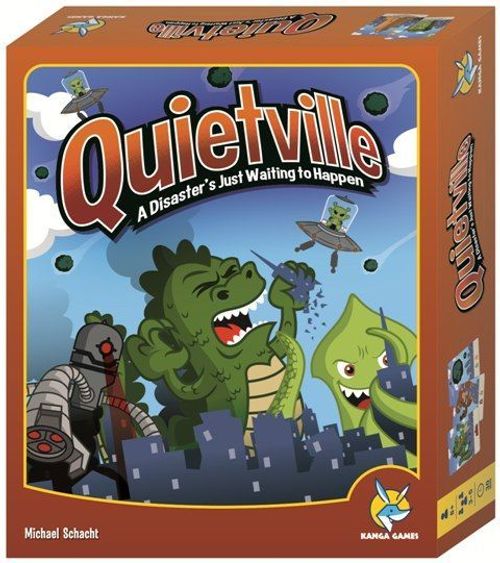
Quietville
Quietville Rulebook
Table of Contents
Table of Contents
Overview
Players: 3-5, Ages: 8 and up, Playing time: 30 minutes
Elephants and china don't go together especially well, and playing this card game will only strengthen that prejudice. The players collect china cards, and their collections grow through additional purchases -- but to earn money, the players must take elephant cards, which may have embarassing consequences on their supply of china cards and therefore their score. The goal of the game is to score as many points as possible by collecting china cards.
Contents
30 elephant cards; 40 china cards in red, blue, and green; 10 starting china cards; 10 money cards; 5 "push" cards; 4 scoring cards; 1 scorepad
Game Set-up
Before the game begins, each player receives a scoresheet, a money card, a "push" card, and any two starting cards with the same Roman numeral on the back -- that is, a starting card with a point value of 3 and one with a point value of 4. With fewer than five players, the remaining starting cards and push cards are returned to the box. The remaining money cards are placed in the middle of the table. The players place their push card, money card, and starting china cards face-up on the table before them.
Shuffle the deck of china cards well. After doing so, arrange the china cards and scoring cards into one draw pile as shown in the illustration: Start with a scoring card on the bottom, then add ten china cards, another scoring card, ten more china cards, and so on. Place this draw pile in the middle of the table.
Shuffle the deck of elephant cards well and place them face-down as a second draw pile next to the deck of china/scoring cards.
Draw the top five cards of both decks, and place them face-up in two rows in front of the corresponding decks.
Game Play
The most awkward player takes the first turn. One of the following can be done on a turn: buy a china card OR take an elephant card OR push.
Buying a china card
A player buys a china card by "paying" a money card for one of the china cards on display. The player places the money card onto the stack of money cards on the table, takes one of the face-up china cards, and places the card face-up before him on the table.
Taking an elephant card
A player takes an elephant card by selecting any one of the face-up elephant cards, the effect of which is then applied to his supply of china cards. When a player chooses this action, he also receives a money card that he places on the table before him.
What does an elephant card do?
A player who takes an elephant card of this type loses china cards in the amount and the colors depicted on that card. (The image shows three cards depicting 2 blue and 2 red elephants; 1 blue, 1 red and 1 green elephant; and 2 green elephants.)
A player who takes an elephant card of this type loses all the china cards in the color of the portrayed elephant. (The image shows three cards depicting 1 large red elephant; 1 large blue elephant; and 1 large green elephant.)
A player who takes an elephant card of this type loses china cards in the colors of his choice equal to the amount pictured on the card. (The image shows two cards: one with 2 small gray elephants, the other with 1 small gray elephant.)
A player who takes an elephant card of this type loses all china cards with the point value depicted on the elephant card. (The image shows two cards, each with a large gray elephant, but the numbers aren't clear in the online rules.)
The lost china cards and the chosen elephant card are removed from the game. It may happen that a player takes an elephant card that doesn't affect his supply of china cards, such as when he has no china cards in the colors depicted on the elephant card. The player nevertheless receives a money card.
Important: When a player has no money cards, he must take an elephant card. When a player has two money cards, he must buy a china card on his turn because no player may hold more than two money cards.
Pushing
Once per game, a player has the option of skipping his turn, that is, pushing it off. When a player pushes his turn, he returns his push card to the box.
Continuing the Game
After the start player has ended his turn, the game continues in clockwise order. Once all five of the china cards on display have been claimed, turn over the next five china cards from the draw pile and display them as at the start of the game. Once all five elephant cards have been claimed, turn over the next five elephant cards from the draw pile and place them face-up as at the start of the game.
Scoring
After ten china cards have been displayed and purchased, the scoring card on the top of the china draw pile signals that a scoring round must take place before the next five china cards can be drawn and put on display. On the score sheet, four different types of scores are listed:
-
The lowest in each color: The player adds the points of the lowest-valued china card in each color (red, green and blue) and writes this sum in the corresponding field on the scoresheet.
-
The highest in each color: The player adds the points of the highest-valued china card in each color (red, green and blue) and writes this sum in the corresponding field on the scoresheet.
-
All of one color: The player adds the point values for all china cards in one color and writes this sum in the corresponding field on the scoresheet.
-
Everything: The player adds the point values on all china cards that he has collected and writes this sum in the corresponding field on the scoresheet.
During each scoring round, each player chooses for himself one of the types of scores listed and writes the points for that score in its location on the scoresheet. Each type of score can be chosen by a player only once during the entire game. Thus, four scoring rounds take place by the end of the game, with each being signaled by a scoring card.
Game End
The game ends after the fourth and final scoring round. Each player then adds his points scored over the four scoring rounds. The player with the most points wins the game.
Divine Intervention (the action cards)
This section is transcribed from Michael Schacht's own "The action cards" mini-expansion document (filename elefaXPUS1.pdf), which BoardGameGeek lists on Quietville's game page under the title "Action cards." Quietville includes this material as a standard part of the box, under the name "Divine Intervention." The source document uses the original edition's names (china card, bull card); see the Card Notes section below for how these map onto Quietville's own card names.
Play with the basic rules with the following additions.
Additional material
14 action cards (6 sorts)
Preparation
The pass cards are not needed, remove them from the game.
Shuffle the new action cards.
Each player gets two and keeps them secret from the others.
Make a draw pile from the rest.
Game play
On each player's turn, they may either:
Buy a china card or
Take a bull card or
Play an action card
Play an action card
The player plays an action card (=> discard pile) and fulfills the action, if he likes.
Then the next player has his turn.
Action card pile exhausted
Shuffle the discard pile and build a new draw pile.
Loose more than one china card
The player gets the money card as usual and an additional action card from the draw pile, if available.
The action cards
From the left to the right:
- Discard a bull card
- Discard a china card from the general display
- Draw a money card, if available
From the left to the right:
- Exchange an own china card with a card from the general display
- Discard all bull cards and replace them by the same number of new cards
- The player on the right is the next who has his turn
Card Notes
Quietville reprints the same components under new artwork and names. Based on official product photographs of the Quietville cards, the component names used in the rules text above map onto Quietville's own cards as follows:
- China card → Building card. Quietville's building cards are illustrated cityscape buildings (a house, a tower block, an apartment building, a skyscraper, and so on) instead of pieces of china, still printed in three colors and with the same point values.
- Elephant card / Bull card → Disaster card. Quietville's disaster cards depict a radioactive dinosaur, a giant ape, a falling meteor, a monster plant, a UFO abduction, and a robot, in place of the original edition's elephants. The colored/numbered icons that determine which building cards are lost work the same way as on the elephant cards described above.
- Push card → Vote card. The card a player returns to the box to skip a turn is themed as a ballot/vote token in Quietville.
- Money card → Money card, themed with Quietville's own currency design but otherwise unchanged.
- Action card → Divine Intervention card. The six action-card effects described above are reprinted under this name.
Quietville's Divine Intervention deck also includes one additional card not described in the designer's action-card document, printed with the text "It's a beautiful day!" over a sunny cityscape. No rules text describing this card's specific effect could be located in any obtainable source; its function is not stated here rather than guessed at.