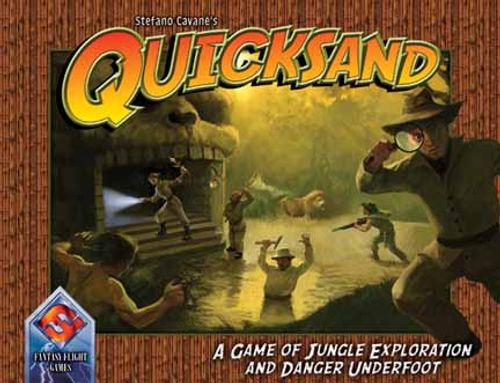
Quicksand (2003)
Quicksand Rulebook
Table of Contents
Table of Contents
Object of the Game
The object of Quicksand is to get your explorer to the temple before your opponents' explorers. The player whose explorer first reaches the temple wins!
While you play cards to move your explorer closer to the temple, you must be careful to keep your explorer a secret. If your opponents discover which explorer is yours, they will avoid playing cards that help you, and do their best to sink your explorer in quicksand.
Likewise, if you closely watch which cards your opponents play, you may be able to deduce which explorers are theirs. Once you do, you can play cards to keep those explorers from reaching the hidden temple.
Components
- Game Board: The board shows the path the explorers must take to reach the hidden temple.
- Game Cards: There is a deck of 83 game cards that you and your opponents play to move your explorers down the path to the hidden temple.
- Identity Counters: These six counters represent the six explorers. Each player draws a random counter before the game and must keep it secret during the game.
- Explorer Pawns: These six pawns represent the explorers racing to the temple. Note that each pawn has its own color (see the diagram for details). Before playing Quicksand for the first time, you must attach stickers to the explorer pawns (as illustrated in the "Assembling the Explorer Pawns" diagram) to make them two-sided. Each pawn has an explorer on its front side and quicksand on its back.
The Board
The board shows the Quicksand space, Temple space, Mask space, Blank space, and Color space, along with the explorer starting spaces.
The Explorers
- Hunter (Red)
- Geologist (Yellow)
- Botanist (Green)
- Zoologist (Blue)
- Jungle Lord (Black)
- Archaeologist (White)
Assembling the Explorer Pawns
Before playing Quicksand for the first time, you must attach stickers to the explorer pawns.
- Attach the Hunter sticker to one side of the red pawn.
- Attach the Geologist sticker to one side of the yellow pawn.
- Attach the Botanist sticker to one side of the green pawn.
- Attach the Zoologist sticker to one side of the blue pawn.
- Attach the Jungle Lord sticker to one side of the black pawn.
- Attach the Archaeologist sticker to one side of the white pawn.
- Attach quicksand stickers to the reverse side of each of the six pawns.
Setup
- Each explorer has its own starting space at the bottom of the board. Place the six explorer pawns on their starting spaces, face-up so the explorers are showing.
- Shuffle the six identity counters face-down.
- Each player secretly draws one identity counter. Look at the counter you draw, but do not show it to the other players. Your counter tells you which of the explorers is yours. Set your identity counter in front of you, face-down.
- Any identity counters remaining are left face-down and set aside. Players may not look at these counters.
- Shuffle the game cards.
- Each player draws six game cards.
Playing the Game
Randomly choose which player will take the first turn. When that player's turn is over, the player to his left takes a turn. In this manner, play rotates clockwise.
On your turn, you must take the following two steps in the order below:
- Play cards from your hand: You may play any number of cards, so long as they are all the same (as explained below).
- Draw cards: Draw cards until you have six in your hand.
Playing Cards
There are two types of cards you may play: Quicksand cards and Movement cards. Movement cards are divided into six colors (one color for each explorer).
During your turn, you may play any number of cards, but they must all be the same. (For example, you may play three Quicksand cards, or two blue Movement cards, or four red Movement cards.)
After a card is played, place it face-up into a discard pile.
Playing Movement Cards
You may play any number of Movement cards, but they must all be the same color.
For each Movement card you play, you must advance that explorer's pawn one space on the board. For example, if you play two red cards, you must move the red explorer (the Hunter) two spaces.
Moving Explorers
When moving an explorer on the board, you must follow these rules:
- You may only move the explorer in a direction indicated by an arrow on its space.
- Only one explorer may occupy a space at a time. You may move one explorer "over" another, however, if you play enough cards.
- Mask cards are special "wild" Movement cards, representing any color. You may play any number of Mask cards, by themselves or in addition to any other Movement cards (which must all be the same color). If you play one or more Mask cards by themselves, you must declare what color they represent.
- Example #1: Kevin plays two green Movement cards and a Mask card, so he must move the Botanist three spaces.
- Example #2: Donna plays two Mask cards by themselves. She declares they are white cards, so she must move the Archaeologist two spaces.
Example of Movement
In this example, the Botanist (green) is in a space with arrows pointing to spaces A and B. By playing one green card, a player may move the Botanist to either space A or B, but not to either of the black spaces.
- Space A (Quicksand): If the player ends the Botanist's movement on this space, the Botanist will be stuck in quicksand, and the player will turn the pawn face-down.
- Space B (Green): If the player ends the Botanist's movement on this space, the player may immediately discard one card from his hand.
By playing two green cards, the player may move the Botanist "over" space A, then end its movement on space C, D, or E.
- Space C (Mask): If the player ends the Botanist's movement on this space, the player may immediately discard one card from his hand.
- Spaces D & E (Yellow & Blue): If the player ends the Botanist's movement on either of these spaces, nothing happens.
Color Spaces
When you end an explorer's movement on a board space of its color, you may discard one card from your hand. Cards are discarded face-up into the discard pile.
For example, if you move the Botanist onto a green space, you may discard a card.
Discarding cards is important because it allows you to remove cards from your hand that, if played, will only help your opponents. For example, if you secretly control the Geologist (yellow), but the Zoologist (blue) is closest to the temple, it would be good to discard your blue cards because if you play them, you will bring the Zoologist's player closer to winning.
Mask Spaces
When you end any explorer's movement on a Mask space, you may discard one card from your hand. Cards are discarded face-up into the discard pile.
Quicksand Spaces
When you end an explorer's movement on a Quicksand space, that explorer becomes stuck in quicksand. To show that the explorer is stuck, turn that pawn face-down on the board so that its quicksand side is showing.
Stuck in Quicksand
A face-down explorer pawn is stuck. When you move an explorer that is stuck, the first card you play is used to rescue the explorer. When you rescue a stuck explorer, turn its pawn face-up.
After you rescue an explorer, you may move it normally.
If you only play one card to move a stuck explorer, you merely rescue that explorer, and cannot move it this turn.
Example: The Archaeologist is stuck. A player plays two white cards to move the Archaeologist. The first card rescues the Archaeologist (turns its pawn face-up) and the second moves it one space.
Playing Quicksand Cards
When you play a Quicksand card, you must choose one explorer pawn to become stuck in quicksand (as explained in detail above). To show that the explorer is stuck, turn that explorer pawn face-down on the board so that its quicksand side is showing.
You may play any number of Quicksand cards during your turn. However, for each Quicksand card you play, you must choose one face-up explorer pawn to become stuck in quicksand. (That is, you may not choose an explorer who is already stuck.) Note that you may choose an explorer that is not on a Quicksand space.
Drawing Cards
At the end of your turn, you must draw cards until you have six in your hand. In this way, your hand is replenished at the end of your turn.
If the deck of game cards runs out, shuffle the discard pile to form a new deck.
Strategy Tips
While you may want to just play cards that move your explorer closer to the temple, doing so may reveal to the other players which explorer is yours. Once they realize which explorer is yours, they will avoid playing cards that help you, and you may find your explorer the target of many Quicksand cards.
Likewise, if you closely watch which cards your opponents play and discard, you may be able to deduce which explorers are theirs. Once you do, you can play cards to slow down those explorers.
Finally, note that discarding is valuable because it allows you to get rid of cards that help your opponent, freeing you to draw more cards that are beneficial to you.
Reaching the Temple and Winning the Game
When an explorer pawn is finally moved onto the temple space, the player who has that explorer's identity counter must immediately reveal it. That player wins the game.
If none of the players have that explorer's identity counter, then the explorer pawn is placed back on its starting space and play continues.