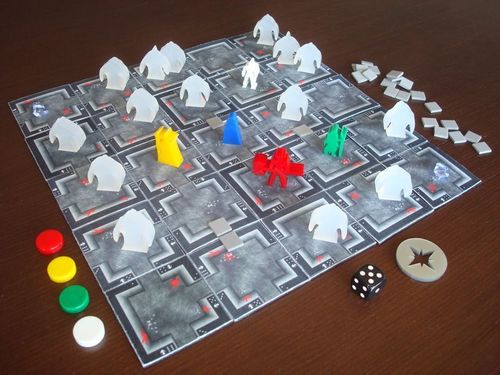
Questor
Questor Rulebook
Table of Contents
Table of Contents
Goals
Questor is an unusual game because each player is trying to accomplish something radically different over the course of the game. Whichever player finishes his or her goal first wins the game. The goal of each hero is described under Game End below.
Components
- Cotton case
- One six-sided die
- 25 dungeon tiles
- Several additional gray paths (squared pieces)
- 4 player pawns (red warrior, blue rogue, yellow mage, green healer)
- 15 monster tokens
- 2 gemstones
- Red, blue, and yellow counters for tracking the Healer's mission during the course of the game
Expansion: compass token and white player pawn (Psionic Prisoner) and counter.
Set-Up
Roll the die to determine who will go first. The player who will go first selects which hero he or she will play last (choose and place your heroes around the four dungeon entrances in reverse order of play). Place the 25 dungeon tiles upside down in a 5x5 grid. Each hero is placed at one of the four different entrances to the dungeon (middle of the sides of the grid), and the two gemstones are placed in diagonally opposite corners of the dungeon grid. Give the red, blue, and yellow tokens to the person playing the Healer.
Gameplay
The player choosing last goes first, and play proceeds clockwise around the table. On the active player's turn, he has two options, but must take one of them: MOVE or DIG. Only the Healer may pass a turn (stopping to pray or meditate). Any other player may not pass his turn or dig where there is nothing new to dig (when outside the dungeon on the first turn or where the path has already been dug).
Move
The player travels one space along a path on the dungeon tile to enter a new tile in the dungeon. This action could involve (a) revealing a new dungeon tile and/or (b) dealing with a monster (or monsters).
a. Revealing a new tile
If movement leads the player to a tile in the dungeon grid that is still upside down (unrevealed), the die must be rolled and the tile turned right-side up and oriented in that square of the dungeon grid. All 25 tiles are identical: they have a ┬ intersection, and the result of the die dictates the orientation of the tile and whether or not a monster is in the room.
To orient the new tile correctly, simply place the tunnel path with the number shown on the die matching the number on the new tile and facing the tile from which the hero moved. In other words, the new tile is placed based from the perspective of the hero entering the tile. If the number rolled on the die has a monster icon next to it on the tile (a 4, 5, or 6) then also place one monster token on the newly revealed tile (adding it to any monster tokens that may have been moved there prior to the tile being revealed by other player actions, see below).
Example: The healer moves one space to the right revealing a new tile. In order to orient the revealed tile correctly, she rolls the die and gets a '6'. The newly revealed tile is placed so that the '6' is facing the previous tile. Then she places a monster on it, as there is a monster icon next to the '6'.
More than one monster can be placed on the same tile (for example, if a tile was revealed and included a monster, and a monster was moved to that tile by the Mage or the Healer; see below).
b. Dealing with a monster (or monsters)
If the tile to which a player moves contains one or more monster tokens, those monsters must be dealt with. Each adventurer has a different way of doing so:
- The Warrior (red) simply slays them all with the fiery Phoenix Cleaver, his massive battle axe, and may claim those monster tokens as trophies toward his or her goal to win!
- The Rogue (blue) uses the Cloak of the River Spirit to turn invisible, and ignore the terrifying creature: it simply remains there but causes no problems.
- The Mage (yellow) uses the Mystic Staff of the Winds to teleport the monster to any other part of the dungeon (even a space where another monster resides or one that has not yet been explored and had its tile revealed). Multiple monsters can be moved independently.
- The Healer (green) uses the holy might of the Sacred Emblem of Gaia to turn and terrify the foul fiends, chasing them out of the area down any of the three (or four) paths to adjacent dungeon tiles (even if not yet explored) at the Healer's choice.
Dig
If the dungeon tile on which a player stands (or the orthogonally adjacent tile to which he or she desires to go) is a ┬ shape, the player may spend the turn digging out the dungeon path (or using rogue skills to discover a new path, magic to carve a new tunnel, or prayer to seek a divine earthquake to open a fresh passage). Whatever the case, an additional path marker is added to the tile from the supply of paths, transforming the ┬ shape into a ┼ shape, and likely granting an additional movement possibility on the following turn. Note: each dig action only transforms one ┬ shape into a ┼ shape, though, so two tiles adjacent to each other like this ┤├ would require two dig actions to open the desired new path forward.
Example: The healer digs by adding a path marker on the tile.
Example: The warrior has to dig twice to open a path forward as both tiles are placed like this ┤├.
Note: any hero may enter the spaces that contain the gemstones, but only the Rogue can recover those treasures (which happens automatically as soon as the Rogue enters that dungeon space: place the gemstone there in front of the Rogue player).
Game End
The game ends immediately as soon as one of the four adventurers completes his or her unique quest: if the Warrior has killed 8 monsters, he or she wins. If the Rogue has reached and collected both gemstones, and exited through one of the four entrances in the centers of the sides of the dungeon grid, he or she wins. If all 25 tiles have been revealed in the dungeon grid (by any player), the Mage wins. If the Healer has been in the same location as every other player at some point during the game, he or she wins (each time the Healer reaches another player, give that player one of the three colored tokens the Healer received at the start of the game, to help track the achievement of this objective).
Special Rules for 2 Players
In a two-player game, each player controls two heroes and does not win until both of the objectives have been completed. Alternate hero selections and turns (first player takes a turn with her first hero, then the second player takes a turn with his first hero, then first player takes a turn with her second hero, and finally second player takes a turn with his second hero; repeat).
Special Rules for 3 Players
In a three-player game, do not use the Healer. The Mage is only required to have 20 of the 25 tiles in the game revealed in order to win.
Optional Advanced Rule
To add even more complexity and strategy for the Healer, give a benefit to each player that visits the Healer! The first time the Healer joins each adventurer on the board, that adventurer gains a one-use special power, indicated by the small token given to the player, and discarded when the player uses that power: the Warrior may charge down a straight passageway in the dungeon once, moving several spaces on one turn, until he hits a wall or a monster to kill; the Rogue gets the power to one time transform into water with the power of the River Spirit Cloak, and not have to stop to dig to go through a passage that is blocked to others; and the Mage gains the power to Teleport him or herself one time, to any explored tile in the dungeon. Not everyone should freely cooperate, though, or the Healer will win the game by handing out all three tokens before anyone else completes their goals! And remember that those special powers can only be used a single time, after having shared a space with the Healer during the game.
Cooperative Game Variant
When playing solo or with players who want to work together, try this variant for a different challenge. The objectives are the same, but the goal is to have each player complete their objective during the same, final round of the game. In other words, all players must complete their goals one right after the other, or else the whole team fails, so if one player gets too far ahead of the others, he or she can lose the game for everyone.
There is one important additional rule to add difficulty to the cooperative version: a new tile must be revealed on the map every single round. So, there will be a constant march toward the conclusion of the game (because of the Mage's goal of having all tiles revealed). If an entire round goes by (all four characters take a turn, but no new tile was revealed in any of their turns), then the adventurers lose the game. They are allowed to reveal more than one tile during a round, but must reveal at least one or they lose the game. So if all four characters cannot complete their different objectives on the same round when the final tile is revealed, they also lose the game, but if they can all complete their goals during that same final round, they all win together.
When playing solo, simply make the moves for all four heroes yourself, remembering the two special rules for the cooperative game: (1) at least one tile must be revealed each round, and (2) all four heroes must complete their objectives in the same round (one right after the next). If you fail at either of those special rules, you lose the game. If you succeed, you can give yourself a score based on the total number of rounds it took you to win (the lower the better).
Optional: The Explorer Token (Compass)
An optional game addition, a small extra token that looks like a compass, serves as a player aid during the cooperative and solo versions of the game. This Explorer Token is simply given to the hero who last revealed a new tile, and each time a new hero reveals a new tile, that hero takes the Explorer Token instead. It helps to keep track of one of the losing conditions: if the same hero's turn comes around and she still has the Explorer Token, then she MUST reveal a new tile this turn, or the whole team loses!
Optional: The Psionic Prisoner (A Fifth Hero)
An optional game addition, called the Psionic Prisoner (white player pawn and matching extra white token for the Healer's quest), allows an interesting variant or five-player game. When using him, the Psionic Prisoner starts at the center of the map. Turn that tile face up and orient it randomly at the beginning of the game. He cannot pass through the tiles where a monster stands, other players may not move a monster to where he stands, and if he explores a tile with a monster on it, he must immediately retreat back to the tile he came from instead of remaining on the newly revealed tile.
His goal is simple: just get out of the dungeon through one of the four entrances in the center of the four sides! So now there are five different motivations in the game: FREEDOM, Fame, Fortune, Friendship, and Forbidden Knowledge.
His problem is he cannot go through tiles with monsters on them, and all four of the tiles immediately around him WILL have monsters on them in this variant (simply put a monster there when the tile gets revealed by whoever reveals it, whether a monster was rolled or not). So he is stuck (a prisoner) until one of the other players lets him out. They probably won't for much of this quick game, though, because once he is out he doesn't have far to go before he wins.
While he waits, he can use his special Psionic power: on his turn, instead of moving or digging, he can choose to concentrate and rotate any one revealed dungeon tile on the map with the power of his mind! He can turn it 90 degrees clockwise or counterclockwise, and uses his power to try to slow down the player(s) in the lead until he has a chance to win the game.
If playing with the advanced rule (players get a special one time power from visiting with the Healer), the Psionic gains the ability to, one time, both move or dig AND rotate a tile on the same turn. So he could move and rotate one tile, or dig and rotate one tile. And he can take those two actions in either order.