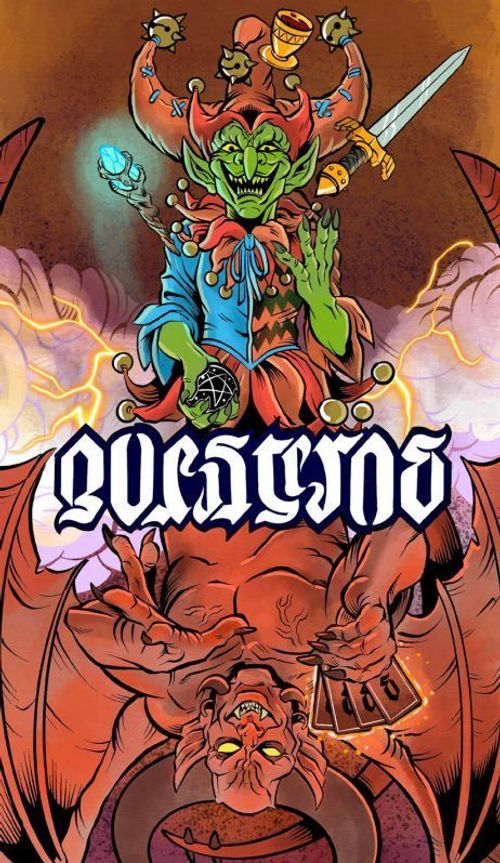
Questeros
Questeros Rulebook
Table of Contents
Table of Contents
- Contents
- Objective
- Multi-Player Game Setup
- Gameplay
- Card Play Rules
- Gods
- Round Scoring
- General Notes
- Multi-Player Gameplay Examples (2 Players)
- Scoresheet
- Ero's Quest (Solitaire Adventure)
- Solo Table Setup
- Solo Game Setup
- Solo Gameplay Outline
- Turn Actions
- Bonus Develop Actions
- Allies
- Game Terms
- Encounters
- Example Encounter
- Combat
- Abilities
- Combat Example
- Card Notes
- Fate Deck (Roleplaying Game Option)
Contents
- 80 Tarot size cards consisting of 56 Class Cards, 22 Epic Cards & 2 God cards
- 6 Epic Reference Cards
- 3 Solo reference/player aid cards
- 1 Scorepad of 75 sheets
- 1 Jester (Initiative) Token
Objective
Over the course of 7 rounds of play, each player must strive to correctly anticipate how many Quests they will win each Round. Experience points (XP) will be earned and lost based on these decisions. The player with the most XP at the end of the 7th round of play is the victor. In the case of a tie, the player who won the most Quests in the final round is the winner.
Multi-Player Game Setup
- Assign one person to be the Scorekeeper for the game. Document player names on the scorepad.
- Each Player begins with 2 XP.
- Provide each player with an Epic Reference card.
- Randomly determine which player starts with Initiative (give them the Jester token). They are also the Dealer.
- The Dealer removes Epic Cards 10 to 15 from the Questeros Deck, sets them aside, and leaves them in order 10-15, face up with the 10 (Deck of Fate) on top.
- The Dealer shuffles the remaining 74 cards, then deals 10 cards to each player face down.
- The Dealer places the rest of the Questeros Deck face down next to the unused Epic Cards.
- Each player picks up their hand of cards. These cards are not to be shared or shown to other Players.
Gameplay
- A multi-player game of Questeros consists of 7 rounds of play.
- Each Round consists of up to 10 Turns of play, wherein each player will play 1 card from their hand. The highest card played, based on the Class cards or Epic cards played, will claim the Quest.
- At the start of a Round of Play, each player (starting with the player to the left of the Dealer) must announce how many Quests they expect to earn, with a minimum of 1 announced.
- Each player's announced number of expected Quests is noted on the scorepad for that round, in the top square box.
- The player with the Initiative Token (the Dealer) begins the game by playing a card of their choice from their hand.
- Each other player plays a card from their hand, clockwise from the first player. Rules for playing cards are in the Card Play Rules section.
- The player with the highest value card earns the Quest. They take all of the cards played and place them into a face down stack in front of them.
- The player that earned the Quest gains Initiative, represented by passing the Jester Token to them. This means that they will play the first card in the next Turn.
- When the Round is over, complete the Round Scoring, then proceed with the steps below.
- All Quest piles are collected and combined back into the Questeros Deck.
- Take the top card of the set-aside Epic Cards, place it into the Questeros Deck.
- The player with Initiative becomes the Dealer.
- Repeat this process until all 7 Rounds are complete. The player with the most XP at the end of the 7th round is the winner. If there is a tie, the player who won the most Quests in the final round is the winner.
Card Play Rules
- The player with Initiative always plays the first card.
- The first card played becomes the Preferred Class for the Turn. If an Epic card was played first, then Epic Cards are the Preferred Class for the Turn.
- Each player must play a card from the Preferred Class, if they have one. If they do not have a card from the Preferred Class, then they may play any card (including an Epic card). If a player would like to play an Epic Card when they have a Preferred Class card in their hand they may opt to pay 1 XP (or if an Epic card is the Preferred Class, a player can pay 1 XP to play a different card instead).
- Follow the rules of each Epic card played before the next card is played.
- Once all players have played a card, the Turn is over. The player with the highest numbered Preferred Class card earns the Quest.
- Note that Epic cards always outrank Class cards. If one or more Epic cards are played during a Turn, the highest value Epic card earns the Quest.
- At the end of the turn resolve any end of turn Epic card effects.
Gods
- There are 2 God cards (Nekradis and Adwanis). These cards outrank all other cards; if they are played they win the Quest. If other players still need to play a card, they may play any card from their hand.
- If both Gods are played in the same Turn the Quest is not won by any player. Instead, discard all cards from this Turn of play. The initiative remains with the player who led that Turn.
*** Alternative Rule *** Players may agree at the start of the game to allow a God card to also negate Epic card abilities. This would only prevent abilities that have end of turn effects, or cards played after the God card is played.
Round Scoring
- Each player adds up how many Quests they earned during the Round and informs the Scorekeeper.
- The Scorekeeper records each player's score on the Scorepad next to the current Round number.
- Each player earns one point per Quest they earned in the Round.
- Each player who earned the exact number of Quests they announced at the beginning of the Round gains an additional 5 XP.
- Questeros! If a single player earned NO Quests in the Round, they win a Questeros. That player gains 10 XP and takes Initiative for the next Round. If more than one player earns NO Quests in a Round, they earn 0 XP and Initiative stays with the player who won the last Quest of the Round.
General Notes
- There are times when you do not want to win a Quest, as it may put you over your announced Quest goal, and prevent you from earning the bonus for meeting that goal.
- Epic cards have a significant impact on a turn, and sometimes on a Round. It is important to announce the effect of an Epic card when played, so that all players understand its impact.
- The option to play or not play an Epic card outside of the standard rules of play always costs 1 XP. This option cannot be chosen if a player does not have 1 XP. This option applies only to Epic Cards.
- The 6 Epic Cards that are set aside at the start of the game are important to remember. Add 1 into the deck each Round after the first to increase the number of Quest Cards available as the game progresses.
Multi-Player Gameplay Examples (2 Players)
Example 1. Player 1 chooses to play the 11 of Blades, which makes Blades the Preferred Class. Player 2 MUST play a Blades card (unless they spend 1 XP to play an Epic card instead). Player 1's card (11 Blades) outranks Player 2's card (6 Blades). Player 1 earns the Quest. They grab the 2 cards and place them face down to form their earned Quest stack.
These cards are not used unless an Epic card refers to them. Otherwise they are kept to track how many Quests have been won at the end of the Round.
Example 2. Player 1 chooses to play 3 of Orbs. Since P2 does not have Orbs they can play any card. They choose the Mentor Epic card. When the Mentor is played, its ability is used. Player 2 may request to look at Player 1's Hand, then the game continues. Player 2's card (Epic card 2) outranks Player 1's card (3 of Orbs). Player 2 earns the Quest. They grab the 2 cards and add them face-down to their earned Quest stack. Since Player 2 won the Quest, they also take the Jester Token and gain Initiative for the next turn.
Example 3. P2 plays their 14 of Cups (King of Cups), then P1 plays their only card, the 3 of Cups. Player 2's card (14 of Cups) outranks Player 1's card (3 of Cups). Player 2 earns the Quest. They grab the 2 cards and add them face-down to their earned Quest stack. Since P2 won the Quest, they also keep the Jester Token and will have Initiative for the start of the next Round since they are out of cards the Round is over.
At the end of the Round the Players complete Round Scoring. Each player would score 1 XP for each Quest they earned that Round, plus 5 additional XP if they earned the exact number of Quests they announced at the start of the Round.
Scoresheet
The pad of 75 scoresheets can be utilized to track scores in the Multiplayer game, and can be used to track Actions in the Solo game. The scoresheet has spaces for: Name of Player; Beginning XP; Round #; Quest "Bid"; Round Game Score; Current Game Score; Solo Action Options; Final Game Score.
Ero's Quest (Solitaire Adventure)
A goblin, named Ero, has been released from servitude in his role as a Jester to a noble court. The Warlock of the Kingdom has instead assigned him a task to save the Realm from a dangerous threat... The Dragon.
Solo Objective
Use the 56 Class cards to develop Ero as you encounter each Epic card in the game. To win the game you must defeat or deter the Necromancer, the Succubus, the Assassin, the Death Knight, the Demon, and finally the Dragon.
You lose the game if you do not have enough Health (Cups Cards) to survive a hit, or if your Deck runs out of cards.
Time & Space
You will need at least 2' x 2' of table space to spread your cards out well. An average game will take around 30 minutes to play.
Difficulty
If you wish to make the game more difficult, remove the 3 of Orbs from your initial setup and shuffle it into the deck. This could be done with the 2 as well.
Solo Table Setup
The Epic Reference Cards and the God cards are not used in Ero's Quest.
The printed Table Setup Visual labels the following zones (the diagram itself is pictorial; follow the written Solo Game Setup below): Quest Cards (1-21); Encounter Cards; Staves Cards; Completed Quests Pile; Empty Until Magic Learned; Orbs Cards (1 to 3); Blades Cards; The Deck; Discard Pile (Empty Until Allies Join); Ally Cards; Cup Cards (1 to 10).
Solo Game Setup
- Separate all of the Epic Cards from the Basic Class Cards.
- Set The Jester in front of you, centered.
- To the right of the Jester, place the One of Blades card. This card represents your combat ability in the game.
- To the left of the Jester, stack the 1, 2, and 3 of Orbs. These cards represent your currency.
- Below the Jester, place the Cups cards 1 through 10 in a single stack, with 1 on top increasing up to 10 below. These cards represent your health in the game.
- Place the One of Staves card underneath the Jester. This card represents your magic ability in the game (you begin with no magical ability).
- Shuffle the remaining Class cards and place them face down as a deck.
- Place the stack of Epic cards, sequenced from 1 to 21, in a single stack to the right of your playing area. The Warlock should be on the top, the Dragon should be on the bottom.
- Place the 3 double sided Encounter cards to the right of the Epic cards.
- Draw 5 cards to form your Hand. You are now ready to begin Ero's Quest!
Solo Gameplay Outline
The game will take place over a series of turns where you manage the following actions in any order:
- Develop Ero's Blades, Staves, and Orbs.
- Purchase new cards using Ero's coins.
- Forget things... so that Ero can make room in his head to learn more.
- Learn things, to better Develop Ero.
- Encounter the Epic cards, creating a story along the way.
- Recover your Blades, Staves, and Orbs cards if you have the resources to do so.
- Rest after a busy day, ending the turn to start a new one.
Turn Actions
You have a total of 7 actions you may take each turn, they can be done in any order. Each action may only be done once per turn. Only the Rest action MUST be completed, and it must be the last action of a Turn.
- DEVELOP - Place a card from your hand onto your Blades, Staves, or Orbs stacks. The card placed must be the next number in sequence (regardless if the highest card in play is Used or Unused). You cannot Develop Cup cards.
- PURCHASE - Use an Orb card by rotating it 90 degrees. Look at a number of cards from the top of the deck equal to the value of the Orb card Used. Choose 1 of those cards to place in your hand, or if it could be used to Develop a stack you may place it immediately as a bonus Develop action. All other cards you looked at are placed on the bottom of the deck in any order you choose.
- FORGET - Discard any number of cards from your hand and place them in the Discard pile. Your little goblin mind is apt to forget things from time to time, in hopes of learning other things more important for the present.
- LEARN - Draw until you have 5 cards in your hand. The fewer cards in your hand when you perform this action, the more cards you are able to draw.
- ENCOUNTER - Face the next Epic card in the Epic stack. Plan ahead for the Encounter in order to meet its criteria. Only one Encounter may be faced each Turn.
- RECOVER - Destroy an 11-14 card of any Class from your Hand to return a matching type of card in your Play Area to its Unused state. You may only affect a card of equal or lesser value to the card you are destroying to do this. The card value is equal to the sum of the two digits on the card: 11 is equivalent to 2, 12 is equivalent to 3, 13 is equivalent to 4, and 14 is equivalent to 5.
- REST - End the turn. You must take a card from the top of the Deck and place it in the Discard pile. All of your actions are refreshed to begin a new Turn.
Bonus Develop Actions
During the game there will be several times when you receive cards other than through your LEARN action.
*** Anytime you get cards outside of your LEARN action you may immediately take one bonus Develop action if that card could go directly onto a Blades, Staves or Orbs stack. ***
As an example, you cannot pick up a 4 of Blades then place a 3 of Blades from your Hand onto a stack, it MUST be the card you just drew to be eligible for this bonus Develop action.
Utilizing these "Bonus Develop Actions" is critical to develop Ero's skills to have a chance at defeating The Dragon at the end of the game.
Allies
Three Epic Cards (The Dwarf King, The Order of the Magi, and The Order of the Shadows) will give you the option to place a card as an Ally. If you do, set the card to the left of your Cups cards.
In any Combat round, one Ally card may be played in addition to any other cards already played. It adds its card value to the damage that is dealt to the Epic Card, then the Ally card is Destroyed.
Game Terms
- Develop: Add the next highest valued card onto your Blades, Staves, or Orb card stacks.
- Discard: Place a card from your Hand into the Discard Pile.
- Destroy: A card that is Destroyed must be removed from the game.
- Play Area: All cards that you have on the table around your Jester card.
- Recover: An action that rotates a Used card to an Unused position.
- Unused Card: Any card in the Play Area that is not Used (see below).
- Used Card: Any card in the Play Area that has been expended and rotated 90 degrees, making it unavailable for further use.
Encounters
Each Epic card in the game represents an Encounter that Ero must face. Many of these are interactions with characters in the Realm, but others are more dangerous and will involve Combat. The game cannot progress until an Encounter's requirement is completed, however you may take as many turns as you wish before choosing to encounter them.
Each Encounter's requirements are listed on the Encounters card, which is only used for the Ero's Quest Solitaire Adventure Game.
Many Epic cards require you to "Give" 1 or more cards to them in order to continue the game. When you Give cards to them, place them under the Epic card, then place them into the Epic discard pile when the Encounter is completed (unless directed otherwise).
Some Encounters require you to Defeat them in Combat. See the next section to understand how Combat is resolved.
Planning ahead for the upcoming Encounter is critical to succeeding in Ero's Quest!
Example Encounter
The first Encounter of the game is The Warlock. The requirement for this card is to:
"Place 1 to 4 cards from your hand of different Classes under the Warlock, then set the Warlock and the cards aside."
If you choose the action to face this Encounter you must follow through with its directions. In this case, you must choose cards from your Hand to place under the Warlock card. You have the choice of what card(s) to place, but must follow its restrictions. For this card, you can only give the Warlock one Blade, one Stave, one Orb, and one Cup card.
You would group the cards under the Warlock and set them aside, as they may be referred to later in the game.
If a card does not say to put it aside, then it will go in the Quest discard pile instead.
You may not face another Encounter card this Turn, as only one may be faced each Turn.
Combat
When an Epic card states that you must Defeat it in Combat, follow this sequence:
Step 1. The Epic card attacks you first, dealing damage equal to its card value. (I.E. The Necromancer deals 5 damage to you). You must Use a total value of Health cards equal to or higher than the damage dealt (in this case, a 1 and 4, a 2 and 3, or a 5 or higher Cup card). Rotate the card(s) 90 degrees to show that they are now Used.
Step 2. You perform your first attack. You must choose one Unused Combat card (Sword card) and/or one Unused Magic card (Stave card) from your Play Area. Rotate these 90 degrees to become Used. Add the values of these cards together to create your attack. (Ex. a 4 Combat card and a 2 Magic card can be Used to create an Attack value of 6). That damage is dealt to the Epic card. If the value is equal to, or higher than, the Epic card's value, then it is defeated. Note that cards remain in the Used position until you use a Recover action on them.
If the Epic card is not yet defeated you may also call for support from a card in your Hand. You may use a Combat or Magic card valued from 11-14 as a Bonus card (only one card per combat round). It will deal damage equal to the sum of its numerical value (11 is equivalent to (1+1)=2, 12 is equivalent to (1+2)=3, 13 is equivalent to (1+3)=4, and 14 is equivalent (1+4)=5). Destroy the card once it is played.
If the Epic card is defeated, place it in the Discard pile. If it is not defeated, note how much damage you have dealt and repeat steps 1 and 2. Note that damage dealt is cumulative. For example, if you deal 10 damage to The Demon on your first attack, you need only deal 5 damage to it on your next attack to defeat it (The Demon is a 15 value card).
These Combat rounds all continue to occur within the same turn until the Encounter is defeated, or you are defeated.
Abilities
Each Epic card that you must Defeat also has an Ability. Be sure to read and understand its Ability prior to starting the Combat. Some Abilities require you to perform an action prior to Combat starting, others impact how Damage is handled.
Combat Example
In the example, Ero is attempting to defeat The Death Knight. Ero has already Used his 2 and 3 of Blades, and his 5 and 6 of Cups in prior Encounters.
The Death Knight strikes first, dealing 13 damage to Ero. Normally Ero would have to Use only Cup cards to take damage equal to or greater than a total of 13. However, the Death Knight allows Ero to take the damage in other cards as an alternative (in any combination). Ero decides to Use the 10 of Cups and the 3 of Cups to suffer the 13 damage. Those cards would be rotated 90 degrees to show they are Used.
Ero then strikes back! He may Use one Blades card and one Stave card. He Uses the 6 of Blades and the 3 of Staves to deal 9 damage to The Death Knight. Those cards are rotated to show they are now Used.
Because the Death Knight has not been defeated, the combat steps are repeated. The Death Knight attacks again, dealing another 13 damage to Ero. Ero decides to use the 9 of Cups and the 4 of Swords to take the damage this time.
Ero attacks again, but only has to deal 4 more damage to defeat The Death Knight. He attacks with the 5 of Blades to finish off the Encounter.
The Death Knight (Epic card text): "You must defeat the Death Knight in Combat. When you are dealt damage by the Death Knight you may take it in Cups, Blades, or Staves cards."
Card Notes
Card Structure
- The 22 Major Arcana cards are called the Epic cards in this set.
- The 56 Minor Arcana cards are called the Class cards in this set. Within the Class cards there are 16 Court Cards (the Page, Knight, Queen, and King of each Class) and 40 numbered cards organised into 4 Classes: Blades, Staves, Orbs, and Cups, each with 10 cards.
- The 79th and 80th cards are the God cards, Adwanis and Nekradis, which do not exist in traditional Tarot decks.
God Card Meanings
Adwanis, Goddess of Light. Hope, Life, Unity, Victory. If Adwanis is drawn in a reading, remove her and place her to the side, then replace her card position with another card. For this reading each card represents only the most positive and fortuitous outcomes as Adwanis guides the way to a brighter future.
Nekradis, God of Darkness. Doom, Chaos, Loss, Defeat. If Nekradis is drawn in a reading, remove him and place him to the side, then replace his card position with another card. For this reading each card represents only the most negative and unfortunate outcomes as Nekradis taints everything in his reach.
If both Gods are drawn in the same reading they are both removed and redrawn, but will represent a strong turmoil and chaos surrounding the reading's topic and focus.
Epic Card Meanings
The core concept behind each Epic card is listed below to help plan how it can impact the game. An Epic card should have a much greater impact on the character, creature, or event than a standard Class card does.
- The Jester: Beginnings, innocence, spontaneity, a free spirit
- The Warlock: Manifestation, resourcefulness, power, inspired action
- The Mentor: Intuition, sacred knowledge, divine feminine, the subconscious mind
- The Centaur: Femininity, beauty, nature, nurturing, abundance
- The Dwarf King: Authority, establishment, structure, a father figure
- The Necromancer: Spiritual wisdom, religious beliefs, conformity, tradition, institutions
- The Succubus: Love, harmony, relationships, values alignment, choices
- The Paladin: Control, willpower, success, action, determination
- The Valkyrie: Justice, fairness, truth, cause and effect, law
- The Druid: Soul-searching, introspection, being alone, inner guidance
- The Deck of Fate: Good luck, karma, life cycles, destiny, a turning point
- The Ranger: Strength, courage, persuasion, influence, compassion
- The Assassin: Pause, surrender, letting go, new perspectives
- The Death Knight: Endings, change, transformation, transition
- The Faeries: Balance, moderation, patience, purpose
- The Demon: Shadow self, attachment, addiction, restriction, sexuality
- Order of the Magi: Sudden change, upheaval, chaos, revelation, awakening
- Order of the Knights: Hope, faith, purpose, renewal, spirituality
- Order of the Shadows: Illusion, fear, anxiety, subconscious, intuition
- Order of the Monks: Positivity, fun, warmth, success, vitality
- The Bard: Judgement, rebirth, inner calling, absolution
Class Card Concepts (Fate Deck)
- Blades: Most impactful in combat or in physically challenging situations to aid with damage or likelihood to hit.
- Staves: Most impactful for casting magical spells or using magical abilities, or in mentally challenging situations.
- Orbs: Most impactful for resolving economical exchanges, or for feats involving dexterity and acrobatics.
- Cups: Most impactful for resolving healing or recovery situations, or for times involving social interactions and faith.
Card Meanings Reference
Every card's general meaning and a more descriptive explanation of the symbolism in its artwork are published by the publisher at thefundamentalgames.com.
Fate Deck (Roleplaying Game Option)
When used with a tabletop role-playing game, this deck provides a GM-guided rules option that introduces interesting and timely events into a game session, or even an ongoing campaign.
- At the beginning of the game session, shuffle all 80 Questeros cards together to become the FATE deck. The GM draws 1 card for each Player in that session. Make a note of which Player received which card. Do NOT share the cards drawn with the Players.
- The GM can utilize the secret FATE card assigned to each Player as a general guideline for what may impact that character this session, or reveal it during a critical moment and apply some story & theme that ties into the meaning of that card.
- During the game, at any time, the GM may also decide that a player has earned a FATE card. This could be for an exceptional role playing moment, a high roll during a challenge, a gift from an NPC, or any other circumstance the GM chooses.
- At any point in a game session a Player may hand one or more of their acquired FATE cards to the GM to trigger a FATE event. This could be positive or negative depending on the circumstances.
- The GM may, but is not required to, have a player roll a d20 to help guide the outcome of the event. The higher the number, the more impactful the event could be.