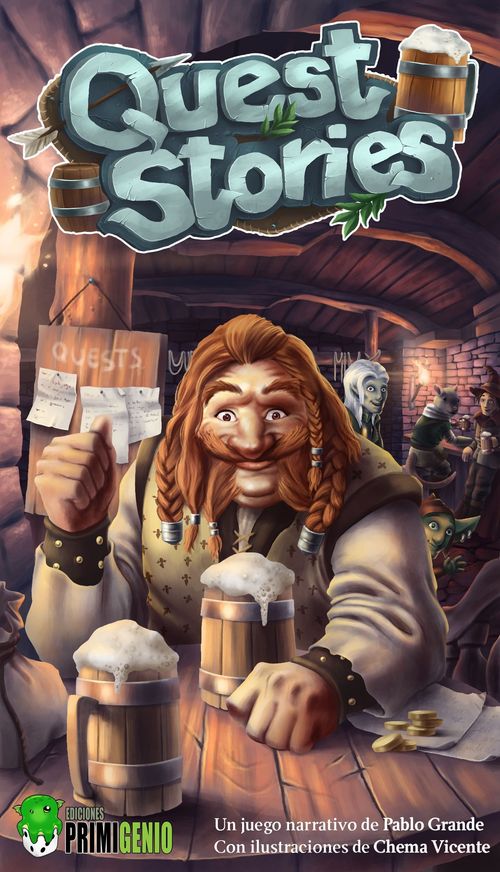
Quest Stories
Quest Stories Rulebook
Table of Contents
Table of Contents
What is Quest Stories?
Quest Stories is a humorous fantasy narrative game for 3-5 players with a duration of about 10 minutes per player. In each round, one player plays the innkeeper in search of the right heroes to fulfil a quest, while the rest of the players represent recruiters who will try to convince the innkeeper that their group of heroes is the iconic one.
Components
- 80 heroes (card deck)
- 40 pre-designed quests
- 8 quest generation cards
- 1 innkeeper card
- 1 die
- 4 wooden cubes
- 1 manual
Object of the Game
The game is divided into as many rounds as there are players; in each round a different player takes on the role of the innkeeper. At the end of those rounds, the player who has accumulated the most coins wins.
Tip: I recommend that you do not think so much about accumulating coins but about creating a good story and enjoying it! In the end, good stories are rewarded with good coins.
Game Setup
- Shuffle the hero deck and leave it face down within reach of everyone.
- Randomly choose a player for the first round and give them the innkeeper card.
- You can start playing!
Rounds
Each round is divided into four phases:
1. Preparation
During this phase, each recruiter will draw five cards from the hero deck.
2. Presenting the Quest
The innkeeper must present the recruiters with a quest, for which they have three alternatives:
Tip: I recommend option A for the first games.
A) Use a pre-designed quest: the innkeeper takes a quest card from the quest deck and reads it aloud.
B) Use the quest generation system: the innkeeper takes four different quest generation cards: What?, To whom/To what?, Where?, How?, and places them on the table. They roll the die and assign a wooden cube marking the result on the first card. They repeat this process for the other three cards, so that they can improvise a story based on the results.
Example: The innkeeper has obtained a 2, 3, 6 and 3, which assigns "Steal a magic artefact in a very remote cemetery". The innkeeper must improvise a quest that includes this idea, for example: A group of heroes is sought who are capable of recovering the invisibility cloak (which, by the way, is invisible), which is located in the cemetery of the land of the Immortal Elves. So what is a cemetery doing there? It is all a mystery!
C) Improvise a quest (for advanced players): the innkeeper makes up a quest using their imagination.
3. Presentation of Teams and Rebuttals
Presentation of teams
Once the quest has been heard, the recruiters must choose three of their five heroes and explain why they believe their team is the most suitable for the quest the innkeeper has set. To do this, as the players think up their stories, they place their selected character cards face down in front of them, to indicate it.
Tip: If you think the players are skilled at improvising, do not give them much time and have them read only the summaries of the heroes. If, on the other hand, you think they need more support, give them time to read each hero's story in more depth.
When all the players have thought up their story (or the innkeeper considers that they have waited long enough), they begin to tell them in order, starting with the recruiter to the left of the innkeeper and continuing clockwise.
Tip: When you tell your story, try not to recite literally what appears on the character card, because it sounds less natural and not at all convincing. Do not hesitate to add characteristics to your characters.
On their turn each player must argue, in a reasonable time, why their team is the most suitable.
Tip for the innkeeper: try not to interrupt the recruiter's narration, I know it is hard! You can react by making faces of approval or displeasure, but if you interrupt and start a debate, it can go on indefinitely and the rest of the recruiters lose the thread.
Rebuttals
When a player has finished telling their story, the nearest recruiter in the clockwise direction will ask them a question that they must answer. These questions serve to look for flaws in the proposals of the other recruiters.
For example: Tell me, if the quest consists of sneaking into a fortress, why are you bringing the giant, who makes the ground shake as he walks?
Tip: All heroes in Quest Stories have some flaw. To make them more convincing, hide them, highlight them as if they were strengths or complementary to the other characters; if not, they will be used against you in the rebuttal phase.
4. Verdict
When all the recruiters have told their story, the innkeeper, basing themselves solely on their own judgement and, in the best of cases, taking into account: the most coherent option, the best narrated, how well they have answered the questions during the rebuttal phase, etc., will decide which story convinces them most. The innkeeper takes the heroes and turns them over, so that they will use the back of the cards to award coins to each player (from least to most) according to how good they consider their story:
- 3 players: 1/2
- 4 players: 1/2/3
- 5 players: 1/2/3/4
Tip: Innkeeper, it is recommended that you explain why you give those scores; the recruiters will like to know.
End of the Round
Once the round has ended, all hero cards are discarded (except those used as coins), the innkeeper role rotates one position clockwise and another round begins.
End of the Game
When all players have played the role of the innkeeper for one round, the game ends and the winner will be the one who has the most coins. In case of a tie, the tied players share the victory.
Variants
The elements in this box and the narrative character of Quest Stories allow the game to be played in many ways. Here are some variants that will suit you depending on the number of players, the time you have, or how advanced you are in the art of improvisation, oratory and rhetoric:
Recruiters' Meeting
Today the innkeeper has no quest to offer, so the recruiters, jobless and idle, gather around the table with a beer and begin to discuss and fantasise about how they would solve that legendary quest of years ago. The one who manages to convince more recruiters with their story will not pay for the round.
When to use this variant? When you have little time or there are many of you.
Players: 3-16
- It is played without an innkeeper.
- One player reads a random pre-designed quest (or you can pose one from any other system).
- Each player draws 5 heroes, tells their story and answers the rebuttal.
- When all players have told their story, there will be a short time for each player to recall briefly what their story was about.
- Then, all players, at the count of three, point at the one whose story has convinced them most. The player or players who receive the most votes will be the winners.
Urgent Quest
The innkeeper called you so quickly that you only brought the résumés of a few heroes!
When to use this variant? When you have a lot of experience and want to test your capacity for improvisation.
Players: 3-5
- The recruiters only draw 3 heroes, instead of 5, so they must use them all even though presumably they will not fit.
Hero's Apprentice
There is a new member in the clan and you have to decide whether or not to send them on the quest, whether or not they have something to learn.
When to use this variant? When you feel like an extra narrative challenge.
Players: 3-5
- The recruiters only choose 2 heroes of their 5 for the quest; the 3rd will be given to them by the recruiter seated to their right and they will have to include it coherently in the story.
Alternative option
- The innkeeper will draw as many heroes as there are recruiters and give one to each recruiter.
- The recruiters will have to use that hero for the quest (and two others as normal).
Superhero
A famous mercenary has arrived in the city and the innkeeper wants you to take them on the quest.
When to use this variant? When you want to see which recruiter can get the most out of a character.
Players: 3-5
- Before presenting the quest, the first hero of the hero deck is revealed and set aside.
- The recruiters only choose 2 heroes of their 5 for the quest; the 3rd has to be the hero revealed at the beginning of the round, who will be included in all the stories.
Achievements
Checklist boxes for tracking achievements across games:
- +1000 EXP: You have completed 10 different quests.
- +2000 EXP: You have completed 20 different quests.
- +1 level!: You have completed all the pre-designed quests that the game includes.
- Because I'm worth it: A recruiter convinces the innkeeper that just one hero is enough to do the quest; the other two are there as decoration.
- Expected allies: A team is formed by three heroes of the same race, for example: three goblins or three humans.
- Unexpected allies: A team is formed by three heroes of different races.
- Girl power: A team is formed by three female heroes.
- Man power: A team is formed by three male heroes.
- Nothing to object to: A recruiter is left without questions during the rebuttal phase.
- Touché: A recruiter is left without answers to a question during the rebuttal phase.
- Magic is for the clumsy: The story that wins the most coins is one in which no kind of magic has been used.
- Guests at the tavern: A friend buys the game after playing with you.