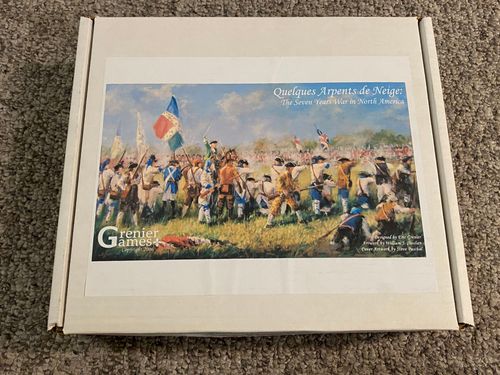
Quelques Arpents de Neige: The Seven Years War in North America
Quelques Arpents de Neige: The Seven Years War in North America Rulebook
Table of Contents
Table of Contents
- 1. Introduction
- 2. Units
- 3. Supply and Logistics
- 4. Terrain and Installations
- 5. Seasonal Turn
- 6. Monthly Turn
- 7. November-December Turn
- 8. Spain
- 9. Native American Nations
- 10. British Empire
- 11. French Empire
- 12. Victory
- 13. List of Event Cards
- 14. Campaign Set-Up
- 15. Order of Battle
- 16. Historical Reinforcements
1. Introduction
Quelques Arpents de Neige: The Seven Years War in North America is a historical simulation game that recreates the Seven Years' War from 1755 to 1763 in North America.
For questions about the rules, errata and new productions of Grenier Games, please visit our website at www.greniergames.com or send an e-mail to [email protected].
This rulebook, written in the form of "cases", contains all the rules you need to play. We advise you to read the rules in their entirety before beginning to play. Everything needed to play is included in the box. You will find the following material:
- The rulebook, which contains all the game rules and set-up information, an Order of Battle, a reinforcement calendar and a list of event cards.
- 855 counters. (Publisher errata 1.0 confirms the count of 855 counters; this printing already gives 855.)
- 27 event cards.
- One player aid.
- One 10-sided die and one 6-sided die.
1.1 The Map
The map sections are to be placed side by side to form two large maps: one of the north-east of North America (NE map) and one of the south-east of North America (SE map). The table sheet can be set aside.
The scale of the NE map is about 33 km per hex and that of the SE map is about 66 km per hex. Each map has different movement potentials. All the tables and charts needed for play, as well as those used to record information during the game, are on both maps and on the table sheet.
Land units have a movement potential on the NE map of 3 Movement Points (MP) for most units. Generals may move 5 MP and cannons 2 MP. The movement potential on the SE map is 1 MP for all land units, except Generals (2 MP). Movement is explained in detail below.
Units may pass from one map to the other. See 6.2.2 and 6.5.
The terrain key on the printed map is a graphic and is not reproduced in this text. The terrain types, and the effects of terrain and constructions, are explained in detail below (4.0).
British and French possessions are separated from each other by a white/red line that follows hexsides. Colonies within these possessions are separated from one another by a black line for the British and a white line for the French. These lines do not follow hexsides. If part of a colony's territory lies in a hex, then the whole hex is considered to belong to that colony. For example, the hex containing Portsmouth belongs to New Hampshire and to Massachusetts, so both New Hampshire and Massachusetts may place units in that hex.
1.2 Time Scale
Turns between March and October inclusive last one month each. November and December together represent a single Monthly Turn, while January and February represent a Seasonal Turn.
In addition to these turns, there are several Seasonal Turns: between April and May, between June and July, between August and September, and after October and before March. These Seasonal Turns are the Spring, Summer, Autumn, Winter and January-February turns respectively.
1.3 Use of Dice
The 10-sided die is used during sieges, naval combat and to determine the weather. The 6-sided die is used for land combat. Modifiers (DRM) affect the result of the dice on the Combat Results Table (CRT). For example, if a die roll gives "3" and the DRM is +1, then the result used on the CRT will be "4". The CRT is explained in detail below (6.4.1).
1.4 Players
This game is designed for two players, one taking the side of the British Empire and the other the French Empire.
2. Units
There are six types of units: irregular infantry, regular infantry, cannons, naval units, generals and supply units. All are used for movement and combat, except supply units, which cannot fight.
The combat strength of each unit is printed on its counter. The strength of each unit is used to determine the force ratio in a battle using the CRT.
Units enter play in two different ways. Regular infantry, generals and ships of the line are placed on the map on certain historical dates, in the places indicated in 16.0. Irregular infantry, cannons and other naval units must be recruited by a player in exchange for supply points (5.4). Units enter play during the Unit Placement Phase of the Seasonal Turn (5.2). Supply units are also placed during Seasonal Turns.
Units may take only one action per turn. So if they attack during the Combat Phase, they may not move during the Movement Phase.
See 1.1 for the different movement potentials on the NE and SE maps.
2.1 Stacking
There is a stacking limit of three land units per hex, except for generals and supply units, which do not count toward this limit. Naval units have no stacking limit at sea, but they do have one when in port (4.3). Units may never end a phase exceeding the stacking limits.
When retreating, units may not retreat into a hex if, by doing so, they would exceed the stacking limit.
Generals (2.6) raise the stacking limit of the hexes in which they are located to four units.
2.2 Irregular Infantry
Irregular infantry units include Canadian militia, colonial regulars, Spanish militia, American militia, Native Americans and marines. When irregular infantry units are destroyed in combat, they are placed in the force pool.
Irregular infantry units are recruited during Seasonal Turns in exchange for supply points (5.4). They are placed in specific regions, as indicated below.
Canadian Militia: These are French units. Canadian militia cost 2 Supply Points (SP) to recruit from the force pool. They have a combat strength of 3 and a movement potential of 3 on the NE map and 1 on the SE map. They suffer no penalty when moving or fighting in forest (4.2).
During the November-December turn, roll 1D10 for each unit to determine whether it deserts. On a result of 1 or 2, the unit deserts and is placed in the force pool. This roll is made during the Final Phase.
Like Native American units, Canadian militia units may raid British towns. Raids against towns are explained below (6.4.2).
When recruited, Canadian militia units must be placed in French towns or forts in their region. For example, a District of Quebec militia must be placed in the District of Quebec. The various regions in which Canadian militia units must be placed are indicated in the Order of Battle (15.0).
Spanish Militia: These are French units. See "Spain" (8.0). Spanish militia cost 2 SP to recruit from the force pool, have a combat strength of 2 and a movement potential of 3 on the NE map and 1 on the SE map. They suffer no penalty when moving or fighting in forest (4.2).
When recruited, Spanish militia units must be placed in the Spanish towns of Florida.
American Militia: These are British units. American militia cost 3 SP to recruit from the force pool, have a combat strength of 2 and a movement potential of 3 on the NE map and 1 on the SE map. They suffer no penalty when moving or fighting in forest (4.2).
During the November-December turn, roll 1D10 for each unit to determine whether it deserts, including the militia of inactive colonies. On a result of 1 or 2, the unit deserts and is placed in the force pool. This roll is made during the Final Phase.
When recruited, American militia units must be placed in British towns or forts in the American colonies. In addition, the units must be placed in their own colony. For example, a Virginia militia unit must be placed in Virginia.
Regular Colonials: Both the British and the French have regular colonials. These units cost 4 SP to recruit from the force pool. French regular colonials, including their Spanish allies, have a combat strength of 4, and British regular colonials have a combat strength of 3. They have a movement potential of 3 on the NE map and 1 on the SE map, and they suffer all the penalties caused by terrain.
When recruited, French regular colonials must be placed at Quebec, Montreal or Louisbourg. Spanish regular colonials must be placed in towns of Florida. British regular colonials may be placed in any British town in the American colonies.
Native Americans: The French and the British have Native American allies. Native Americans cost 2 SP to recruit from the force pool, have a combat strength of 2 and a movement potential of 3 on the NE map and 1 on the SE map. They suffer no penalties for moving or fighting in forest or hills.
During the November-December turn, each Native American unit outside its territory is checked. The Native American territories are shown on the map and explained below (9.0). For each Native American unit outside its territory, roll 1D10, and on a result of 1 or 2 the unit must be placed anywhere in its territory. For example, an Algonquin unit outside Algonquin territory must be returned to Algonquin territory. This roll is made during the Final Phase.
Like Canadian militia units, Native American units may raid British towns.
When recruited, Native American units must be placed in their home territory, but not in hexes adjacent to enemy units or in towns under enemy control. Supplies must be drawn from the colony in which the territory lies, except for certain Native American nations (9.0).
Native Americans may also observe the strength of a fort from a distance of two hexes (4.1).
Native Americans do not need supply.
Marines: These are French units. Marines may be exchanged for French warships. They have a combat strength of 2 and a movement potential of 3 on the NE map and 1 on the SE map. They are affected by all types of terrain.
French frigates may be exchanged for marines. To do so, the warship must be in a friendly port of any type during a Seasonal Turn. During that Seasonal Turn, the warship is simply returned to the force pool and replaced by a marine unit.
2.3 Regular Infantry
Regular infantry units are the most powerful land units in the game. They enter play on the historical dates indicated in 16.0 and cost the player nothing when they arrive. French regular infantry have a combat strength of 7 and British regular infantry have a combat strength of 8. Regular infantry units have a movement potential of 3 on the NE map and 1 on the SE map.
When a regular infantry unit is destroyed, it cannot return to play.
Regular infantry units are affected by all terrain modifiers.
When they enter play, regular infantry units are placed in the areas of France or Great Britain. They may then be transferred by sea to North America (6.2.2).
Hors de Combat: When a regular infantry unit suffers a loss in combat, it is not automatically destroyed. A "hors de combat" marker is placed on it. This unit is no longer able to fight. If it is attacked by enemy units while stacked only with units that are all "hors de combat", roll 1D6. On a result of 1 or 2, the unit may retreat one hex; on a result of 3 to 6, the unit is destroyed and all generals present in the hex may retreat one hex. If it is stacked with other units able to fight, then this unit is simply inactive and may suffer losses in combat. Its strength is not added to the defence strength.
The "hors de combat" marker may be removed from regular infantry units by placing them in a town or fort during a Seasonal Turn. Deduct 5 SP per unit from the territory in which they are located (5.5).
2.4 Cannons
The French and the British have cannons. They are recruited during Seasonal Turns and are returned to the force pool when they are destroyed.
Cannons cost 5 SP to recruit from the force pool and have a movement potential of 2 on the NE map and 1 on the SE map.
Cannons do not need to move along rivers or coastlines to move through non-settled terrain. Cannons can move through any hex that has a river or coastline on one of its hexsides. Thus, cannons can move "across" forested, foothill or mountainous terrain from one river to another. The cannons are in effect "portaging" across the terrain. (Publisher errata applied to this paragraph; see the note at the end of this rulebook.)
Cannons have no combat strength. They have a combat modifier of +1 (1.3) for attacks and -1 in defence. They project this modifier into a land battle taking place in their hex or in an adjacent hex. Cannons may use their modifier only once per turn.
Cannons are also used during sieges (6.4.3) and may fire on warships (6.4.4).
When cannons are attacked and are alone in their hex, roll 1D6. On a result of 1 or 2, the cannon unit may retreat one hex. If no retreat hex is available, the unit is destroyed. On a result of 3 to 6, the unit is destroyed.
Cannons may be placed only in the following towns: Baltimore, Philadelphia, New York, Boston, Montreal, Louisbourg and Quebec. Cannons may also be placed in France and Great Britain.
Cannons are also present in forts intrinsically (4.1).
Cannon modifiers, including when naval units act as cannons (2.5), may not exceed 3. Thus, no more than three cannons or warships may provide a modifier to each side (attack or defence). Any cannon or warship in excess projects 1 Force Point (FP) to the combat strength of the attacker or the defender.
For example, if the British attack a French position with 4 cannons and 5 ships of the line, they have a modifier of +3 and 6 FP added to the attack. If the French have 4 cannons, they have a modifier of -3 and 1 FP added to the defence.
2.5 Naval Units
Naval units include warships (ships of the line and frigates) and merchant ships. Naval units are placed on the map according to the historical reinforcements (16.0) and may be built from the force pool.
When they are sunk, naval units are placed in the force pool. They may later be bought in the force pool during a Seasonal Turn.
When a naval unit is hit, a "damaged" marker is placed on it. Damaged naval units may not fight or transport units. Units aboard a naval unit when it is damaged remain on board and are "hors de combat" if they are regular units, and are eliminated if they are of another type. Supplies aboard are not affected. Naval units may be repaired (5.5) in ports, but not in small ports.
Naval units have different movement potentials, but all of them need a full turn to move from France or Great Britain to the northern edge of the American maps. See naval movement (6.2.2).
When they enter play as historical reinforcements, naval units are placed in France or Great Britain. Half of the naval units of each nation are placed according to the historical reinforcements, and the rest are placed on the map at the start of the game. The half arriving according to the historical reinforcement calendar should be placed on the Year Track according to their date of entry. Thus, ships become available for purchase in the force pool only after ships in play have been destroyed.
For all naval units, moving into coastal hexes (4.3) increases the chance of running aground (6.2.2).
Warships may be used as cannons, in attack or in defence, during land combat when a warship is adjacent to an attacked hex. In that case, each warship represents one cannon unit. Warships may be used as cannons only once per turn.
When combat units are aboard a naval unit when it sinks, those units may be placed on another naval unit (if its transport capacity is not already reached by carrying other units) and are "hors de combat" if they are regular units, or destroyed if they are of another type. Generals and Admirals aboard a sunk ship are placed on any other ship in the stack or adjacent to it. All supplies aboard a sunk ship are lost.
Hexes on the SE map cost 2 MP for all naval units.
Ships of the Line: These warships have a strength of 5 (6.2.1) and a movement potential of 25. When damaged, they have a movement potential of 20. Their repair costs 8 SP, and their construction from the force pool costs 15 SP.
Ships of the line rebuilt from the force pool may be placed only in the following towns: Baltimore, New York, Boston, Halifax, Louisbourg, Montreal and Quebec (shipyards).
These warships may carry (6.2.2) one land unit or 3 SP per turn, and their strength is reduced by 1 when a unit or supplies are aboard.
Frigates: These warships have a strength of 3 and a movement potential of 30. When damaged, their movement potential is 25. Their repair costs 6 SP, and their construction from the force pool costs 10 SP.
Frigates rebuilt from the force pool may be placed only in the following towns: Baltimore, Norfolk, New York, Boston, Halifax, Louisbourg, Montreal and Quebec (shipyards).
These warships may carry one land unit or 3 SP per turn, and their strength is reduced by 1 when a unit or supplies are aboard.
Merchants: Merchant ships have a strength of 1 and a movement potential of 30. When damaged, their movement potential is 25. Their repair costs 4 SP, and their rebuilding from the force pool costs 8 SP.
Merchant ships rebuilt from the force pool may be placed only in the following towns: Baltimore, Norfolk, New York, Boston, Halifax, Louisbourg, Montreal and Quebec (shipyards).
Merchant ships may carry up to three land units or 10 SP per turn, but may not fight while units are aboard.
2.6 Generals
There are four types of General units: Commanders-in-Chief, Commanders, Generals and Admirals. They enter play according to the historical reinforcements (16.0) and are permanently removed from the game when destroyed. As historical reinforcements they cost no supply to enter play, and they are placed on the map according to the Order of Battle (15.0).
Generals raise the stacking limit of the hex in which they are located to four units.
Generals have no combat strength but provide a modifier (1.3). A General's value ranges from -2 to +2, and this value is used as the modifier (for example, a die roll of 2 with a +2 General is equivalent to a die roll of 4 on the CRT). A +2 General involved in an attack gives a modifier of +2. A +2 General attacked gives a modifier of -2. So if two opposing Generals of equal value take part in a battle, their modifiers cancel each other out. Likewise, for example, if the attacking General is +1 and the defending General is -2, the modifier for that battle will be +3.
Generals stacked with units taking part in an attack must also take part in that attack, even if their modifier is negative.
Generals have a movement potential of 5 on the NE map and 2 on the SE map. They are not affected by terrain for movement.
Generals allow ordered retreats (6.4.5). Without a General in an attack, any retreat makes land or naval units "hors de combat", or destroys them if they are not regular units.
When two Generals of equal rank are present in a combat, the one that entered play first has priority.
On the counters, the General's rank is printed beneath his value. Commanders-in-Chief are marked "C-inC", Commanders are marked "Cmdr" and Admirals are marked "Adm". All others are Generals.
If enemy units enter a hex occupied only by a General, roll 1D6. On a result of 1 to 5, the General may retreat one hex; on a result of 6, he is destroyed.
In a land battle, a roll of 1 destroys a General in attack, and a roll of 6 destroys a General in defence.
Commanders-in-Chief: Commanders-in-Chief are the Generals of highest rank. In combat they take priority over all other friendly Generals present, and their value is the one used for the battle. When a new Commander-in-Chief enters play, he replaces the previous one. The French have only one Commander-in-Chief (Montcalm), and the British have four. Thus, when Loudoun enters play, Braddock is removed; when Abercrombie arrives, Loudoun is removed from play; and when Wolfe arrives, Abercrombie is removed from play.
Commanders: Commanders are the second-highest ranking Generals. Commanders take priority over Generals, and their value is used when they are present in a battle.
Generals: Generals are the lowest-ranking Generals and take priority over no other General unit.
Admirals: Admirals are the only General units used at sea. An Admiral adds his value to the strength of the naval unit that carries him. Without Admirals, a warship is "damaged" when it withdraws from a battle. Admirals are not needed for an ordered retreat when no ship of the line is engaged in the combat. When such ships are present, Admirals are needed for an ordered retreat. Admirals with a positive value also add their value to interception and evasion rolls.
2.7 Supply Units
Supply units are generic units used during sieges and the Supply Phase of the Monthly Turn (6.0), and during several phases of the Seasonal Turns (5.0).
During Seasonal Turns, supply may be exchanged for new units and also for repairing units. For example, if 10 SP have been produced in a certain region, and there were already 5 SP in that region, then these 15 SP may be exchanged for a ship of the line in the force pool. Likewise, to repair a regular infantry unit that is "hors de combat", deduct 5 SP from the region in which it is located, whether from the supply already present in that region or from what the region produces during the Seasonal Turn.
Supply units have a movement potential of 3 on the NE map and 1 on the SE map, and they are affected by all terrain modifiers. Supply units are not used in combat and so have no strength.
Supply units may be captured by the enemy when the enemy occupies a hex containing only supply units. The supply then becomes the property of the other player.
If a hex containing supply is lost in combat, the supply may not move with the retreating units. Capturing a hex in combat means capturing the supply located there.
Supply present in a fort is destroyed when that fort is voluntarily destroyed (4.1).
3. Supply and Logistics
Supply is used for several purposes. Mainly, it supports units and prevents them from becoming "hors de combat", destroyed or "damaged". Units already "hors de combat" or "damaged" will be destroyed if they do not receive supply. Supply is also used to recruit, build and repair units during Seasonal Turns, and finally it is used during sieges (6.4.3).
Each colony or region produces a certain quantity of supply during each Seasonal Turn. This quantity may be used to build supply units, exchanged for new units in the force pool, or exchanged to repair land units that are "hors de combat" and naval units that are "damaged".
Each land unit, except Generals and Native Americans, needs 1 SP per monthly turn, and these supply points are deducted at each Supply Phase. 1 SP is needed per group of three naval units per monthly turn if they are not in port. See 6.3.2 for details. If there is not enough supply within range (6.3.2), units that have not been supplied become "hors de combat" if they are regular infantry units, or are destroyed if they are not. Naval units that do not receive supply become "damaged".
1 SP is needed per cannon per monthly turn during a siege (6.4.3).
Each region of the map produces a certain quantity of supply during each Seasonal Turn. The quantity produced is shown in a small shield next to the name of the region. The regions and the quantities produced are as follows:
British Empire
| Region | Supply produced |
|---|---|
| New Hampshire | 6 |
| Massachusetts | 24 |
| Rhode Island | 6 |
| Connecticut | 15 |
| New York | 12 |
| New Jersey | 12 |
| Pennsylvania | 18 |
| Delaware | 6 |
| Maryland | 18 |
| Virginia | 30 |
| Nova Scotia | 12 |
| North Carolina | 12 |
French Empire
| Region | Supply produced |
|---|---|
| District of Quebec | 30 |
| District of Montreal | 18 |
| District of Trois-Rivières | 6 |
| Gaspésie | 6 |
| Acadia | 6 |
| Île Royale | 9 |
| Pays d'en Haut | 6 |
| Domaine du Roi | 3 |
| Louisiana | 9 |
| Florida | 9 |
| France | 30 |
Only certain towns in these regions can produce supply. They are indicated below. The quantity of supply that a region can no longer produce when one of its towns has been captured by the enemy is shown in parentheses. For example, if Boston is captured, Massachusetts can produce only 9 SP. This value is also indicated in each town on the map. Supply must be placed in or adjacent to the following towns:
British Empire
- New Hampshire: Portsmouth (6)
- Massachusetts: Springfield (6), Falmouth (3), Boston (15)
- Rhode Island: Providence (3), Newport (3)
- Connecticut: Hartford (6), New Haven (9)
- New York: Albany (3), New York (8), Oswego (1)
- New Jersey: Trenton (8), New Brunswick (4)
- Pennsylvania: Philadelphia (14), Carlisle (4)
- Delaware: Dover (6)
- Maryland: Baltimore (12), Annapolis (6)
- Virginia: Williamsburg (8), Norfolk (10), Alexandria (8), Richmond (4)
- North Carolina: Wilmington (6), New Bern (6)
- South Carolina: Charleston (9)
- Georgia: Savannah (5), Brunswick (1)
- Nova Scotia: Halifax (3), Grand Pré (3), Annapolis Royal (4), Lunenburg (1), Canso (1)
French Empire
- District of Quebec: Québec (22), Les Trois Pistoles (8)
- District of Montreal: Montréal (16), Fort Chambly (2)
- District of Trois-Rivières: Trois-Rivières (6)
- Gaspésie: Gaspé (3), Paspébiac (1), Nepisiguit (1), Matane (1)
- Acadia: Fort La Tour (3), Fort Beauséjour (3)
- Île Royale: Louisbourg (8), Port Toulouse (1)
- Pays d'en Haut: Fort Frontenac (3), Fort Niagara (2), Fort Duquesne (1)
- Louisiana: Nouvelle-Orléans (6), Fort de Chartres (2), Fort Vincennes (1)
- Florida: Pensacola (3), St. Augustine (6)
- Domaine du Roi: La Malbaie (1), Tadoussac (1), Sept-Îles (1)
Colonies in which all of the supply-producing towns have been captured by the enemy produce only half of their supply, rounded down, during the Seasonal Turn, for that enemy. The supply is placed in any towns that produce supply. This supply is produced only during Seasonal Turns in which the conquering nation controls all of the supply-producing towns.
4. Terrain and Installations
Some terrains have a rank. The highest-ranking terrain in a hex is the terrain used for modifiers and movement. The ranking is as follows, inhabited terrain being the highest, marshes second, and so on:
- Inhabited terrain
- Marsh
- Mountains
- Hills
- Forests
Impassable hexsides: If a hexside is completely covered by impassable terrain or water (this does not include rivers), then land units may not cross that hexside.
4.1 Fortifications
Forts: Several forts are printed on the map (Fort Augusta, Fort St. Frédéric, etc.), but they are not the only ones. Some towns also have forts (Québec, Louisbourg, etc.). Forts are shown off-map on the Fort Strength Table, so a face-down fort strength marker is placed in the fort in question. When an enemy is adjacent to the hex containing the fort, the marker is turned over to reveal its strength. Native American units may observe the strength of a fort from a distance of two hexes, but the strength of that fort is revealed only while the Native American unit is within two hexes of the fort.
Forts may be reinforced during Seasonal Turns. Deduct 4 SP from the region where the fort is located to reinforce it by one level. New forts may not be built, but destroyed forts may be rebuilt. For example, if Fort Duquesne is reduced to a strength of 0, then during the Seasonal Turn Fort Duquesne may be reinforced to a strength level of 1.
The strength of a fort is the modifier applied when it is attacked. Thus a fort of strength 3 applies a modifier of -3 to any attack. Forts may also bombard naval units (6.4.4). Fort strength ranges from 1 to 5. Fort strengths are indicated in the Set-Up of the Campaign (14.0).
Forts may be voluntarily destroyed by the defender if they are captured in combat. This prevents the enemy from using the fort. After the defender has been pushed out of the fort, roll 1D6 (if the defender wishes to destroy the fort). On a result of 1 or 2, the fort is destroyed: place a "Fort Destroyed" marker on the Fort Table in the appropriate place. Supply present in the fort is also destroyed. On a result of 3 to 6, the fort remains intact. When a fort is captured in combat, its strength level is reduced by 1.
Barricades: Barricades are fortifications placed by units in hexes that contain no fort. A barricade may be built during the Final Phase of a Monthly Turn. Infantry units that did not move or fight during that Monthly Turn may build a barricade in their hex, in which case a barricade (breastwork) marker is placed in the hex. Barricades give a modifier of -1 when attacked. When a hex containing barricades is captured in combat, the marker is removed from the hex.
4.2 Terrain
Rivers: Rivers are shown as blue lines on the map. Rivers affect combat and movement. If all units attack across a river, there is a modifier of -2. If some but not all units attack across a river, the modifier is -1.
For movement, rivers act as inhabited terrain. So even if there are forests or mountains in a hex where a river is present, entering the hex costs only 1 MP. On the SE map, rivers cost only 1/2 MP.
Forests: Forests are found in any hex whose base terrain colour is green. Forests affect movement and combat. Hills, mountains, marshes and inhabited terrain take priority over forests.
If a combat involves a regular infantry unit attacking into a forest, the attacker suffers a modifier of -1.
It costs 3 MP to enter a forest on the NE map for all units, except Canadian militia, American militia, Spanish militia and Native American units, which spend only 1 MP. Forests cost 1 MP for all units on the SE map, except Canadian militia, American militia, Spanish militia and Native American units, which spend only 1/2 MP.
Cannons may not enter a forest unless there is a river in that hex.
Hills: Hills are represented by light green patches on the map. They affect combat and movement. Mountains, marshes and inhabited terrain take priority over hills.
All attacks in hills suffer a modifier of -1.
All units spend 3 MP to enter a hill on the NE map, except Native American units, which spend 1 MP. On the SE map, hills cost 1 MP for all units, except Native American units, for whom the cost is 1/2 MP.
Cannons may not enter a hill unless there is a river in that hex.
Mountains: Mountains are represented by dark green patches on the map. They affect movement and combat. Inhabited terrain and marshes take priority over mountains.
All attacks in mountains suffer a modifier of -2.
All units spend 3 MP to enter a mountain on the NE map and 1 MP on the SE map. Cannons may not enter a mountain unless there is a river in that hex.
Marshes: Marshes are represented by very light green patches with grass symbols. They affect movement and combat. Inhabited terrain takes priority over marshes.
All attacks in marshes suffer a modifier of -2.
All units spend 3 MP to enter a marsh on the NE map and 1 MP on the SE map. Apart from militia and Native American units, no unit may enter a marsh hex unless a river is also present in that hex.
Inhabited Terrain: Inhabited terrain is represented by yellow, brown and green patches resembling fields. It has no effect on movement and combat. Its entry cost is 1 MP on the NE map and 1/2 MP on the SE map.
Impassable Terrain: Impassable terrain is represented by dark green dots along the coastlines. This terrain may be considered a partly land or coastal hex. It is shown on the map for aesthetic reasons only, and units may not cross hexsides that are completely covered by impassable terrain.
Towns: Towns are represented by historical plans in the hexes, together with their names. Towns include named places, such as forts (for example Fort Frontenac). Towns have no effect on movement or combat.
Towns are used so that units "hors de combat" can recover. These units may return to full operational status in towns during Seasonal Turns, as indicated in 5.5. Some towns are also used to build supply and units, as indicated in 5.4. Capturing certain towns is also necessary to win the game (12.0). Finally, capturing towns counts toward the monthly victory objectives (6.1).
4.3 Maritime Installations
If naval units are in port when enemy units capture that port, during combat or by movement, a die must be rolled for each naval unit in port immediately after the enemy occupies the hex. Use 1D10: on a result of 1 or 2, the units become the property of the player who captured the port (place a British or French marker on the unit to show its owner); on a result of 3 to 5, the units are destroyed and placed in the force pool; on a result of 6 to 10, the units move to an adjacent sea hex that is not already occupied by enemy naval units. If no such hex exists, the ships are captured.
Small Ports: Small ports are represented by an anchor on a green background and are found in some coastal towns. In small ports, naval units do not consume supply. There is a stacking limit of six naval units per small port. Units exceeding this limit may remain in the hex, but are not considered to be in port.
Ports: Ports are represented by an anchor on a blue background and are found in some coastal towns. In ports, naval units do not consume supply, and those that are "damaged" may be repaired (5.5). There is a stacking limit of 12 naval units per port. Units exceeding this limit may remain in the hex, but are not considered to be in port. (Publisher errata: the 12-unit limit is a port limit and the word "small" does not belong in that sentence. In this printing the sentence already reads "par port", while the six-unit limit stays with small ports.)
Shipyards: Shipyards are represented by anchors on a blue background surrounded by ships, and are found in some coastal towns. In shipyards, naval units do not consume supply, and those that are "damaged" may be repaired (5.5). New naval units may also be built there from the force pool (5.4). There is no stacking limit in these hexes.
Sea Hexes: "Sea hex" is a general term used in the rules; it includes coastal and ocean hexes.
Coastal Hexes: Coastal hexes are represented in light blue. Naval units must spend 1 MP to enter a coastal hex on the NE map and 2 MP on the SE map. However, coastal hexes may cause a naval unit to run aground (6.2.2). Both naval and land units may be present in a coastal hex.
Some coastal hexes represent navigable rivers, such as the St. Lawrence. Naval units may move along these rivers as long as there are coastal hexes. The cost of a coastal hex is 1 MP, whatever other type of terrain is in the hex.
St. Lawrence River: The St. Lawrence freezes in October, November-December and March. The hexes between Montreal and Les Trois Pistoles-Tadoussac (everything west of the freeze point) become non-navigable during these turns.
A die is rolled for naval units that are not in port and that are in these hexes during the October, November-December and March turns. Use 1D6: on a result of 1 or 2, the unit is destroyed; on a result of 3 to 5, the unit is damaged (unless it is already damaged, in which case it is destroyed); on a result of 6, nothing happens. This roll is made during the Final Phase of each of the three turns.
The St. Lawrence east of Montreal, like the other river mouths, is made up of coastal hexes. Attacks across it must therefore be amphibious assaults (6.4.7).
Ocean Hexes: Ocean hexes are represented in blue. Only naval units, or land units carried by naval units, may enter them. The cost is 1 MP on the NE map and 2 MP on the SE map.
5. Seasonal Turn
There is a Seasonal Turn between April and May, between June and July, and between August and September, as well as after October and before March. These turns are the Spring, Summer, Autumn, Winter and January-February Seasonal Turns respectively.
During Seasonal Turns, players may buy new units, place supply and historical units on the map, choose event cards, and repair forts, naval units and land units.
There are five phases in a Seasonal Turn:
- Event Card Phase
- Unit Placement Phase
- Supply Placement Phase
- Unit Recruitment Phase
- Fortification Repair Phase
5.1 Event Card Phase
During the Event Card Phase, two cards are chosen from the deck (three in Winter, none in January-February). The deck should contain only the cards of the current year and of previous years that have not yet been chosen. The list of event cards, what they do, and the year in which they may be chosen is in 13.0.
At the end of the year, the cards that remain are joined by the cards of the following year. Shuffle the deck when new cards are added.
During the Winter Seasonal Turn, the cards of the following year are added to the deck after the three cards have been chosen.
The instructions printed on a card must be applied immediately after the card is chosen.
Six cards indicated in 13.0 are placed in the deck each year. When they are chosen, set them aside so that they can be returned to the deck the following year.
In 1762 there will be only six cards in the deck. So two cards will be chosen in Spring, Summer and Autumn, and none during the Winter Turn.
5.2 Unit Placement Phase
During the Unit Placement Phase, all units arriving according to the historical reinforcement calendar (16.0) are placed on the map. Units are placed in Great Britain, France or North America as the calendar indicates.
Some units have a very specific placement (such as Great Britain, France or Quebec), while others have a more general placement (North America, Pays d'en Haut). Where a general placement is indicated, units may be placed anywhere in territory controlled by the player. For example, a British General to be placed in North America could be placed right next to Quebec if the British control that hex.
5.3 Supply Placement Phase
During the Supply Placement Phase, each player places the quantities of supply indicated in 3.0. The quantities of supply produced by each colony are also shown on the map by icons in the territories.
For example, Massachusetts receives 24 SP, which may be placed at Springfield, Falmouth and Boston. The British player controls these towns and decides to place 15 SP at Boston and 9 SP at Springfield. Both the British and French players do this for each region under their control. All supply produced in a colony may be placed in a town with a supply value, or in a hex adjacent to that town.
Besieged towns and forts limit where and how much supply may be placed (6.4.3). Supply may not be placed in besieged towns or forts, and the supply value of the town or fort is deducted from the supply produced by the colony. For example, if Louisbourg is besieged, the supply production of Île Royale is reduced to 1 (Port Toulouse).
5.4 Unit Recruitment Phase
During the Unit Recruitment Phase, each player may recruit and buy units from his force pool, and the French player may also exchange frigates for marines (2.2).
The process is as follows. A player decides which units he wishes to recruit or build from the force pool. For example, the British player wants to recruit one Massachusetts militia unit and to build one merchant ship. He wishes to recruit the militia at Boston and to build the merchant ship at Norfolk. He therefore deducts 3 SP from the territory of Massachusetts, takes the Massachusetts militia unit from the force pool and places it at Boston. He then deducts 8 SP from the territory of Virginia, takes the merchant ship from the force pool and places it at Norfolk.
Players carry out these actions simultaneously and may recruit as many units as their supply allows.
Units must be placed in or adjacent to towns of their recruitment region (for example, Massachusetts militia units in Massachusetts).
5.5 Fortification Repair Phase
During the Fortification Repair Phase, forts may be reinforced and naval units repaired.
Forts: To reinforce a fort, deduct 4 SP from the region where the fort is located to increase its level by one. For example, if the French player wishes to raise Fort Duquesne from 3 to 4, he deducts 4 SP from Pays d'en Haut and then exchanges the strength-3 marker for a strength-4 marker.
The strength of a fort may not exceed 5.
New forts may not be built, but destroyed forts may be rebuilt. For example, if Fort Duquesne is reduced to 0 at some point, it may be reinforced to strength 1 during a Seasonal Turn. This applies only to towns with a fort name and to towns that contained a fort at the start of the game.
Forts may be reinforced by only one point per Seasonal Turn. They may not exceed their starting strength level.
Land Units: To repair regular infantry units that are "hors de combat", they must be in a town or fort during the Seasonal Turn. Repairing a unit costs 5 SP.
For example, the French player wishes to repair a regular infantry unit that is "hors de combat" at Louisbourg. He deducts 5 SP from Île Royale and removes the "hors de combat" marker from the infantry unit.
Naval Units: To repair a "damaged" naval unit, it must be in a port or shipyard during the Seasonal Turn. The repair cost of a naval unit varies according to its type (2.5).
For example, the British player wishes to repair a damaged ship of the line at New York. He deducts 8 SP from the colony of New York and removes the "damaged" marker from the ship of the line.
6. Monthly Turn
The Monthly Turns are the turns in which all combat and movement take place. There are nine Monthly Turns per year (March to October, and November-December).
There are six phases in each Monthly Turn:
- Initial Phase
- Naval Phase
- Supply Phase
- Combat Phase
- Movement Phase
- Final Phase
6.1 Initial Phase
During the Initial Phase, the players determine who has the initiative. Initiative is obtained by the player with the most victories on the Victory Objectives Table. Each turn, victories are shown on the Victory Objectives Table. A victory is defined in three ways:
- Destroying all units in a hex occupied by the enemy through combat, without all of the attackers being destroyed.
- Forcing all enemy units to leave a hex, without all of the attackers being destroyed.
- Capturing a town or fort.
When a player obtains one of these results, he increases his Victory Objective by one. During the Initial Phase of the next turn, the player with the most victories will have the initiative for that turn. When initiative has been determined, the victory objectives are reset to zero.
If the French and the British have the same number of victories (including zero), roll 1D6, and the player obtaining the higher result gains the initiative.
Initiative gives the player the choice of moving first during the Naval, Supply, Combat and Movement Phases.
6.2 Naval Phase
All movement and combat of naval units take place during the Naval Phase. The embarkation of land units also takes place during this phase.
There are two sub-phases in the Naval Phase: the Naval Combat Sub-Phase and the Naval Movement Sub-Phase.
6.2.1 Naval Combat Sub-Phase
Combat between naval units takes place in the Naval Combat Sub-Phase. Combat may also take place during the Naval Movement Sub-Phase through interception. Interception is also a factor in the movement of units during that phase. The process of the Naval Combat Sub-Phase is as follows:
- The player with the initiative decides whether he moves first or second.
- The player declares the attacks he will attempt and moves his naval units, according to their movement potentials, into the hexes of the enemy naval units he wishes to attack. His units may be subject to interception (6.2.2).
- Combat takes place.
- The player who moves second repeats steps 2 and 3.
Naval Combat: Naval combat follows these steps, which take place for each attack attempted in the turn:
- The attacker rolls 1D10 to try to locate the enemy units. On a result of 1 to 7, the enemy units have been located and the players proceed to step 2. On a result of 8 to 10, the enemy units have not been located, the attacking units are moved into an adjacent hex that is not occupied by other enemy units, and no combat takes place.
- If the enemy is located, the defender declares whether he intends to stay in the hex or to attempt to flee. If he attempts to flee, roll 1D10. On a result of 1 to 5, the flight succeeds and the defender may move his naval units into a sea hex that is not occupied by enemy units, and no combat takes place. If there are Admirals among the defender's naval units, the value of the highest-ranking Admiral is added to the result needed for the flight. So if an Admiral +2 is on a naval unit in defence, a result of 1 to 7 is needed to succeed in fleeing. A coastal bombardment takes place (6.4.4) if it is possible.
- If the location roll succeeded and the flight roll failed or was not attempted, combat takes place. The attacker rolls 1D10 for each of his naval units. A hit is obtained when the die result is less than or equal to the strength of the unit. So if a ship of the line attacks, it obtains a hit on a result of 1 to 5. Admirals may increase the range of results needed for a unit, as indicated in 2.6.
- The defender rolls 1D10 for each of his naval units. A hit is obtained when the die result is less than or equal to the strength of the unit. Admirals may also increase the firepower of units in defence.
- For each hit obtained, a "damaged" marker is placed on a unit, or a damaged unit is destroyed. For example, if the British obtained three hits against the French, the French player might place a "damaged" marker on two naval units and put a ship that is already damaged into the force pool. Both players distribute their losses. An undamaged naval unit may take two losses, which destroys it.
- If both sides still have ships in the hex, the attacker decides whether to withdraw or to remain for another round of combat. If he decides to withdraw, the defender may decide to pursue him. If the defender decides to pursue, roll 1D10, and on a result of 1 to 5 (modified by Admirals with a positive value, as for flight), another round of combat takes place. If the attacker decides to withdraw and the defender decides not to pursue him, or has failed his pursuit roll, then the attacker moves his naval units into an adjacent sea hex that is not occupied by other enemy naval units. Remember that if ships of the line are present in a combat, an Admiral is necessary in order to withdraw without penalty.
If ships of the line are involved in a naval combat, any withdrawal by the defender or the attacker requires the presence of an Admiral so that there is no penalty. If there is no Admiral with the withdrawing fleet, a naval unit is damaged, or a damaged naval unit is destroyed. This does not include flight before the start of combat.
Steps 2 to 7 are repeated until one side has succeeded in leaving the battle or until one side has been entirely destroyed.
Flight is not possible if there is no adjacent sea hex free of enemy naval units.
Port Combat: If combat takes place in a port, cannons or forts may make a coastal bombardment (6.4.4) between step 2 and step 3, but only during one combat round. The location roll is not made, but flight is possible. If flight takes place, the fleet is allowed to take supply with it.
6.2.2 Naval Movement Sub-Phase
During the Naval Movement Sub-Phase, all naval units that did not fight may move and embark units.
The player with the initiative decides whether he moves first or second during the Naval Movement Sub-Phase.
Naval units may move according to their movement potentials, taking into account the differences between coastal hexes and ocean hexes. The entire route to be followed must be declared before the movement is made.
Coastal bombardment may take place during this sub-phase.
From Europe to America: Naval units may move directly from the Great Britain or France Zone to the North American maps. This is done simply by removing the naval units from the Great Britain or France Zone and placing them in any hex of the south or east edge of the NE map, or of the east edge of the SE map. This ends the movement of those units. Units may not move from the Great Britain or France Zone to attack units on the North American maps. Moving from North America to Europe is done in the same way, the naval units having to begin the Naval Phase on the east or south edge of the NE map, or on the east edge of the SE map.
From the Atlantic to the Gulf of Mexico: To cross the Atlantic Ocean into the Gulf of Mexico, naval units go to the south edge of the SE map in the Atlantic Ocean. To enter the Gulf of Mexico, naval units are placed on the south edge of the SE map in the Gulf of Mexico. This movement costs 10 MP.
Transfer Between Maps: Naval units may transfer from the SE map to the NE map, and vice versa, simply by moving from one map edge to the other, at a cost of 1 MP. For the NE map, these are the hexes on the south edge of the sea zones (6.3.2) containing Chesapeake Bay and Delaware Bay. For the SE map, these are the north and east edges of the sea zone containing the coast of North Carolina.
Grounding: A grounding may occur when naval units cross or enter coastal hexes. When a stack of naval units enters a coastal hex, roll 2D6. This roll is made only once for the whole movement of a stack of naval units. On a double 1, a grounding takes place.
When there is a grounding, roll 1D6. The result is divided by two and rounded up. This gives the number of units that must be damaged or sunk. The effect of the grounding takes place when the units reach their destination, so units are not damaged during their transit.
If the only coastal hex entered during the movement is the one entered when the ships enter port, no grounding roll is made. Similarly, if naval units begin their movement in a coastal hex, no grounding roll is made unless those units enter another coastal hex.
Embarking Units: Naval units may embark land and supply units during this sub-phase. For this, the naval units embarking land or supply units must be in a port of any type. The land or supply unit to be embarked must also be in that port. The land or supply units are then considered to be on the naval units and may move with them. Embarkation may take place before or during the movement of the naval units.
Interception: Naval units may intercept enemy naval units when they pass within two sea hexes. Naval units in port may intercept enemy naval units that pass within three sea hexes.
Interception takes place in the same way as an attack. The intercepting units are moved into the hex, the defender may attempt to flee, and so on. The attack procedure during an interception is the same as for naval combat.
Interception may also take place during the Naval Combat Sub-Phase.
Interception temporarily ends the movement of the intercepted naval units. When the combat is finished, or if the ships are not located, or if flight succeeded, the naval units may continue their movement. This also means that units may return in the direction from which they came.
Ships may intercept even if they have already moved during the Naval Phase. Naval units may intercept only once per Naval Phase.
If fleet A attacks fleet B and fleet B has fled, then fleet A may not intercept fleet B during the Naval Movement Sub-Phase of that turn, but it may do so during the Naval Combat Sub-Phase.
Counter-interception, that is, the interception of ships that are intercepting, is permitted. For example, if French fleet A is intercepted by British fleet B, then French fleet B (if it is within the interception range of British fleet B) may intercept the British fleet. It is also possible for other units to intercept the units performing a counter-interception, and for those units in turn to be intercepted, and so on, for as long as there are units able to intercept other units.
Slipping Through: Naval units may attempt to slip through enemy fleets by passing through hexes occupied by those fleets. An attempt to slip through is declared when the route of the units is declared, before the movement takes place. If the moving fleet has only merchant ships, it may slip through on a result of 1 to 5 on 1D10. If the fleet has only frigates, possibly with merchant ships, it may slip through on a result of 1 to 4. If the fleet has ships of the line, it may slip through on a result of 1 to 3. The highest-ranking Admiral may add his value to the result needed to slip through successfully.
If the slipping through fails, the naval units may be intercepted by the enemy fleet if the enemy player so wishes.
Naval units that succeed in slipping through into a hex may not be intercepted by the fleet occupying that hex.
6.3 Supply Phase
Supply is handled during the Supply Phase. There are two sub-phases in the Supply Phase: the Movement Sub-Phase and the Deduction Sub-Phase.
Supply units may not enter unoccupied hexes within the Zone of Control of enemy units. A Zone of Control (ZOC) consists of the six hexes surrounding a unit. If a friendly infantry unit is in a hex within a Zone of Control, a supply unit may pass through that hex.
6.3.1 Movement Sub-Phase
During the Movement Sub-Phase of the Supply Phase, all supply units may move. The player with the initiative decides whether he moves first or second during this sub-phase.
Any supply unit embarked on a naval unit may disembark if that naval unit is in a friendly port. Supply units that disembark from a naval unit may not move any further for the rest of the turn. Supply units may not enter unoccupied hexes within the Zone of Control of enemy units.
Land units in the Great Britain or France Zone also need to receive supply.
6.3.2 Deduction Sub-Phase
During this sub-phase, supply units are removed from the map to support land and naval units. Any unit that has no supply unit to support it becomes "hors de combat" if it is regular, is destroyed if it is not, or becomes "damaged" if it is a naval unit. This sub-phase takes place simultaneously for both players.
Supply range is five hexes on the NE map and three hexes on the SE map.
During this sub-phase, every unit that is not "hors de combat" requires a supply unit to be removed from the map (do not count militia of inactive colonies). These supply units must be within supply range of the unit and must have a path to the unit to be supported that is free of enemy units or sea hexes. For example, a unit at Port Toulouse would cause a supply unit to be removed from Louisbourg, because Louisbourg is two hexes from Port Toulouse and therefore within supply range of the unit.
Supply units embarked on naval units may also be used to supply land units if the transport ships are in a coastal hex within range.
If a unit has no supply units within its supply range, it becomes "hors de combat" if it is regular, and is destroyed otherwise.
Units embarked on ships may use supply embarked on other ships present in the hex, or supply within range of the port where the ships and units are.
Likewise, during this sub-phase, supply is deducted for naval units that are not in port. Sea hexes are divided into several large zones, represented by light blue lines along hexsides. The freeze line on the St. Lawrence is also a sea-zone line. For each group of three naval units that are not in port and that are controlled by the same player in a sea zone, one supply point must be deducted from the supply embarked on the naval units in that sea zone. This applies to multiples of 3. So if there are one or two naval units in a sea zone, no supply point is deducted. If there are three to five naval units in a sea zone, 1 SP must be deducted. For six to eight naval units, 2 SP, and so on. The Great Britain and France Zones are considered ports for the purpose of supply deduction.
If there is not enough embarked supply in a sea zone to support all of the naval units that are not in port, then the units that receive no supply instead receive a "damaged" marker.
6.4 Combat Phase
All land battles, sieges, coastal bombardments and raids take place during the Combat Phase. Movement may also take place. The phase alternates between the British player and the French player, each attacking after the other. An attack is defined as a land battle, a siege, a coastal bombardment or a raid. A movement may also be substituted for an attack during this phase.
Units may not capture unoccupied towns or fortresses located in an enemy Zone of Control (6.3.1). Towns and fortresses can be captured in combat only when enemy units are pushed out of the town or fort, even when other enemy units project their Zone of Control into that town or fort.
During the Combat Phase, 1D6 is used to resolve battles, and 1D10 is used to resolve sieges and raids.
There is no sub-phase in the Combat Phase, but there are several steps to follow:
- The player with the initiative decides whether he attacks first or second.
- The player declares the attack or movement he will make and moves his units into the hexes adjacent to the enemy units he wishes to attack, or into the hex where he wishes to move them, all according to their movement potentials.
- The attack takes place.
- The player who moves next repeats steps 2, 3 and 4.
Only one attack may be made at a time, attacks alternating between the players. For example, the British have the initiative and decide to move first. They make a land battle. Then the French make a raid against a town. Then the British make a coastal bombardment. Then the French make a siege. Then the British make another land battle, and so on. This process continues until each player has passed in turn (when a player decides not to attack or move).
Units may make only one attack or movement per turn.
6.4.1 Land Combat
Land combat takes place across hexsides, not within a hex. Attacking units must therefore be adjacent to the units they wish to attack, and their strength is projected across the hexside. Land combat proceeds as follows:
-
The player moves his units into hexes adjacent to the hex he wishes to attack and indicates which units will take part in the attack.
-
The strength of all attacking units is added together. The strength of all defending units is added together.
-
When the attacker's strength is greater than the defender's, the attacker's total strength is divided by the defender's, rounding fractions down. The result is the force ratio. For example, if the attacker's total strength is 16 and the defender's is 5, then 16 divided by 5 gives 3.2, rounded to 3. The force ratio is therefore 3-1.
When the defender's strength is greater than the attacker's, the defender's strength is divided by the attacker's, rounding up. For example, if the attacker's strength is 3 and the defender's is 7, then 7 divided by 3 gives 2.33, rounded to 3. The force ratio is therefore 1-3.
The only exceptions are the ratios 2-3 and 3-2. The ratio is 3-2 or 2-3 when the result of the division is greater than 1.5 and less than 2.
-
Roll 1D6. Add and/or subtract all modifiers (terrain, Generals, cannons, etc.) to the result. The outcome of the combat is found at the intersection of the modified result and the force ratio on the Combat Results Table (CRT). Apply the result.
The CRT results are as follows. Several results may apply at once, because the defender and the attacker may both be affected (for example, DR1/A1 means that there is both a DR1 result and an A1 result). A hex may be captured only when the defender is eliminated or retreats.
-
Defender Eliminated (DE): All units in defence, including Generals, are destroyed. The hex may be occupied by the attackers.
-
Defender Retreats with Losses (DR#): In the case of a DR followed by a 1 or 2, all units in defence must retreat to the nearest hex or hexes (remember ordered retreats, 6.4.5). The number indicated corresponds to the number of regular infantry units that must be made "hors de combat", and/or the regular infantry units "hors de combat" that must be destroyed, and/or the other units that must be destroyed. If no hex free of enemy units is accessible to the retreating units, the defender is entirely eliminated. The hex thus freed may be occupied by the attacker's units, respecting the stacking limits.
-
Defender Suffers Losses (D1): The defender does not retreat, but a regular infantry unit must be made "hors de combat", or a regular infantry unit "hors de combat" must be destroyed, or a land unit of another type must be destroyed.
-
Defender Retreats (DR): All units in defence must retreat to the nearest hex (remember ordered retreats). If no hex is accessible, the defender is entirely eliminated.
-
Attacker Departs (AW): No effect.
-
Attacker Retreats (AR): No effect, but the attacker must make an ordered retreat.
-
Attacker Suffers Losses (A1): The attacker must make a regular infantry unit "hors de combat", or destroy another land unit of any type.
-
Attacker Retreats with Losses (AR#): In the case where AR is followed by a 1 or 2, the attacker must make an ordered retreat. The number indicated corresponds to the number of regular infantry units that must be made "hors de combat", and/or the regular infantry units "hors de combat" that must be destroyed, and/or the other units that must be destroyed.
6.4.2 Raids on Towns
Two types of units may make raids: French Canadian militia units, and Native American units belonging to the French and British players.
When one of these units is within movement range of a town, it may make a raid. The units are not actually moved. A raid may be made against a town only if the town is under enemy control and is not occupied by enemy units.
To make a raid, roll 1D10, then divide the result by two, rounding down. The result is the number of supply points that the raiding units may place in their hex. These supply units come from anywhere in the colony of the town that suffered the raid. The defender chooses which supply units he loses. Slave colonies (10.0) that suffer a raid do not divide the die result by two. However, on a result of 1, the raiding unit is destroyed.
For example, a French Iroquois unit in its territory (near Oswego) wishes to raid Oswego, New York, which is unoccupied. The French player rolls 1D10 and gets a 7, which divided and rounded gives 3. The British player must then choose three supply units in the colony of New York. He chooses three supply units located at Albany. The French player then takes these three supply units and places them in the hex of the Iroquois unit.
Supply captured in a raid may not move before the next turn.
6.4.3 Sieges
Sieges are conducted to reduce the strength of a fort. Cannons and/or warships are required to conduct a siege.
Cannons and warships conducting a siege may be placed at a distance of two hexes from the fort instead of adjacent to it. In that case, however, the cannons may not be used in an assault on the fort by land units, because they are out of range.
Warships that moved or fought during the Naval Phase may not conduct a siege.
To conduct a siege, follow this procedure:
- The player declares the cannons and/or warships taking part. A "Be-Sieged" marker is placed in the fort's hex. He deducts 1 SP for each cannon within supply range. Supply embarked on naval units is used for besieging warships.
- The besieger rolls 1D10 for each cannon and warship taking part in the siege. On a result of 1 to 3, a hit is obtained; on a result of 4 to 10, there is no effect.
- The defender now rolls as many D10 as the strength of the fort. For example, for a fort of strength four, roll 4D10. On a result of 1 to 3, a hit is obtained; on a result of 4 to 10, there is no effect.
- For each hit obtained against the attacker, a "damaged" marker is placed on a warship or a cannon is destroyed. For each hit obtained against the defender, the strength of the fort is reduced by 1.
- The attacker may conduct another round of siege, in which case return to step 1.
During the Supply Placement Phase of a Seasonal Turn, supply may not be placed in a besieged fort.
A fort is no longer considered besieged when there are no enemy units adjacent to it, or when its strength has been reduced to zero.
The supply value of a besieged town is deducted from the supply production total of its colony.
6.4.4 Coastal Bombardment
During coastal bombardment, cannons and forts in coastal hexes may bombard enemy naval units in the same hex or in an adjacent coastal hex. The strength of a fort represents the number of cannons available for coastal bombardment.
Bombardment of naval units follows the same procedure as a siege, except that it does not cost additional supply.
- The player declares the cannons taking part.
- The bombarding player rolls 1D10 for each cannon. On a result of 1 to 3, a hit is obtained; on a result of 4 to 10, there is no effect.
- The defender now rolls as many D10 as he has undamaged frigates and ships of the line. On a result of 1 or 2, he obtains a hit; on a result of 3 to 10, there is no effect.
- For each hit obtained against the attacker, a cannon is destroyed or the strength of the fort is reduced by one. For each hit obtained against the defender, a naval unit is damaged, or a damaged naval unit is destroyed.
- The attacker may conduct another round of coastal bombardment, in which case return to step 1. If the defender wishes, he may withdraw into an adjacent sea hex and end the coastal bombardment (unless he is still within range).
Coastal bombardment may also take place during the Naval Movement Sub-Phase (6.2.2). This occurs when an enemy naval unit enters the same coastal hex as a cannon or fort, or a coastal hex adjacent to a cannon.
6.4.5 Ordered Retreats
Ordered retreats occur when a General is present after a combat. During a land battle, when the result requires a retreat (DR, AR, etc.) and a General is part of the force attacking or defending, the retreat is made without loss. If no General is part of the attacking or defending force, a regular infantry unit is made "hors de combat", or a regular infantry unit "hors de combat" is destroyed, or a unit of another type is destroyed.
6.4.6 Movement Without Combat
Movement without combat during the Combat Phase involves a stack of units moving together to another hex. This movement is made according to movement potentials and terrain modifiers. Movement during the Combat Phase may be made to capture a town, to bring units into position before that position is attacked, to capture enemy supply units that are not accompanied by land units, and so on.
Units may also disembark naval units onto coastal hexes under friendly or enemy control.
6.4.7 Amphibious Assaults
Infantry units embarked on naval units may also take part in a land battle. The naval units carrying the infantry units must be in a coastal hex for this. During the Combat Phase, infantry units may disembark into a coastal hex and attack enemy land units there.
An amphibious assault imposes a modifier of -2. If an amphibious assault is made in coordination with units attacking normally from land, the modifier is only -1.
No retreat of units taking part in an amphibious assault may be an ordered retreat (6.4.5), even if a General is present. Units may retreat into their naval units, one unit being damaged or destroyed.
If more units are attacking a coastal hex than the stacking limit allows, the additional units may occupy adjacent coastal hexes that are not occupied by enemy units. They may also return to their naval units.
6.5 Movement Phase
During the Movement Phase, all land units that did not move or attack during the Combat Phase may now move according to their movement potentials and terrain modifiers. The player with the initiative decides whether he moves first or second.
Land units may disembark from naval units during this phase. They may disembark only in a port, of any type. Land units are simply considered to be in the port, and not on the naval units, when disembarkation takes place.
Supply units that did not move during the Supply Phase may do so during this phase.
Units may not capture unoccupied enemy towns or forts located in the ZOC of enemy units.
Transfer Between Maps: To transfer from the NE map to the SE map, or vice versa, a land unit must begin the Movement Phase in a map-edge hex containing a letter of the alphabet from A to S. During the Movement Phase, this unit may transfer to the other map and enter a hex bearing the letter corresponding to the hex it has just left.
For example, a unit in hex S of the NE map, just below Lake Drummond, may move during the Movement Phase to hex S of the SE map, which lies on the coast of the Atlantic Ocean. This ends the movement of the unit.
6.6 Final Phase
During this phase, barricades may be built (4.1). Die rolls are made for naval units in the St. Lawrence when it is frozen (4.3). Die rolls are also made for units that may desert or return to their territory of origin during the November-December turn (2.2).
Move the month marker to the next month, and the year marker to the next year if necessary. If a new year begins, place the historical reinforcements due to arrive in that year in the Seasonal Turn boxes.
7. November-December Turn
The November-December turn is similar to the other Monthly Turns, except for the following:
- Supply: All units require double the normal supply. So three naval units in a sea zone will require 2 SP, and each land unit will require 2 SP during the Deduction Sub-Phase. Sieges also require 2 SP per cannon.
- Combat: All combat suffers a modifier of -1.
Don't forget: die rolls must be made to see whether Native American units return to their territory of origin (2.2), whether militia units desert (2.2), and whether naval units trapped in the ice of the St. Lawrence are damaged (4.3). All of this takes place during the Final Phase.
8. Spain
Spain controls the colony of Florida and is allied with the French. Spain is inactive at the start of the game and is activated if the British bring units into Florida or attack French naval units in Spanish ports. Spain is automatically activated in April 1762 if its activation has not already taken place.
Florida's supply production is not placed on the map before Spain is activated. In the turn in which Spain is activated, Florida's supply production is immediately placed in Florida.
French naval units may enter Spanish ports to avoid using supply.
When Spain enters play, it is controlled by the French player.
9. Native American Nations
The Native American nations are allied with the French or with the British, and may become neutral or change sides during the game.
Native American units may only be built in their own territories, which are identified by a ring of Native American dwellings around the name of the nation, and which include all of the hexes containing the dwellings as well as those inside the ring.
Native American units outside their territory during the November-December turn may be obliged to return home (2.2).
A number is printed beneath the name of each Native American nation on the map. When a Native American territory is occupied by this number of enemy units (regular or irregular infantry), and there are no friendly infantry units in the territory, then no new Native American units may be built in that territory. Units already on the map may continue to take part in the war.
There are eleven Native American nations allied with the French (and under the control of the French player) and two Native American nations allied with the British (and under the control of the British player). A nation may change its allegiance.
For the French player, the Maliseets, Algonquins, Hurons and Iroquois nations have no special rules.
The Penobscots and Abenakis may only be built with supply from Acadia, Gaspésie or the District of Quebec.
The Mi'kmaq cost only 1 SP to recruit from the force pool after the event card "Expulsion of the Acadians" has been played, instead of the normal cost of 2 SP.
When a Native American nation becomes neutral, all units of that nation are removed from the game, and it may no longer build new units.
The Potawatomis become neutral when Fort Detroit is controlled by the British. They become active again on the side of the French if the French recapture the fort. This takes place at the moment the control of the fort passes from one side to the other.
The Miamis become neutral when Fort des Miamis is controlled by the British. They become active again on the side of the French if the French recapture the fort. This takes place at the moment the control of the fort passes from one side to the other.
The Shawnees and Delawares become neutral when Fort Presque Isle, Fort Le Bœuf, Fort Machault and Fort Duquesne are all under British control. If all four forts are again under French control, these nations become active again. This takes place at the moment the control of all the forts passes from one side to the other.
For the British player, there are no special rules concerning the Mohawks and Oneidas.
The British player may use supply from any colony on the SE map to build a Cherokee unit. The Cherokees begin the game allied to the British, and under British control. However, when the event card "Slaughter of the Cherokee Allies" is played, the allegiance of the Cherokees passes to the French side, and they are now under the control of the French player. When this card is played, any Cherokee unit occupying a hex containing British units immediately moves three hexes towards Cherokee territory.
10. British Empire
The British Empire controls the following territories: Massachusetts, New Hampshire, Delaware, Maryland, North Carolina, South Carolina, Georgia, Virginia, New York, New Jersey, Pennsylvania, Connecticut, Rhode Island and Nova Scotia. The British player also controls the Great Britain Zone and may place units there.
Colonial Participation: From the start of the game, the colonies of Nova Scotia, Virginia, New York, Massachusetts, New Jersey, North Carolina and South Carolina are active. Units may be built there and supply produced there.
The colonies of New Hampshire, Delaware, Maryland, Georgia, Pennsylvania, Rhode Island and Connecticut are inactive until an event card activating them is played, or until an enemy unit enters one of these colonial territories. When one of these events occurs, the colony is immediately activated and may build units and produce supply. Until a colony is activated, an "At Peace" marker is placed on it. While a colony is inactive, the native militia of that colony may not move, and no new units or supply points may be produced there. Friendly units that do not originate from the colony may pass through it, and warships may use its ports.
Certain event cards also halt militia production in a colony for a number of turns. In that case, place a "Disapproval" (désapprobation) marker on that colony itself, not on the turn chart. (Publisher errata 10.0 applied. This printing names a "disapproval table"; the errata specifies the colony itself, not the turn chart.)
Slave Colonies: The slave colonies of North Carolina, South Carolina, Georgia, Virginia and Maryland are particularly vulnerable to raids against their towns (6.4.2). Not all raid rolls against slave colonies are divided by two.
Nova Scotia: Militia units may be built in Nova Scotia only after the event card "Expulsion of the Acadians" has been played.
British Surrender: The British Empire surrenders when all the towns and forts of at least six British colonies are under French control.
11. French Empire
The French Empire controls the following territories: Île Royale, Îles de la Madeleine, Île Saint-Jean, Acadia, Gaspésie, Domaine du Roi, District of Quebec, District of Trois-Rivières, District of Montreal, Pays d'en Haut and Louisiana. The French player also controls the France Zone and may place units there.
French Surrender: The French surrender when Fort Niagara, Fort Duquesne, Fort Frontenac, a fort or New Orleans in Louisiana, Louisbourg, Quebec, Montreal and Trois-Rivières are all under British control.
12. Victory
The game ends after the Final Phase of the March 1763 turn if neither the French nor the British have yet surrendered at that point.
French Major Victory: The French obtain a major victory if they force the British to surrender before the end of the game.
French Minor Victory: The French obtain a minor victory if the game ends without either side having surrendered, and Montreal and Quebec are still under French control.
Draw: The game is a draw if neither side has surrendered and Quebec or Montreal is under British control.
British Minor Victory: The British obtain a minor victory if the French surrender from the September 1760 turn onward inclusive.
British Major Victory: The British obtain a major victory if the French surrender in August 1760 or earlier.
13. List of Event Cards
Annual cards (returned to the deck each year):
- Bad Harvest (British): Remove 1 SP from each British colony, including those occupied by the enemy.
- Bad Harvest (French): Remove 1 SP from each French colony, including those occupied by the enemy.
- Good Harvest (British): Place a supply unit in each British colony, including those occupied by the enemy.
- Good Harvest (French): Place a supply unit in each French colony, including those occupied by the enemy.
- Native Displeasure (British): Remove one Native American unit from the map.
- Native Displeasure (French): Remove one Native American unit from the map.
1755
- Colonial Displeasure (British): New York cannot produce militia units before the next Seasonal Turn.
- Colonial Participation (British): New Hampshire enters the war.
- Colonial Participation (British): Maryland enters the war.
- Expulsion of the Acadians (British): The British begin deporting the Acadians from Nova Scotia to the American colonies, France and Great Britain. Militia units may now be built in Nova Scotia, but the supply value of Grand Pré is deducted from the supply production of Nova Scotia. Place an "Acadians Expelled" marker on Grand Pré. For the French player, the Mi'kmaq Native American units now cost 1 SP.
1756
- Colonial Displeasure (British): Virginia cannot produce militia units before the next Seasonal Turn.
- Colonial Participation (British): Rhode Island enters the war.
- Colonial Participation (British): Pennsylvania enters the war.
1757
- Colonial Displeasure (British): North Carolina cannot produce militia units before the next Seasonal Turn.
- Colonial Participation (British): Delaware enters the war.
- Colonial Participation (British): Georgia enters the war.
- Pitt the Elder (British): Pitt the Elder becomes Prime Minister of Great Britain. Place 20 SP in Great Britain.
1758
- Colonial Displeasure (British): Massachusetts cannot produce militia units before the next Seasonal Turn.
- Typhus (French): Typhus breaks out in the French navy, probably in the French Atlantic ports. One ship of the line and one frigate are damaged.
- Smallpox (French): An epidemic of smallpox breaks out among the Native Americans around the Great Lakes. Remove half of the Native American units of Pays d'en Haut (rounding up).
1759
- Colonial Displeasure (British): South Carolina cannot produce militia units before the next Seasonal Turn.
- Slaughter of the Cherokee Allies (British): A group of Cherokee warriors marching with the Virginia militia loses its provisions and is abandoned by the Virginians. The Cherokees help themselves to the soldiers' horses. The Virginians massacre 20 Cherokee warriors and mutilate their bodies. In reprisal, the Cherokees raid the American villages. The Cherokee War begins. The Cherokees now pass under French control. See 9.0.
- Battle of Lagos (French): The British defeat the French fleet. Supply production in France is reduced by 5 SP per turn.
- Battle of Quiberon Bay (French): The British win a decisive victory in the naval Battle of Quiberon Bay, destroying the French fleet. Supply production in France is reduced by 15 points per turn.
1760
- Colonial Displeasure (British): Nova Scotia cannot produce militia units before the next Seasonal Turn.
- War Weariness (British): In 1760, British public opinion begins to tire of the war. Supply production in Great Britain is reduced by 10 SP per turn.
1761
- Colonial Displeasure (British): Connecticut cannot produce militia units before the next Seasonal Turn.
14. Campaign Set-Up
Place as much supply in each colony as it can produce in one Seasonal Turn, including in the colonies "At Peace". Place an "At Peace" marker on New Hampshire, Connecticut, Rhode Island, Pennsylvania, Georgia, Maryland and Delaware. Place the year marker on 1755 and the month marker on April.
Place all units not listed in the set-up on the Year Track, according to their arrival years (16.0).
Create the Event Card deck for 1755 and place it in the Event Card Storage Box.
The British player places his units first.
The starting strength of the forts is indicated on the Fort Table.
Publisher errata (14.0) applied: the 46th Regiment of Foot is not set up in Virginia; it arrives in Spring 1757. The 48th Regiment of Foot is set up in Virginia. The set-up below and the Order of Battle already reflect this.
British Empire
Place units anywhere in the colonies, including in border hexes.
- Virginia: 44th and 48th Regiments of Foot; Colonial Regulars x1; Virginia Militia x3; Colonel George Washington; Major General Edward Braddock; Colonel Thomas Dunbar; Lieutenant Colonel Thomas Gage; Royal Artillery x2.
- New York: 45th, 50th and 51st Regiments of Foot; Colonial Regulars x1; New York Militia x2; General William Johnson; General Phineas Lyman; Governor William Shirley; Royal Artillery x3.
- Nova Scotia: 40th and 47th Regiments of Foot; Massachusetts Militia x2; Lieutenant Colonel Robert Monckton; Royal Artillery x2.
- South Carolina: Colonial Regulars x1; South Carolina Militia x1.
- North Carolina: Colonial Regulars x1; North Carolina Militia x2.
- Massachusetts: Massachusetts Militia x1; Colonial Regulars x1.
- Maryland: Maryland Militia x1.
- Connecticut: Connecticut Militia x1.
- New Jersey: Colonial Regulars x1; New Jersey Militia x1.
- New Hampshire: New Hampshire Militia x1.
- Rhode Island: Rhode Island Militia x1.
- Delaware: Delaware Militia x1.
French Empire
Place units anywhere in the colonies, including in border hexes.
- Fort Duquesne: Compagnies Franches de la Marine x1; District of Montreal militia x1; Algonquin x1; Sieur Coulon de Villiers; Sieur de Contrecoeur; Captain Daniel Beaujeu; Captain Dumas.
- District of Montreal: the Régiments de la Reine, d'Artois, de Bourgogne, de Languedoc, de Guyenne and de Béarn; District of Montreal militia x2; Algonquin x1; Baron Dieskau; Artillery x6.
- Île Royale: Compagnies Franches de la Marine x1; Infanterie de la Marine x1; Louisbourg militia x1; Chevalier de Drucour.
- Fort Beauséjour: Compagnies Franches de la Marine x1; Acadia militia x1; Louis DuChambon, Sieur de Vergor.
- District of Quebec: Compagnies Franches de la Marine x1; District of Quebec militia x2; Marquis de Vaudreuil.
- District of Trois-Rivières: District of Trois-Rivières militia x1.
- Pays d'en Haut: Pays d'en Haut militia x1.
- Louisiana: Louisiana militia x1.
- Florida: Coloniales x1; Milicia x2.
- Marine Française (any French ports): French Ships of the Line x5; French Frigates x4; French Merchants x5. The rest of the naval units are placed on the Year Track according to their arrival years.
Native Americans
Place one Native American unit per nation in its respective territory.
15. Order of Battle
British Empire
Regulars (25), strength 8 (arrival and placement)
- 40th Regiment of Foot: start, Nova Scotia
- 44th Regiment of Foot: start, Virginia
- 45th Regiment of Foot: start, New York
- 47th Regiment of Foot: start, Nova Scotia
- 48th Regiment of Foot: start, Virginia
- 50th Regiment of Foot: start, New York
- 51st Regiment of Foot: start, New York
- 27th Regiment of Foot (Inniskilling Regiment): 1756, Great Britain
- 35th Regiment of Foot: 1756, Great Britain
- 42nd Regiment of Foot (Black Watch): 1756, Great Britain
- 1st Regiment of Foot (The Royal Regiment): 1757, Great Britain
- 43rd Regiment of Foot: 1757, Great Britain
- 46th Regiment of Foot: 1757, Great Britain
- 55th Regiment of Foot: 1757, Great Britain
- 58th Regiment of Foot: 1757, Great Britain
- 60th Regiment of Foot (Royal American): 1757, Great Britain
- 77th Regiment of Foot (Highlanders): 1757, Great Britain
- 78th Regiment of Foot (Highlanders): 1757, Great Britain
- 15th Regiment of Foot: 1758, Great Britain
- 22nd Regiment of Foot: 1758, Great Britain
- 28th Regiment of Foot: 1758, Great Britain
- 62nd Regiment of Foot: 1758, Great Britain
- 80th Regiment of Foot (Light Infantry): 1758, Great Britain
- 94th Regiment of Foot (Royal Welsh Volunteers): 1760, North America
Colonial Regulars (10), strength 3 (placement in the American colonies)
- American Rangers x2
- Colonial Regulars x8
Militia (42), strength 2 (placement in the colony named)
- Massachusetts Militia x6: Massachusetts
- Virginia Militia x6: Virginia
- Maryland Militia x6: Maryland
- Connecticut Militia x5: Connecticut
- New York Militia x3: New York
- North Carolina Militia x3: North Carolina
- South Carolina Militia x3: South Carolina
- New Jersey Militia x3: New Jersey
- New Hampshire Militia x1: New Hampshire
- Rhode Island Militia x1: Rhode Island
- Delaware Militia x1: Delaware
- Pennsylvania Militia x2: Pennsylvania
- Georgia Militia x1: Georgia
- Nova Scotia Militia x1: Nova Scotia
Royal Artillery (25): Great Britain
Royal Navy (56), placement in America or Great Britain
- Ships of the Line x20, strength 5
- Frigates x16, strength 3
- Merchants x20, strength 1
Commanders-in-Chief (4) (value in brackets)
- Major General Edward Braddock (-1): start, Virginia
- Earl of Loudoun (-1): 1756, America
- Major General James Abercrombie (-2): 1758, America
- General James Wolfe (0): 1759, Great Britain
Commanders (4)
- General William Johnson (-1): start, New York
- Governor William Shirley (0): start, New York
- Major General Jeffrey Amherst (0): 1758, Great Britain
- Lieutenant General John Bradstreet (+1): 1758, America
Generals (13)
- Colonel George Washington (0): start, Virginia
- Colonel Thomas Dunbar (0): start, Virginia
- Lieutenant Colonel Robert Monckton (+1): start, Nova Scotia
- Lieutenant Colonel Thomas Gage (0): start, Virginia
- General Phineas Lyman (+1): start, Virginia (see the note below)
- General James Mercer (0): 1756, America
- General George Munro (0): 1757, America
- General John Forbes (0): 1758, America
- Brigadier Lord Augustus Howe (+2): 1758, America
- General John Prideaux (0): 1759, America
- General James Murray (+1): 1759, Great Britain
- General George Townshend (+1): 1759, Great Britain
- Captain John Byron (0): 1760, America
Admirals (4)
- Admiral Edward Boscawen (+1): start, at sea
- Admiral Charles Saunders (+1): 1759, Great Britain
- Rear Admiral Philip Durell (0): 1759, Great Britain
- Vice Admiral Charles Holmes (0): 1759, Great Britain
French Empire
Regulars (15), strength 7
- Régiment de la Reine, Régiment d'Artois, Régiment de Bourgogne, Régiment de Languedoc, Régiment de Guyenne, Régiment de Béarn: start, Montreal
- Régiment de la Sarre: 1756, France
- Régiment de Royal-Roussillon: 1756, France
- Régiment de Berry, 2nd Battalion: 1757, France
- Régiment de Berry, 3rd Battalion: 1757, France
- Régiment de Cambis: 1758, France
- Régiment des Volontaires étrangers: 1758, France
- Régiment Français: 1760, France
- Régiment d'Angoumois: 1762, France
- Régiment de France: 1762, France
Colonial Regulars (4), strength 4
- Compagnies Franches de la Marine x4: Quebec, Montreal or Louisbourg
Canadian Militia (20), strength 3
- Militia of the District of Quebec x6: Quebec
- Militia of the District of Montreal x6: Montreal
- Militia of the District of Trois-Rivières x2: Trois-Rivières
- Acadian militia x2: Acadia
- Quebec militia x1: Quebec
- Pays d'en Haut militia x1: Pays d'en Haut
- Louisiana militia x1: Louisiana
- Louisbourg militia x1: Louisbourg
Spanish Militia (2), strength 2
- Milicia x2: Florida
Spanish Regular Colonials (1), strength 4
- Coloniales x1: Florida
Marines (3), strength 2
- Infanterie de la Marine x3: France
Artillery (15): France
Marine Française (28), placement in North America or France
- Ships of the Line x10, strength 5
- Frigates x8, strength 3
- Merchants x10, strength 1
Commanders-in-Chief (1)
- Marquis de Montcalm (+1): 1756, Quebec
Commanders (4)
- Baron Dieskau (+1): start, Montreal
- Marquis de Vaudreuil (0): start, Quebec
- Sieur de Contrecoeur (0): start, Fort Duquesne
- Chevalier de Drucour (+1): start, Louisbourg
Generals (10)
- Sieur Coulon de Villiers (0): start, Fort Duquesne
- Captain Daniel Beaujeu (+1): start, Fort Duquesne
- Louis DuChambon, Sieur de Vergor (-2): start, Fort Beauséjour
- Captain Dumas (+2): start, Fort Duquesne
- Le Marchand de Lignery (+1): 1758, Pays d'en Haut
- Chevalier de Ramesay (0): 1758, Montreal
- Chevalier de Lévis (+2): 1758, Quebec
- Captain Pierre Pouchot (+1): 1758, Pays d'en Haut
- Sieur de Bougainville (+1): 1759, Quebec
- Chevalier de Ternay (0): 1762, France (see the note below)
Admirals (3)
- Captain Vauquelin (+2): 1757, Louisbourg
- Chaffault de Besne (+1): 1758, France
- Lieutenant François Chenard de la Giraudais (0): 1760, France
Native Americans
Strength 2, placed in their own territory
- Allied with the French (16): Mi'kmaq x2; Maliseet x1; Penobscot x1; Abenaki x1; Algonquin x3; Huron x1; Potawatomi x1; Miami x1; Shawnee x2; Delaware x2; Iroquois x1.
- Allied with the British (4): Mohawk x3; Oneida x1.
- Changing allegiance (3): Cherokee x3.
Printed-text note: the set-up places General Phineas Lyman in New York, while this Order of Battle gives his arrival as the start in Virginia. Both entries are transcribed as printed. Likewise the Angoumois and de France regiments and Chevalier de Ternay are dated 1762 here, but the reinforcement schedule in 16 places them in Spring 1763. The schedule in 16 is also transcribed as printed.
16. Historical Reinforcements
British reinforcements placed in Great Britain
- Spring 1756: 27th, 35th and 42nd Regiments of Foot; 2 Ships of the Line; 2 Frigates; 2 Merchants.
- Spring 1757: 1st, 43rd, 46th, 55th, 58th, 60th, 77th and 78th Regiments of Foot; 2 Ships of the Line; 2 Frigates; 4 Merchants.
- Spring 1758: 15th, 22nd, 28th, 62nd and 80th Regiments of Foot; Major General Jeffrey Amherst; 3 Ships of the Line; 2 Frigates; 3 Merchants.
- Spring 1759: General James Wolfe, General James Murray, General George Townshend, Admiral Charles Saunders, Rear Admiral Philip Durell, Vice Admiral Charles Holmes; 3 Ships of the Line; 2 Frigates; 1 Merchant.
British reinforcements placed in North America
- Spring 1756: General James Mercer.
- Summer 1756: Earl of Loudoun.
- Spring 1757: General George Munro.
- Spring 1758: Major General James Abercrombie, Lieutenant General John Bradstreet, General John Forbes, Brigadier Lord Augustus Howe.
- Spring 1759: General John Prideaux.
- Spring 1760: 94th Regiment of Foot; 95th Regiment of Foot (in South Carolina); Captain John Byron.
French reinforcements placed in France
- Spring 1756: Régiments de la Sarre and de Royal-Roussillon; 2 Ships of the Line; 2 Frigates; 1 Merchant.
- Spring 1757: 2nd and 3rd Battalions of the Régiment de Berry; 2 Ships of the Line; 1 Frigate; 1 Merchant.
- Spring 1758: Régiments de Cambis and des Volontaires étrangers (Foreign Volunteers); Chaffault de Besne; 1 Ship of the Line; 1 Frigate; 1 Merchant.
- Spring 1760: Régiment Français; Lieutenant François Chenard de la Giraudais; 1 Merchant.
- Spring 1763: Régiments d'Angoumois and de France; Chevalier de Ternay; 1 Merchant.
French reinforcements placed in North America
If the regions or towns where these units must be placed are occupied by the enemy, they may be placed in French-controlled hexes anywhere in North America.
- Spring 1756: Marquis de Montcalm (at Quebec).
- Winter 1757: Captain Vauquelin.
- Spring 1758: Le Marchand de Lignery (at Pays d'en Haut).
- Winter 1758: Chevalier de Ramesay (at Montreal), Chevalier de Lévis (at Quebec), Captain Pierre Pouchot (at Pays d'en Haut).
- Spring 1759: Sieur de Bougainville (at Quebec).