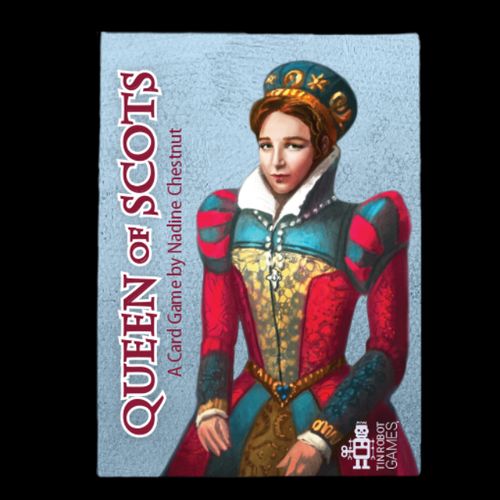
Queen of Scots Card Game
Queen of Scots Rulebook
Table of Contents
Table of Contents
The Rules
Set-up
Remove the 4 royalty reference cards from the deck and give one to each player to be placed face-up on the table for reference throughout the game. They are not playable cards and are there for reference only. These are to remind you of which cards are part of the royal family.
Choose a player to shuffle and deal the cards. Start by dealing 11 cards to each player and finishing with one card turned up beside the deck. The person immediately to their left goes first and will be the scorekeeper. Each player takes turns dealing, in clockwise order. The first player to reach a cumulative score of 1000 wins. If 2 players cross 1000 on the same turn, the person with the highest score wins. Keep track of scores on a piece of paper.
Taking Your Turn
On each player's turn; you start your turn by picking up a card and you end your turn by discarding a card face-up on the face-up pile.
When you pick up a card, you can pick up a card from the face-down pile or pick up the entire face-up pile, based on the most recent discarded card. To do this, you must have at least 2 cards (in your hand) that match the face-up card and place them down in front of you with this top facing card. The remainder of the cards from the face-up pile go into your hand unless you can place any of them down, either by making a new set or adding to an existing set with matching cards. You can only pick up the pile by matching to cards in your hand, not that which is already on the table. During your turn, you can choose whether to place down sets of cards, add cards to current sets, or hang on to cards. Your strategy will drive your decisions. When placing a set down, it goes on your side of the table only. At the end of a round, any cards on your side of the table count toward your score. Any cards in your hand are deducted from your score. You can only place cards down onto your own sets.
Card values are indicated on the bottom right of each card.
You can make a set of matching cards in front of you if you have 3 or more of the same card. You cannot mix and match cards unless they are part of the royal family (see below). You can place as many wild cards that you wish with a set, but the initial set MUST CONTAIN at least two matching cards or 2 cards from the royal family. You can add matching cards or wild cards to any set on the table in front of you during your turn.
A round ends when a player can completely empty their hand by placing their last card with a set on the table or the discard pile.
Scores are counted at the end of each round. It is possible to go into the negative and scores should be tracked accordingly.
The Royal Family
The royal family (indicated by a crown over the coin):
Any member of the royal family can be paired with each other (including duplicates of King James). If placed down as an initial set, they can be matched with a wild card as long as at least 2 members of the royal family are placed down with the wild card. Royal family member cards are indicated by a crown over the coin in the bottom right-hand corner.
The Crown Jewels (Wild)
The crown jewels are wild. This card can be placed with any two matching cards to form a set. It can also be added to any set that is already on the table. If this card is face-up on the discard pile, it may be picked up if you have two crown jewels in your hand. You must show the other players that you have two in your hand to qualify but are only required to immediately play the wild card that was picked up. You cannot pick it up if you cannot immediately play it.
Special Considerations
Cards on the table do not move. You cannot pick a card back up (such as a wild card) and use it for something else. Once you discard at the end of your turn. You cannot make changes to card combinations that have already been played. You can add to any sets you have on the table during your turn.
The Characters
Mary Stuart (Mary I), reigned over Scotland from 14 December 1542 to 24 July 1567. Mary, the only surviving legitimate child of King James V of Scotland, was six days old when her father died and she acceded to the throne. She spent most of her childhood in France while Scotland was ruled by regents, and in 1558, she married the Dauphin of France, Francis. Mary was queen consort of France from his accession in 1559 until his death in December 1560. Widowed, Mary returned to Scotland, arriving in Leith on 19 August 1561. Four years later, she married her half-cousin, Henry Stuart, Lord Darnley, and in June 1566 they had a son, James. On July 24, 1567, while imprisoned in Loch Leven Castle, Mary was forced to abdicate in favour of her one-year-old son James. After fleeing to England in 1568, with the hopes that Elizabeth I would help her regain her throne, she was placed in protective custody at various castles throughout England until her execution on February 8th, 1587.
Henry Stuart, Lord Darnley (7 December 1545 – 10 February 1567) was the second Husband to Mary Stuart. The union infuriated England's Queen Elizabeth, who felt the marriage should not have gone ahead without her permission, as Darnley was both her cousin and an English subject. Elizabeth felt threatened by the marriage, because as descendants of her aunt, both Mary and Darnley were claimants to the English throne and their children, if any, would inherit an even stronger, combined claim.
David Rizzio (1533 – 9 March 1566), was an Italian courtier, who rose to become the private secretary of Mary, Queen of Scots. Mary's husband, Lord Darnley, is said to have been jealous of their friendship, because of rumours that he had impregnated Mary. Darnley joined in a conspiracy of Protestant nobles, led by Patrick Ruthven, 3rd Lord Ruthven, to murder Rizzio. Mary was having dinner with Rizzio and a few ladies-in-waiting when Darnley joined them, accused his wife of adultery and then had someone murder Rizzio, who was hiding behind Mary. Mary was held at gunpoint and Rizzio was stabbed 57 times. The murder was the catalyst for the downfall of Darnley, and it had serious consequences for Mary's subsequent career.
Sir Nicholas Throckmorton (circa 1515/1516 – 12 February 1571) was an English diplomat and politician, who was an ambassador to France and played a key role in the relationship between Elizabeth I and Mary, Queen of Scots.
William Cecil, 1st Baron Burghley (13 September 1520 – 4 August 1598) was an English statesman, the chief advisor of Queen Elizabeth I for most of her reign, twice Secretary of State (1550–1553 and 1558–1572) and Lord High Treasurer from 1572. Burghley set as the main goal of English policy the creation of a united and Protestant British Isles. His methods were to complete the control of Ireland and to forge an alliance with Scotland. In 1587, Cecil persuaded the Queen to order the execution of the Roman Catholic, Mary Queen of Scots, after she was implicated in a plot to assassinate Elizabeth.
James Hepburn (c. 1534 – 14 April 1578), 1st Duke of Orkney and 4th Earl of Bothwell (better known simply as Lord Bothwell), was a prominent Scottish nobleman. He was known for his association with, abduction of, and marriage to Mary, Queen of Scots, as her third and final husband. He was accused of the murder of Mary's second husband, Henry Stuart, Lord Darnley, a charge of which he was acquitted. His marriage to Mary was controversial and divided the country. When he fled the growing rebellion to Scandinavia he was arrested in Norway and lived the rest of his life imprisoned in Denmark.
Robert Dudley, 1st Earl of Leicester (24 June 1532 – 4 September 1588) was an English statesman and the favourite of Elizabeth I from her accession until his death. He was a suitor for the Queen's hand for many years. Dudley was involved in domestic, as well as, foreign politics alongside William Cecil and Francis Walsingham. Although he refused to be married to Mary, Queen of Scots, Dudley was for a long time relatively sympathetic to her until, from the mid-1580s, he strongly advocated for her execution.
Loch Leven Castle: Both Protestants and Catholics were shocked that Mary would marry the man accused of murdering her husband. The marriage was tempestuous, and Mary became despondent. Twenty-six Scottish peers, known as the confederate lords, turned against Mary and Bothwell, raising an army against them. Mary and Bothwell confronted the lords at Carberry Hill on 15 June, but there was no battle as Mary's forces dwindled through desertion during negotiations. Bothwell was given safe passage from the field, and the lords took Mary to Edinburgh, where crowds of spectators denounced her as an adulteress and murderer. The following night, she was imprisoned in Loch Leven Castle on an island in the middle of Loch Leven. Between 20 and 23 July, Mary miscarried twins. On 24 July, she was forced to abdicate in favour of her one-year-old son James. Moray was made regent while Bothwell was driven into exile. He was imprisoned in Denmark, became insane and died in 1578.
Fotheringhay Castle: On 1 February 1587, Elizabeth I signed the death warrant, and entrusted it to William Davison, a privy councillor. On 3 February, ten members of the Privy Council of England, having been summoned by Cecil without Elizabeth's knowledge, decided to carry out the sentence at once. At Fotheringhay Castle on the evening of 7 February 1587, Mary was told that she was to be executed the next morning. She spent the last hours of her life in prayer, distributing her belongings to her household, and writing her will and a letter to the King of France. The scaffold that was erected in the Great Hall was draped in black cloth. It was reached by two or three steps and furnished with the block, a cushion for her to kneel on and three stools, for her and the earls of Shrewsbury and Kent, who were there to witness the execution. The executioners (one named Bull and his assistant) knelt before her and asked forgiveness, as it was typical for the executioner to ask the pardon of the one being put to death. She replied, "I forgive you with all my heart, for now, I hope, you shall make an end of all my troubles." Her servants, Jane Kennedy and Elizabeth Curle, and the executioners helped Mary to remove her outer garments, revealing a velvet petticoat and a pair of sleeves in crimson brown, the liturgical colour of martyrdom in the Catholic Church, with a black satin bodice and black trimmings. As she disrobed, she smiled and said that she "never had such grooms before ... nor ever put off her clothes before such a company". She was blindfolded by Kennedy with a white veil embroidered in gold, knelt on the cushion in front of the block, on which she positioned her head, and stretched out her arms. Her last words were, In manus tuas, Domine, commendo spiritum meum ("Into thy hands, O Lord, I commend my spirit").
A Gruesome End: Mary was not beheaded with a single strike. The first blow missed her neck and struck the back of her head. The second blow severed the neck, except for a small bit of sinew, which the executioner cut through using the axe. Afterwards, he held her head aloft and declared, "God save the Queen." At that moment, the auburn tresses in his hand turned out to be a wig and the head fell to the ground, revealing that Mary had very short gray hair.
A Skye terrier, Geddon kept Mary company during the last few years of her life when she was kept imprisoned by her cousin, Queen Elizabeth I. At her execution, Mary moved slowly to the scaffold and placed her head on the block, where the executioner beheaded her. As her body was being removed, those present noticed a rustling under her clothes. Under her petticoat was a terrified Geddon. The executioner tried to take him away but he escaped, running back to his mistress and curling up between her body and her severed head. The loyal little dog ended up covered in her blood and was forcibly taken away to be washed.
James VI and I (James Charles Stuart; 19 June 1566 – 27 March 1625) was King of Scotland as James VI from 24 July 1567 and King of England and Ireland as James I from the union of the Scottish and English crowns on 24 March 1603 until his death in 1625. The kingdoms of Scotland and England were individual sovereign states, with independent parliaments, judiciaries, and laws, though both were ruled by James in personal union. James was the son of Mary, Queen of Scots, and a great-great-grandson of Henry VII, King of England and Lord of Ireland, positioning him to eventually accede to all three thrones. James succeeded to the Scottish throne at the age of thirteen months, after his mother was compelled to abdicate in his favour. Four different regents governed during his minority, which ended officially in 1578, though he did not gain full control of his government until 1583. In 1603, he succeeded the last Tudor monarch of England and Ireland, Elizabeth I, who died childless. He sponsored the translation of the Bible into English that would later be named after him: the Authorized King James Version. He continued to reign in all three kingdoms for 22 years until his death, a period known as the Jacobean era.
John Knox (c. 1514 – 24 November 1572) was a Scottish minister, theologian, and writer who was a leader of the country's Reformation. He was the founder of the Presbyterian Church of Scotland. He continued to serve as the religious leader of the Protestants throughout Mary's reign. In several interviews with the Queen, Knox admonished her for supporting Catholic practices. When she was imprisoned for her alleged role in the murder of her husband Lord Darnley and forced to abdicate her throne to her son, Knox openly called for her execution.
Elizabeth I (7 September 1533 – 24 March 1603) was Queen of England and Ireland from 17 November 1558 until her death on 24 March 1603. Elizabeth was the last of the five monarchs of the House of Tudor.
Elizabeth was the daughter of Henry VIII and Anne Boleyn, his second wife, who was executed two-and-a-half years after Elizabeth's birth. Anne's marriage to Henry VIII was annulled, and Elizabeth was declared illegitimate. Her half-brother, Edward VI, ruled until his death in 1553, when Elizabeth's sister Mary had Lady Jane Grey executed and took the crown. During Mary's reign, Elizabeth was imprisoned for nearly a year on suspicion of supporting Protestant rebels.
In 1558 upon Mary's death, Elizabeth succeeded her half-sister to the throne and set out to rule by good counsel. The Queen's health remained fair until the autumn of 1602 when a series of deaths among her friends plunged her into a severe depression. In March, Elizabeth fell sick and remained in a "settled and unremovable melancholy", until she died on 24 March 1603. A few hours later, Robert Cecil (Son of William) and the council set their plans in motion and proclaimed James VI of Scotland as King of England.
Source: Wikipedia