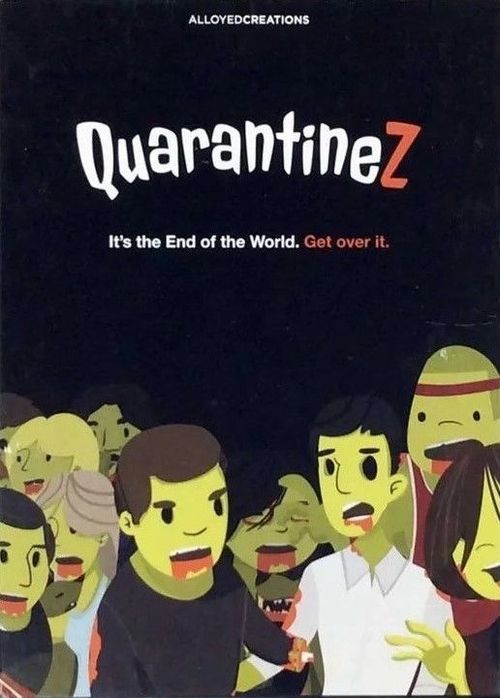
Quarantine Z
Quarantine Z Rulebook
Table of Contents
Table of Contents
Introduction
Quarantine Z is a survival card game for 3-5 players. It takes place in a town, city or neighborhood that has been infested with a Zombie outbreak. The Department of Inexplicable Events has placed the area under quarantine; nothing can get out of the area until the zombie threat runs its course. One player plays as the Zombies, whose goal is to kill all Survivors. The remaining Players are Survivors, whose goal is to collect supplies and find shelter to outlast the zombie threat and the quarantine.
You Will Need
- Quarantine Z Deck.
- 54 Zombie Cards (The Zombie Deck, denoted by a Z on their backs)
- 12 Action Cards (Denoted by the QZ on their backs)
- 36 Supply Cards – (S cards) Items and Equipment
- 27 Munition Cards – (M cards) Weapons and Ammunition
- 18 Building Cards – (B cards) Locations that you can visit
- A Six-sided die. (It is recommended that you have 1 for each Survivor)
You May Want
Some find it easier to keep track of how much Life their character and zombies have using some of the following.
- Pen and paper.
- Pennies, buttons, or other small objects to be used as tokens during play.
Setting Up the Game
- Select a Zombie Player. The rest of the players are Survivors.
- Separate and shuffle the different decks of cards — Supplies (S), Munitions (M), Zombies (Z), and Buildings (B).
- Give each Survivor a set of Action (QZ) cards — Fight, Shoot, Escape.
- Deal 10 Building Cards (B) face up — this is the quarantine area.
- Each Survivor draws either a Supply or Munition card into their hand. They may look at this card. They may do this until they have drawn 4 total cards. The Zombie Player draws 4 cards from the Zombie (Z) deck.
Playing the Game
Playing a Survivor
Winning and Losing: Survivors win the game when the Zombie Player has no more cards in their deck and their hand. They lose if at any point they run out of Life (Survivors start with 3, don't worry there are cards that can heal you). There are two methods for getting rid of cards in the Zombie deck: finding Shelter and waiting the Zombies out, or blowing them to pieces.
Waiting Them Out: Zombies eventually die off from lack of food. If you can find food to last you, and a place to hole up, you can wait for the Zombies to die off. While at a Shelter, the Survivors may play a Supply Card for each living Survivor, the Zombie Player must discard 6 cards from the game. Survivors may do this as many times as they please at any given Shelter. The Zombie Player may discard cards from their deck or their hand. The fewer Survivors there are, the easier it is to wait out the Zombies.
Fighting Them: Every time you visit a Location, the Zombie Player has an opportunity to play a Zombie and Survivors have a chance to kill it. Zombies have an amount of Life indicated on their card. When a Survivor damages the Zombie its Life is reduced. When a Zombie drops to 0 Life, it is dead (again). The more Survivors you have, the easier it is to fight them off.
Gameplay: Survivors can have up to 6 Supply and/or Munition cards in their hand. While not in combat, Survivors can: use and equip items, trade items with each other (or steal them), and ambush other Survivors.
Use/Equip Items: Survivors can play non-combat items at any time while they are not in combat (though some require additional conditions). They may also equip any number of equipment cards. They do this by playing them face-up in front of themselves. Once a card has been played face-up in this way, it may never be played face-down. Survivors may not equip two items of the same name. Equipped items are not considered to be part of your hand.
Trade: What good are Bullets without a gun? And what good is a gun without Bullets? Survivors may trade items with each other. Remember, Survivors cannot exchange cards in the middle of Combat. Additionally, if another Survivor isn't paying attention, it is perfectly legal to steal their Supply cards, Munition cards, or Equipment. Just watch out for retribution.
Ambush: It's a harsh world out there. Survivors can betray and ambush each other for any reason or no reason at all. To ambush another Survivor, play either your Fight or Shoot cards and resolve that action. This is considered a free attack, so they cannot immediately respond. After the attack is resolved, then all Survivors enter combat and follow the normal combat rules.
Zombie Player
Winning and Losing: The Zombie Player wins once all Survivors are dead. The Zombie Player loses if they run out of cards in their hand, and cards in their deck.
Gameplay: The Zombie Player is limited to 8 cards in their hand. They may draw cards whenever Noise is made. To try and kill off Survivors, they get to play zombies that attack them.
Playing a Zombie: The Zombie player may only play a Zombie during the Zombie! step of the On the Move phase (more on that later) or by playing a card that allows them to do so. To play a Zombie, the Zombie Player plays any card in their hand face-down, or any card that says "This is a Zombie" face-up. These Zombies may be modified with Mutation cards, cards that change the Zombies statistics and behavior. No mutation may be played twice on the same zombie. If the Zombie Player so desires, they may draw a card instead of playing a Zombie. Once Zombies have been played, play moves into Combat.
Some Zombie Cards are able to be played "when you could play a Zombie." If the Zombie Player chooses to play one of these cards, they follow the instructions on the card, and play proceeds as normal.
Game Phases
In Quarantine Z Survivors are either On the Move, At a Location, or In Combat. By taking various actions, Survivors transition from one phase or the other. Zombie Players can typically cause combat by playing Zombies. These phases repeat until the Zombie Player is out of cards or until all Survivors have perished.
On the Move
The game starts in the On the Move phase. Survivors who are On the Move, have left a location to travel to another. This phase of gameplay follows 4 Steps: Decide, Sneak, Zombies!, and Loot.
All the Survivors must decide on a location to travel to. Any disputes can be settled civilly or violently. All Survivors must go to the same location. In order to not attract undead attention, Survivors must sneak to their destination. To do this, each Survivor rolls a die. Each Survivor who rolls a 3 or below makes Noise. Once each Survivor has rolled, the Zombie Player draws a Zombie Card for every Noise made.
Once at the location, the Survivors must check for Zombies! At this point, the Zombie Player may play a Zombie that the Survivors must fight or escape from. If a Zombie is played, then Combat immediately begins. This happens each time the Survivors travel to a location, not just the first.
After successfully resolving Combat (or if no Combat occurred) the Survivors can loot the location. If it's the first time the Survivors have successfully arrived there, draw an additional number of cards face-down as indicated by the building's Supply and Munition values. If it's a variable location (such as a House) have one player roll a die to determine what is there. Mark this location as being "looted" (we like to turn the card sideways).
The game now moves to the At a Location phase.
At a Location
Survivors can do several things while only at a location. They can: collect items, stash items, use items that are there, use any special properties of the location, and leave.
Collect: Any cards that are at a building can be claimed by a Survivor. If no other Survivor objects, they get to take the card into their hand. If another Survivor has an objection, they can either settle it civilly, or violently (by one Survivor ambushing the other); the only rule is, nobody gets the card until disputes are settled. Survivors who successfully "Escaped" from the previous combat may not object (either civilly or violently) until the non-Escaping Survivors have finished Collecting their loot.
Stash: If a Survivor has too many cards, they may choose to "Stash" a card at the location. Place the card face-down under the location. It is then considered to be at the location and collected by the normal collection rules.
Use/Equip: Items that are at a location can be used or equipped just like items that are in a Survivor's hand. Using items in this way is subject to the same limitations as Collecting (there can be no objections).
Special Properties: Some locations have special properties, like the Shelter property. These properties may be used whenever the Survivors are not in combat while at that location.
Leave: The Survivors may choose to leave the location and transition to the On the Move phase at any time.
Combat
Combat interrupts whichever phase it starts in, either by a Zombie being played, or by a Survivor ambushing another Survivor. It's comprised of 4 Steps: Decide, Declare, Resolve… and Zombie. Survivors are unable to trade or steal cards during combat, or equip or use non-combat items.
- Decide: Survivors decide which action to take — Fight, Shoot, or Escape — and lay this card face-down on the table.
- Declare: Survivors simultaneously flip their cards face-up, revealing which action they've decided to take. At this point, each Survivor declares the target of their action. Since Survivors may target other Survivors at this time, some Survivors prefer to "Roll Initiative," that is, each Survivor rolls a die and declares their target in order from lowest roll to highest roll (though this is entirely unnecessary). Survivors may play Combat Items at this time. Survivors may also choose to Pass by leaving their card face-down, taking no action this turn.
- Resolve: Survivors resolve the outcome of their actions, by rolling a six-sided die, and following the instructions on the Action card they played. Damage is dealt to targets of Fight and Shoot actions, and Survivors attempting to Escape either succeed and escape combat, or fail and are stuck in combat. Any Zombies who are killed are removed from play at the end of this Step.
- Zombie: The Zombie Player is able to deal damage for each Zombie still alive, as indicated by their card. If any Survivors target a Zombie with the "Fight" command, that Zombie must deal damage to one of them, otherwise, it is able to damage any Survivor who hasn't successfully escaped. The Zombie Player now draws a card for each Noise made during the round. If a Survivor has died, any Supplies or Munitions in their hand are laid face-down at the current Location. Any equipment they had equipped is laid face-up at the current Location.
Repeat this sequence until all Survivors have died or escaped, or until no Zombies remain in combat (and no Survivors are still trying to kill one another). Once combat has ended, Survivors return to the phase they were in prior to entering Combat unless otherwise prompted.
Escaping from Combat
When a Survivor attempts to escape from Combat, they must roll a number greater than or equal to the Escape Value. If a Survivor successfully escapes, they are excluded from play until Combat ends and Loot has been collected. In the event that all Survivors escape, they immediately transition to the On the Move phase, and any Zombies still alive remain at the previous location and return to full Life.
Calculating the Escape Value
The Escape Value is calculated by adding all Escape Value modifiers. These modifiers come from the location of Combat, Zombies and other various items or effects.
Escape Bonuses
Any Survivor trying to escape receives a +1 bonus to their roll for each other Survivor at that location not also trying to escape — including Survivors who have already been killed during this combat.
Glossary
Noise: Certain cards or events indicate that they make Noise. For each Noise made, the Zombie Player may draw a card (if they are able to). Normal combat does not generate Noise.
Headshot: This is an instantly lethal attack. It deals no damage but instead instantly kills whatever it hit. (In the case of the Horde, this counts as a hit, in the case of Survivors it doesn't damage Armor, but does still kill them)