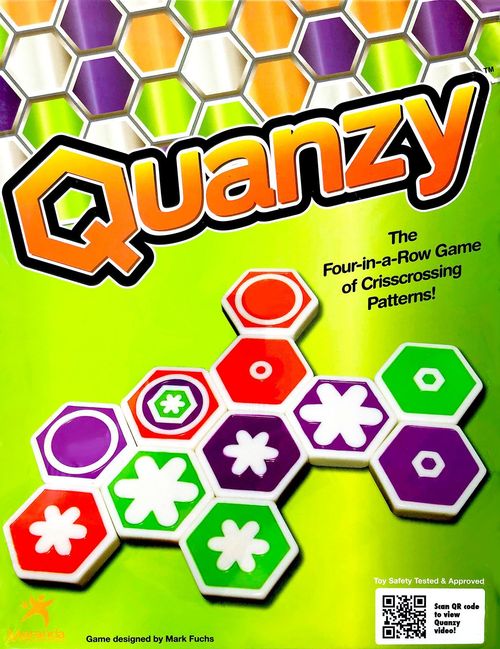
Quanzy
Quanzy Rulebook
Table of Contents
Table of Contents
Hexagons
Everybody familiarize yourselves with the hexagonal tiles, of which no two are exactly alike. Each has a symbol with three attributes: shape (hexagon, circle, and asterisk), size of the shape (large, medium, and small), and color of the background: (orange, purple, and green).
Set Up
Find the Wild Tile, (the only tile with all nine attributes) and place it face-up in the center of the table. (See Figure 1) Place the rest of the tiles face-down, and scramble them to form the "pool." Each player takes three tiles and stand them up on edge facing you, so nobody else can see them.
Figure 1: Wild Tile
Wild Tile
The Wild Tile earns it's name from the fact that in contains all 9 attributes. Any tile placed next to the automatically has all of it's attributes in common.
To Play
Choose a player to go first. The first player places a tile next to the Wild Tile. This is simple, because every tile can be played next to the Wild Tile, but things will get more complicated as the game goes on! Play then passes to the person on the left. On your turn, place one of your tiles adjacent to one on the table that has at least one attribute in common with yours.
Study the diagram below, which shows tiles that can be played adjacent to others because of their matching attributes. Notice that to place any tile, it must have a least one common attribute with at least one other tile it touches. Watch your opponents and make sure their placements satisfy this rule.
Once you've played your tile, take another one from the pool, and your turn ends.
Examples of Attributes in Common
The diagram shows pairs of touching tiles, each marked with a letter. The key to the letters is:
- A: Both shapes are medium size
- B: Green, Asterisk, Medium
- C: Purple, Hexagon, Medium
- D: Both shapes are hexagons
- E: Green, Hexagon, Small
- F: Orange, Hexagon, Large
- G: Both shapes are hexagons
- H: Both shapes are small
- I: Both backgrounds are orange
- J: Nothing (However, this is a legal move because it is touching tile K)
- K: Both shapes are circles
What Ifs
If the pool is empty before anybody completes a straight row of four adjacent tiles, keep playing until your own tiles are all played.
If still no one has completed a straight row of four when the pool is empty, and you're out of tiles, you may slide a previously played tile to a new position. You may not pick it up, or move any other tiles to do so. You may not slide a tile, if doing so would separate one or more remaining tiles from the connected group on the table.
Hint
Try not to place a tile which creates "three in a row" of any particular attribute.... this could set up one of your opponents for the win!
Winning
If you're first to complete a straight row of four tiles, you win!