Quantum tic-tac-toe
Quantum Tic-Tac-Toe Rulebook
Table of Contents
Table of Contents
Basic Rules
The rules for Quantum Tic-Tac-Toe are the same as for Classical Tic-Tac-Toe, with the additions below.
Quantum Moves
On each move, the current player marks two squares with their letter (X or O), instead of one, and each letter (X or O) is subscripted with the number of the move (beginning counting with 1). The pair of marks are called spooky marks. Because X always moves first, the subscripts on X are always odd and the subscripts on O are always even.
Players take turns making quantum moves with X going first. Quantum moves consist of a pair of "spooky" marks, either X's or O's subscripted with the number of the move. In a quantum move, two different squares are marked at once - a quantum move looks like a classical move that is half in one square and half in another.
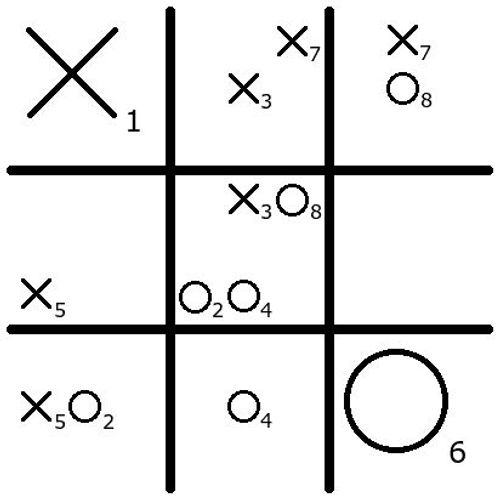
For example, player 1's first move might be to place "X1" in both the upper left and lower right squares. The two squares thus marked are called entangled. During the game, there may be as many as eight spooky marks in a single square (if the square is entangled with all eight other squares).
Entanglement
Quantum moves may entangle by sharing squares. An entanglement arises when two or more quantum moves share a square.
Cyclic Entanglement and Collapse
A cyclic entanglement is a cycle in the entanglement graph, and it occurs whenever there is a path from one square back to itself. For example, if:
- square 1 is entangled via move X1 with square 4, and
- square 4 is entangled via move X3 with square 8, and
- square 8 is in turn entangled via move O4 with square 1,
then these three squares form a cyclic entanglement.
At the end of the turn on which the cyclic entanglement was created, the player whose turn it is not - that is, the player who did not create the cycle - chooses one of two ways to "measure" the cycle and thus cause all the entangled squares to "collapse" into classical tic-tac-toe moves. In the preceding example, since player 2 created the cycle, player 1 decides how to "measure" it. Player 1's two options are:
- X1 collapses into square 1. This forces O4 to collapse into square 8 and X3 to collapse into square 4.
- X1 collapses into square 4. This forces X3 to collapse into square 8 and O4 to collapse into square 1.
Any other chains of entanglements hanging off the cycle also collapse at this time. For example, if square 1 were also entangled via O2 with square 5, then either measurement above would force O2 to collapse into square 5. It is impossible for two or more cyclic entanglements to be created in a single turn.
On a cyclic entanglement, the other player chooses the collapse to classical moves, indicates the kept halves, one per square, and eliminates the others. In a collapse the spooky marks are replaced with classical marks.
When a move collapses into a single square, that square is permanently marked (in larger print) with the letter and subscript of the collapsed move - a classical mark. A square containing a classical mark is fixed for the rest of the game; no more spooky marks may be placed in it.
Winning and Scoring
The first player to get 3 in a row of classical moves (horizontally, vertically, or diagonally) wins.
Since it is possible for a single measurement to collapse the entire board and give classical tic-tac-toes to both players simultaneously, the rules declare that if there are multiple 3-rows, the earliest in time gets a full point and the later gets a half point. An earlier-in-time 3-row is the one with the lower largest subscript. So the player whose tic-tac-toe has the lower maximum subscript earns one point, and the player whose tic-tac-toe has the higher maximum subscript earns only one-half point.