Quantum Leap
Quantum Leap Rulebook
Table of Contents
Table of Contents
Components
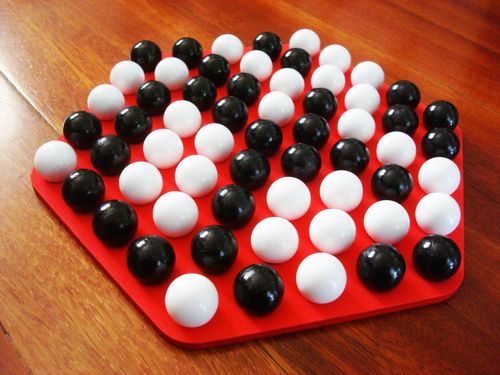
- A hexagonal board with 61 holes.
- 30 white particles and 31 black particles (balls)
- Carrying case
Game Preparation
Place the board in the middle of the playing surface.
Randomly distribute the supply of balls (30 white and 31 black) on the board holes, so each hole contains only one particle. Black has an extra particle to counteract White's first player advantage.
How to Play
Each player has an allocated colour (White or Black).
White starts the game. Players alternate turns during the game until one of them cannot make a valid move, thereby losing the game.
On your turn, you must make one capture. A particle makes a capture by leaping in a straight line in any of the 6 directions radiating from it exactly as many spaces as friendly particles surround its original position, and landing on an enemy particle, which is removed from the game (the attacking particle occupies its place). Particles can leap over other particles.
Example of capture: The white particle is surrounded by 3 friendly particles, so it leaps exactly 3 spaces to capture the black particle.
Aim
The last player making a legal move wins the game.
Endgame example: White cannot make a legal capture and loses the game.
Strategy Tips
Quantum Leap lacks some visual clarity, as it takes a bit of time to spot the possible moves, specially long jumps. However, if you follow some basic guidelines, you'll be able to focus only on those moves that really matter.
Isolated particles (solitons) cannot capture, so try to keep your particles connected in groups of at least 2.
For the same reason, try to isolate the opponent's particles by cutting out 'arms'.
Example: White 'arms' indicated in red. Cut out an arm to isolate a ball. Solitons indicated in blue.
You can 'rescue' a friendly isolated particle by capturing an adjacent opponent's particle.
'Compact' groups are harder to split and some configurations even allow quick re-connections:
Example: If the ball marked with a red dot is captured, the group can be re-arranged again by re-capturing the cell.
However, long jumping potential (5-6 spaces) might not be a good idea, as it will be limited by the edges of the board. Also, balls on the edge have limited jumping directions. Try to move them towards the centre of the board.
Puzzle
Can you setup the board up such that one of the white particles can make a sequence of 31 leaps that captures all black particles?