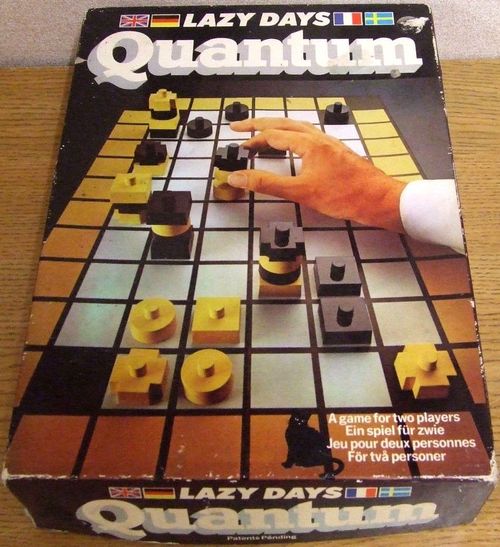
Quantum
Quantum Rulebook
Table of Contents
Table of Contents
Introduction
Quantum is a game for two players. The aim of the game is to take over, or convert, your opponents' pieces to your own side.
Each player starts with sixteen interlocking pieces: six squares, six circles and four crosses.
Whatever colours are used for quantum pieces, one side is darker than the other and the two sides are usually referred to as black and white.
Players move alternately, white being the first to play. A player may not miss a move.
Setting up the board
The board can be used in two different ways:
(a) the whole board can be used (10 squares by 8 squares)
(b) the outer coloured squares can be ignored and the game played on the central 60 squares. When the inner board is being used pieces may never be moved onto the outer squares.
For beginners, or for a shorter game, the inner board is recommended.
Starting positions for the game on the inner board: the printed rules show the starting diagram, with each player's six squares, six circles and four crosses placed in the arrangement shown on the inner board.
How the pieces move
For the game on the full board all pieces move outwards one square, so the same positions are taken up at the edges of the board.
Each piece can move one square at a time. The different shapes move in different ways.
- Square: moves straight forward, backwards or sideways.
- Circle: moves diagonally.
- Cross: can move in any direction.
How pieces take over
Pieces take other pieces over by moving on top of them. They can only do this in their normal direction of movement. They may not join up with pieces on their own side. By this process they form towers, which have greater power of movement.
Towers
A tower belongs to the player whose colour is on top. It moves in a straight line in the normal directions of movement of the piece on top, whether this is a square, circle or cross. However, it can now move further.
It can move any number of squares up to the number of pieces which make it up, e.g. a four high tower could move one, two, three or four squares during any move.
Neither single pieces nor towers ever jump over other pieces.
A four high tower with a circle on top can move up to four squares diagonally across the board.
Fixed towers
As soon as a tower becomes six or more high it can no longer move, take or be taken.
It becomes fixed at the point where it reaches six or over. It becomes more than six, if, say, a three high tower takes a four — or a five takes a five.
The black corner squares
There are four black corner squares on the board if the inner board is being used, eight if the whole board is in play.
These squares are power squares, and a piece standing on one can move as far as it likes. It still moves in its own particular direction, whether a cross, circle or square.
The Winner
The winner is the first player to build three fixed towers.
Resolving drawn games
If a position arises when it is not possible for either player to make three fixed towers the draw may be resolved by counting up the pieces under each player's control. The one with the most is the winner, provided he has at least one fixed tower.