Quando
Quando Rulebook
Table of Contents
Table of Contents
Material & Game Idea
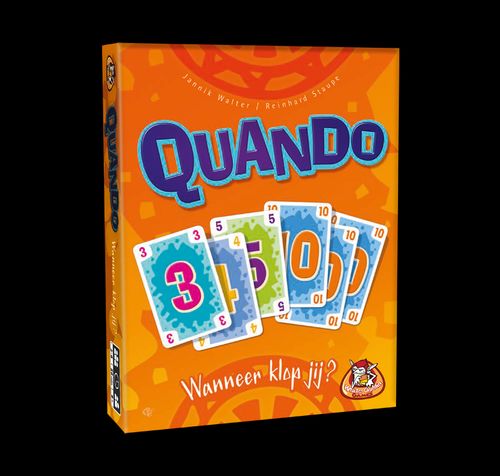
The 55 cards are printed on both sides and show two different numbers from 0-10 on the front and back.
Each number combination (0-1, 0-2, 0-3, etc.) exists exactly once. The colours of the numbers have no meaning, they only serve to make them easier to distinguish.
Each player has 7 cards in their hand at the start of a round (8 cards if there are two or three players). During the course of the game, each player tries to reduce the number of cards in their hand while minimising their value. Whoever has the lowest sum in their hand at the end of the round gets 0 points (it doesn't get any better than that!). All other players get their sum noted down. Several rounds are played. The game ends as soon as a player has 50 points (or more). The player with the fewest points is the winner!
Game Preparation
The 55 playing cards are shuffled well. It's best to shuffle a little first, then turn over a few cards and then shuffle well again so that the faces and reverses are shuffled well!
Each player is dealt 7 cards, which they take into their hand - 8 cards in a two-player and three-player game. Note: The cards must be placed in your hand as if the side that is face up after being dealt is the back (as when dealing normal playing cards).
Very important: You are not allowed to look at the reverse sides of your own cards as soon as you hold them in your hand, not even during the rest of the game!
The remaining cards are placed in the centre of the table as a draw pile. A discard pile is created to the right of the draw pile during the course of the game.
Game Process
The player to the left of the dealer begins. The game is played clockwise in turn. The player whose turn it is must first play cards and then draw exactly one card from the draw pile. Then it's the next player's turn in the same way. There are the following two options for playing the cards, of which the player whose turn it is must decide in favour of one, either A or B.
Option A: Playing Out a Straight
The player plays exactly 3 cards (never more or less) with consecutive numbers, e.g. 0-1-2 or 3-4-5 or 8-9-10. The cards are placed on the discard pile. The player then draws exactly one card from the draw pile and it is the next player's turn in clockwise order.
Maria plays a straight of 7, 8 and 9 and draws a card from the draw pile.
Option B: Playing Equal Numbers
The player plays any number of cards with the same number - this can also be just a single card, e.g. a 0 or a 7 or two 4s or five 6s (for "number triplet" special action, see below). The cards are placed on the discard pile. The player then draws exactly one card from the draw pile and it is the next player's turn in clockwise order.
Linus plays two 10s and draws a card from the draw pile.
Attention: The active player's action always and without exception ends when a card is drawn. It is never possible for a player to have no card in their hand at the end of their action. Everyone should work together to ensure that the active player does not forget to follow suit.
The following applies to drawing from the draw pile (at any time during the game!):
Whenever you draw a card from the draw pile and take it into your hand, you can either take the face-up side or choose the face-down side. If you decide in favour of the face-down side, you take the previously face-down side into your hand.
Attention: If you decide in favour of the face-down side, then that's what you'll do! You must not look at the face-down side first and then decide in favour of the face-up side again.
Special Action: Number Triplet
With option B, there is a special case that you can use to annoy the other players a little. If the player whose turn it is plays exactly three cards with the same number (regardless of the number), the following happens to the other players after he has drawn exactly one card from the draw pile:
- Whoever has a zero in their hand must turn over the zero. If a player has several zeros in their hand, they only has to turn over one zero of their choice (without looking at the reverse side of course).
- Whoever does not have a zero in their hand must draw a card from the draw pile and take it into their hand.
Note: The players perform their respective actions (flip a zero or draw a card) in clockwise order.
It is Tim's turn, he plays a number triplet (three 8s) and draws a card from the draw pile. In turn, the others must now carry out their "punitive action". Sarah has two zeros in her hand and turns over a zero. Maria has no zero in her hand and draws a card from the draw pile. Linus also has no zero and draws a card from the draw pile. Now the game continues as normal. It's Sarah's turn.
Game tip: Whoever plays a number triplet should announce this loudly and clearly so that the other players are aware of it: "Number triplet - turn over zero or draw a card!".
Play continues in the same way until the current round ends.
Note: If the draw pile is exhausted, the discard pile is completely turned over (i.e. turned 180°) without shuffling it, neatly arranged and placed as a new draw pile.
End of the Round
A round can end in two different ways: 1.) Only zeros in the hand. 2.) Knock.
1.) If a player, after playing cards and then drawing exactly one card, has only zeros in their hand (no matter how many!), then the round ends immediately - no further action is taken (this applies at any point in the game, even for the last round if another player has knocked)!
It's Maria's turn. She has four cards in her hand, three 9s and one 0. She plays the three 9s and draws exactly one card from the draw pile. The card drawn also shows a 0. Maria therefore only has zeros in her hand after drawing, shows them and the round ends immediately (the "penalty action" for the number triplet is cancelled).
2.) When it is a player's turn, instead of playing cards and drawing exactly one card, they can tap the table and announce "last round". Now all the other players have exactly one more turn, then the round ends. The knocker can no longer take a turn. If one of the following players does not want to play any more cards in the last round, they simply say "Pass" and do nothing.
Note: Each player must have played at least two cards before knocking.
Very important: In the last round (after the knock) it is absolutely permitted and possible for a player whose turn it is to play a number triplet. The "Number triplet penalty action" (turning over zero or drawing a card) also explicitly applies to the player who knocked. The knocker is therefore taking a risk by knocking, as they may incur 5 penalty points, see "Noting the Score".
Furthermore: For the players, the question is always when is the right time to knock. This is exactly where the name of the game comes from, because "Quando" means "when" translated.
Noting the Score
Once the round is over, each player adds up the numerical values of all the cards they have in their hand (only the visible face sides). The points (sum of the numerical values) are recorded.
Note: The player with the lowest total is awarded 0 points (as the winner of the round, so to speak). If several players have the same lowest total, all these players receive 0 points.
Linus has knocked. After Tim, Sarah and Maria have had their turn, the round ends. Linus has 2 points in his hand, Tim 11, Sarah 6 and Maria 4. Linus is awarded 0 points (as the winner of the round), Tim 11, Sarah 6 and Maria 4 points.
Attention, very important: Once a player has completed the round by knocking, they must reach the smallest number alone. If this is not the case, the knocker receives 5 penalty points in addition to the total number of cards in their hand.
Sarah has knocked. After Maria, Linus and Tim have had their turn, the round ends. Sarah has 4 points in her hand, Maria 12, Linus 7 and Tim also 4. As Sarah knocked, but did not have the smallest number alone, she receives 5 penalty points in addition to the 4 points in her hand, i.e. a total of 9 points (4+5=9). Tim gets 0 points, Maria 12 and Linus 7 points.
Ending the Game
The game is played round after round in the manner described. After each round, the dealer changes in a clockwise direction. The game ends as soon as a player has 50 points (or more). The player with the fewest points is the winner. If there is a tie, there are several winners.
Tip: In a two-player game, you may want to set the end of the game a little lower, e.g. at 40 points.