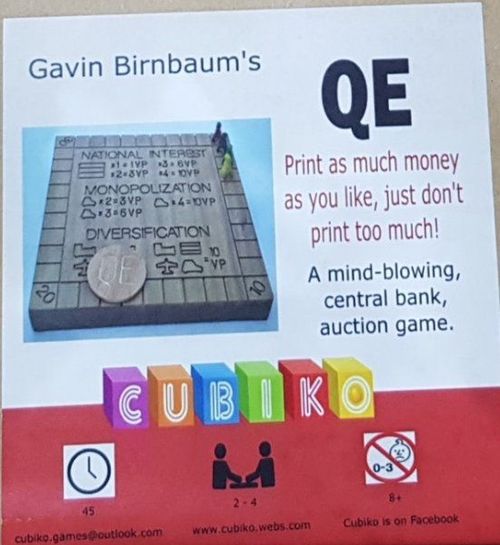
Q.E.
Q.E. Rulebook
Table of Contents
Table of Contents
Contents
1 board, 16 company tiles, 4 'industry' tokens, 4 nation tokens, 4 bid boards, 4 'No QE' marker, 4 VP cubes, 4 pens, 4 erasers, 1 Q 'round' marker, 1 E 'turn' marker and a VP card.
Objective
Bid for Victory Points (VP) with printed money. Win the highest amount of VP without bidding the highest total.
Setup
Set up cubes, erasers, pens, markers and boards
Give each player a VP cube, a 'No QE' marker, a pen, an eraser and a 'bid' board of the same colour. Place the 'No QE' marker face down. Put the VP cubes on the '0' square of the VP track.
Deal the tokens
- Deal one 'nation' token to each player, face up.
- Deal one 'industry' token to each player, face down. Players view their 'industry' token but must not disclose it to the other players. (Ensure that the 'nation' tokens are dealt first)
Organise the company tiles
The company tiles must be organised into 4 stacks of 4 tiles so that each industry icon (car, plane, train and bank) is represented in each stack.
- Group the company tiles by industry into 4 stacks then shuffle each stack face down.
- Deal each stack to create 4 new stacks then shuffle the new stacks. Place one of the stacks on the area marked 'stack'.
Game structure
The game is played over 4 rounds. Each round comprises of 4 company sales. Each sale has 5 phases.
Play
Decide who will start and give them the Q and E markers.
Phase 1 – 'Open' bid
You are the start player you have the 'E' marker. Reveal the top tile from the stack on the board and place it face up on the area marked 'SALE'. Write the amount you are prepared to pay to buy the company on your bid board and put it on the area marked 'OPEN' for all to see. You cannot bid zero. (For the very first sale, an opening bid of between 10 and 40 is recommended)
Phase 2 - Secret bids
Each of the other 3 players secretly write their bid for the company on their bid board and place it on the area marked 'SECRET'. The start player collects and views all the bid boards. (Secret bids must not be equal to the 'open' bid.)
Phase 3 - Record the winning bid and award the company tile
The start player announces which player submitted the highest bid and records the bid on the back of the company tile. If the start player made the highest bid they must record it openly for all to see, otherwise record it secretly. The highest bidder takes the company tile and places it, face up, in front of them for all to read. (The value of the bid must not be displayed.)
Phase 4 – Reveal zero bids and record VP
The start player reveals any zero bids. Players who bid zero receive 2 VP. (See Bidding zero).
Phase 5 - End of the sale
Players take back their 'bid' board and wipe it clean. Pass the 'E' marker clockwise and start the next company sale. (Phase 1)
End of Round
When 4 sales have been completed the round ends. Pass the 'Q' marker 1 player clockwise and pass the 'E' marker to that player too. Place another stack of 4 company tiles onto the area marked 'STACK'. Turn all 'No QE' markers face down. Start a new round.
End of game
After 4 rounds the game ends.
Victory points
There are five categories to resolve. Consider all of your company tiles for each category. Resolve VP in the following order:
- a) Company VP shown on the face of the tiles that you won.
- b) Nationalization — For winning tiles that match your nation token. 1 = 1pt. 2 = 3pts. 3 = 6pts. 4 = 10pts.
- c) Monopolization — For winning any industries of the same type. 2 = 3pts. 3 = 6pts. 4 = 10pts. Your 'industry' token counts as 1 in this category. You may monopolize and score across multiple types of industry.
- d) Diversification — For winning industries of different type. 3 = 6pts. 4 = 10pts. Your 'industry' token does not count for this category.
- e) QE — Add up the total of your winning bids. The player (or players) with the highest total lose all their VP. The player (or players) with the lowest total score 6VP.
Winner
The player with the most victory points wins. (In the event of a draw the player with the lowest total of winning bids is the winner.) If all players lose their VP then everyone loses.
Bids
Use whole numbers. Write clearly. Use the line on the bottom of the tiles to ensure bids are read the correct way round. The 'open' bid (phase 1) cannot be zero. Secret bids (phase 2) can be higher or lower than 'open' bid but cannot be the same amount.
Bidding zero
Once per round you may score 2VP by bidding 0 on your board. Only after phase 3, reveal your bid and turn your 'No QE' marker face up. Move your marker 2 spaces along the scoring track. At the end of the round turn your 'No QE' marker face down.
Equal bids
Players who place equal winning bids must rebid. Rebids override previous bids and can be any amount (except equal to the open bid). All bids (including non-tied ones) are then re-evaluated. If equal winning bids are submitted 3 times in a row the highest unique bid of the entire sale wins.
Keeping track of how much money you have created
During the game you may view your own winning bids.
Only 3 players? Here is how you can set up and play QE
After the normal set up, take 1 tile from each of the 4 stacks to form a new stack. Then take one tile from the new stack and place it on its own.
Play; Use the 5 stacks (of 3 tiles) to play 5 rounds. Then play a sixth round where each player submits a blind bid for the final company.