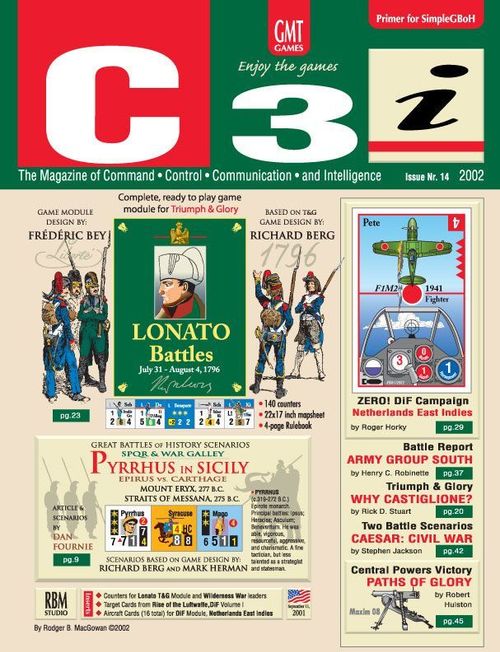
Pyrrhus in Sicily: Epirus versus Carthage, 278-275 B.C.
Pyrrhus in Sicily: Epirus versus Carthage, 278-275 B.C. Rulebook
Table of Contents
Table of Contents
Historical Background
Deputations
The story begins after the Pyrrhic Victory at Ausculum. It seems the Epirote monarch didn't relish the thought of more battles with the hydra-like Romans (every army he destroyed being replaced by two more). The Tarentines were becoming leery of their new guest, as well. At this point Pyrrhus received two very interesting invitations. A deputation of Macedonians offered him the crown of Alexander, as Ptolemy Keraunos had been slain in a Celtic invasion and the land was leaderless. However, another deputation was in Tarentum from Syracuse, reporting that the city was under siege by the Carthaginians, and offered Pyrrhus command of all the Sicilian Greeks. In a rare flash of strategic insight, Pyrrhus decided to go first to Sicily. The emergency there was more immediate, and he rightly judged Macedonia would remain ripe for the picking for some time. This proved a prescient estimation, for when Pyrrhus finally returned to Macedonia, he took the throne without serious opposition in 275.
Meanwhile, after the Battle of Ausculum, the Carthaginian admiral Mago arrived with a fleet at the port of Ostia. Mago visited the Senate in Rome and formed an alliance against Pyrrhus. As initially envisioned, Rome would fight on land and Carthage at sea. In their first joint operation, the Punic navy transported a Roman army to Rhegium to put down a rebellion of Campanian soldiers. The attack failed, and the two forces parted ways. However, some 500 Roman legionary marines were detached to the Carthaginian fleet for further operations. Mago sailed for Syracuse.
Back in Sicily, Syracuse had fallen into one of her cyclical periods of weakness and disarray following the death of the tyrant Agathocles (317-289). In addition, a large body of Campanian mercenaries had been paid off and sent packing. Pausing for a rest at Messana the Campanians treacherously slew all the male inhabitants and seized their homes and women for themselves. The mercenaries styled themselves "Sons of Mars,"—the Mamertines—and became a rival to Syracuse for the next few decades. Rid of the Campanians, Syracuse fell under control of the tyrant Hiketas, until he was overthrown by Thoinon in 279. Another general, Sosistratus, rose against Thoinon and plunged the city into civil war. The Carthaginians, sensing an opportunity, seized Agrigentum and besieged Syracuse. With an army of 50,000 mercenaries (undoubtedly a great exaggeration, 10,000 to 15,000 troops might be closer to the mark) and a fleet of 100 galleys under Mago, the Carthaginians pressed the siege. Thoinon and Sosistratus were forced to enter a truce and send their plea for aid to Pyrrhus.
Lightning Strikes Sicily
Pyrrhus posted strong garrisons in the cities of his Italian "allies," and readied an expeditionary corps of nearly 15,000 men. In the summer of 278 he sailed from Tarentum to Locri. With the Mamertines allied to Carthage, Pyrrhus avoided the Straits of Messana (Fretum Siculum), landing to the south at Tauromenium, where the tyrant Tyndarion joined his cause. Next, Pyrrhus sailed to Catana, which also voluntarily submitted. Then, Pyrrhus landed his army and marched on Syracuse, with his fleet paralleling at sea. Mago was short 30 ships, which were detached on an errand, and declined to challenge the 60 Epirote galleys with his own 70 ships. Instead, the Carthaginians abandoned the siege and withdrew both Mago's fleet and their army, allowing Pyrrhus into Syracuse, where both Thoinon and Sosistratus pledged allegiance to the Epirote King. More importantly, Pyrrhus gained access to the city treasury, its army and its fleet of 140 galleys. Mago had squandered Carthage's best opportunity to defeat Pyrrhus—at sea before he entered Syracuse.
Seeing which way the wind was blowing, Heraclides, tyrant of Leontini, joined Pyrrhus with 4,000 foot and 500 horse. The other Greek cities of eastern Sicily followed the lead of Heraclides. After incorporating his new allies into his army, Pyrrhus advanced along the coast to Agrigentum with his army and fleet (now 200 galleys). Even before he arrived, the Punic garrison fled. At Agrigentum, the Epirote army was joined by 8,000 infantry and 800 cavalry. These were reportedly crack troops, probably Greek mercenaries formerly employed by Carthage. By then it was autumn, and Pyrrhus went into winter quarters to plan his next campaign.
The Carthaginians appear to have hoped that Pyrrhus would return to Italy or Epirus after liberating Syracuse and Agrigentum. They had not counted on the limitless ambition of this Diadochian prince. Pyrrhus now mustered 30,000 foot, 2,500 horse and 19 elephants. As soon as the spring of 277 arrived, he embarked on the conquest of the Punic Epicraty, the western third of the island under Phoenician and later Carthaginian control for centuries. Selinus, Heraclea Minoa and Segesta fell in rapid succession. Finally at Mount Eryx the Carthaginians made a stand.
No details of this battle were recorded. We know only the size of Pyrrhus' army and the fact that the Punic army was routed in a battle. Recognizing the inferior quality of his troops, it seems probable that the Punic commander (possibly Mago) waited until enough mercenaries were recruited to outnumber the Epirotes. Considering the rapid growth of Pyrrhus' army, this may explain the long delay before battle was joined. Carthage may have mustered as many as 35,000 foot and 3,000 horse, from the usual sources: Numidian, Libyan, Mauretanian and other north African levies bolstered with Iberian, Balearic, Celtic and Ligurian mercenaries. The Carthaginian army likely sought rough terrain to nullify the Epirote juggernaut of phalanx, heavy cavalry and elephants. In the event, Pyrrhus appears to have taken advantage of the initiative surrendered by the Punic commander to rout the Carthaginian army.
The defeated Punic army found refuge in the fortress crowning Mount Eryx. Here the Carthaginians made a determined stand. Thirty years hence in the First Punic War, Hamilcar Barca would hold this fortress against Roman assaults for seven years (247-241) until a naval defeat forced his evacuation. It was definitely a tough nut to crack. The initial Epirote assaults were repelled with heavy losses. Pyrrhus, however, was not to be denied. He had additional siege engines brought from Syracuse. Once a breach in the walls was made, King Pyrrhus personally led the assault into the fortress. All resistance was overwhelmed. Another campaign season had passed.
Punic Vengeance
In the spring of 276, Pyrrhus quickly seized Erecte and Panormus. The conquest of the Punic Epicraty was complete, save for the fortress port of Lilybaeum. At this point, Pyrrhus turned back to deal with the Mamertines. These rapacious mercenaries controlled all of Northeastern Sicily, sending out tax collectors to oppress the Greeks and native Sicels of their sphere. The Epirote lieutenants began arresting and executing these tax gatherers. This struggle for financial control led to open warfare between the Epirotes and the Mamertines during the summer of 276. The Mamertines were driven out of their outlying outposts and forced back into the city of Messana. Pyrrhus left sufficient garrisons to pen the "Sons of Mars" in their lair. After two years campaigning, Pyrrhus assumed the title King of Sicily and appointed his son Alexander as heir and successor.
One task remained—to drive the Carthaginians from Sicily once and for all. However, as the Epirote army advanced on Lilybaeum, a Punic embassy arrived with terms. Carthage offered to end her alliance with Rome, permanently cede all the cities already lost, and provide tribute and ships if Pyrrhus would allow the retention of Lilybaeum and return to Italy. Indeed, his Italian allies were faring badly against Rome, and dispatching pleas for aid. His Epirote advisors recommended accepting the terms, but his Sicilian allies demanded the complete expulsion of the Carthaginians. Pyrrhus rejected the Punic offer and laid siege to Lilybaeum in the fall of 276. In the meantime, however, the city had been heavily reinforced. Though the Carthaginians could not meet the Epirote army in open battle, they remained tenacious siege warriors and crafty engineers. Every Epirote assault was beaten back in a cloud of bolts and stones. Mining efforts were counter-mined. Sorties burned the Epirote siege engines. After two months of futile effort, Pyrrhus was forced to break off the siege as winter approached.
Pyrrhus now proposed to his Sicilian allies that he would defeat Carthage by invading Africa. The Syracusan tyrant Agathocles had very nearly succeeded in this scheme just a decade earlier (310-307), and Pyrrhus had superior resources. During the winter of 276-275, Epirote officers began an aggressive campaign to conscript soldiers and sailors for the great expedition. Pyrrhus' popularity immediately began to wither. Too fearful to rebel openly, the Siciliot Greeks delayed preparations and resisted the draft. Back in Syracuse, Pyrrhus had Thoinon seized and executed. Was the Epirote King unduly paranoid, or was everyone plotting against him? Two millennia hence, it is difficult to judge. In any case, all of Pyrrhus' faults began to show. Never an able administrator or diplomat, he became increasingly autocratic when resistance to his rule hardened. A Punic army emerged from Lilybaeum to challenge the Epirotes. Pyrrhus routed this army as well, but now faced a guerrilla war against Punic mercenaries, Mamertines and native Sicel tribes. All the while, his allied Greek forces were deserting his army. Suddenly, the pleas from his allies in Italy seemed more urgent. It was time to leave.
Carthage had outlasted yet another Greek warlord. Pyrrhus left Hiero, a trusted Siciliot officer, in command of Syracuse. He even gave his daughter Nereis to marry Hiero's son Gelon. He left Hiero instructions to hold the city until his return. He never returned. Hiero became King Hiero II, and led the city through a long and prosperous reign (272-215). As he sailed from Sicily in the spring of 275, Pyrrhus reportedly commented "What a wonderful battleground I am leaving for Carthage and Rome."
Carthaginians still burned with hatred for Pyrrhus, and they knew he would have to enter their element—the sea—to leave the island. As Pyrrhus readied a fleet of 100 galleys, perhaps 50 small craft and 50 transports for the journey, Carthage sent a fleet of 100 galleys to Messana. This included the squadron with 500 Roman legionary marines. The Mamertines were happy to cooperate in dealing a parting blow to the would-be conqueror of Sicily. They probably contributed another dozen galleys and more than twice as many small pirate craft. Pyrrhus would not attempt the cross directly at the Straits of Messana, but the sailing methods of the day required him to come close to the narrowest point of separation between Sicily and Italy. Mago was waiting.
Pyrrhus may have been a genius in land warfare, but he wasn't much of an admiral. Sailing near the Straits of Messana, his fleet was waylaid by Mago and his Carthaginian squadron. In a confused battle, the Epirotes lost 70 galleys and many transports. Carthaginian losses were not recorded, but appear to have been quite light. Pyrrhus' fleet was crippled and his army losses were heavy. These veteran soldiers would be sorely missed at Beneventum later in the year. Carthage had her revenge!
Pyrrhus went down to defeat at Roman hands at Beneventum that summer, and finally abandoned his western adventure. Pyrrhus briefly seized the throne of Macedon, but was soon embroiled in a nasty war with Antigonus Gonatus. Pyrrhus died as befit a mercenary warlord—struck down by a roof tile while leading his men in a desperate street battle in Argos in 272. His foretelling of fighting between Carthage and Rome proved right on the mark—the First Punic War broke out eleven years after his departure from Sicily.
SOURCES: The history of Pyrrhus' campaigns comes from Diodorus Siculus and Plutarch. Good secondary accounts include C.A. Kincaid's Successors of Alexander the Great. For Carthage in this period, B. H. Warmington's Carthage: A History is recommended.
Battle of Mount Eryx, 277 BC
Pyrrhus, King of Epirus, & Sicily vs. Carthage. SPQR scenario.
Map: Use the Cynoscephalae map. The Punic army is drawn up facing south at the base of the mountain. It is in a defensive position, from fear of the elephants and phalanx.
Balance: Carthage has numbers and the uphill position. Pyrrhus has superior leadership, better troops and elephants and should have the advantage here. The challenge for the Epirotes is moving uphill, staying organized and delivering a crippling blow. The Carthaginians must take advantage of the terrain and attack at the right moment.
Playing Time: About three hours.
Lines:
| Carthage | Epirus |
|---|---|
| SK | PH & HO/HI & MI |
| LI | LI, SK & EL |
| MI & HI | Any Cavalry |
| Any Cavalry |
Retreat Edge: The Carthaginians retreat towards the north map edge; the Epirotes retreat towards the south map edge.
Victory: The Carthaginian Army withdraws when it has accumulated 125 RPs. The Epirote Army withdraws when it has accumulated 115 RPs.
Army Size and TQ Levels:
| Army | Size | TQ Pts | Rout Ratio | Quality Ratio |
|---|---|---|---|---|
| Carthage | 281 | 368 | 35% | 6.01 |
| Epirus | 228 | 291 | 25% | 6.06 |
The Epirote-Siciliot army numbered 30,000 infantry, 2,500 cavalry and 19 elephants.
Carthage fielded around 35,000 foot and 3,000 horse.
Initial Deployment: Carthaginian Army under Mago
| Unit(s) | Hex(es) | Source/Color |
|---|---|---|
| Skirmish Line | ||
| Balearic SK (1-11) | 2114-32 (even hexes) | SPQR/lt. blue |
| The Van | ||
| Hanno | 2320 | SPQR |
| Numidian LI (1-4) | 2314-17 | SPQR/brown |
| Iberian LI (1-15) | 2318-32 | SPQR/lt. blue |
| N. African LI (1-6) | 2333-38 | SPQR/blue |
| The Main Line |
Initial Deployment: Epirote-Siciliot Army under King Pyrrhus
| Unit(s) | Hex(es) | Source/Color |
|---|---|---|
| Epirote Expeditionary Army (Right Wing) | ||
| Pyrrhus [OC] | With any unit | SPQR |
| Alexander | With any cavalry | SPQR |
| Milon | With any infantry | SPQR |
| Macedonian Phalanx (1-6) | 1027-38 | SPQR/red |
| Epirote Hypaspist HI (1-3) | 1039-41 | SPQR/red |
| Illyrian LI (1-4) | 1427, 1431, 1435, 1439 | SPQR/red |
| Epirote Slinger SK (1-3) | 1429, 1433, 1437 |
Notes:
a = Commands only Numidians (LC, LI and MI).
b = You can get a fourth Indian elephant from another game, or use an African EL, but treat it as an Indian.
Simple GBoH for Mount Eryx
Deploy both armies as indicated.
Carthaginian Formation Chart
| Commander | Formation |
|---|---|
| Mago [OC]/4 | Main Line (Bruttian HI, Numidian, Mauretanian, Celt & Ligurian MI) |
| Hanno | Van (Iberian, Numidian & N. African LI) |
| Hasdrubal/2 | Celtic LN and Carthaginian HC |
| Tychaeus/1 | Numidian LC |
| (auxiliaries) | Balearic SK |
Carthaginian Units with Reduced Side: Carthaginian Heavy Cavalry (HC)
Epirote/Sicilian Formation Chart
| Commander | Formation |
|---|---|
| Pyrrhus [OC]/5 | None |
| Milon | Epirote PH and HI |
| Alexander/2 | Guard and Epirote (Macedonian) HC |
| Thoinon | Syracusan/Siciliot (Thes. & Grk. Merc.) HC and LC |
| Hiero/3 [a] | Syracusan/Siciliot (Merc, Aetolian, Athn) HI and MI |
| (auxiliaries) | All LI and SK and Elephants |
NOTES:
a = Heiro may not use a successful Turn Seizure to activate an Epirote commander.
(The printed note reads "Heiro" while the chart and deployment table read "Hiero"; transcribed as printed.)
Epirote/Sicilian Units with Reduced Side: Epirote Phalanx (PH); All Heavy Cavalry except the Guard (HC)
Army Withdrawal Levels:
- Carthaginian: 125 Rout Points
- Epirote/Sicilian: 115 Rout Points
Special Rules: The Epirote/Sicilian player goes first (there is no die roll).
Straits of Messana—275 BC
Epirotes vs. Carthaginians & Mamertines (Pyrrhic Wars). War Galley scenario.
Map: The game uses the "sea" map. Carthaginian side is hexrow xx00 (North). Epirote side is hexrow xx28 (South).
Balance: The numbers are even. Pyrrhus must protect his transports at all costs. The Carthaginians have better seamanship on their side and are favored here.
Playing Time: This battle should take about 2-3 hours to finish. Difficulty Rating is 3.0.
Ship Scale: 1 counter = 5 galleys
Initial Deployment: Carthaginians
The Carthaginian player receives the following Green ships:
- The Carthaginian Squadron:
- 10 Quinqueremes (ID 11-25)
- 2 Quinqueremes (ID 86-87)—has the Roman legionary marines
- 8 Cat. Triremes (ID 1-8)
The Carthaginian receives the following Squadron Commanders: Mago (Admiral), *Hanno, *Gisgo.
- The Mamertine Squadron:
- 2 Quadremes (ID 1-2)
- 4 R. Lembi (ID 1-4)
The Mamertines receive the following Squadron Commander: *Metellus (may only command Mametine ships).
The Carthaginian player may deploy his ships anywhere West of hexrow48xx and within six hexes of the north edge.
Initial Deployment: Epirotes
The Epirote player receives the following Red ships:
- 1 Sexteres (ID 1)
- 10 Quinqueremes (ID 8-17)
- 4 Quadremes (ID 1-4)
- 6 Cat. Triremes (ID 31-36)
- 8 Lembi (ID 1-8)
- 9 Transports (ID 1-9)
The Epirotes receive the following Squadron Commanders: Pyrrhus (Admiral; use C3i #13 insert or Demokrates from WG), *Nicanor, *Aristodemus and *Gelon.
The Epirote player may deploy his ships anywhere East of hexrow 22xx and within six hexes of the south edge.
* Only Mago and Pyrrhus are known as commanders in this battle, the others are notional.
(WG = War Galley.)
Victory
Pyrrhus is trying to get his army back to Italy above all else. Therefore, Epirote transports are worth 10 VP each. Epirote transports that exit the north edge of the map do not count 7 Carthaginian VP, unless, for every two transports so exited, the Carthaginian exits a galley (along the north edge). In that case:
- The exited transports (in groups of two) do count as Carthaginian VP.
- The exited Carthaginian galley does not count as Epirote VP, but it may not return.
The Epirote player wins when he has at least 60 VP, and that number is at least twice that of the enemy. The Carthaginian player wins when he has at least 80 VP, and that number is at least twice that of the enemy. If neither of the above happens, and/ or the players halt play by mutual agreement, a minor, indecisive victory goes to he who has the most VP.
(Editor's note: the printed sentence reads "do not count 7 Carthaginian VP"; the character before "Carthaginian" is a small glyph in the scan that does not read as a word. Transcribed as printed. The sense appears to be "do not count as Carthaginian VP"; verify against the magazine before relying on the wording.)