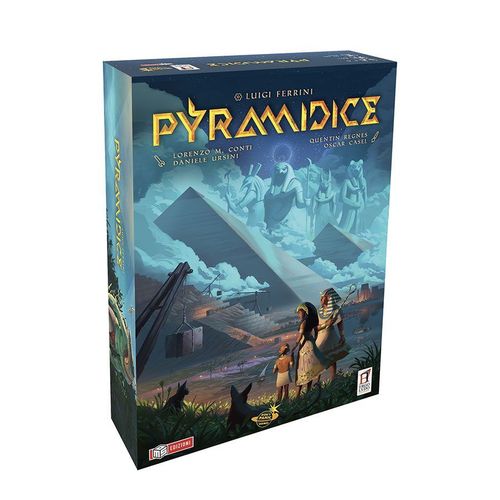
Pyramidice
Pyramidice Rulebook
Table of Contents
Table of Contents
Contents
- 3 Pyramid boards
- 1 Sphinx board
- 1 Divinities board
- 4 Player boards / Great Architects
- 21 Workers
- 9 Cats
- 1 Golden Cat
- 4 Glory tokens
- 20 Stone dice (beige)
- 4 Prayer dice (orange)
- 38 Divinity cards
- 12 Scarab cards
- 6 Project cards
- 12 Rest tiles
- 1 Quarry tile
- 4 +50/+100 tokens
- 1 Pharaoh tile
- 1 rulebook
Setup for 2-4 Players
-
Place the Pyramid boards in the middle of the table: use all three with 4 players; with 3 players, put the Mykerinos board back in the box; with 2 players, put both the Mykerinos and Khephren boards back in the box.
-
Place the Sphinx board near the Pyramids and assemble it with the Divinities board, with the Quarry tile between the two according to the number of players (on the fourth space from the left for a 2-player game, on the fifth space for 3 players, on the sixth space for 4 players).
-
Shuffle the Rest tiles and draw 6 at random for a 2-player game, 8 for a 3-player game, and 10 for a 4-player game (put the remaining tiles back in the box). Place the Rest tiles between the Sphinx and Divinities boards, so as to fill all available spaces to the left of the Quarry tile.
-
Place 4 Prayer dice on the Quarry tile.
-
Shuffle the Divinity cards and remove 10 at random for a 2-player game, 5 for a 3-player game, and 3 for a 4-player game. Put the removed cards back in the box without looking at them. Place the remaining pile face-down to the left of the Divinities board, then draw 3 cards and place them face-up on the 3 spaces of the Divinities board.
-
Leave a free space to the right of the Divinities board to discard Divinity cards.
-
Place the Pharaoh tile in the middle of the table with the end-of-game conditions visible.
-
Take 14 Stone dice for a 2-player game, 19 for a 3-player game, and 20 for a 4-player game. Place these dice on the table within reach of all players (the reserve) and put the remaining dice (if any) back in the box.
-
Place the Workers and the Cats (except the Golden Cat) on the table within reach of all players (the reserve).
-
Each player chooses a color and takes the Player board, the Glory pawn, and the +50/+100 token of that color (place the +50/+100 token next to the Sphinx board once you pass the corresponding Glory point threshold).
-
Each player places their Glory pawn on space "5" of the Glory track (on the Sphinx board).
-
Each player takes from the reserve 4 Workers, 1 Stone die, and 1 Cat, and places them, as they choose, on 6 of the 8 available spaces on the Player board, one resource per space.
-
Each player randomly draws 1 Project card, looks at it, and keeps it face-down next to their Player board. Put the remaining cards back in the box.
-
Each player randomly draws 2 Scarab cards, chooses one, and places it to the left of their Player board, thereby declaring their ability to the other players. Put the discarded and remaining Scarab cards back in the box.
The Game
Choose a first player at random. Starting with them, clockwise, each player chooses to take a Rest turn or a Work turn.
Rest
If you choose to take a Rest turn, carry out the following steps in order (as shown at the top of the Player board):
- Activate a Divinity
- Choose a Rest tile and activate it
- End of turn
1. Activate a Divinity
If you have the Bes and/or Hapy Divinity cards, you may rotate them to use their ability (more detail in the "DIVINITY CARDS" section).
2. Choose a Rest tile and activate it
Take 1 of the available Rest tiles from under the Sphinx board and place it in front of you on the first available space at the top left of your Player board (you cannot take Rest tiles that are already in front of other players) and activate all its effects. If the tile shows resources (Workers, Cats, and/or a Stone die) take them from the reserve and place them on your Player board, one resource per space. Some Rest tiles show a special effect (more detail in the "REST TILES" section).
Each space on your Player board can hold only one resource: if you gain more resources than you have available spaces, you must choose which resources to keep among those you just gained and those you already had on your Player board. When you discard resources, return the Stone die to the Quarry and the Workers and Cats to the reserve.
3. End of turn
Return to a vertical position any activated Divinity cards bearing a tilt symbol; they may be activated again in future turns. Check which case applies:
A. There are 1 or 2 Rest tiles on your Player board. This is the end of your turn, and the next player's turn begins.
B. There are 3 Rest tiles on your Player board. Put them back under the Sphinx board, making them available again. Discard the last Divinity card on the right of the row, slide the remaining Divinity cards to the right, and complete the row by drawing the first Divinity card from the pile. It is the next player's turn.
If you fulfill one of the end-of-game conditions (see the "END OF THE GAME" section), take the Pharaoh tile, flip it to show its Pharaoh side, and place it facing you to indicate that your next turn will mark the end of the game.
Example
-
You take a Rest turn: take the Rest tile that gives 1 Worker and 1 Stone die and place these resources on your Player board to fill two empty spaces.
-
You now have 3 Rest tiles in front of you; put them back under the Sphinx board.
-
Since you put back the Rest tiles, discard the last Divinity card on the right, slide the remaining cards over, and reveal a new Divinity card from the pile.
Three Resources
Workers
Workers are the main resource in this game; you need them to roll dice, build a Stone die onto the pyramids, take Divinity cards, and activate certain powers when specified. Do not discard them when calculating the number of dice you are about to roll; in other cases, return the Workers to the reserve.
Stone dice
The beige dice are the Stone dice; you need them to build the pyramids, take Divinity cards, and activate certain powers when specified. Stone dice used to build the pyramids stay on the Pyramid boards on which they were placed; otherwise, return them to the Quarry. Once you take them out of the reserve, they never return to it. Taking the last Stone die out of the reserve triggers the end of the game.
Cats
Cats let you modify the result of any die you roll at any point during your Work turn. For each Cat discarded, you may increase or decrease the value of the die by 1 point. You cannot go below 1 or above 6. You may use several Cats on the same die. You also need Cats to take Divinity cards and to activate certain powers when specified. After each use, return the Cats to the reserve.
Work
If you choose to take a Work turn, carry out the following steps in order (as shown at the bottom of the Player board):
- Move a Stone die to the Quarry
- Choose and roll dice
- Use the dice
- Support the cult of the Divinities
1. Move a Stone die to the Quarry
Move all Stone dice from your Player board to the Quarry (if any), adding them to the Prayer dice and any other Stone dice already there from previous turns.
2. Choose and roll dice
From the Quarry, take 1 die for each Worker you have on your Player board. Choose between the available Prayer dice and Stone dice (if you have more Workers than there are available dice, take them all), then roll them.
3. Use the dice
Once the dice are rolled, carry out the actions below in the order of your choice. You may choose the same action several times. Each die may be used for only one action. The available actions are:
I. Reroll dice
Once per turn, you may reroll any number of unused Stone or Prayer dice of your choice, before or after an action.
II. Worship a divinity
Choose one of the 3 face-up Divinity cards on the Divinities board and pay the cost in dice and/or resources as shown in the left-hand column. If the cost is a beige die, you must use a Stone die, but if the die shown is both orange and beige, you may use either die of your choice. The die you spend must show the exact value indicated on the card; if no value is shown, you may choose a die of any value you like. Return the spent die to the Quarry. If the cost of a card shows Cats or Workers, take them from your Player board and return them to the reserve. Place the chosen Divinity card to the left of your Player board. Do NOT draw a card to replace the one you just took. If you cannot pay for a Divinity card, you may not choose this action.
III. Build a pyramid
You may only build a pyramid with a Stone die. When you place a Stone die on a pyramid, place it on the Pyramid board of your choice: you may build on an empty space on the first level, or on one of the upper levels as long as the level below contains 4 dice arranged in a square (you build on the intersection of these 4 dice). Once a Stone die is placed on the pyramid, it stays there for the rest of the game. To place a Stone die, you must discard a number of Workers depending on the die's value (as shown in the construction table at the base of the Khufu pyramid) and on the level you are building on (each pyramid indicates the additional cost for each of its levels). If you do not have all the Workers required, you may not choose this action. You immediately gain a number of Glory points equal to the value of the die placed, in addition to any other bonuses granted by the level (each Pyramid board indicates a bonus number of Glory points for each of its levels) and by certain Divinity cards.
IV. Activate a Divinity's power
During your Work turn, you may activate every Divinity card you have, even ones you just acquired. Divinities bearing a tilt symbol may only be activated once per Work turn: rotate them after using them. Other cards have continuous effects, or effects that can only be activated at certain moments (see "DIVINITY CARDS" for more detail).
V. Replace a Divinity
Return 1 die of your choice to the Quarry in order to discard a card from the Divinities board. Slide all remaining Divinity cards to the right, draw the first Divinity card from the pile, and place it face-up on the empty space furthest to the left (draw only one card even if there are several empty spaces).
VI. Gain Glory
Return 2 dice of your choice to the Quarry and gain 1 Glory point. Move your Glory pawn 1 space on the Glory track.
Support the cult of the Divinities
If you cannot or do not want to take any more actions, return all unused dice to the Quarry, then support the cult of the Divinities. Count the number of Divinity cards you own. If you have more Divinities than resources, you MUST discard ONE Divinity card, no matter the difference between the two values. If you do not have more Divinities than resources on your Player board, nothing happens.
This is where your turn ends; if there are fewer than 3 cards in the row of Divinities, slide the remaining cards to the right and draw the necessary cards from the pile to complete the row, then return activated Divinity cards bearing a tilt symbol to a vertical position, ready to be activated again in future turns. It is then the next player's turn, going clockwise.
If you fulfill one of the end-of-game conditions (see the "END OF THE GAME" section), take the Pharaoh tile, flip it to show its Pharaoh side, and place it facing you to indicate that your next turn will mark the end of the game.
Example
-
You take a Work turn with 4 Workers: since you have no Stone die to return to the Quarry, you choose 3 Prayer dice and 1 Stone die from those available in the Quarry. Since you are satisfied with your first roll, you decide not to reroll your dice.
-
You use 1 Cat to change a "2" into a "1" and another Cat to change a "6" into a "5", then you return all your dice to the Quarry to take Hathor.
-
Finally, to support the cult of your 4 Divinities, you have 4 resources and therefore do not need to discard a Divinity card. To complete the row of 3 Divinity cards on the board, you reveal the last card of the pile, then you take the Pharaoh tile, announcing the end of the game.
End of the Game
The end of the game is triggered by one of the following conditions:
- The reserve of Stone dice is empty.
- The pile of Divinity cards is exhausted.
If you trigger the end of the game, you take the Pharaoh tile and place it Pharaoh-side up in front of you. It serves to remind all players that the game will end after your next turn is finished. At that point, each player adds bonus Glory points to the Glory points they earned during the game:
Scarab cards: The Quartz and Obsidian Scarabs grant bonus Glory points as explained on their cards.
Divinity cards: Some Divinity cards grant you Glory points, indicated in the top right corner. If the Divinities belong to the Ennead of Heliopolis, you gain points based on the number of Ennead cards you own, as shown on the cards.
Project cards: Disassemble the pyramids level by level, without changing the value or position of the Stone dice. Each player then reveals the Project card chosen at the start of the game and, for each level of the pyramid (from the top to the base), the player gains points based on the condition shown on their card.
The player with the most Glory points is the finest architect of Egypt and wins the game! In case of a tie, the player with the most resources on their Player board wins. If the tie persists, the players share the victory.
Rest Tiles
Rest tiles show special abilities and/or resources to take from the reserve. Some Rest tiles show a cost in resources or Glory points: if you cannot pay this cost, you may not take the Rest tile. If you choose a Rest tile with a cost in Glory points, move your Glory pawn back immediately on the Glory point track (you cannot go below zero Glory points). More detail on Rest tiles below:
- Discard 1 resource of your choice (Workers and Cats return to the reserve, and Stone dice to the Quarry) then take 2 resources of your choice, different from the one discarded.
- Lose 1 Glory point and take 1 resource of each type.
- Lose 2 Glory points and take a Divinity card from among the face-up cards on the board (slide the remaining cards over and complete the row after activation).
- Take 2 resources of your choice. All other players gain a Cat.
- Lose 1 Glory point and take 3 copies of the same resource.
- Lose 1 Glory point and take 1 resource of your choice, then immediately play a Work turn.
- Take the 2 resources indicated on the tile.
Scarab Cards
At the start of the game, each player randomly draws 2 Scarab cards and keeps one of the two. Scarab cards grant unique powers for the rest of the game; keep it face up to the left of your Player board so everyone can see it. The power of each Scarab card is explained on the card itself.
Project Cards
At the start of the game, each player randomly draws 1 Project card and keeps it near their Player board, hidden from the other players for the rest of the game. Project cards grant bonus Glory points that are awarded at the end of the game based on how the Stone dice are placed. Each card gives Glory points for orthogonal arrangements (never diagonal) between specific die values on each level. The conditions for gaining Glory points are explained and illustrated on each Project card.
Pyramids
The construction table, illustrated at the base of the Khufu pyramid, indicates the number of Workers to discard for construction according to the die's value:
- 0 Worker for values "1" and "2"
- 1 Worker for values "3" and "4"
- 2 Workers for values "5" and "6"
Khufu (in a game of 1 to 4 players)
Each of the 9 Stone dice used for the first level is placed following the construction table and grants a number of Glory points equal to its value. The 4 dice of the second level require 1 additional Worker and grant 2 Glory points in addition to the value of the Stone die used for construction. The single die of the third level requires 2 additional Workers and grants 4 bonus Glory points.
Khephren (in a game of 3 to 4 players)
Each of the 4 dice of the first level requires 1 additional Worker compared to what is shown in the construction table and grants 2 Glory points in addition to the value of the Stone die used for construction. The single die of the second level requires 2 additional Workers and grants 4 bonus Glory points.
Mykerinos (only in games with 4 players)
The single die of this pyramid requires 2 additional Workers compared to what is shown in the construction table and grants 4 Glory points in addition to the value of the Stone die used for construction.
Divinity Cards
Most Divinity cards show a tilt symbol in the bottom left corner: you may only activate these Divinities once per Work turn (tilt them after activating). 2 Divinity cards show a different symbol in the bottom left corner: you may only activate these Divinities once per Rest turn (tilt them after activating).
Divinity cards that show a stack symbol in the bottom left corner have no effect during the game, but grant Glory points at the end of the game. You must stack these cards after taking them so that their effects remain visible to all players.
All other cards with no symbol may be activated only during a Work turn, and may be activated several times per turn.
Glory points shown are gained at the end of the game. The cost of Divinities is shown on the left of their card. Here are some examples:
- Return 1 Stone or Prayer die of the value indicated to the Quarry.
- Return 1 Cat to the reserve.
- Return 1 Stone or Prayer die of your choice to the Quarry.
- Return 1 Worker to the reserve.
- Return to the Quarry 1 Stone die of the value indicated.
ATUM, SHU, TEFNUT, GEB, NUT, OSIRIS, SETH, ISIS, NEPHTHYS, HORUS
The Ennead is a group of 9 Divinities worshipped at Heliopolis, to whom Horus the Elder is often added. The priests of Heliopolis tried in vain to extend their supremacy throughout the kingdom.
Effect: These Divinities stack. They count as a single Divinity in every situation in the game (for the "Support the cult of the Divinities" phase, for example). At the end of the game, they grant you Glory points based on their total number, as shown on the relevant cards (0 points for 1 card, 2 points for 2 cards, 6 points for 3 cards, and so on…).
KHNUM, SATIS, ANUKET
The triad of Elephantine: father, mother, and daughter. Creator Divinities and protectors of the Nile floods.
Effect: Once per Work turn, you have 1 additional "virtual" Stone die with one of the two values indicated on the card. The value of this "virtual" die cannot be modified by Amun or by Cats.
AMUN
Creator Divinity, transcendent and self-created; considered the king of the gods.
Effect: Once per Work turn, you may change the value of 1 Prayer die to the value of your choice. This card is worth 2 Glory points at the end of the game.
ANUBIS
Protective Divinity of the necropolis and the underworld. Taxidermist and inventor of mummification.
Effect: During the "Support the cult of the Divinities" phase, you may keep up to 3 more Divinities than you have occupied spaces on your Player board.
ATON
Representative of the power of the solar disc. Principal Divinity of Atonism, through which the cult of Aton would become exclusive.
Effect: Once per Work turn, you may discard one of your Divinity cards (except Aton) in order to gain 4 Glory points. The entire Ennead of Heliopolis counts as 1 single Divinity for Aton. This card is worth 1 Glory point at the end of the game.
BASTET
Divinity of gentle and protective temperament. Divinity of Cats, the Home, and Women.
Effect: You may treat your Workers as Cats and vice versa.
BES
Protective god of the Home, Sleep, and Marriage. He fought against the forces of evil.
Effect: Once per Rest turn, you gain 1 Glory point.
HAPY
Personification of the fertility and prosperity of the land brought by the Nile floods.
Effect: During Rest turns, instead of choosing a Rest tile and activating it (step 2), you may use this power. Discard 1 resource from your Player board (Worker, Cat, or Stone die) and take 3 resources different from the one you discarded (return the Stone die to the Quarry, not to the reserve). This card is worth 1 Glory point at the end of the game.
HATHOR
Divinity of Joy, Love, Dance, Motherhood, and Beauty.
Effect: No effect during the game, but 6 bonus Glory points at the end of the game.
HEH
Divinity symbolizing the limitless flow of time, eternity, and infinity.
Effect: Once per Work turn, you gain 1 Glory point.
HEKA
Deification of magic, which manifested by activating the power of the soul.
Effect: Once per Work turn, you may return 2 Cats to the reserve in order to gain 1 Worker (from the reserve) and 3 Glory points.
KHEPRI
Divinity who steered the boat of the Sun on its daily journey through the underworld.
Effect: You may return to the Quarry 3 dice (Stone and/or Prayer) of the same value to gain 3 Glory points and 1 resource of your choice (Worker, Cat, or Stone die). Take the Worker or Cat from the reserve and place it on your Player board; take the Stone die from the reserve and roll it immediately, then use it during the current turn. This effect may be activated several times. This card is worth 1 Glory point at the end of the game.
KHONSU
Divinity of the Moon and Youth. He measured the time of men.
Effect: Once per Work turn, you may return 1 Worker and 1 Cat to the reserve in order to gain 4 Glory points.
MAAT
Personification of cosmic balance, harmony, morality, and justice.
Effect: Once per Work turn, you may reroll as many dice as you wish. This roll is in addition to the one you have each Work turn. This card is worth 3 Glory points at the end of the game.
MERTSEGER
Cobra goddess, protector of the necropolis of Thebes and of nature. Terrible, but merciful towards her faithful.
Effect: Once per Work turn, you may return 2 dice of your choice to the Quarry to immediately take 1 Stone die from the reserve, roll it, and use it during the current turn. This card is worth 2 Glory points at the end of the game.
MIN
Divinity of Fertility, Reproduction, and Virility.
Effect: Once per Work turn, you may return 2 dice of your choice to the Quarry to take 1 Worker from the reserve. Place it on your Player board. This card is worth 2 Glory points at the end of the game.
MONTU
Falcon-headed god of War, embodiment of the Pharaoh's conquering vitality.
Effect: Once per Work turn, you may return 2 Workers to the reserve in order to gain 1 Cat (from the reserve) and 4 Glory points.
MUT
Divinity, mother at the origin of the world.
Effect: Once per Work turn, you may change the value of 1 Stone die to the value of your choice.
NEITH
Divinity of the Hunt and War, forger of warriors' weapons and guardian of the dead on the battlefield.
Effect: Once per Work turn, you may return 1 Worker and 1 Cat to the reserve, then 1 Stone die to the Quarry, in order to gain 7 Glory points.
PTAH
Creator of the universe; patron of craftsmen and architects, Divinity of Learning and Knowledge.
Effect: Once per Work turn, you may return 1 die of your choice to the Quarry in order to restore to a vertical position all the tilt-symbol cards you have activated during the current Work turn. This card is worth 2 Glory points at the end of the game.
RA
A major Divinity of Egypt, identified with the midday sun. He reigned over all worlds: the sky, the earth, and the underworld.
Effect: Once per Work turn, you may return 1 Worker to the reserve in order to gain 3 Glory points.
SEKHMET
Divinity of War, Plagues, and Healing. She could generate a desert with her breath.
Effect: Once per Work turn, you may return 1 Worker and 1 Cat to the reserve, then 1 Stone die to the Quarry, in order to gain 7 Glory points.
SERKET
Scorpion goddess, protector against the venom of animals and the bites of serpents, even those of the underworld.
Effect: During your Work turn, when you place 1 Stone die on a base of 4 other Stone dice, you gain 3 Glory points.
SESHAT
Divinity of Writing, Arithmetic, and the architectural design of temples and buildings.
Effect: During your Work turn, when you place 1 Stone die on a pyramid, you do not need to pay the usual cost, but only the cost shown on this card.
SOBEK
Divinity linked to the power of the pharaoh and to military power.
Effect: Once per Work turn, you may return 2 Stone dice to the Quarry to gain 3 Glory points.
SOPDET
Divinity personifying the star Sirius, which guided and nourished the dead in the sky.
Effect: Once per Work turn, you may return 1 die of your choice to the Quarry to take 1 Cat from the reserve and place it on your Player board. This card is worth 1 Glory point at the end of the game.
THOTH
Divinity of Wisdom, the Measure of Time, Mathematics, and Geometry.
Effect: During your Work turn, when you place 1 Stone die on a pyramid, you gain 1 additional Glory point for each Worker discarded for the construction (you may not use this ability if, thanks to the Pearl Scarab, the construction takes place during another player's turn).
Solo Mode
A solo player may challenge one of the Great Architects of ancient Egypt: Sneferu, Hemiunu, Amenhotep, and Imhotep (from easiest to hardest). The Great Architects are represented on the back of the Player boards, and their level (1, 2, 3, or 4) is indicated by the number of eyes on the scroll.
Setup
Choose one of the Great Architects to challenge and place the corresponding board face-up on the table. Then choose one of the available colors and place the Player board near the Great Architect's board, so that both are within reach. The rest of the setup is the same as for a 2-player game; the only exception being that you do not take a Scarab card (out of respect for the Great Architect).
Randomly place 2 Project cards face-up (3 against Amenhotep) to the right of the Great Architect board. Take 1 Project card at random from those remaining and place it face-up next to your Player board. The number of Project cards to draw for each Architect is indicated in the bottom right corner of their board. Each Great Architect has a power, explained and illustrated on the board, that grants them a special, continuous ability; take it into consideration at the indicated moments and in the manner described.
You begin by following the basic rules. Then it is the Great Architect's turn; alternate turns in this way until one of the end-of-game conditions is fulfilled.
Great Architect Turn
During the Great Architect's turn, follow the steps below (as shown in the upper part of the Great Architect board) in order:
-
The Great Architect takes, from the Divinities board, the Divinity card with the highest Glory point value (top right corner). Ennead cards are always considered to have the highest value compared to other Divinities. In case of a tie, the Architect takes the one furthest to the right among the tied cards. Place the card face-down on the Great Architect board.
-
Roll 1 Stone die taken from the Quarry; if there is none, take it from the reserve and roll it. Compare the value obtained with the numbers shown on the Sphinx and Divinities boards, next to the game's six Rest tiles.
One of the following cases occurs:
3A. The corresponding Rest tile is still on the board: the Great Architect takes it and places it on the leftmost space above their board without activating it. If this space shows a Glory point value, advance the Great Architect's Glory pawn by the corresponding number of spaces. If the space on which the tile is placed is the last available space on their board, return all of the Great Architect's Rest tiles to the Sphinx board, filling all available spaces as you see fit. Then discard the last Divinity card on the right of the board, slide the remaining card to the right, and draw new Divinity cards to complete the row. The Stone die you rolled is returned to the Quarry.
3B. The corresponding Rest tile is not available: the Great Architect places the Stone die on the pyramid, starting with the lowest incomplete level and the empty space furthest to the top left (according to the orientation of the Pyramid board). But if the Architect can complete one of the arrangements on their Project cards with this construction, they place the Stone die in that position instead, ignoring the rule above (if several arrangements are available, place the Stone die in the first available space according to the Great Architect's main construction rules). As soon as the Stone die is placed, advance the Great Architect's Glory pawn according to the value of the die (adding any bonuses linked to the pyramid level or to the Great Architect's special power).
The end of the game is triggered according to the general rules. After triggering the end of the game, if the Great Architect must play a turn with no cards on the Divinities board, they do not take a card. Furthermore, if there are no more Stone dice in the Quarry or in the reserve, they take the Rest tile corresponding to the lowest number and play phase 3A normally.
At the end of the game, you reveal all the cards placed on the Great Architect board. The Great Architect's Glory points are calculated by adding the points obtained during the game to the points granted by all the Divinity cards on the Great Architect board (the points shown in the top right corner, as well as the points granted by Ennead cards), in addition to all the points awarded by Project cards.
Count your Glory points following the general rules: whoever has the most Glory points wins the game. In case of a tie, the Great Architect always wins.
Example
-
Sneferu takes Hapy from the Divinities board (Hapy grants as many Glory points as Khepri, but is further to the right).
-
Since the Quarry is empty, he takes the last Stone die from the reserve. The end of the game is triggered, and he takes the Pharaoh tile (it will then be your turn, then Sneferu's turn will be the last).
-
He rolls a "2" on the die. Rest tile number 2 is under the Sphinx board, so Sneferu takes it.
-
He places it on his board, in the leftmost empty space, which grants him no Glory points. This is the end of his turn.
Clarifications for Certain Scarab Cards
Amethyst Scarab: Its power ends at the end of your Work turn. The chosen Divinity card does not count toward the number of Divinity cards you own at the end of your turn, and its Glory points do not count at the end of the game.
Silver Scarab: If your Player board is full (8 spaces), gaining 1 new resource does not trigger the Scarab's power.
Example: You have 7 occupied spaces and you take a Rest tile that gives you 2 Workers. With the first Worker, you fill your board and gain 2 Glory points. With the second Worker, you may choose which resource to discard, but you do not gain Glory points again.
Pearl Scarab: By activating its power, you gain as many Glory points as your opponent, including those obtained through construction or Divinity cards. You may not activate the power of your own Divinity cards.
Example: If an opponent holding the Thoth Divinity card places a die with a value of 6 on the first level of the Khufu pyramid, they may use 1 Worker to gain 3 + 1 Glory points. You may also obtain them by spending 2 Workers.
Emerald Scarab: If you choose a Rest tile owned by an opponent, it is turned face-down, but remains in front of them.