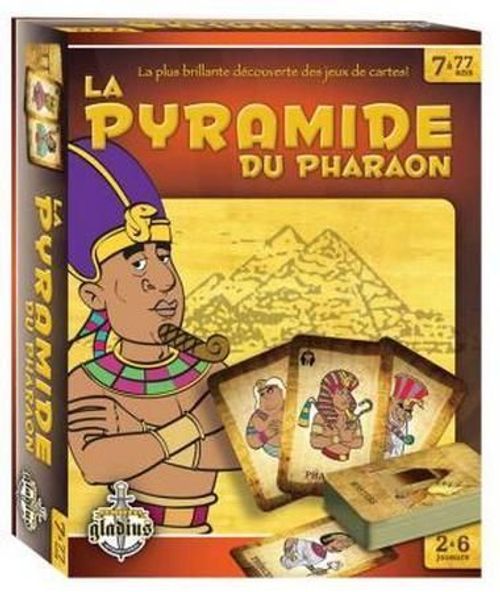
Pyramide du Pharaon
Pyramide du Pharaon Rulebook
Table of Contents
Table of Contents
Basic Rules
Pyramide du Pharaon is a game for 2 to 6 players. Play proceeds clockwise and, unless an exception applies, a player takes only one action per turn.
Setup
Take the 6 decks of cards (Level I, II, III, IV and V cards, and Mystery cards) and place them in the center of the table. Shuffle the cards of each deck thoroughly. Deal 3 Mystery cards to each player. The oldest player (and therefore the wisest) takes the first turn.
Objective
As in days of old, the goal is to be the first to build a complete and perfect pyramid. It consists of 15 Level cards, face down in front of you, identical to those illustrated below.
Construction
Players use Mystery cards to obtain the Level cards they need. The 15 Level cards required to form a pyramid may be accumulated in any order and exchanged at any time (even once your 15 cards are placed), in order to obtain all the elements required to complete a perfect pyramid. (See the reference sheet to understand the contents of a perfect pyramid.)
Note: a player may consult or rearrange the position of the cards in their pyramid as they wish, to prevent other players from remembering where they placed certain cards. However, they may not shuffle them when a Fortune Telling or Theft card is used against them.
Diagram caption: the pyramid, face down.
Diagram caption: example of a complete and perfect pyramid.
Course of Play
The game is played clockwise. On their turn, a player must choose one of 3 options:
-
TAKE A NEW MYSTERY CARD: The player takes the card on top of the Mystery deck and keeps it in hand for later. Their turn is over. A player may hold no more than 5 Mystery cards in hand. CAUTION: if, when a player's turn comes, they already hold 5 Mystery cards, they have no choice but to use one of them: they may not take a new one. If a player is caught with more than 5 cards in hand, they must pass a turn and discard the excess cards.
-
EXCHANGE ONE OR MORE MYSTERY POINTS CARDS FOR A LEVEL CARD: The player may use one or more Mystery Points cards to obtain a Level card of their choice. For example, they may use a 2-point Mystery card and a 1-point Mystery card from their hand to take a Level III card. They then place their cards face up on the Mystery discard pile and take a card from the Level III deck. Their turn is over. As soon as a player obtains a Level card, they must either place it face down on the table at the corresponding level, in the position they wish, or return it to the bottom of its original deck (if it does not suit them). The player must make sure not to exceed the maximum number of cards for each level (see the Perfect Pyramid reference sheet). If that number is already reached, they may place their new card in the position of their choice, but must discard one of the cards already laid out.
-
USE A SPECIAL MYSTERY CARD: The player may use a Special Mystery card according to the rules defined in the section "Special Mystery Cards". Once the action is carried out, their turn is over.
Cards
Level Cards
The Roman numeral (I to V) on the front of a Level card indicates the level of the pyramid and the number of points required to acquire the card. On the back is one of the essential elements for building your pyramid. (See page 5 for details of each level.)
Mystery Cards
There are two types of Mystery card: Mystery Points cards, which carry a number of points allowing the player to obtain the Level cards they want, and Special Mystery cards, which have varied effects that can change how the game unfolds. (See the Special Mystery Cards section for details of each type and their respective effects.)
Level Card Details
Level I: The People
Level I is that of the people (the workers): it is the base of the pyramid. It contains 54 cards in total, divided into 4 categories, each representing a number of Egyptians: 10,000, 20,000, 30,000 and 40,000. To complete Level I of your pyramid perfectly, it must contain 5 cards and total a minimum of 100,000 workers.
Level II: The Resources
Level II is that of the resources needed to build a pyramid. It contains 50 cards in total, divided into 4 categories, each representing a resource: Tools, Stone, Wood and Water. To complete Level II of your pyramid perfectly, it must contain each of the resources, so 4 cards in total.
Level III: The Administration
Level III is that of the administration of the pyramid. It contains 37 cards in total, divided into 3 categories, each representing an administrator of ancient Egypt: the Priest, the Scribe and the Vizier. To complete Level III of your pyramid perfectly, it must contain the 3 administrators, so 3 cards in total.
Level IV: The Royal Family
Level IV is that of the royal family. It contains the princes and the princesses. It contains 28 cards in total, divided into 2 categories: the true members of the royal family (these cards are marked with a hieroglyph) and the impostors. To complete Level IV of your pyramid perfectly, it must contain one true Prince and one true Princess, so 2 cards in total.
Level V: The Pharaoh
Level V is that of the pharaoh. It contains 20 cards in total, divided into 2 categories: the pharaohs (these cards are marked with a hieroglyph) and the impostors. To complete Level V of your pyramid perfectly, a player must possess one Pharaoh, so 1 card.
Mystery Points Cards
These cards serve as currency for acquiring Level cards. They have a value from 1 to 5 points. A Level card is obtained by exchanging it for one or more Points cards of equal or greater value to the level concerned. For example, a Level I card may be acquired for a 1-point card, a Level II card for a 2-point card or for two 1-point cards, and so on. Furthermore, with a 3-point card you may obtain a Level III card, but you may also obtain a Level II or a Level I card instead. In every case, any excess points are lost. You may also add the points of several cards to obtain a higher-level card. For example, a 3-point card added to a 2-point card lets you obtain a Level IV card or a Level V card.
Special Mystery Cards
Tour of Egypt (Tour de l'Égypte): Performs a rotation of cards among all players. The holder of the card decides which level of the pyramid will be exchanged and in which direction. Only one card per player is exchanged during a Tour of Egypt, and each player is free to choose which card they wish to exchange from the level concerned. If a player has only one card at that level, they must exchange it. If they have none, they simply pass the card they receive, without looking at it, to the next player. The player holding the Tour of Egypt card announces the terms of the exchange aloud. For example, if they say "Tour of Egypt, Level III, to the left", each player must hand a Level III card to their left-hand neighbour. The player who proclaimed the Tour of Egypt is the first to hand their card to their left-hand neighbour. The Tour of Egypt ends when that player receives their card (coming from their right-hand neighbour). During the exchange, a player may not look at the card they receive before giving their own. Once that is done, they look at their new card and place it in their pyramid.
Fortune Telling (Voyance): Allows a player to seize a card from another player by guessing its contents. When a player wishes to use a Fortune Telling card, they place it in front of a Level card in another player's pyramid and say: "I see that this card contains..." They then name the presumed contents of the card. For example: "...a Vizier." The player concerned reveals their card to everyone. If the prediction is correct, they hand the card to the player who guessed its contents. That player places it in the appropriate position in their pyramid and gives one of their own cards of the same level to the player who had to give up their card. If the seer was wrong, the turn ends and the targeted player keeps their card and turns it face down again.
Theft (Vol): Allows a player to steal a card from another player. The player announces from whom they wish to steal a card. They only need to point to the desired card, and that player has no choice but to hand it over (without revealing it to anyone). The player who performs the theft must take the card even if they do not like it, and must place it in their pyramid. In a theft, the stolen card is not replaced.
Divine Intervention (Intervention divine): The Divine Intervention card allows a player to replace all the cards of one level (complete or not) in their pyramid. For example, if a player has three Level II cards laid out in front of them, they take their Divine Intervention card and announce that they wish to change their Level II cards. They take the 3 cards from their pyramid and slip them under the corresponding deck, then take 3 new ones. They then place their 3 new cards at Level II of their pyramid. Note: when playing the Divine Intervention card, the player must replace all of their cards at the chosen level. The only cards they may keep are those protected by a Reinforcement card, which are untouchable.
Reinforcement (Renforcement): This card protects a card in your pyramid against the effect of Fortune Telling, Theft, Divine Intervention and Tour of Egypt cards. Each card indicates at which level of the pyramid it may be used. For example, a card marked "I" protects a Level I card, a card marked "II" protects a Level II card, and so on. The Reinforcement card marked "I-II-III-IV" may be used between Levels I and IV. When a player wishes to use a Reinforcement card, they do the following: on their turn, they turn over the card they want to protect (face up) and slip their Reinforcement card underneath it, which makes their card "untouchable".
Double Effort (Double effort): The Double Effort card allows a player to play twice in a row. When their turn comes, they place their Double Effort card on the table and play twice consecutively, without restriction.
End of the Game
As soon as a player believes they have a perfect pyramid, they exclaim "Glory to the Pharaoh!" The game stops and they turn their cards face up to verify the contents of each. If they have all the elements required for a perfect pyramid, the player is declared the winner and receives the gratitude of the pharaoh. Otherwise, the player places their cards back in front of them, face down, and as punishment must pass their next three turns!
You are now ready to perpetuate the legend of the Pyramid of the Pharaoh!
Variant: The Gods of Egypt (Les Dieux d'Égypte)
In this way of playing, you are forbidden from looking again at your cards once you have placed them in your pyramid. The only moment you may look at a card is when you draw it, that is, when you receive a card from another player, or when a Fortune Telling card is used against you.
Card Count by Category
Level cards (189 total):
| Level | Category | Quantity |
|---|---|---|
| I | 10,000 | 21 |
| I | 20,000 | 19 |
| I | 30,000 | 9 |
| I | 40,000 | 5 |
| II | Tools | 18 |
| II | Stone | 15 |
| II | Wood | 10 |
| II | Water | 7 |
| III | Priest |
Mystery cards (82 total):
| Category | Quantity |
|---|---|
| 1 point | 22 |
| 2 points | 15 |
| 3 points | 10 |
| 4 points | 7 |
| 5 points | 4 |
| Tour of Egypt | 5 |
| Fortune Telling | 4 |
| Theft | 3 |
| Divine Intervention | 3 |
| Double Effort | 3 |
| Reinforcement I | 2 |
| Reinforcement II | 1 |
Total: 271 cards (189 Level cards and 82 Mystery cards).