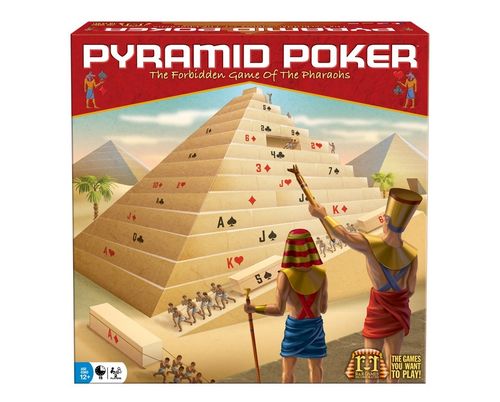
Pyramid Poker
Pyramid Poker Rulebook
Table of Contents
Table of Contents
Equipment
- 54 blocks
- 1 Pyramid Foundation
Note: Jokers are included, but are NOT wild and cannot be part of a hand. (See Choosing)
Set-Up
Place the Foundation on the table between the players. Place the 54 blocks face down on the table off to one side and shuffle them. Each player takes 15 blocks and keeps them face down in front of them. (Try not to look at them as you place them face down. You can also mix them up a bit once you have all 15.) Put any unused blocks aside without looking at them, they are not used in this game.
Build Pyramid
Starting with the first player to say "Tut Tut", players take turns adding one block from their personal supply to the pyramid until they run out (30 blocks total.)
When placing a block, choose one of your 15, look at it, and then place it on the Pyramid, facing you. Do not let your opponent see the block! You may place the block in any open space in the foundation, or centered on top of any pair of neighboring blocks.
Note: you will not be building a complete pyramid. That would take 36 blocks and you will only be placing 30. This means there are a few different shapes that the pyramid can take, based on the placement of the last few blocks.
The rulebook shows three example pyramids illustrating valid and invalid final shapes: Example 1 (good), Example 2 (good), and Example 3 (incorrect, marked with an X over the top block).
Making Hands
When each player has placed all 15 of their blocks, it's time to make poker hands! Players continue taking turns, but now they will be choosing a block from the pyramid and placing it in one of their hands. This is done 15 times, after which each player will have made three five-card hands.
Choosing
You may take any block that has no blocks on top of it. You may take a block that faces you, or a block that faces your opponent. If you choose a Joker, discard it. Then turn up three of the remaining face down tiles. Choose one to add to one of your hands and discard the other two out of the game.
Placing
Once you have chosen a block you must add it face up to one of your three hands next to the foundation.
Scoring
Basic Scoring
Compare the hands of each player. If you win two out of these three, you've beaten your opponent. If you win all three you've skunked your opponent!
Advanced Scoring
For a more strategic game, play with these advanced scoring rules. Each hand will produce a numerical score. Each player calculates his score and the player with the higher score earns points equal to the difference between the scores. For a short game, play to 7 points. For a longer game, play to 11 points.
Advanced Score Chart
| Result | Points |
|---|---|
| Straight or Flush | 1 point |
| Full House | 2 points |
| 4 of a kind | 3 points |
| Straight Flush | 4 points |
| Royal Flush | 5 points |
| Win 2 hands | 3 points |
| Win all 3 hands | 4 points |
| Every hand lower than one Pair | -1 point |
Example: Jenn has a King high (-1) point, a Flush (+1) point and a pair of 8's (0) points. Her total is currently zero. Frank has a Full House (2) points, 3 of a kind (0) points and an Ace high (-1) point. His total is 1 point. However Frank won two of the hand matchups which gives him an additional 3 points. His new total is 4 points. Since the difference between his total and Jenn's is 4, he gets 4 points for this round.
Example of Rankings for Poker Hands (Lowest to Highest)
| Hand | Cards |
|---|---|
| No Pair | 4♦ 9♣ Q♣ K♥ 7♦ |
| Pair | 4♦ 9♣ Q♣ Q♥ 7♦ |
| 2 Pair | 4♦ 4♣ Q♣ Q♥ 7♦ |
| 3 of a Kind | 4♦ Q♦ Q♣ Q♥ 7♦ |
| Straight | 4♠ 5♦ 6♣ 7♥ 8♦ |
| Flush | Q♠ 7♠ 4♠ 9♠ K♠ |
| Full House | Q♥ Q♦ Q♣ 2♦ 2♠ |
| 4 of a Kind | Q♥ Q♦ Q♣ Q♠ 3♣ |
| Straight Flush | 4♠ 5♠ 6♠ 7♠ 8♠ |
| Royal Flush | 10♠ J♠ Q♠ K♠ A♠ |
Variants
The following variants are from an official addendum distributed by R&R Games alongside the base rulebook.
Pyramid Poker for 3-4 Players
3 Players
Two players sit on one side of the board and one sits on the opposite side. Each player takes 10 tiles face down. Each player will attempt to build TWO hands of poker instead of the usual three.
Print the 3-4 player board out to use in this version.
4 Players
This is played similarly to the 3 player game, but with a few slight differences. Two players sit on each side of the board.
Individual Play: Each player takes 10 tiles face down. Each player will attempt to build TWO hands of poker instead of the usual three. Because there are now 40 tiles in play, play as if there is one extra white rectangle at the base, so 9 base rectangles instead of 8.
Compare all four #1 hands and all four #2 hands to determine winners.
Team Play: Each player takes 10 tiles face down. This plays just like the individual 4 player version with these exceptions:
- A. Players A and C are teammates, likewise Players B and D. Play remains clockwise so two players on one side of the board place or remove their tiles followed by their teammates on the other side of the board.
- B. Score Player A vs Player D and Player B vs Player C. Use the advanced scoring playing to a total of 20. (You can also use basic scoring, but if the teams tie, the highest ranking hand is the tiebreaker.)
Texas Hold 'Em Variant for 2 Players
Courtesy of Greg Jones and Aaron Medvick
Print the 5-tile Community board out to use in this version.
Each player sits opposite each other and starts with 10 face down tiles. Set the 5 tile Community board perpendicular to the normal board at one end, opposite the end where you will place your hands that you build.
Play normally to build the pyramid but use a base of only 6 white rectangles. Players will build 3 hands of two tiles each. Those hands will play vs each other as they do in the regular game, but each hand will be allowed to use the best three cards from the 5 tile Community board.
When you dismantle the pyramid you now have the option of doing one of these 3 actions:
- A. Locking the tile taken into one of your three hands. Max of two tiles per hand and these tiles are placed facing you so your opponent never sees what you take.
- B. Placing the tile taken face up on to one of the 5 spaces on the Community board. These are the cards available to both players. Once all 5 spaces are filled, you cannot use this option.
- C. Place the tile taken face down on the dotted rectangles of the Community board. These represent the burn cards that are taken out of play in Texas Hold 'Em. Once three tiles are placed here, you cannot use this option.
After all tiles have been placed, each player reveals their hands and make the best poker hands using the two tiles of their hand and three from the common board. This game can be played as per the basic rules where the winner wins 2 out of 3 hands, or use the Advanced scoring chart.