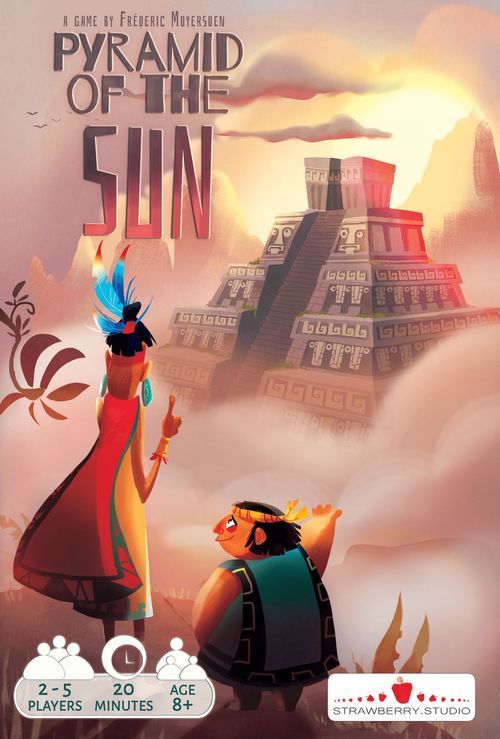
Pyramid of the Sun
Pyramid of the Sun Rulebook
Table of Contents
Table of Contents
Components
2 - 5 Players * 20 minutes * Age 8+
107 CARDS:
- 10 PYRAMID BASE SPECIAL CARDS
- 48 STANDARD SEGMENT CARDS
- 30 EDGE SEGMENT CARDS (INCLUDING PYRAMID TOPS)
- 2 SCORE TRACK CARDS
- 5 PLAYER COLOR CARDS
- 12 DOUBLE-SIDED SCORE CARDS
- 5 SCORING MARKERS (1 IN EACH PLAYER COLOR)
- THIS BOOKLET WITH ALL THE RULES
Setup
-
Create the scoring track from 2 main score track cards according to the image below. This scoring track has spaces from 0 to 9 victory points. Points in excess of 9 will be recorded using the additional +10/+20, +30/+40, +50/+60 and +70/+80 double-sided scoring cards.
-
Give each player a color card and place the scoring markers of all players on the zero space of the scoring track. Place any unused scoring markers and player color cards back into the box. You will not need them during the game.
-
Build the base of the pyramid using the base cards. They are easily identifiable by the purple dot on their backs. Each of them also has a value of 0. Place the left edge pyramid base card, followed by 6, 7 or 8 random pyramid base cards and then the right edge pyramid base card. For the short game use 6 random pyramid base cards, for the standard game use 7 of them and for the long game use all 8.
Return any unused pyramid base cards back to the box. They will not be used during the game.
-
Separate the segment cards into two piles: one containing standard segment cards, and one containing edge segment cards (this includes pyramid top cards). Shuffle each of those piles separately. Then, draw 1 random edge segment deck and place it face-up on the table. Place the rest of the edge cards across the face-up card, forming a face-down deck.
-
Shuffle the standard segment cards together and place them face-down, forming a deck. Each player draws 4 cards to start their hand.
-
The player who has last seen a temple or a pyramid in Mexico becomes the first player. If no one has seen any (such a pity, they are truly beautiful), choose the starting player at random. You are now ready to play.
Player Turn
PYRAMID OF THE SUN is played in turns. Each player performs their whole turn, after which play passes clockwise to the next player.
On your turn, you can perform one of the following actions:
Draw 2 Cards
You may draw a total of 2 cards from the decks. You may take both cards from a single deck, or take 1 card from each deck (in any order). You may look at the first card drawn before you draw the second one. If, after drawing, you have more than 5 cards in your hand, you must immediately discard down to 5 cards.
When you discard a card, place it on the appropriate discard pile (standard or edge segment cards discard pile). If there is no discard pile of a given type, your discarded card will start it. If at any time you need to draw a card from an empty deck, reshuffle its discard pile to form a new deck.
NOTE: The card placed on the bottom of the edge cards deck is there to simply mark which deck is which, so that players do not make mistakes during the game. For all intents and purposes it is considered to be out of the game (just like any cards placed back in the box). It is never reshuffled back into any deck.
EXAMPLE 1: On her turn, Maria decides to draw cards. She draws 1 card from the edge cards deck, examines it, and decides to draw her second cards from the standard segments deck. As the deck is empty, she reshuffles the discard pile to form a new face-down deck. She draws 1 card. Now Maria is left with 6 cards in her hand. She must immediately discard 1 card before her turn is over.
Play Cards
You may play any number of cards from your hand onto the pyramid. After playing each card, pause the game briefly to gain points and/or make use of an icon special ability. After you have finished playing any number of cards from your hand, play passes to the left. You do not draw cards at the end of the turn during which you played cards.
How to Play a Card?
To play a card, place it above any 2 cards in the lower level of the pyramid in such a way that its base is over 2 cards below (as if placing one brick on top of two others). When placing cards, adhere to the following restrictions:
- A card may never be placed over just one card on the lower level. A segment of the pyramid must always "stand" on top of another 2 segments of the lower level.
- An edge segment card may only be placed on the appropriate far end of any row. No card may ever be played to the left of the left edge card, or to the right of the right edge card. A top card may only be placed as the last card of the pyramid (on its top).
- A standard segment card may also be played onto any end of a row, or as a top card.
The picture in the rulebook demonstrates the spaces (marked with a V) where segment cards may be legally placed.
Scoring Points
Every card you play onto the pyramid will score you a number of victory points. After you place the card, pause the game briefly, and receive the lower of the two:
- a number of points equal to the value of the card played,
- a number of points equal to the level the card was placed on.
If you placed an edge segment card, you receive double (x2) the number of points. If you placed the top segment card (thus finishing the pyramid), you receive triple (x3) the number of points.
NOTE: The bottom row of cards in the pyramid is considered Level 0. Consequently, the level directly above is level 1, the level directly above 1 is 2, etc.
EXAMPLE 2: Steven plays a value 2 card to level 1 of the pyramid. He immediately receives 1 victory point. Continuing his turn, he now plays another value 2 card, but this time to the level 3 of the pyramid. Out of the two options (2 points for the card value, or 3 points from the level), Steven has to choose the one that scores fewer points, so he receives 2 victory points. Finally, Steve places a value 2 edge card on level 2. That scores Steve 4 points: the normal points are doubled, as Steve placed an edge segment.
Having placed a total of 3 cards (scoring 7 points total), Steven elects to finish his turn, even though he still has 2 cards in his hand.
Activating Icons
If, on your turn, you place a card with a symbol in such a way that it is adjacent to any number of the same symbols, choose one of the following options:
- Immediately draw 1 card into your hand (regardless of the number of adjacent symbols).
- Immediately score a number of points equal to the number of adjacent symbols identical to the one from the card just placed. When determining the number of points scored, do not count the symbol from the card you have just placed.
Card Adjacency
Two cards are considered to be adjacent if they share at least a part of their sides. This includes up to 4 cards in the lower and/or higher level (directly above or below the card).
Game End
A game of PYRAMID OF THE SUN ends immediately after a player has placed the final segment of the pyramid, by either playing a top card, or by playing a standard segment card to the top position in the pyramid.
After the game ends, players should compare their victory points. The player with the highest number wins. In the case of a tie, the player with more cards in hand is considered the winner. If still tied at this point, the tied players share a common victory (and they should also visit Teotihuacan together).