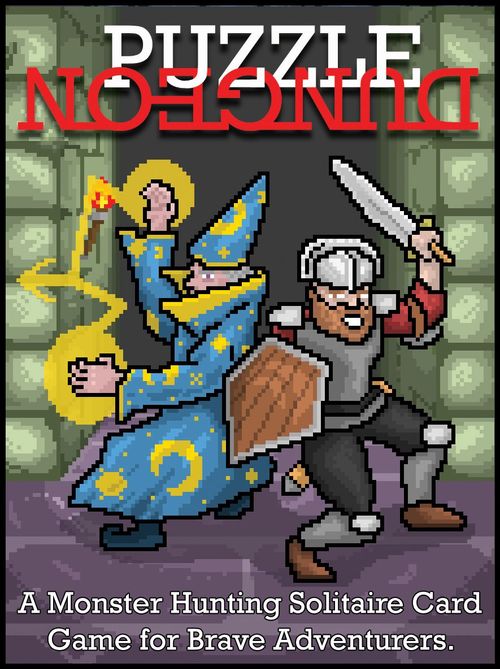
Puzzle Dungeon
Puzzle Dungeon Rulebook
Table of Contents
Table of Contents
Heroes
Hero cards have a unique hero printed on each face. Only one hero is used each game.
- Challenge: Heroes with a skull icon before their name are challenging to play.
- Prey: A hero's prey are the monster types shown in its prey area. The quantity after the type symbol is the number of monsters of those types you must collect to win.
- Abilities: Most heroes have two abilities.
The Rogue is a good hero for learning the game.
Example: Rogue
The Rogue card shows two faces:
- Rogue (front): Prey — chest-type monsters x4, goblin-type monsters x2, wisp-type monsters x2. Abilities: "When you collect a monster, draw a card." / "Trophy: Reverse the order of any column."
- Skull Rogue (back, the challenging side): Prey — chest-type monsters x4, Monster King x4. Abilities: "When a Monster King is revealed, shuffle and deal the monsters into three columns." / "Trophy: You may discard any card from the arsenal to draw a card."
Monsters & Monster Kings
Monsters are double-faced. The back of each monster depicts that monster as a Monster King.
- Type: There are four monsters of each type. Monsters with types not shown in your hero's prey area are Trophies. Some heroes have the Monster King symbol in their prey area. Monster King is not a monster type. A Monster King is a Trophy if its monster type is a Trophy.
- Weapon: Monster King weapons have two suits.
- Defense: The suits you must match to defeat this monster.
- Ability: A monster's Loot triggers when it's defeated.
When a monster leaves the dungeon, if there is only one monster of its type remaining in the dungeon, that remaining monster flips to its Monster King face as a triggered ability.
A Monster King's ability is always in effect regardless of its position in the dungeon.
Abilities that affect monsters affect Monster Kings.
Monster Kings count as their monster type and as Monster Kings for the purposes of winning the game.
Example: Battlesnake
- Battlesnake (front): Weapon suit — Mitt. Type — Battlesnake's own type icon. Defense — Claw, Torch, Mitt, Mitt. Ability: "Loot: You may reveal a Battlesnake-type Monster King. If you do, defeat the front Monster King of any column."
- Battlesnake (back, Monster King): Weapon suits — Mitt, Mitt. Type — Battlesnake's own type icon. Defense — Claw, Torch, Mitt, Mitt. Ability: "Reveal: Reveal the back Monster King of any column."
Arsenal Cards
There are 32 arsenal cards with four suits: Torch, Claw, Hand, and Mitt, and the values 0, 2–8.
A card's value has no meaning unless referenced by an ability. Abilities refer to arsenal cards by their suit, value, or range of values.
Example: A 7+ can be a 7 or 8. A 0 Mitt is a 0 and a Mitt.
Set Up
- Choose a hero.
- Shuffle the monster deck, then deal the monsters left to right, top to bottom into four columns of five cards each to form the dungeon.
- Shuffle the arsenal cards, then deal six cards to the arsenal and draw six cards (not pictured).
Abilities that trigger when a card is dealt or drawn trigger during set up.
The Monster Deck
The 20-monster deck is organized into four groups of five monsters each:
- Dragon, Cultist, Stone Golem, Ratman, Mutant
- Cyclops, Automaton, Reaper, Werewolf, Minotaur
- Ghost, Banshee, Goblin, Witch, Skeleton
- Haunted Armor, Lich, Vampire, Blue Devil, Animated Weapons
Each monster card shows a Loot ability, triggered when the monster is defeated. Examples visible in the rulebook's monster gallery:
- Mutant — Loot: Shuffle any four cards in the arsenal into the deck.
- Minotaur — Loot: You may shuffle the monsters and deal them into four columns.
- Skeleton — Loot: Shuffle the bottom five cards of the discard pile into the deck.
- Animated Weapons — Loot: Shuffle up to four cards in the arsenal and/or discard pile with the same suit into the deck.
Game Play
The game is played by taking actions. The two actions you may take are Deal and Attack.
Deal cards until you can attack. After attacking, either attack again or deal more cards.
The Deal action moves the top card of the deck to the rightmost position in the arsenal.
You may take the Deal action any number of times. The arsenal may have any number of cards. You do not lose if there are no cards in the deck.
The Attack action is the primary way to defeat and collect monsters from the dungeon. Some card abilities allow you to attack. You can't attack a monster if you can't match each suit in its defense.
Whether you're attacking by taking the Attack action or by the effect of an ability, take the following steps:
- Choose the front monster of any column.
- Abilities that trigger when you attack trigger now and must be resolved before going to the next step.
- If the suit of the front card of the arsenal matches any suit in the monster's defense, you may discard it from the arsenal to add its suit to the attack. You may repeat this process for each unmatched suit in the monster's defense.
Example: You can discard the 6 Mitt and the 4 Torch from the arsenal to match those suits in the Mold Demon's defense, but you can't discard the 0 Hand since its defense doesn't have a Hand.
- When you're done discarding cards from the arsenal, for each unmatched suit in the monster's defense, you may discard a card from your hand whose suit matches it.
- If there are still unmatched suits in the monster's defense, you may exhaust ready, collected monsters to use their weapon(s) suits to match those suits.
Monster King weapons have two suits. When you exhaust a Monster King to use its weapon's suits in an attack, you may choose to use only one of its suits.
- When each suit in the monster's defense has been matched, the monster is defeated.
- Trigger its Loot.
- Collect it by moving it to your collected area.
You may attack using only cards in the arsenal, your hand, monster weapons, or any combination of them.
Attack and Defeat
When an ability instructs you to attack a monster, follow the steps of the Attack action. When an ability defeats a monster, its Loot triggers and it moves to your collected area.
Abilities
Abilities are not optional. Abilities don't affect collected monsters unless otherwise specified.
Heroes and Monster Kings can have abilities written as statements with no trigger. When a Monster King with this type of ability is revealed, its effect begins immediately no matter where it is in the dungeon and doesn't end until the Monster King is collected.
Some Monster Kings have abilities that begin with: "While this Monster King is collected." These abilities are only in effect while the Monster King is in the collected area.
When a Monster King with a Reveal icon is revealed, its ability is triggered.
Triggered Abilities
Triggered abilities tell you when they occur. They often use words like "when" or "after". Abilities that are written as SYMBOL: EFFECT like Loot and Trophy are triggered abilities. These abilities are triggered when a monster is defeated.
These are the Bodyguard hero's abilities. All three are triggered.
- After set up, attach the first dealt Torch card to this hero as a wizard.
- Trophy: You may exhaust the wizard to defeat the front monster of any column.
- Monster King: You may discard a card from your hand to ready the wizard.
More than one ability may be triggered by the same action. When two or more abilities are triggered at the same time, you may resolve them in any order.
In the example above, when a Trophy that is also a Monster King is defeated, you may resolve the Bodyguard's Trophy or Monster King first.
Each ability is resolved in the order it is written and can't be interrupted. Resolving an ability may trigger additional abilities.
Loot: You may reveal a Battlesnake-type Monster King. If you do, defeat a Monster King at the front of any column.
This ability has two parts: revealing a Battlesnake-type Monster King and defeating a Monster King at the front of a column. Revealing a Monster King may trigger another ability, but it can't be resolved until this second part of this ability is resolved.
You may not take actions until all triggered abilities have been resolved.
If the effect of an ability instructs you to do more than you can, like draw two cards while there's one card in the deck, do as much as you can.
Some abilities specify a cost which must be paid to gain their effect. These are written as "Do X to do Y."
The Overseer's ability has the cost of shuffling the Overseer into a column. If you do, another collected monster's Loot triggers.
- Loot: You may shuffle this monster into any column with the most cards to trigger any other collected monster's Loot.
Ready & Exhausted
Cards begin the game ready. When a card becomes exhausted, rotate it 90 degrees.
Moving or shuffling a card does not change its orientation. Exhausted cards may only be readied by the effects of abilities.
Exhausted monsters in the dungeon may be attacked as normal and their Loot still triggers. When you collect an exhausted monster, it remains exhausted when you collect it.
Adjacency
A card in a column is adjacent to the cards in front of and behind it in its column. A column is adjacent to the column to its right and left. A card in the arsenal is adjacent to the card to its right and left.
Columns
The play area that contains columns is called the dungeon. Abilities that refer to the dungeon affect all of the monsters in all of the columns.
When a column becomes empty, it remains in the dungeon and monsters may be moved back to it. Abilities that affect columns ignore empty columns.
Abilities that refer to the leftmost column refer only to the column furthest to the left of the player. Abilities that refer to the middle column refer to either a single column in the center of the dungeon if there are an odd number of columns, or the two columns closest to the middle if there are an even number of columns. Abilities that refer to the rightmost column refer only to the column furthest to the right of the player.
Drawing & Discarding Cards
Cards may only be drawn during set up or from the effects of abilities. When an ability instructs you to discard a card, discard it from your hand unless otherwise specified.
When the deck contains no cards, it remains empty unless an ability moves cards to it.
Attaching Cards
Some abilities attach cards to other cards. If a card moves or changes game areas, cards attached to it move with it. Cards are attached face up unless otherwise specified.
Monsters attached to heroes may be readied and exhausted by abilities as normal and are still considered collected for the purposes of winning.
Status Effects
Names, types, and other labels created by abilities are statuses. When an ability creates a status it defines how it is used.
Variant - Traps & Treasures
- Type: Traps and Treasures are optional cards. Traps are shown with one icon, Treasures with another.
- Monster Type: Use Traps/Treasures with the same types as monsters in the dungeon.
- Ability: Defeating a monster of the Trap/Treasure's type triggers its ability.
Example — Owner's Manual (a Trap/Treasure card): "Trap: Discard the top two cards of the deck or exhaust a collected monster." / "Treasure: For each Treasure in the dungeon, draw a card or shuffle any column."
Traps and Treasures are optional cards that may be used together or separately to change the difficulty of the game.
After set up, attach any number of Traps to your hero and/or collect any number of Treasures. When there are no monsters in the dungeon with the type of an attached Trap, flip it to its Treasure face and collect it.
While you have a collected Treasure, you may take the action: "Treasure: Trigger this Treasure's effect, then remove it from the game."
Reference
Any: Any means "any one".
Example 1: "Draw any 0 in the discard pile" means to choose one 0 in the discard pile and draw it.
Example 2: "Shuffle any column with the most monsters" means to shuffle one column among the columns with the most monsters. If two columns have five monsters and two have four, the two columns with five both contain the most monsters.
Flip: Turn a card face up or face down.
Ignore: Ignored abilities resolve with no effect and can't have an effect as long as they're ignored.
Swap: Two or more cards exchange places simultaneously.
This Column: Abilities that trigger when a monster is defeated that refer to "this column", refer to the column the monster was in when it was defeated.
Thanks for checking out my game. You can leave a review and find more info at boardgamegeek.com. Join my discord here: - Brian Garber