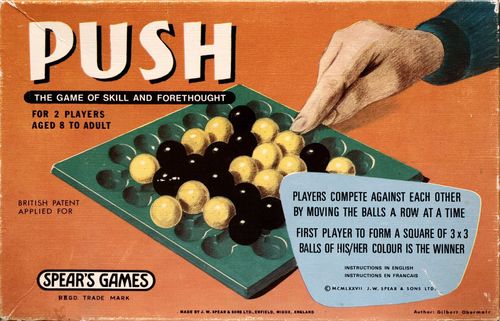
Push (1977)
Push (1977) Rulebook
Table of Contents
Table of Contents
Components
- 25 playing spaces (receiving regions or "pockets") arranged on the playing area proper, in two sets of parallel channel rows that cross at right angles
- 20 border pockets forming a border around the playing area proper, ten of which are numbered 0 to 9 and the rest unnumbered
- 26 playing balls in total, in two colours: 13 balls of one colour (for example black) and 13 balls of a different colour (for example yellow)
- Two storing compartments, 104 and 105, one for each colour of ball
Board
- The playing board, indicated generally at 101, is generally cellular in form and consists of two sets of parallel rows, each row being in the form of a channel.
- The rows of one set, indicated by 106, lie at right angles to the rows of the other set, indicated by 107.
- The black balls are indicated at 102 and the yellow balls at 103. As shown in FIG. 1 the balls are arranged in two storing compartments, 104 and 105: the black balls in compartment 104 and the yellow balls in compartment 105.
- Each intersection between the rows in one set and the rows in the other set defines a region 108 for receiving a playing ball. Each playing space is a pocket that holds a ball in position and places a limited restraint on a ball in that pocket against movement out of that pocket and into an adjacent pocket.
- There are twenty-five playing spaces in all. These twenty-five receiving regions form the playing area proper.
- The end of each row terminates in a further receiving region in the form of a further pocket 109 (there being twenty such pockets in all), into which a ball can be placed or displaced when playing the game. The further pockets 109 form a border around the playing area proper and are referred to below as border pockets.
- Two of the rows of border pockets that are adjacent are identified by reference numerals in the patent figure. The border pockets in one row are numbered from 0 to 4 and the border pockets in the other row are numbered from 5 to 9. The remaining border pockets are not numbered.
Game Modes
The game can be played as a game of patience for one person, or as a competitive game for two persons.
Patience (One Player)
- At the start of the game twenty-five of the balls are arranged in random fashion or in a predetermined pattern on the playing area. That is to say, each playing space (receiving region or pocket 108) is occupied by a ball; none of the border pockets 109 is occupied. When each of the playing spaces is occupied, the balls are closely adjacent or touching.
- The remaining ball is placed in any one of the numbered border pockets 109 and is then pushed against the ball which is at the end of the row to which the border pocket in which the remaining ball has been placed is an extension.
- The end ball is pushed in a direction along the axis of that row so that each of the balls in that row except the other end ball, which is moved off the playing area proper and into the border pocket at the other end of that row, is moved into its next adjacent receiving pocket in that row. The said remaining ball takes up the original position of the said end ball. That is to say, one ball is moved into one of the border pockets which are not numbered.
- The ball which is pushed off the playing area proper and into a border pocket is then picked up and is used for the next push: that is to say, the ball which is picked up is placed in one of the numbered border pockets and is used to push the same or a different row.
- When the game is a game of patience, the balls can be prearranged so that they take up a definite pattern. Thus, for example, the various playing balls can be arranged in any one of the patterns shown in FIGS. 3a to 3p.
- The object of the game is then, by a minimum number of pushes, to achieve a different pattern. For example, the playing board can be arranged as shown in FIG. 3a. The player then tries with as few pushes as possible to turn that pattern into another pattern, for example that shown in FIG. 3c. In this example the transformation from FIG. 3a to FIG. 3c is solved in the quickest possible way by consecutively placing a ball, and then pushing, in the following number border pockets: 9, 7, 7, 1, 9, 6, 8.
- The various patterns indicated in FIG. 3a to FIG. 3p are only given as examples, and many other different patterns could be used.
Competitive Game (Two Players)
Starting the Game
- The two players draw for who starts. The player starting selects his colour of balls and the other player has the other colour balls.
- The balls are then arranged on the playing area so that the twenty-five receiving regions or pockets are occupied, and so that the playing ball which is left over is of the colour selected by the person who starts the game.
- Preferably, the balls are arranged at the start of the game in a preset pattern, for example as shown in FIG. 3a.
Making a Push
- By placing the ball which is left over in any one of the border pockets numbered from 0 to 9, the player who starts pushes a given row of balls so that the end ball in that row remote from the border pocket in which the player has placed his ball is pushed off the board and into an unnumbered border pocket.
- If the ball which is moved into the unnumbered border pocket is of the same colour as the colour selected by the person who is playing, then the same player can perform the next push.
- If, however, a different colour is pushed into an unnumbered border pocket, then it is the other player's turn to push.
- The ball which is pushed off the playing area proper and into the unnumbered border pocket is then picked up and is used for the next push, as described above for the game of patience: that is to say, the ball which is picked up is placed in one of the numbered border pockets and is used to push the same or a different row.
Winning
- The aim of each player is to achieve, in any part of the playing board, a square of three-by-three balls of his colour, for example as indicated in FIGS. 3q to 3t. As shown in FIGS. 3q to 3t, black has formed such a square. In the latter mentioned drawings the other balls are all shown as yellow, but of course in practice, either three or four or more of these would be black, and arranged in random fashion on the board.
Variations
- In the competitive game the rules can be modified so that each player tries to achieve a predetermined pattern, for example as shown in FIG. 3(c), or a block of twelve balls (4 by 3) of his colour as shown in FIG. 3(t).
- Further, the rules could include the stipulation that to win the game a player must achieve a block or pattern, and that the colour of the last ball to be displaced from the playing area is that player's colour.
- The board game as described above can be modified in a number of ways. For example, a die or dice could be used to determine the number of consecutive pushes of a player. If a die or dice is used and the ball moved off the playing area by the last push is the same colour as that selected by the player who is pushing, then the rule that that player can have at least one further push can still be used.
- The rules of the game can also be modified so that each player can push from any side of the board (which should shorten the game) or from only one side of the board (which should lengthen the game).
- It is also possible to modify the game by having playing pieces of more than two colours and allowing three or more players to play.
Alternative Layouts and Piece Options
From the patent's summary of the invention. These are the described alternative forms of the board and pieces.
- Preferably the spacing between adjacent rows in one set is the same and equal to the spacing between adjacent rows in the other set.
- Advantageously, at least one end of each row is extended beyond the playing area, the extension of each row defining an individual playing piece receiving region. Those individual regions are arranged in two further rows, one lying substantially parallel to one of the sets of rows and the other lying substantially parallel to the other set of rows.
- A further playing piece can be arranged in one of the individual receiving regions and used to apply the said force to the end piece in the row to which the said one region forms an extension. Each of the pieces in that row except the other end piece is moved into its next adjacent pocket in that row, and the said other end piece is moved off the playing area. Alternatively, each individual receiving region can be used to receive a playing piece displaced from the playing area proper, that is to say from the row to which it forms an extension.
- Each end of each row may be extended beyond the playing area, each extension of each row defining an individual playing piece receiving region. Those individual regions are arranged in four further rows: one of the sets of rows lies between and substantially parallel to two further rows, and the other set of rows lies between and substantially parallel to the other two further rows. In this case, a piece moved off the playing area will always be moved into a respective one of the individual receiving regions.
- Advantageously, each of the individual regions which is in a (or the) further row lying parallel to one of the sets of rows, and each of the individual regions which is in a (or the) row lying parallel to the other set of rows, has an identifiable characteristic, for example a number or letter. In this case the playing piece which is placed in one of the individual regions to displace the playing pieces in a row can be placed in any one of the identified individual regions.
- The two sets of rows may be arranged at various angles to each other, but it is of advantage if the two sets of rows lie at right angles to each other.
- Further, although the playing area may take various shapes, it is of advantage, for reasons of simplicity, if the playing area is of square shape.
- Although the identifiable characteristic of each playing piece may be a pattern or number, it is of advantage if the colour of each playing piece defines the identifiable characteristic of that playing piece.
Notes on the Source
- This rulebook is transcribed from the patent description (columns 1 to 4 of the patent's description text). The patent's claims, front matter and figure drawings are omitted. The figures (FIGS. 1, 2 and 3a to 3t) are referred to by number only and are not reproduced.
- The patent is the only rules document located for Push. It is not a printed rulebook, and the box rules published by Spear's Games may be worded differently. Rules not described in the patent are not included here.
- In the scan of the patent, the first reference to the winning-pattern diagrams reads "FIGS. 3g to 3t" and the second reads "FIGS. 3q to 3t" (the second is partly illegible). Both are transcribed as 3q to 3t, matching the figure sequence.