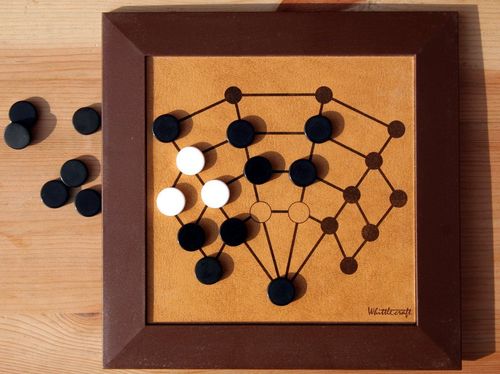
Pulijudam
Pulijudam Rulebook
Table of Contents
Table of Contents
How to Play
The game is played on the points of the board shown in Illustration 1, one side having three tigers and the other having fifteen lambs. On some boards there are arcs instead of the horizontal lines shown here, but this does not affect the way the game is played.
Illustration 1: the traditional pulijudam board.
Beginning the Game
- The game begins with the tigers placed on the board as shown in Illustration 2.
- The lambs make the first move.
Illustration 2: the tigers ready for play.
Moving the Pieces
- In the lambs' turn, a lamb is placed on any desired point on the board.
- No lamb may be moved while there are still lambs waiting to be placed.
- In the tigers' turn, a tiger may be moved from its current point, along a marked line, to the adjacent point, in any direction.
- Once all the lambs have been placed, a lamb may instead be moved in the same way as a tiger.
Capturing Lambs
- A tiger may, instead of moving to an adjacent point, capture a lamb by leaping over it onto the vacant point beyond.
- The tiger may not change direction during a leap, it must jump over only a single lamb, and it may make only one such leap in its turn.
- Lambs may not leap over tigers.
Winning the Game
- The lambs win the game by confining the tigers such that no tiger may move in its turn.
- The tigers win the game by capturing so many lambs that their task is no longer possible.
Variations
In Sumatra, a game called meurimüeng-rimüeng-do uses the same board, but has five tigers facing fifteen sheep.
A larger board shown in Illustration 3 is used with three tigers and fifteen "dogs" in a game called rafaya in India or demala diviyan keliya in Sri Lanka. The larger board makes the game last somewhat longer than pulijudam.
Illustration 3: the board for rafaya, or demala diviyan keliya.
Further Information
Players interested in reading more about pulijudam and related games can find more information in the following books:
- Astrop, J. The Pocket Book of Board Games. Kestrel Books, 1980.
- Bell, R. C. Discovering Old Board Games, pp. 39-40. Aylesbury: Shire Publications Ltd., 1973.
- Bell, R. C. Board and Table Games from Many Civilizations, vol. 2, pp. 47-48. New York: Dover Publications, Inc., 1979.
- Botermans, J, et al. The World of Games, p. 153. New York: Facts on File, Inc., 1989.
- Murray, H. J. R. A History of Board-Games Other Than Chess, p. 107. Oxford: Oxford University Press, 1952.
- Parlett, D. The Oxford History of Board Games, pp. 195-196. Oxford: Oxford University Press, 1999.