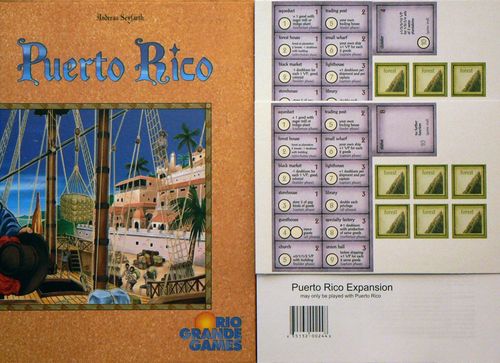
Puerto Rico: Expansion I – New Buildings
Puerto Rico: Expansion I – New Buildings Rulebook
Table of Contents
Table of Contents
- Buildings
- Aqueduct (Aqueduc)
- Forest House (Baraque forestière)
- Black Market (Marché noir)
- Boutique
- Pension (Pension)
- Commerce (Commerce)
- Church (Eglise)
- Small Wharf (Petit quai)
- Lighthouse (Phare)
- Specialty Factory (Manufacture spécialisée)
- Library (Bibliothèque)
- Syndicate (Syndicat)
- Cloister (Cloître)
- Statue (Statue)
Buildings
Costs are in doubloons. The tile value is the figure printed in the corner of each tile in the tileset.
Aqueduct (Aqueduc)
Cost: 1 doubloon. Tile value: 1.
Phase: craftsman phase.
If the owner of an occupied aqueduct produces at least 1 indigo from an indigo plant (not a small indigo plant), he takes one additional barrel of indigo. In the same way, if he produces at least one sugar from a sugar mill (not a small sugar mill), he takes one additional barrel of sugar.
Example 1: The player produces 0 indigo from his indigo plant and 1 sugar from his small sugar mill: he takes 0 indigo and 1 sugar.
Example 2: The player produces 1 indigo with his indigo plant and 3 sugar with his sugar mill: he takes 2 indigo and 4 sugar.
Reminder: The aqueduct does not work with a small indigo plant or a small sugar mill.
Forest House (Baraque forestière)
Cost: 2 doubloons. Tile value: 1.
Phase: settler phase; builder phase.
During the settler phase, the owner of a forest house may choose to place a forest instead of a plantation tile on an available space on his island. To do so, he places his tile (turned over) on his island. This tile is then considered a forest tile.
During the builder phase, each pair of forest tiles on your island reduces the cost of each building by one doubloon. This also works even if your construction hut is not occupied at that time. This advantage is added to the reductions granted by quarries and by the builder privilege, but it is not subject to the same restrictions as the quarries (see the upper part of the central board). Forest tiles do not require colonists to work.
Example: The player has 6 forests and 2 occupied quarries, and chooses the builder role. To build the large warehouse he pays nothing: 6 doubloons, minus 1 (builder), minus 2 (quarries), minus 3 (forests, no limit) = 0.
Note: If a player who owns a forest house also uses his hacienda or his cadastre (trader phase only), he may look at the tile he drew before choosing whether to place it as a plantation or as a forest on his island.
Note 2: If a player who owns a forest house also owns a library, he may place 0, 1 or 2 forest tiles. He may gain up to 3 forest tiles if he also owns a hacienda.
Note 3: If the player owns a hospice, he places his acquired colonist on San Juan.
Black Market (Marché noir)
Cost: 2 doubloons. Tile value: 1.
When the owner of an occupied black market builds a building, he may reduce the cost of construction by up to 3 doubloons by exchanging at least: a colonist, a good, and/or a victory point to the supply. In this case, a noble counts as a colonist.
Note: The player may choose, if he has these resources, to exchange them, but never more than one of each. Also, he may not keep any doubloons after the construction. So he can only use the black market if he first spends all his doubloons on this construction.
Example: The owner of an occupied black market wants to build the harbor (8 doubloons), but he has only 6 doubloons. He spends 6 doubloons, then exchanges to the supply one indigo and one colonist to make up the missing 2 doubloons. However, he cannot exchange any victory points, because his building is now paid for.
Note 2: If a player who owns a black market exchanges a victory point or a colonist after the end-game procedure has been triggered, the game ends normally.
Note 3: Colonists placed on players' black markets cannot be exchanged. Those placed on the quarries used to buy the building also cannot be exchanged.
Boutique
Cost: 3 doubloons. Tile value: 1.
Phase: captain phase.
At the end of each captain phase, the owner of an occupied boutique may, in addition to the barrel he is allowed to keep on his compass rose, keep three additional barrels that were not loaded. They may be of any type.
Example: The owner of an occupied boutique also owns a large warehouse: he may therefore keep all the barrels of 2 types of goods plus 4 additional barrels of any type.
Pension (Pension)
Cost: 4 doubloons. Tile value: 2.
Phase: mayor phase; guests may be moved in all phases.
During the mayor phase, the owner of an occupied pension may place up to 2 colonists on it. He may later move his guests at the start, during, or at the end of any other phase onto any buildings, plantations or quarries he has chosen; they then immediately become active and must stay there until the next mayor phase. The 2 guests may be moved together, or individually in different phases.
Example: At the end of the captain phase, the owner of a pension moves 1 guest onto his boutique and immediately uses his boutique to keep 3 additional barrels on his compass rose. Later, he chooses the trader role and moves the second guest onto his library. In doing so he doubles his privilege. These two guests, like the colonists, will stay on the boutique and the library until the next mayor phase.
Commerce (Commerce)
Cost: 5 doubloons. Tile value: 2.
Phase: trader phase.
During the trader phase, the owner of an occupied commerce may choose between selling a good to the trading house, or to his commerce.
If he chooses to sell the good to his commerce, he may sell any good he holds (including those already present in the trading house) at the normal price, adding of course the trader bonus if he is the one who chose the role. He then places the good directly in the supply. The player thus has, in effect, a small commerce with space for one good. The player may sell to his commerce even if the trading house is full.
Note: The small market and the large market do not grant their bonuses when a player sells a good to his commerce!
Note 2: Players must not own the comptoir and commerce buildings at the same time in a game.
Church (Eglise)
Cost: 5 doubloons. Tile value: 2.
When the owner of an occupied church builds a building in the 2nd or 3rd column, he gains 1 victory point. When he builds a large building (4th column), he gains 2 victory points.
Note: The player does not gain victory points when he builds the church itself, even if he has an occupied university or pension.
Small Wharf (Petit quai)
Cost: 6 doubloons. Tile value: 2.
Phase: captain phase.
During the captain phase, when a player owns a small wharf and must load goods, then instead of placing them on the ship he may place any number of barrels of goods, of a single type or of any other type, into the supply. He then gains 1 victory point for each pair of goods he transfers.
Example: You load 3 indigo, 2 tobacco and 1 corn: you gain 3 victory points.
Note: The small wharf may be used only once per phase.
Lighthouse (Phare)
Cost: 7 doubloons. Tile value: 3.
Phase: captain phase.
Each time, during the captain phase, when the owner of an occupied lighthouse loads his goods onto the ship, he gains 1 doubloon. If the owner of a lighthouse is also the captain, he receives 1 additional doubloon (regardless of his shipment).
Example: The captain owns an occupied lighthouse and loads 2 corn onto the corn ship in his first captain phase. He takes 3 victory points and 2 doubloons: 1 for the lighthouse and 1 for having been captain. On the next shipping round, he ships 3 indigo from his occupied wharf and takes 3 victory points and 1 doubloon. On his third turn, he ships 3 sugar on his small wharf and takes 1 victory point and 1 doubloon.
Specialty Factory (Manufacture spécialisée)
Cost: 8 doubloons. Tile value: 3.
Phase: craftsman phase.
The specialty factory is similar to the factory, but it rewards one type of good. The player takes 1 doubloon fewer than the total number of barrels of one same type that he has produced (except corn).
Note: A player may not use the specialty factory for corn!
Note 2: The player receives the doubloons at the end of the craftsman phase, together with the bonuses granted by the craftsman privilege.
Example: The owner of a specialty factory produces 4 corn, 3 sugar and 2 coffee. The specialty factory therefore gives him 2 doubloons: 3 (sugar) minus 1.
Library (Bibliothèque)
Cost: 8 doubloons. Tile value: 3.
Phase: all phases.
The owner of an occupied library doubles the privilege of his role. A settler who has an occupied library first chooses a plantation or quarry tile. Then, after all players have taken their plantations, the settler may take one of the remaining face-up plantations. He may not take a quarry as a double privilege. The craftsman privilege gives rise to 2 goods, identical or different.
Note: If the player choosing the craftsman role owns an occupied library, he may take 2 goods, identical or different.
Note 2: If the player who has an occupied construction hut chooses the settler phase, he may take a quarry as his second plantation. If he has a hospice, he benefits from the colonist only for his first plantation. If he has the forest house, he may use his 2 plantations as forests. If he has a hacienda, he must take the extra plantation tile before the first quarry/plantation tile of his settler turn. When he selects his second plantation tile through his settler privilege, his hacienda this time does not allow him to take a second one. He therefore cannot wait for the draw of his second tile to use his hacienda.
Syndicate (Syndicat)
Cost: 9 doubloons. Tile value: 3.
Phase: captain phase.
Before the owner of an occupied syndicate ships his goods during the first captain phase, he gains 1 victory point for each pair of identical goods on his compass rose. Afterwards, shipping continues normally.
Example 1: The owner of an occupied syndicate has 3 corn, 2 indigo and 1 coffee. He takes 2 victory points: 1 for the corn and 1 for the indigo.
Example 2: The owner of an occupied syndicate has 4 corn and 2 coffee. He takes 3 victory points: 2 for the corn and 1 for the coffee.
Cloister (Cloître)
Cost: 10 doubloons. Tile value: 4.
Phase: end of game.
The owner of an occupied cloister gains extra victory points for each set of 3 identical islands. For one set of three identical islands he gains 1 victory point. For two sets he gains 3 victory points. For three sets he gains 6 victory points, and for four sets he gains 10 VP.
Example: The owner of an occupied cloister has 6 forests, 3 quarries, 2 corn plantations and 1 coffee plantation at the end of the game. He gains 6 extra victory points.
(If he had had a corn plantation instead of his coffee plantation, he would have gained 10 victory points.)
Statue (Statue)
Cost: 10 doubloons. Tile value: 8.
Phase: end of game.
No colonist is needed to benefit from the statue. The statue is worth 8 victory points at the end of the game.
Note: When a player with an occupied university builds the statue, he places his colonist on San Juan.