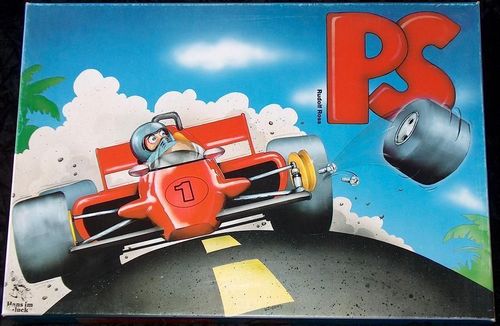
PS
PS Rulebook
Table of Contents
Table of Contents
Equipment
- 1 Gameboard
- 12 race cars in 4 different colors
- 9 special PS dice
- 24 counters
- 5 lap markers
- 1 scoreboard
- 1 set of rules
Game Goal
The goal of the game is to race with your three cars, finishing with the best positions possible. The team that gains the most finishing points wins the event.
Game Preparation
The racecars, the scoreboard and the gasoline table (last page of the rules) are put beside the board. Each player should take three cars of a color and the corresponding round counters. In addition, everyone will need a pencil and a gasoline-consumption & damage log.
Course of the Game
Select the number of laps - First the players must agree to the number of laps that they want to race. 3-5 laps are recommended.
Roll for the starting order - Each player selects one of his racecars. Each player rolls the 3 blue dice, and announces his sum. The player with the highest throw sets his car on the pole position. The pole position will be the 6, 9 or 12 to the inside of the track. Multiply the number of players by 3 to determine which place to use. The cars are set to the side of the track, angled to enter the track. The player with the next highest total places his car one position behind the pole sitter, etc.
Afterwards each player takes his second car and it in the same way determines the next tier of starting order. Finally, all players repeat this process to set the starting order for their third car. Once all positions are assigned, the cars form a line as shown in figure 1. (See German rules).
Roll for the start - Now all players roll the blue dice one more time. The player with the highest throw begins the race. Play will proceed clockwise around the table.
The special PS dice
The cars are moved by means of dice.
Blue dice have small values (1-3) for slow driving.
The red dice offer medium to very high speeds. The red dice have values of 4-6. If a 6 is rolled, that die must be rolled again, until no further 6’s are rolled. All throws of this die are totaled.
The yellow dice have values of 7-9, for high speed driving.
General Driving Rules
The player selects any three dice, with which he then rolls at the same time. Each car must have one die assigned to it. But the player may decide which die will be assigned to which car after he rolls the dice. The results from red and yellow dice must be moved by exact count. The first move with red and yellow dice must be one space forward. Subsequent moves may be sideways.
Example #2: Car #4 rolls a 7.
He must pull around Car #10 and must move forward with the first movement point.
When rolling the blue dice, some movement may be voluntarily forfeited. However, at least one space must be moved. This may be moved forward or sideways.
Example 3: Car #4 rolls a 2.
The player moves his car one space to the side and forfeits the other movement point, in order to get to the favorable space. (See example 6)
Example 3a: Car #4 rolls a 3.
The car pulls directly in front of Car #10. Car #4 voluntarily forfeits one movement point, in order to force Car #10 to roll a slow blue die.
If a player has three cars on the course, he must roll three dice during his turn. The following conditions may cause a car to leave the course:
- Taking a Pit Stop
- Loss of 1 or 2 cars
- 1 or 2 cars have already finished the race.
If a player no longer has three cars on the track, he reduces the number of dice thrown to equal the number of cars on the track.
Other cars cannot be jumped over. If a car is directly behind another car, it may only be moved with a blue die. Only blue dice allow a car to initially move sideways.
Example 4: Car #4 rolls a 3.
Car #4 must pull around Car #10 and therefore the first move must be sideways.
Initial Moves
On the starting move, no car, except the last, may finish its move on the inner lane. If a car is unable to observe this rule, it must remain on its starting position. The last car in the starting lineup is allowed to finish its move on the inside lane.
Driving on the Straightaway
When driving on a straightaway all general driving rules apply. Remember, after moving sideways a car must move at least one space forward.
Driving in a Curve
The beginning and the end of all curves have a double line.
There are two ways of navigating a curve:
- Within the speed limit
- Over the speed limit
A. Within the speed limit - In front of each curve is a number, which indicates the speed limit. If one does not exceed this speed, the driver may freely move forward and diagonally. (When changing lanes in the curve, all sideways movement should be diagonally forward.)
Example #5; Car #4 rolls a 3.
The car can be moved at will, e.g. inward.
B. Over the speed limit - If a car is on a space with a triangle, it can speed into the curve. It must alternate straightforward moves with diagonal moves towards the outside of the curve. If the route is blocked by another car this move is not permitted.
Example #6: Car #4 rolls a 7.
The car can speed through the corner.
The meaning of μ and σ
The μ indicates that these curves (the 5 corner and the full chicane) may not be passed through in a single move. That is, when speeding, that by this space all movement points of the die must be consumed. If a speeding car still has remaining movement points when arriving on this space the car will fly from the curve.
The σ indicates the preferred line. A car starting from this space can safely speed so long as the route is not blocked.
Both symbols are intended as assistance for a quick overview of the driving options in the curves.
Gasoline consumption
There are 3 options for gasoline consumption when playing PS:
- No gasoline rules
- Limited refueling
- Full gasoline rules
No gasoline rules: Gasoline consumption is omitted.
Limited refueling: Each car must stop once during the race for fuel. Each player may decide when to make the stop. Keep track of which cars have made their stop on a sheet of paper. With this variant it is recommended to race more laps.
Full gasoline rules: In this variant gasoline consumption is tracked on the gasoline consumption sheet. The length of the race determines how many fuel points a full tank of fuel has. Consult the “Benzinverbrauchstabelle” for when to consume fuel points. This variant is very tactical.
Damage
In four cases a racing car suffers damage:
- Flying from a curve
- Striking another car
- Nowhere to Go
- Running out of gasoline
Flying from a Curve - If a speeding car drives into a curve, it must adhere to the previously described rules (driving straightforward - then diagonally outward – then straightforward etc.). If he runs out of track with one or more movement points remaining, the car must fly from the track.
Consequences:
The car is set on the space of the outer lane, from which it left the track. From there it is moved backwards in the outer lane as many spaces, as were rolled for the car. Other cars can be jumped over. If a car stands on the final space, the erring car is set one space further back.
The car receives a point of damage.
Example #7: Car #4 rolls a 5.
The car exceeds the speed limit of 4, and flies from the curve. It is set on the space where it exited the track, and then moved 5 spaces backwards.
Striking another Car – This happens when a car has a movement point left and must halt because the route is blocked by another car.
Example #8: Car #4 rolls an 8.
Since car #4 cannot move sideways twice in a row, he will strike either car #1 or car #10.
Consequences:
The car is moved backwards as many spaces as was rolled for the car.
The car receives a point of damage.
Nowhere to Go – (see example)
Example #9: Car #4 moves on the space beside car #10. Car #10 is the next car to move, and can neither go forward or sideways.
Consequences: The car receives a point of damage.
Running out of Gasoline (only with full gasoline rules) - If a car uses the last of its fuel, then on subsequent turns the car can only be moved with a slow blue die. This condition persists until the car refuels in a pit stop. If a player for this car nevertheless uses a red or yellow die, the car receives a point of damage and can nevertheless only move three spaces.
Pit Stops
Cars must halt on the Stop space. Thereafter those cars making a pit stop require no die to be thrown. Instead, advance the car one space each round until the pit stop is finished.
There are two reasons to take a pit stop:
For refueling OR repairing - the cars drives through spaces 1-3.
For refueling AND repairing - the car drives through spaces 1-6.
Refueling: The car leaves the pit with a full tank. Consult the Tankfüllung table for how many fuel points a full tank of gasoline is worth.
Repairs: All damage points are repaired.
When a car is on the last pit stop space (3 or 6) it may move normally leaving the pit area.
Loss of a racing car
If a car receives a fourth damage point, it is removed from the game. Thereafter the player will roll one less de during his turns. The removed car is placed on the lowest finishing order spot of the scoreboard that is still available.
Laps Completed and Scoring - Lay the lap tiles beside the gameboard. As soon as a car completes a lap, move that cars round lap counter to the next highest lap tile. When a car completes the last lap of the race, move the car to the highest finishing position still unoccupied on the scoreboard.
It is recommended to track the current running order on the scoreboard using the duplicate round counters.
Game End
The player who achieved the most victory points for his entire team wins the game.