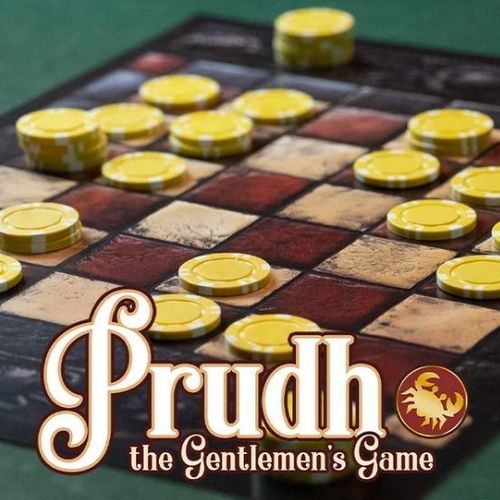
Prudh: The Gentlemen's Game
Prudh: The Gentlemen's Game Rulebook
Table of Contents
Table of Contents
Components
Prudh is played on a 6x6 board of alternating light and dark squares, with 36 identical stacking pieces. Note that a "stack" is defined as one or more pieces in a space. They do not actually have to stack, as the order of the pieces is not relevant.
Setup
Start by placing one piece on each space. One player owns the dark spaces, and the other owns the light. Choose a random player to go first.
Note: Traditional Prudh boards bear a subtle indication of which side belongs to which player. For example, a thin white stripe along one edge, a small black dot, etc. The board above has a thin edge that is light on one side, and dark on the other.
On Each Turn
On your turn you must make a legal move, either a slide or a run, described below. If you have no legal move, the game is over.
Slide
A slide combines two of your stacks. Choose a space of your color with at least one piece on it. Move the piece(s) in a straight line diagonally, through any empty spaces, to the first occupied space, combining those two stacks into one.
Note: You cannot make a slide unless it brings two stacks together.
Run
A run captures enemy pieces. Choose a space of your color with a stack of at least two pieces. Move that stack in a straight line orthogonally, dropping one piece onto every space as you go. If there are any pieces left over when you reach the edge of the board, return the extras to the space where they started the move.
What happens in each space where you drop a piece will depend on the color and contents of that space:
- Empty Space (either color): The new piece occupies the space.
- Friendly Stack: The new piece joins the stack.
- Enemy Stack, Smaller: If you drop a piece onto an opponent's stack that is smaller than the moving stack (that is, smaller than its original size), the enemy stack is captured. Remove all the pieces from the board, including the capturing piece, and set them aside. Captured pieces are worth one point each.
- Enemy Stack, Equal or Larger: If you drop a piece onto an enemy stack that is equal to or larger than the moving stack, the new piece joins the stack.
Note: You cannot make a run unless it will capture at least one piece.
Variations
There are at least four regional variations for what happens when a run reaches the edge of the board:
- Ordinary: As described above, when a stack moves "off the board," i.e., when there are more pieces in the stack than spaces in the run, the extras return to their starting space.
- Traditional: By the Fiorentine rules, when several pieces capture an enemy stack at the edge of the board, all the pieces are included in the capture. If the last space is friendly, they simply stop there.
- Tika ("The Shell"): The rules of Ouesta are similar to the Fiorentine, but only one of the capturing pieces is removed, and the others remain on the final space, becoming an enemy stack.
- Tomío ("The Pit"): The Grecan rules introduce a "pit," which is a reserve of pieces outside the board. Stacks can move fully off the edge and off the board, with all such pieces going into the pit. These pieces are awarded to the player who makes the last move of the game (rather than the tallest stack, see below).
End of Game
The game ends when either player cannot make a legal move. The player who made the last move of the game scores a bonus, equal to their tallest remaining stack. The high score wins, with ties broken in favor of the player who went second.