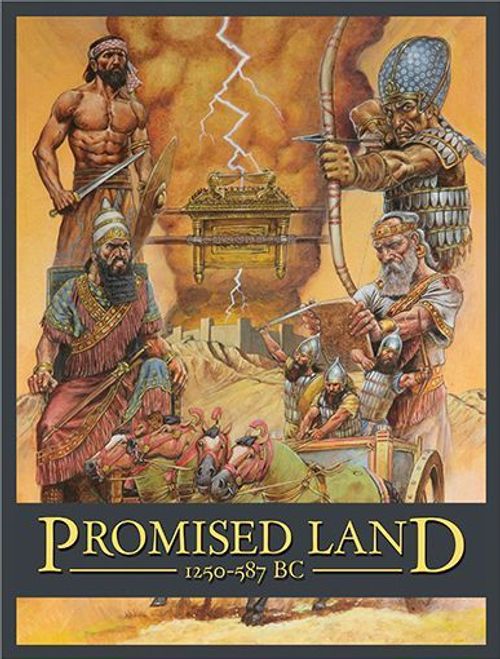
Promised Land: 1250-587 BC
Promised Land: 1250-587 BC Rulebook
Table of Contents
Table of Contents
Components
The map shows the hills and plains that make up the Promised Land. In their midst are the Salt Sea and Sea of Chinnereth connected by the River Jordan. To the west is the Great Sea. Other rivers complete the natural geography. There are twenty-five lands altogether. Each land contains a town, some of which are ports, and some lands contain roads. Some lands are designated as 'start-lands' for the various kingdoms. There is also a Time track, Royal track, Kingdom track, an array for Artefacts, supply space for cities and temples and the Combat chart.
Other components include:
- 72 Artefacts kept in the cloth bag
- 8 Royal tokens and 12 Kingdom tokens
- 6 cities
- 2 temples and the Ark of the Covenant (assemble using gold bases)
- Hebrew units: Northern tribes / Southern tribes
- Heathen units:
- Phoenicians / Edomites / Ammonites - Philistines / Moabites / Arameans ('neighbours')
- Canaanites / Assyrians / Babylonians - Midianites / Egyptians ('invaders')
Note: Though Heathen kingdoms may share the same counters, they each function as separate kingdoms. In exceptional circumstances two kingdoms sharing the same counters may become adjacent, in which case they form a united kingdom at that time. In the case of the Babylonians they will inevitably continue the expansion of the Assyrians as they share the same counters.
- Six sets of 6 Patriarch pieces (assemble using respective coloured bases): Farmer, Merchant, Priest
- 54 Kingdom cards. Each card shows: the points value if a weaker card, the number of dice used when attacking in hills, the number of dice used when attacking on plains, the card number indicating position on the Time track, the number of units for this kingdom, the name of the Heathen kingdom or name of the Hebrew leader, and the startland town for this kingdom. Units for this kingdom will be the same colour as the card and have this image.
- The game is divided into three sections: Books 1, 2 and 3. Heathens and Hebrews each have a deck of nine cards in each Book.
- 2 Reference cards
- Royal track marker, Kingdom track marker, Time track marker, Combat chart marker
- A supply of coins in '5's and '1's in each of bronze, silver and gold.
Note: Bronze, silver and gold coins are of equal value in the game. Bronze coins are collected by Farmers occupying hills or plains. Silver coins are collected by Merchants occupying roads or ports. Gold coins are collected by Priests occupying cities and temples and for being with the Ark.
- 4 dice
- Score-pad
Setting Up
- Place the six cities in the towns of: Jericho, Megiddo, Hebron, Hazor, Tyre and Kir-Haraseth. Place the two temples in the towns of Hebron and Hazor. Place the Ark in Heshbon.
- Place a Southern tribes unit in Heshbon and a Northern tribes unit in Jabesh-Gilead. Place one Heathen unit of the appropriate type (colour) in each Heathen start-land. Place a Canaanite unit (purple) in each of the remaining lands. Place the remaining units beside the map.
- Place the bronze, silver and gold coins beside the map.
- Separately shuffle each set of Book cards (six altogether, three Hebrew and three Heathen), placing each by the side of the map.
- Place the Artefacts in the cloth bag. Draw and place twenty Artefacts on the Artefact array.
- Randomly draw the eight Royal tokens placing them on the Royal track (left to right).
- Randomly draw and place the four 1 point Kingdom tokens on the Kingdom track (left to right), followed by the 2 point tokens and then the 3 point tokens.
- Decide who will play Heathens and who will play Hebrews. These teams should be closely matched (e.g. two versus three in a 5-player game). Each player takes a set of Patriarchs and matching Track markers. Each player places one Track marker to the left of the Royal track and one to the left of the Kingdom track.
- Each player draws one Artefact from the cloth bag and, depending on the points value of the Artefact, collects a number of coins: 1 point Artefact - 6 coins. 2 point Artefact - 4 coins. 3 point Artefact - 2 coins. The coins must be of the same type as that shown on the Artefact.
- Artefacts are kept face up until played
Initial Placement of Patriarchs
Each Heathen player places all six of their Patriarchs, followed by each Hebrew player placing just one of their Patriarchs.
The owner of most coins determines the Heathen placement order (roll dice to resolve ties). The first player places any one Patriarch in any Heathen occupied land. The second and third Heathen players do likewise. Continue in order until each Heathen player has placed all six of their Patriarchs, at least three of which must be placed in Canaanite occupied lands. More than one Patriarch may occupy a land; however, the following conditions must always be met:
- Each player may have only one of their Patriarchs in any one land
- Only one Patriarch of each type may occupy a land
Similarly the Hebrew players determine placement order and then each places one Patriarch in either of the two Hebrew occupied lands. The same conditions apply when placing these Patriarchs.
The Rules
Note: These rules now continue, describing the game as for 4 players. The changes needed for games of 2, 3, 5 or 6 players are set out in the Miscellaneous rules section.
Distributing Book Cards (4-player game)
In the 4-player game (two players per team), deal four Heathen Book 1 cards to each Heathen player, and four Hebrew Book 1 cards to each Hebrew player. Each player then discards one card back to the supply (each player uses a hand of THREE cards).
This process will be repeated at the start of Book 2 and at the start of Book 3.
Note: There are 'Weaker cards' in each Book for both Heathens and Hebrews. These cards are each worth points at game end; players must therefore retain their cards until the end of the game.
Player Turns
The game begins by placing the Time track marker on the first space of the track and calling for Card 1: Joshua. If a player has that card, then it is declared and the player's turn begins. When the turn is complete, the next card will be called for. If no player has the card, then the next card is called, and so on. Heathen and Hebrew turns are likely to be irregularly interspersed, but follow the Time-track sequence.
A player's turn proceeds in phases:
- Reveal the card and take units
- Conquer / Build / Stack units / Unused units / Move the Ark ('Kingdom building')
- Actions (Place Patriarch / Advance on the Royal track / Advance on the Kingdom track / Collect coin)
- Collect revenue
- Buy Artefact (two may be bought if the Authority token has been achieved on the Royal track)
Note: One Artefact may be played during a player's turn, two if the Power token has been achieved on the Royal track.
Reveal the Card and Take Units
The player reveals the declared card and takes the number of units shown for that kingdom from the appropriate supply. These units will be used for this 'active' kingdom (and no other kingdom) during Kingdom Building of this turn.
For example, if Card 8: Moabites is revealed, then four Moabite units will be taken and any kingdom building will take place in and around the Moabite start-land in the south-east of the map. Other Heathen kingdoms (e.g. Philistines) will remain inactive, although it may be possible (in exceptional circumstances) for a united kingdom to be formed.
Conquer
A kingdom may conquer lands belonging to other kingdoms that are adjacent to its own lands.
Note: The two Hebrew kingdoms may attack each other.
A Heathen kingdom must conquer lands contiguous to its start-land. If the kingdom does not already occupy its start-land, it must first place a unit into that land to conquer it automatically (simply remove all counters from that land, without rolling dice). If the active kingdom is or becomes adjacent to another Heathen kingdom sharing the same counter, then they form a united kingdom (this can help in achieving tokens on the Kingdom track).
A Hebrew kingdom is allowed to conquer lands that are NOT contiguous to its start-land. If a Hebrew kingdom does not have any units on the map (and only in this instance), then it must first place a unit into its start-land to conquer it automatically (without rolling dice). If a Hebrew kingdom is 'split' (e.g. if the Northern tribes have been cut in two by the Midianites), then only one portion may be used to achieve tokens on the Kingdom track.
Attacking
To attack, simply place one unit into a land that is adjacent to any land occupied by the active kingdom's units. The attacking player rolls dice unless making a 'Force victory' (see below). Any player can roll dice as the defender (e.g. a player having a Patriarch in that land or a player who played that kingdom most recently) - it doesn't matter.
The attacker rolls the number of dice for the terrain (hills or plains) as shown on the Kingdom card and uses the best SINGLE dice score (e.g. the attacker rolls 5, 3, 1 and uses 5). The defender always rolls one dice. The defender may receive a 'defence bonus', adding +1 to the dice score for each of the following:
- If defending a city
- If there is a stacked unit in the land
- If a Heathen is defending its own start-land
In addition:
- If a Hebrew is defending a land containing the Ark, then the defender adds +1 to the dice score
- If a Heathen is defending a land containing the Ark, then the defender SUBTRACTS 1 from the dice score
All factors are cumulative (you will find the maximum defence possible is +3).
If an attack fails (i.e. the defender's final score is equal to or greater than the attacker's), then the attacking unit is removed. Should another unit be used to continue the attack (immediately), then +1 is added to the attacker's next dice score. This may continue to +2 and +3, and this can be recorded on the Combat chart.
If the attack succeeds (i.e. the defender's final score is less than the attacker's), then any defending units (i.e. one unit or BOTH stacked units) are removed. Any city or temple is also removed.
Force Victory
If a land does NOT have any defence bonus (0), then instead of rolling dice the attacker may 'Force victory' as follows:
- If the card shows 3 dice for that type of terrain, the player simply (and always) replaces the defending unit with the attacking unit.
- If the card shows 1 dice for that type of terrain, then the attacker may spend an extra ONE unit (return one unit to the supply) and thereby conquer the land.
- If the card shows 2 dice for that type of terrain, then the attacker may spend an extra HALF unit and thereby conquer the land. To show this, place one of the kingdom's units on the ½ space of the Combat chart. If a subsequent half unit needs to be spent to force another victory, then remove the unit from the ½ space. If there is a unit on the ½ space at the end of the turn, then that unit is removed.
Note: When using the Siegecraft Artefact the +1 city defence bonus is ignored, which may then allow a Force victory.
Retreating Patriarchs
If a land containing a Patriarch is conquered, then the Patriarch may retreat to an adjacent land of the same kingdom, subject to the usual conditions (i.e. each player may have only one of their Patriarchs in a land and only one Patriarch of each type may occupy a land). If no such retreat can be made, then the Patriarch is removed back to the player's supply ready to be used again later in the game.
- If a land containing two or three Patriarchs is conquered, then each may retreat to a land (and not necessarily the same land) subject to the usual conditions
- A Patriarch may NOT be removed in order to allow another Patriarch to retreat
Build
To build a city costs 1 unit.
- A city may only be built in a land occupied by the active kingdom
- A land may contain a maximum of one city
To build a temple costs 2 units.
- A temple may only be built in a city belonging to the active kingdom
- A city may contain a maximum of one temple
Stack Units
A second unit may be stacked in one or more lands of the active kingdom. Stacked units may NOT be used again except to assist in the defence of that land (providing a +1 defence bonus).
Unused Units
Any unused unit (whether because there are insufficient units in the general supply, or that player is unable to use all his units, or simply doesn't want to use them all) can be exchanged 1:1 for any coin.
Move the Ark
If the active kingdom controls the Ark, then the Ark may be moved to another land of that kingdom.
- The Ark may not be moved across a 'split' in a Hebrew kingdom.
If a player's own Priest is with the Ark (i.e. in the same land), then that Priest may be moved with the Ark. If another player's Priest is with the Ark, then that Priest MUST be moved with the Ark. In any such case, the usual conditions regarding Patriarchs occupying a land will apply.
Note: Moving the Ark (or moving a Priest with the Ark) does not constitute an 'action' (see Actions).
Actions (4-player game)
Actions take place after Kingdom building. There are four types of action:
- Place Patriarch
- Advance on the Royal track
- Advance on the Kingdom track
- Collect coin
In the 4-player game a player may make THREE actions in total. A player may make the same action more than once in a turn.
Place Patriarch
For one action a player may place one Patriarch in a land of the active kingdom. The Patriarch may come from the player's supply or it may be removed from the map and placed again. The player may NOT remove a Patriarch from the map simply to make way for the placement of another. More than one Patriarch may occupy a land; however, the usual conditions must always be met:
- A player may have only one of their Patriarchs in any one land
- Only one Patriarch of each type may occupy a land
Note: If the Justice Royal token is achieved then one Patriarch may be placed for free (it does NOT cost an action) during this same Actions phase and in each subsequent Actions phase.
Advance on the Royal track
For one action a player may advance to the next token (left to right) on the Royal track. Pay the amount of coins shown on the token and move the player's marker onto that token. More than one marker can occupy the same token.
- Any benefit shown on the token can be used during the remainder of the turn in which it is achieved and in each subsequent turn; any points are scored at game end
Advance on the Kingdom track
For one action a player may advance to the next token (left to right) on the Kingdom track provided the active kingdom (alone) has achieved the demands of that token. The player's marker is moved onto that token. More than one marker can occupy the same token.
- When tokens have similar demands (e.g. 'Control 4 hills' and 'Control 5 hills') and if a player wanted to achieve both in the same turn, then both demands would have to be separately achieved by the active kingdom (i.e. the active kingdom would need to control 9 hills in total that turn)
Collect coin
For one action a player may collect any one coin (any two may be collected if the Treasury Royal token has been achieved).
Collect Revenue (4-player game)
Revenue is collected after the Actions phase. Each of a player's Patriarchs on the map (not just those in the active kingdom) may generate revenue.
In the 4-player game revenues are as follows:
- Farmer: collect 1 bronze coin when occupying a hill; collect 2 bronze coins when occupying a plain
- Merchant: collect 1 silver coin when occupying a road; collect 2 silver coins when occupying a port
- Priest: collect 1 gold coin when occupying a city; collect an additional 2 gold coins when occupying a temple; collect an additional 1 gold coin if with the Ark
Buy Artefact
After the Collect revenue phase a player may use coins to buy one Artefact (two may be bought if the Authority token has been achieved on the Royal track). The amount and type of coins needed is shown on each Artefact. Artefacts are initially placed face-up in a player's supply and turned face-down when played.
- See List of Artefacts below
The player's turn ends after Buy Artefact.
Playing Artefacts
One Artefact may be played per turn (two may be played if the Power token has been achieved on the Royal track). Artefacts vary as to which phase they may be played in and this is shown on each. Some are only played in Kingdom building (KB), some in Actions (A), some in Collect revenue (CR). Others may be played in either Actions or Collect revenue. Treaty is played as a defence in another player's Kingdom building phase. The Bonus Artefacts are never turned face down, but may be used in every Collect revenue phase.
Note 1: No Artefact may be played in the Buy Artefacts phase. Note 2: Some Artefacts may be used throughout the Kingdom building phase as explained in List of Artefacts.
Starting Book 2 and Book 3
- Draw Artefacts from the cloth bag to re-fill empty spaces on the array.
- Distribute new Book cards.
Ending the Game and Winning
The game ends when the last turn has been played.
Use the Score-pad to tally each player's points as follows:
- Each Hebrew player scores points for each of their Patriarchs remaining on the map ('Hebrew remnant'). These points are equal in number to the revenue the Patriarch would be able to collect (but may NOT make use of any Artefact)
- Score points as shown for each Royal token the player has achieved
- Score points as shown for each Kingdom token the player has achieved
- Score 1 point for every 5 coins of the same type in the player's supply
- Score points as shown for the Weaker cards played by the player
- Score points as shown for the Artefacts in the player's supply (face-up and face-down)
The player scoring most points wins the game. In the event of a tie, the tied players compare their remaining coins; the player with most is the winner. If this is still a tie, then there are joint winners.
Miscellaneous
Ezion-Geber
This port is situated on the Red Sea (off map) but is incorporated into the land of Bozrah. Occupying this land will mean that the port can be used for revenue and for achieving tokens on the Kingdom track.
Canaanite Start-land
There is no Canaanite start-land shown on the map. In the unlikely instance of there being no Canaanite units on the map when the Canaanite card is revealed, then the Canaanite start-land is Kedesh.
Team of 1 Player (versus 1 or 2 players)
The following changes are made for the player in this team:
- Deal six cards to that player and discard two (use a hand of FOUR cards only)
- The player may make TWO actions only
Team of 3 Players (versus 2 or 3 players)
The following changes are made for players in this team:
-
Deal three cards to each player and discard one (use a hand of TWO cards only)
-
Each player may make FOUR actions
-
All revenue amounts increase by 1 coin as follows:
- Farmer: collect 2 bronze coins when occupying a hill; collect 3 bronze coins when occupying a plain
- Merchant: collect 2 silver coins when occupying a road; collect 3 silver coins when occupying a port
- Priest: collect 2 gold coins when occupying a city; collect 3 additional gold coins when occupying a temple; collect 2 additional gold coins if with the Ark
Secrecy
Cards and coins should be kept secret until played. Artefacts are initially placed face-up. After an Artefact is played it is turned face-down (with the exception of Bonus Artefacts).
Unit Supply
If there are insufficient units for a kingdom at the start of a turn, then a player must follow the rules for Unused units.
The counter mix is as follows:
- Hebrews - 30 counters
- Heathen neighbours - 24 counters
- Heathen invaders / Canaanites - 30 counters
Coin Supply
The number of coins is finite and, should no further coins be available of that type, then they are simply not collected.
Alternative 'No Dice' Combat System
By extension of the Force victory rules, the game can be played without the use of dice (i.e. when attacking lands that do have a defence bonus, as well as those that don't).
The table shows how many extra units to spend in order to Force victory.
| 0 defence | +1 defence | +2 defence | +3 defence | |
|---|---|---|---|---|
| 1 dice attack | 1 unit | 2 units | 3 units | 4 units |
| 2 dice attack | ½ unit | 1 unit | 2 units | 3 units |
| 3 dice attack | 0 units | ½ unit | 1 unit | 2 units |
Note: Players should decide at the start of the game whether or not to use this system.
List of Artefacts
| Name | Cost | Points | Description |
|---|---|---|---|
| Treachery | 3 coins | 1 | Attack one land using 3 dice. (KB) |
| Plague | 3 coins | 1 | Choose one land of the active kingdom. Any stacked units (both Heathen and Hebrew) in adjacent lands are removed. (KB) |
| Populate | 3 coins | 1 | Stack 1 unit (taken from the general supply) in each of two lands of the active kingdom. (KB) |
| .....Boom | 3 coins | 1 | Collect double revenue for Farming / Trade / Culture (see Artefact icon) this turn. (CR) |
| Masons | 3 coins | 1 | To build 2 cities costs 1 unit. To build 1 temple costs 1 unit. Masons may be used several times in the turn. (KB) |
| Siegecraft | 3 coins | 1 | The +1 defence bonus of cities is ignored throughout this turn. (KB) |
| Tribute | 3 coins | 1 | Collect 2 coins of one type. (A or CR) |
| Proliferate | 3 coins | 1 | Place any 1 Patriarch in the active kingdom. (A) |
| Recruit | 3 coins | 1 | Receive 1 unit. (KB) |
| Commerce | 6 coins | 2 | Exchange any number of coins for an equal number of any other coins. (A or CR) |
| Chariots | 6 coins | 2 | The active kingdom uses 3 dice when attacking on plains throughout this turn. (KB) |
| .....Bonus | 6 coins | 2 | An appropriate occupying Patriarch (see Artefact icon) collects 1 extra coin in revenue. Note: This Artefact is kept face up and used in every Collect revenue phase. (CR) |
| Assault | 6 coins | 2 | Conquer one land (but NOT one that contains a temple) for 1 unit only. (KB) |
| Tribute | 6 coins | 2 | Collect 4 coins of one type. (A or CR) |
| Proliferate | 6 coins | 2 | Place any 2 Patriarchs in the active kingdom. (A) |
| Recruit | 6 coins | 2 | Receive 2 units. (KB) |
| Capitulation | 9 coins | 3 |
Royal Track Tokens
| Name | Cost | Description | Points |
|---|---|---|---|
| Palace | Any 3 coins | 2 | |
| Palace | 1 bronze + 1 silver + 1 gold coins | 3 | |
| Palace | 2 bronze + 2 silver + 2 gold coins | 4 | |
| Palace | 3 bronze + 3 silver + 3 gold coins | 5 | |
| Treasury | Any 3 coins | For one action collect 2 coins of any type. | 1 |
| Authority | 1 bronze + 1 silver + 1 gold coins | May buy 2 Artefacts per turn. | 2 |
| Power | 2 bronze + 2 silver + 2 gold coins | May play 2 Artefacts per turn. | 3 |
| Justice | 3 bronze + 3 silver + 3 gold coins | May place 1 Patriarch for free per turn. | 4 |
Kingdom Track Tokens
| Description | Points | Description | Points |
|---|---|---|---|
| Occupy 2 plains | 1 | Occupy 4 hills | 2 |
| Occupy 1 port | 1 | Build or destroy 1 temple | 2 |
| Occupy 3 roads | 1 | Occupy 2 ports | 3 |
| Build or destroy 1 city | 1 | Occupy 5 hills | 3 |
| Occupy 3 plains | 2 | Build or destroy 2 cities. Note: It is not sufficient to build 1 and destroy 1 | 3 |
| Occupy 4 roads | 2 | Possess the Ark (i.e. the Ark is simply in the active kingdom) | 3 |