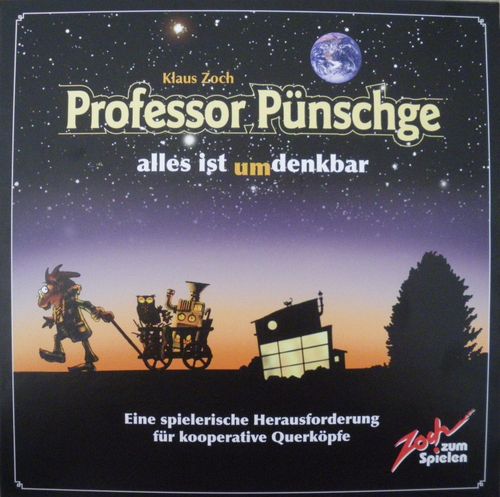
Professor Pünschge
Professor Pünschge Rulebook
Table of Contents
Table of Contents
Game Components
- 1 game board
- 1 figure, Professor Pünschge
- 117 playing cards with a total of 702 "tasks"
- 1 card box
- 25 marker stones: 15 white, 10 black
- 60 crystals:
- 30 white crystals worth 1
- 20 blue crystals worth 5
- 10 red crystals worth 20
Object of the Game
Find out which spaces Professor Pünschge wants to step on or avoid on his way home! Draw the correct logical conclusions from his "steps"! Can you bring the Professor home exclusively over the spaces he "wants"?
You have the choice:
- Cooperative: You try together to get to the bottom of the Professor's logic.
- Competitive: You compete against each other, measuring your mental powers.
For the first time we recommend the cooperative game. The competitive rules can be found starting on page 5.
Important tips for beginners
Play the first rounds absolutely with the light blue "Junior cards" and ignore their more difficult backs for now. These cards contain the simplest tasks and lead gently into the logic of the game. Later you can play the tasks either "mixed" or sorted by difficulty level.
What kinds of tasks there are is described in the chapter "What's coming at us?" starting on page 7.
Setup
Place Professor Pünschge on the "Denk-Bar" (start space), shuffle the playing cards and place them in the card box within reach next to the game board. Sort the marker stones and place them next to the game board. Also sort the crystals and place them as a supply next to the game board.
Crystals come in values 1 (white), 5 (blue) and 20 (red).
Each card has two differently coloured sides with three tasks each. The colours indicate the level of difficulty:
- light blue = Junior (entry-level tasks)
- green = easy
- yellow = medium
- red = hard
- dark blue = Gourmet (especially original tasks)
To make orientation easier, the "general rules" that apply to both variants are shaded yellow.
Together We Can Do It! The Cooperative Rules
In the cooperative game one player takes on the role of the Professor. He draws a card and chooses a task to set his fellow players. They discuss together which spaces are "right" and which spaces are "wrong". If they make few wrong attempts, they increase their chances of winning and reduce Professor Pünschge's income.
Course of play
One player takes on the role of the Professor. He takes the rearmost card from the card box so that only he sees the front of this card. From it he chooses a task, but does not read it aloud. Then he marks the first two spaces of this task's solution row on the game board with one white marker stone each. The other players are the assistants. They try to solve the task.
Example: Solution row: 2 • 4 • 12 • 17 • 18. Spaces 2 and 4 of the game board are marked with a white chip.
The Professor places crystals worth at least four, but at most eleven, from the supply on his little house (goal space).
Then the other players take turns (active player).
And off we go!
The assistants confer and decide together on which space they put the game piece. If the players cannot agree on a space, the active player moves the game piece to a space of his choice.
When the game piece is placed on a "right" space, the Professor gives a cheerful "brumm brumm". When the game piece is placed on a "wrong" space, the Professor lets out a grumpy "möööb". (Of course the Professor could also say "wrong" and "right" in plain German, but as we all know, brilliant professors are sometimes a bit peculiar.)
Incidentally: A real Professor Pünschge never uses the word "right". He softly murmurs "brumm brumm" when a correct space has been stepped on. The Professor also does not say "wrong", but emits a clearly audible "mööööb" when the piece has been placed on a wrong space.
Whenever the game piece is placed, the Professor announces whether the chosen space is "right" or "wrong".
WRONG and RIGHT spaces
A space is wrong if it
a) does not appear in the solution row at all, or
b) does appear in the solution row, but is not the next space of the solution row.
The Professor places a black marker stone on this (wrong) space.
A space is right if it is the next space of the solution row (that is, the preceding space of the solution row has already been marked with a white stone). The Professor places a white marker stone on this space and immediately removes all black marker stones from the game board.
Example: Solution row 1 • 3 • 5 • 7 • 9 • 11 • 13 • 15 • 17 ...
Spaces 1 and 3 are marked as right.
After thorough discussion with his fellow players, Bernd places Professor Pünschge on space 7. This space is indeed part of the solution row. But because space 5 has not yet been recognised (and marked) as a right space, space 7 is currently still wrong ("mööööb"!) and is therefore covered with a black marker stone.
Against the advice of the other assistants, Renate places Professor Pünschge on space 6. She too earns a "mööööb!": this space does not belong to the solution row and receives a black marker stone.
Uta follows the advice of her fellow players and places Professor Pünschge on space 5. Right! ("brumm brumm!") The next space of the solution row is thereby "cracked" and receives a white marker stone. The black marker stones on spaces 6 and 7 are removed again. Now Uta tries space 9. That is ("mööööb!") wrong, because the next (and thus right) space of the solution row would have been space 7. Space 9 is marked black.
Thorsten tries space 7. "Brumm brumm!" Right! Then he tries space 9. Also right. How about space 11 now? ... Yes, with that he also reaches the next space of the solution row...
Whoever moves the game piece to a right space stays on turn. Otherwise his left neighbour follows. The Professor never moves the game piece. He is simply skipped in this turn order.
Incidentally: On each turn the game piece starts from the space that was last marked as "right" (white). Between individual turns the piece may be set aside so that all information on the board spaces is always visible to all players.
Crystals for the Professor
Whenever the game piece is placed on a wrong space, the Professor immediately receives one white crystal from the goal space (in the example above, 3 in total). After the last crystal has been given out, the Professor reads aloud the hint of the task card. From then on, for every further wrong space the game piece steps on, he receives one white crystal from the supply. To carry out payouts correctly, crystals are exchanged for crystals of another colour according to their value where necessary.
Finally home! (The goal space)
If the game piece is moved into the goal space although not all spaces of the solution row have yet been "cracked", the assistants earn a "mööööb" from the Professor. The players keep trying to solve the task.
If the game piece is moved onto the goal space, accompanied by a "brumm brumm" from the Professor, all spaces of the solution row have been "cracked".
That is rewarded! There are three possibilities:
- If Professor Pünschge reaches the goal space without the hint having been read aloud, all assistants receive crystals worth 5 from the supply.
- If Professor Pünschge reaches the goal space in the turn immediately following the reading of the hint, all assistants receive crystals worth 2 from the supply.
- If Professor Pünschge reaches the goal space later, there is no reward.
If crystals are still lying on the goal space, they are returned to the supply. The role of the Professor passes to the player to the left of the previous Professor.
The game ends...
...after every player (in turn) has played the role of the Professor once. Whoever now owns the most valuable crystals wins. There can be several winners.
...too early???!!!
Whoever wants it longer can, for example:
- play until every player has been Professor Pünschge twice (three times, four times ...). Professor Pünschge recommends: "Write down the score from time to time."
- first play one complete round cooperatively and then one complete round according to the differing rules of the competitive variant, so that each player takes on the role of the Professor once in both variants.
More Competition! The Differing Rules of the Competitive Variant
Crystals worth 5 are placed on the little house (goal space).
Whoever is on turn places the game piece on a space of his choice.
The players do not discuss which spaces are right or wrong; they try to keep their "knowledge" and their guesses to themselves in order to solve the task themselves if possible.
But: On every turn, fellow players may offer their help.
Offering help
Whoever is not on turn himself but believes he can lead Professor Pünschge to the goal without error may offer help to the active player. The active player may decline the help. If he accepts it, however, the helping player tells him which solution row (or which logic behind it) he considers right. The active player may now follow this help suggestion by placing the game piece one after another on exactly the spaces the helping player specifies. But he may also ignore the help given, after having listened to it, and then make a completely different move.
Example A: Thorsten is on turn. Renate offers him help. Thorsten declines. Renate keeps her knowledge to herself.
Example B: Thorsten is on turn. Renate offers him help. Thorsten accepts, listens to Renate's suggestion, follows it and so solves the task. Thorsten and Renate share the reward (of the 5 crystals won she receives 3).
Example C: Thorsten is on turn. Renate voices a solution idea. Thorsten follows this idea and so solves the task. Since Renate simply announced her solution idea without asking whether Thorsten wanted to hear it at all, Thorsten receives the due reward alone. Renate goes away empty-handed.
Example D: Thorsten is on turn. Renate offers him help. Thorsten accepts and listens to Renate's suggestion. He then decides, however, to make a different (unsuccessful) move. Afterwards it is Uta's turn. She has also heard Renate's solution suggestion, follows it and thereby solves the task. Since it was not Uta (but Thorsten) who asked Renate for help, Uta collects the reward for solving the task alone.
The Professor bets that his task remains unsolved
Before the first turn the Professor may bet that the first two assistants will not succeed in solving his task. If he is proved right, he may, after these two players have had their turns:
- end the bet and collect the stake
- or
- raise the stake and claim that the next two players will not solve the task either.
How the Professor bets
He places a white crystal from the supply on the "Denk-Bar" (start space). If he raises this stake for the first time, he adds crystals worth 2. At the second raise the value laid out rises by a further 3, the next time by 4, then by 5 and so on. This means that at first one white crystal lies there, after the first raise 3, after the second already 6, then 10, 15, 21 and so on.
If he ends the bet, he takes all crystals already lying on the "Denk-Bar" (start space). He then reads aloud the hint of the task card and may from then on no longer place any stake. This also ends the competition among the other players. You now have exactly one turn left to solve the task together and so win 2 crystals, exactly as described in the cooperative variant.
The Professor loses his bet if a player succeeds in moving Professor Pünschge to the goal before the Professor has taken the stake.
Goal reached!
If a player succeeds in moving the game piece onto the goal space before the hint has been read aloud, this player receives all crystals lying on the start and goal spaces. If a player solves a task because he followed a fellow player's help, he shares the reward with that player. If one (indivisible) crystal is left over, the helper receives it.
Example A: "Professor" Bernd's stake is 10. Now Renate solves the task. She receives Bernd's stake (10) and the crystals from the goal space (5).
Example B: "Professor" Bernd ends his bet, receives the stake and reads the hint aloud. On the next turn the other players solve the task. They each receive crystals worth 2.
What's Coming at Us? How Professor Pünschge's Tasks "Tick"
Have you already noticed that the spaces on Professor Pünschge's path ...
- show 7 different symbols (bank, dragon, owl, fish, covered wagon, ibex, bull) in different numbers and in changing combinations?
- have 4 different shapes (sun, moon, star, cloud)?
- have 4 different colours (green, yellow, red, white)?
- lie in 4 different areas (mountains, lake, forest, meadow)?
- are numbered from 1 to 26?
- are positioned on straight stretches or corner spaces?
This information is particularly important for solving Professor Pünschge's tasks. It could be, for instance, that the Professor has set his mind on heading for all yellow spaces that contain a fish, or all moon spaces that are not in the forest, or all spaces with even numbers, or ...
However, it cannot be ruled out that he simply wants to reach all spaces of the upper half of the board.
You will not find any tasks, however, that are so complex (that is, restricted by so many conditions) that they could only be worked out by pure luck and guessing (for example: "All green moon and sun spaces on which at least two legs can be seen."). Furthermore, every solution row consists of at least four spaces.
A. The Junior cards (colour: light blue)
Here you find tasks that
- are defined by a single condition (e.g. "moon"). Example: "Every moon space" or "Every white space" or "All spaces with an odd number".
Please play the first rounds as a "warm-up" exclusively with Junior cards. But do not take these cards out of the game in later rounds either. You will find that these simple tasks can be very "treacherous": if you expect a more demanding task, such a Junior task sometimes sends you thinking into the void...
And with that you have already received a particularly useful tip for the whole game: just think! The more complicated your thinking is, the further you move away from what goes on in Professor Pünschge's head!
B. The easy tasks
Here you find tasks that
- allow two conditions of the same kind (e.g. colour) at the same time. Example: "All green and red spaces"
- exclude certain spaces. Example: "All spaces on which there is no fish"
- demand "jumps". Example: "Every 3rd space" or "2 spaces wrong / 2 spaces right (in constant repetition)"
- demand "jumps" to simply defined spaces. Example: "Next star, then next moon (in constant repetition)"
- are defined by the number of space symbols. Example: "All spaces in which there are 3 symbols"
- are defined by two conditions (e.g. green / covered wagon). Example: "All green spaces on which there is a covered wagon"
C. The medium tasks
Here you find tasks that
- refer to spaces before or after certain places. Example: "Every space located immediately before a star space"
- are defined by one condition, but exclude certain spaces from it. Example: "All lake spaces that are not white"
- allow two conditions (also of different kinds) at the same time. Example: "All yellow spaces and all cloud spaces"
- demand ascending or descending "jumps". Example: "1 space right - 2 wrong, then 1 right - 3 wrong, then 1 right - 4 wrong ... etc."
- demand a defined alternation of certain kinds of spaces. Example: "3 times moon, then 3 times sun (in constant repetition)"
- refer to the position of the spaces. Example: "All spaces of every second straight"
- exclude a certain number of space symbols. Example: "All spaces with 1 or 3 (but not 2) symbols"
D. The hard tasks
Here you find tasks that
- exclude two conditions. Example: "All spaces that show neither fish nor cloud"
- demand a repetition of "jump sequences". Example: "2 times cloud, then 2 times star (in constant repetition)"
- allow two demanding conditions (also of different kinds). Example: "All lake spaces and all spaces on which there is an ibex"
- refer to the position of defined spaces. Example: "All green spaces of the upper half of the board"
- demand "jumps" to demandingly defined spaces. Example: "Next space bank, then next space fish"
- demand "jumps" that vary at defined places. Example: "Always jump 1 space, but from a meadow space jump 4 spaces"
E. The "Gourmet tasks"
These tasks are partly easy and partly (medium-)hard. What they have in common is that they possess a wilful originality. More is not revealed here yet.
F. For the creative ...
Simply set your fellow players tasks that you have thought up yourselves! You will surely notice that it is harder to devise solvable tasks than unsolvable ones! (That is why you should only play this variant once you have already "practised" plenty.)