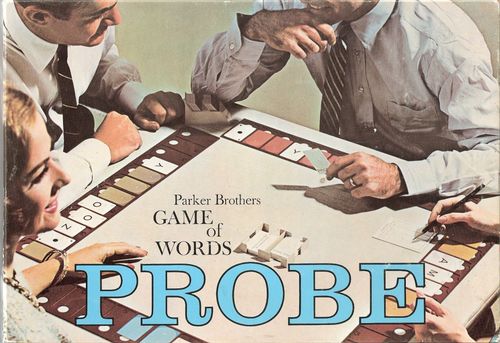
Probe
Probe Rulebook
Table of Contents
Table of Contents
Object
Each player selects a secret word of up to 12 letters. Then, letter by letter, the other players try to guess it. Any words are acceptable - nouns, adjectives, adverbs or any other parts of speech - just as long as they are not spelled with apostrophes or hyphens and are not proper names or abbreviations.
Equipment
- 4 Word Trays
- Lined Paper
- 36 Activity Cards
- 1 Activity Deck Tray
Preparation
Each player begins with a word tray. Choose a player to keep score. He will need a pencil and paper. Shuffle the activity cards and place them face down in one side of the activity deck tray.
How to Begin
- Each player opens the flaps on his word tray and positions the tray so that the numbers are facing him.
- Each player tears the top sheet from the lined pad and places it in the flat section of his tray.
- Each player thinks of a word which he will use in the game. He does not disclose his word to the other players.
- If the word selected has less than 12 letters, the player may try to fool his opponents as to the true length of the word by adding DOTS which represent blank spaces.
- A player may use up to 5 DOTS in his word.
- DOTS may be used before or after the word, or both, but are not substitutes for letters and may not be inserted between letters.
- Starting at the left hand box and out of sight from his opponents, each player prints his word on his sheet in the proper spelling sequence. He may begin his word with a dot or the first letter of his word.
- Each player closes the flaps over all letters and dots, leaving open flaps where nothing has been printed.
- Each player turns his tray around, so that the flaps, when open, face his opponents.
- Players may use a dictionary before play begins; however, they may not use it during the game except when a word is finally guessed and there is controversy over the spelling of the word.
How to Play
-
The player selected to start, takes the top card from the activity deck and reads it aloud. The instructions on the activity cards must be followed by all players at the appropriate time. Then the activity card is placed face-up in the other side of the tray.
NOTE: If a player cannot obey the instructions on an activity card, he ignores them and discards the card. His turn continues according to the rules below.
-
This same player then begins his search for the letters that make up the words of his opponents. Without saying where he thinks it is hidden, he asks any opponent if he has hidden a particular letter of the alphabet or a dot.
-
If the opponent questioned answers, "Yes", the opponent reveals the letter or dot called for. Should he have more than one of that letter (or more than one dot) in his word, he selects which letter (or dot) to reveal. He never reveals more than one letter or dot in response to any one question.
EXAMPLE: If the word of the player questioned is "treasurer" and an "r" is asked for, it is that player's privilege to expose whichever "r" he wishes.
-
If the player whose turn is in progress has guessed correctly, he is entitled to guess again. He may question the same opponent or he may question any other opponent. He may even come back to the original opponent later during the same turn.
-
A player's turn ends when he fails to guess correctly. The player to the left of the first player then takes his turn in the same manner, first drawing an activity card and then questioning opponents.
-
Players are not permitted to keep a list of letters that have been called during the game.
Meanings of the Activity Cards
TAKE YOUR NORMAL TURN - Your normal turn is simply guessing until an opponent says "No" to your question. Then your turn ends.
TAKE AN ADDITIONAL TURN - After an opponent says "No" to your question, draw another activity card and continue guessing until you fail to guess correctly.
OPPONENT ON YOUR LEFT (OR RIGHT) WILL EXPOSE A LETTER OR A DOT - The opponent so designated must choose any one of his hidden letters or dots and expose it before you make your guess. Should he have only one letter or dot left covered, he must still expose it.
IF YOU HAVE A DOT, EXPOSE IT - Before taking your normal turn, you must expose a dot if you have one hidden.
QUINTUPLE (QUADRUPLE OR TRIPLE) THE VALUE OF YOUR FIRST GUESS - If your turn includes a sequence of guesses, you may multiply only the points that you earn on your first guess.
ADD (OR DEDUCT) FROM YOUR SCORE - The scorekeeper immediately tallies the amount indicated as a plus or minus to your score.
Scoring
- The scorekeeper adds or deducts the points each player gains or loses at once, so that each player's score is kept as a running total.
- Whenever a player correctly guesses a letter or dot, he gains the point value (5, 10 or 15) indicated on the flap where his opponent's letter or dot appears.
- When a player guesses an opponent's last hidden letter, he receives a 50 point bonus for completing and exposing that player's word.
- No player scores if a player draws an activity card that requires him to expose one of his own letters or dots.
- If a player draws a card requiring one of his opponents to expose a letter or dot, he receives the point value of the letter or dot exposed.
- If a player asks for a dot from an opponent who has none, the player loses 50 points from his score.
- If a player misspells his word, he loses 100 points from his score.
- No player is ever left out. If his word is guessed, he continues to play and can earn points until the game is over.
- A time will come when only one player is left with one or more unexposed letters or dots. When this occurs, each of his opponents has 2 more turns (twice around in normal playing rotation) to guess the last unexposed word. During these final rounds, all players, including the player with the unexposed word, continue to draw cards from the activity deck in the normal manner. If, after the final 2 turns, the player still has unexposed letters and dots, he exposes them and earns the point values for them. In addition, he earns a 50 point bonus for successfully hiding his word. He receives a 100 point bonus if he has 5 or more letters and dots hidden when the game ends.
Winning
The game ends when every player's letters and dots have been exposed. The winner is the player with the highest score.
Interruptive Rule
One of the unique features of this game is the interruptive rule. Under this rule, any player may interrupt the game, no matter whose turn is in progress, if the player believes that he can guess another player's word. A player may take advantage of this rule only when the player he questions has 5 or more unexposed spaces on his tray.
When using the interruptive rule, a player must identify each letter and dot (if any) in its proper sequence. If he is correct, the opponent must reveal his word. The points exposed, plus a bonus of 100 points are awarded to the player for his correct guess. If the guess is incorrect, the player is penalized 50 points. As no penalty is attached to the misuse of the interruptive rule, a player who is questioned with less than 5 unexposed spaces on his tray should not make any reply whatsoever, since any answer on his part might be revealing.
Exceptions for Two Players
Each player takes two trays. He places one tray to his right and the other to his left. When a player draws the card which reads "OPPONENT ON YOUR LEFT (OR RIGHT) WILL EXPOSE A LETTER OR A DOT", the opponent must expose a letter or dot on his left (or right) tray.
A player does not specify to which of his opponent's words he is referring when asking for a letter or dot. The opponent must reveal that letter or dot if he has it in either word. If the letter or dot appears in both words, the opponent may expose it from the word of his choice. When using the interruptive rule, a player must specify the word to which he refers.
Progressive Game
Played progressively, this is a true party game. Twelve players participate for a really good time. Invite your friends and ask two of them to bring along their own sets of the game so that you may have three tables of four players each. After each game, the two players with the high scores at each table move or progress to another table.
One player still scores at each table but everyone tallies his own score and carries it with him to the next table. The player with the highest score at the end of the party is the winner.