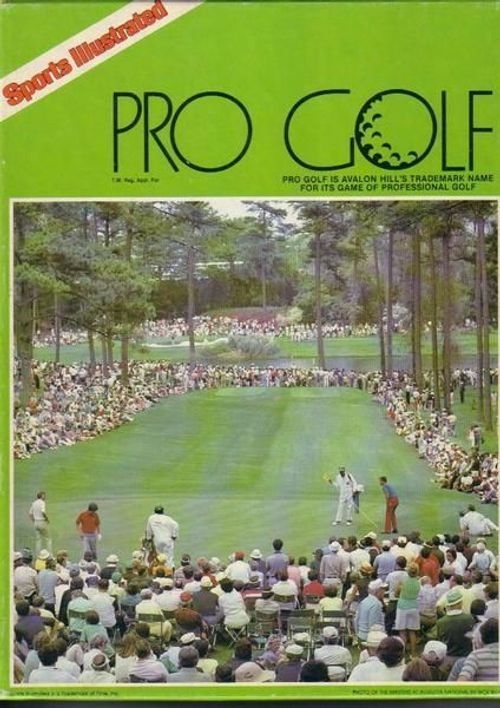
Pro Golf
Pro Golf Rulebook
Table of Contents
Table of Contents
1.0 Introduction
PRO GOLF is a precise simulation of the famous Masters golf tournament held in Augusta, Georgia, every April. Thirty-six professional golfers are scientifically rated to play as they actually did on the 1981 Tour. In the future, Avalon Hill may update the player cards and introduce new fields so that you can enjoy the game even more.
2.0 Included Equipment
- One Augusta National course booklet.
- One rules folder.
- One scorepad.
- 36 player cards, and 1 "Second Putt" card.
- Two dice.
3.0 Game Play
PRO GOLF can be played solitaire or with a group. Normally, each player assumes the role of a golfer and plays all 18 holes with the corresponding player card. Each stroke a player makes is resolved by a roll of the dice and by consulting the Course Manual. The number of strokes needed to complete each hole is recorded on the scorepad. The total number of strokes needed to complete the course is compared with the scores of the other golfers; the lowest score determines the winner. For information on how the Masters Tournament is run, see Section 8.0. It is generally recommended that one golfer complete a hole from start to finish before another player begins. This system is not mandatory, but it certainly speeds up play. All official rules of the United States Golf Association apply to any unusual golf situations not covered by the following rules.
(3.1) The Player Cards
All professional golfers included in PRO GOLF are rated on individual player cards in ten different categories: Drive (D), Fairway Woods (FW), Long Irons (LI), Medium Irons (MI), Short Irons (SI), Pitching (P), Chipping (Ch), Play in the Sand (Sd), Putting, and an Overall Value. When a player takes part in a round, his card is consulted each time he attempts a stroke, comparing the result of the dice roll with the type of stroke being attempted.
(3.2) The Course Manual
The course manual included with PRO GOLF shows the historic Augusta National Golf Course, site of the annual Masters tournament. The 18 holes are represented graphically, although these representations have nothing to do with the course of play. Instead, all the crucial information about the play of each hole is found on the facing page (called the "hole card"). All possible strokes and their results are shown there (except putts).
4.0 How to Play a Hole
(4.1) How to Read the Dice
For each stroke, the golfer must roll two dice. The numbers on the dice are not added together; they are read in a particular way, giving 21 possible combinations. To read the dice, always read the lower number first, followed by the higher. For example, if one die shows a 2 and the other a 3, the result is 23. If one die shows a 6 and the other a 1, the result is 16. If the two numbers are the same, the two digits are simply read together (for example, a 2 and a 2 are read as 22). Every possible dice result has a corresponding numbered box on the left side of all player cards.
(4.2) How to Read the Results
Generally, the results of strokes on the player card will be a number or a series of abbreviations. If a number appears, the ball has landed on the green at the indicated distance in feet from the hole. If an abbreviation appears, the ball has not landed on the green, but the length and final location of the stroke are indicated as follows: The first letter always indicates the length of the stroke: S = Short, M = Medium, L = Long. The second letter always indicates the position of the stroke: L = Left, C = Center, R = Right. All other abbreviations are explained in Section 7.0.
(4.3) Tee Shot
On every hole it is indicated how the golfers will make their tee shot. In most cases it will be made with the driver, but on certain par 3 holes irons may be used. To make a tee shot, a player rolls two dice. The number obtained on the roll must be looked up in the corresponding column of the player card. The result will be a series of letters and abbreviations (indicating the result of the stroke) or a number (indicating that the ball has landed on the green at the indicated distance from the flag).
(4.4) Second Strokes
If the tee shot has landed on the green, no second stroke is needed. Instead, the golfer must putt to complete the hole (see 4.6). If the tee shot has not landed on the green, consult the "Second Stroke" section of the hole card. There all possible results of the tee shot are listed, shown with abbreviated letters, which show where the ball has landed and what type of stroke must be attempted next.
(4.41) If a second stroke is needed after the tee shot, it must be played with the club indicated on the corresponding line of the hole card. For example, on hole 1 of Augusta National, a long center tee shot (LC) must be followed by a second stroke with a short iron (SI).
(4.42) The second stroke is made in a similar way to the tee shot. The type of club to use is determined by the hole card, and the corresponding column on the player card is consulted immediately. Two dice are rolled and the number obtained is compared with this column to obtain the result. Second strokes will either land on the green (see 4.6) or require a third stroke (see 4.5).
(4.43) Occasionally, a tee shot will not land in the fairway but somewhere more difficult, such as trees or a bunker. The second stroke that must be played from these difficult lies is followed by a number in parentheses. This figure means that the indicated number of boxes must be subtracted from the golfer's second stroke. For example, on hole 1 of Augusta National, a short right tee shot lands in the trees. The second stroke must be made with a long iron, minus 5. The player rolls a 33. The resulting subtraction of five boxes (in the upward direction) on the player card gives 22. The 22 is compared with the LI column to obtain the result. No dice roll can be lower than 11.
(4.44) On some par 5 holes, the hole card may indicate that the second stroke is a "Layup". See Case 4.7 for an explanation of approach strokes.
(4.45) Some holes may require that the second stroke be a "rescue", followed by another stroke. See Case 5.3 for an explanation of "rescues".
(4.46) On par 3 holes, the two-letter abbreviation indicating the result of some tee shots may be followed by a hyphen and another abbreviation. This abbreviation will be "P" (Pitch) or "Ch" (Chip), indicating that the second stroke will use one of these approaches to the green. The hole card must be consulted immediately to see whether this tee shot has resulted in any difficulty, such as sand or trees. For example, on hole 4 of Augusta National, a long iron tee shot may result in a "SL-Ch" on the player card. When checking the "Second Stroke" area of the hole card, it is determined that this tee shot has landed in the sand. In addition, the card indicates that the second stroke must be made in the golfer's "Sd" (Sand) column. On the other hand, if the result of the tee shot had been "SC-Ch", the hole card indicates — under the heading "All other Ch" — that the stroke has landed near the green and that the second stroke must use the golfer's "Ch" (Chip) column to be resolved.
(4.47) The results of some drives may be followed by an asterisk. This is a "superlative" drive and may affect the second stroke. See Case 5.1 for an explanation of superlative drives.
(4.5) Third and Additional Strokes
If the second stroke has landed on the green, no third stroke is needed and the golfer must putt to complete the hole (see 4.6). If the second stroke has not landed on the green, a third stroke is required. Furthermore, if the third stroke (or any later stroke) does not land on the green, an additional stroke must be made. In essence, the golfer must keep making strokes while the ball has not landed on the green. Third (and all additional) strokes are resolved exactly like second strokes. That is, the player must consult the "Third Stroke" section of the hole card to determine where the second stroke landed and what type of stroke will be required as the result. All the rules of Case 4.4 apply in full to third (and additional) strokes. For example, on hole 1 of Augusta National, if a long iron was required for the second stroke and this resulted in a "SL-Ch", the "Third stroke" section of the hole card indicates that this stroke landed in the sand and the golfer must use the "Sd" (Sand) column for the third stroke. On the other hand, if the result of the long iron stroke was "SC-P", the hole card indicates that the third stroke must be a "P" (Pitch). If the pitch still does not land on the green, the fourth stroke and subsequent strokes are resolved according to the instructions in the "Additional strokes" section of the hole card.
(4.51) On par 5 holes, the third stroke may follow a second stroke that is a "Layup" or a normal second stroke. See Case 4.7 for a full explanation of par 5 holes.
(4.52) Par 3 holes never have a "Third stroke" section on their hole cards. Instead, if the second stroke (and all subsequent ones) do not land on the green, the "Additional strokes" section of the hole card is consulted.
(4.6) On the Green
If the result of any stroke is a number instead of a letter or abbreviation, the ball has landed on the green. The golfer must complete this hole with a putt. The number indicates the distance in feet at which the ball landed from the flag. All players must write it down to remember it. Next, the player rolls two dice, comparing this number with the Putt column. The result will again be a number (exception: see 4.61). If this number is equal to or greater than the distance from the ball to the hole, the putt is valid and the hole is completed. If the number is less than the distance from the ball to the hole, the putt is not valid and a second putt is required (which is considered automatically valid; exception: see 4.62) to complete the hole. For example, if the ball lands on the green 37 feet from the hole and, due to a dice roll for the putt, a result of 7 is obtained, that putt is not valid, but the second putt is considered automatically holed (for a total of two putts on the green).
(4.61) A result of "Holed" in the golfer's Putt column means that a putt of any length is considered holed in one stroke. A result of "Miss" in the golfer's Putt column means that a putt of any length has been missed.
(4.62) If a putt attempt is missed and the number obtained in the Putt column is followed by a letter (A, B, C or D), the second putt is not automatically valid. Instead, the player must consult the Second Putt Card and, if necessary, roll the dice again to check whether the second putt is valid:
A. Consult the corresponding column of the Second Putt Card according to the letter that appears after the result of the first putt: A, B, C or D.
B. Locate the corresponding box on the left side of the Second Putt Card according to the length of the original putt.
C. Compare this distance with the column of the corresponding letter. The resulting number is the distance in feet of the second putt attempt (exception: see step D). The player must roll the dice and resolve the second putt exactly as described in Case 4.6; that is, a putt distance on the player card that is equal to or greater than the distance of the second putt is valid. If it is less, it is not valid (see Case 4.63).
D. If, when comparing the original putt distance with one of the four letter columns of the Second Putt Card, a result of "Good" is obtained instead of a number, the second putt is holed automatically without the player having to roll the dice.
(4.63) If the second putt is missed, the player rolls two dice immediately. A result of 11 means that the third putt is also missed. Any other result indicates that the third putt will be holed. If the third putt is missed, the fourth putt will be holed automatically.
(4.7) Par 5 Holes: Special Rules
Tee shots on par 5 holes are resolved normally. However, the second stroke on such holes may be of two types: Layup (see 4.71) or Normal (see 4.72).
(4.71) When determining the type of second stroke to be used on a par 5 hole, the word "Layup" may appear after the type of stroke indicated on the hole card. A Layup means that the golfer is not seeking to reach the green with the second stroke, but will try to strike the ball with the greatest possible accuracy down the fairway. An approach stroke is made normally (see 4.42), except that its result must be interpreted by consulting the "Third stroke (approach)" section of the hole card. In this case, the result of the second stroke (approach) is transformed into new instructions for the third stroke. If this third stroke does not land on the green, the usual procedure (see 4.5) is followed until it does.
(4.72) If the word "approach" does not appear after the type of second stroke required on a par 5, the golfer must aim for the green with the second stroke. This means the golfer resolves the second stroke normally (without interpreting it) by consulting the section of the hole card labeled simply "Third stroke". In addition, the rest of the hole is also resolved normally.
(4.73) The modifiers in parentheses for all strokes on par 5 holes apply in full (see 4.43).
(4.74) Some par 5 holes, such as hole 13 at Augusta National, may offer players the option of attempting a difficult shot at the green or an easier and simpler approach shot. Whatever the player's decision, he must announce it aloud before the second shot.
(4.75) Some par 5 holes may require a positive modification to the second or third stroke. Such modifications are made as described in Case 4.43, except that squares are added to the final dice roll, not subtracted. No dice roll may exceed 66.
Example of a Par 5 Hole
-
A tee shot on hole 2 of Augusta National results in a short center drive (SC). The second stroke required is a layup approach shot with the right (FW). The player rolls two dice, obtains a result from the FW column of his golfer, and consults the "Third stroke (Layup)" section of the hole card. Assuming the result of the FW stroke was 43, it is seen that the ball has not landed on the green; instead, the third stroke requires a "P" (Pitch). Suppose the result of this pitch is "SC-Ch". Consulting the "Additional strokes" section of the hole card, this means a chip (Ch) to the green is required for the fourth stroke.
-
A tee shot on the same hole results in a long drive to the left (LL). The second stroke required is simply "LI" (Long Iron). The player rolls the dice, consults the LI column of his golfer and obtains a result of 43. This ball, which has landed on the green, is holed in two putts to achieve a birdie.
5.0 Special Rules
(5.1) Superlative Strokes
The results of some strokes on the player cards may be followed by an asterisk. These are called superlative strokes and may positively influence the second stroke if it lands on the green. Second strokes that do not land on the green (as well as all approach strokes) are not affected by superlative strokes. In these cases, the fact that the stroke was superlative is ignored. If the golfer's stroke immediately following a superlative stroke lands on the green, the player rolls one die. The result of this roll is subtracted from the distance the ball has traveled from the flag, indicating the final distance of the ball from the flag after the second stroke. If this subtraction makes the distance exactly zero, the ball has gone into the hole and no putts are required to complete it. If the subtraction gives a negative number, simply ignore the minus sign and consider the ball to be at that distance from the hole. For example, if a long iron stroke on a par 4 hole, immediately after an exceptional drive, lands 2 feet from the hole, the player rolls one die. A result of 2 means the long iron went into the hole for an eagle. A result of 5 means the ball landed 3 feet from the hole, and a result of 1 (or 3) means the ball ends up 1 foot from the hole (Exception: see 5.23).
(5.2) Results in Parentheses
(5.21) Some tee shot results may appear in parentheses on the hole card (such as the SL result on hole 5 at Augusta National). The player who obtains such a result must roll one die to determine the type of second stroke he must make. The possible types of second strokes are indicated directly on the hole card.
(5.22) Results that appear in box 66 of the P (Pitch) or Sd (Sand) columns of some players may appear in parentheses. This means that the pitch or sand shot just made may be holed. The player immediately rolls one die: a result of 1, 2 or 3 means the ball has gone into the hole, and a result of 4, 5 or 6 means the ball has landed 30 cm (1 foot) from the flag. NOTE: For the ball to have a chance of going into the hole, the dice roll must be an unmodified 66. Any result in parentheses obtained in box 66 due to the sum of the dice numbers has no chance of going into the hole; instead, it remains 30 cm from the hole.
(5.23) Any approach stroke that obtains an unmodified result of 66 immediately after an exceptional drive is resolved as follows: The player rolls one die. If a result of 1, 2, 3 or 4 is obtained, the approach stroke goes into the hole. If a 5 or a 6 is obtained, the ball lands 30 cm from the hole.
(5.24) Any chip or sand shot that results in "Holed" means the shot has gone into the hole.
(5.3) Rescues
On the "Second Stroke" section of some hole cards, some tee shot results may require the second stroke to be a "Rescue" followed by a fairway wood, iron or pitch stroke. A Rescue means that the tee shot has landed in an area of rough that makes the second stroke impossible, unless the golfer "rescues" his position by taking the ball out of this disadvantageous position with a chip. A Rescue is automatic and is not resolved with dice rolls. Instead, the second stroke must be made normally after the Rescue. Remember that this second stroke is actually the golfer's third stroke, and his third stroke would be the fourth, and so on. For example, if on hole 5 at Augusta National a golfer obtains a short left tee shot, his second stroke would be a Rescue followed by an iron. If he completes this hole in 4 normal strokes, remember that the rescue would make his score on this hole 5.
(5.4) Water Penalties
Water penalties work like Rescues. If the ball falls into the water, a penalty of one stroke is automatically applied to the golfer's total for that hole. (The action of reaching into the water, removing the ball and dropping it nearby is considered the penalty.) The type of stroke indicated on the hole card after the ball has been removed from the water is then played. No golfer can avoid the one-stroke penalty by attempting a stroke from the water.
6.0 Optional Rules
The following rules are optional for playing PRO GOLF. They should only be used with the mutual consent of both players. These rules considerably increase the realism of the game, but also its complexity.
(6.1) Playing Safe and Gambling
In reality, no professional golfer will attempt to play a hole the same way round after round. Instead, he considers each hole from the overall perspective of his performance in the tournament as a whole. If it is the last round and he is trailing by 3 strokes at the tee of hole 16, he will have to take risks to win. On the other hand, if he is leading by 6 strokes at the same tee, the most prudent course would be to play with caution and avoid disaster. In professional golf, a player may declare that he will play safe (see 6.11) or gamble (see 6.12) on any tee shot, with a fairway wood or with an iron (not on approach strokes, chips, sand shots or putts). If a player does not execute a stroke in either of these two ways, that stroke is resolved normally, without modifications.
(6.11) If a player plays safe, he rolls two dice and determines his result normally. However, immediately afterward he rolls one die and subtracts a number of boxes equal to this result from the original number of the dice. For example, if a player obtains a 45 when playing safe and then rolls a 5 on one die, the final result of this stroke would be 33. The advantage of playing safe is that the player may choose any result for his stroke that lies between box number 11 in the corresponding column of the player card and the box corresponding to the newly determined result (inclusive). The player must state aloud which result he chooses from the available boxes. In the example above, the player would choose any numbered box between 11 and 33 (inclusive) in the corresponding column of the player card. No dice result may be lower than 11. NOTE: If a golfer plays with caution, exceptional tee shots are ignored.
(6.12) If a player gambles, he rolls two dice and determines the result in the usual way. However, before consulting the player card [the source reads "cartas de jugador o de mano"], he must consult the Total Value of his golfer (a two-digit number that appears on the card). If the result of the dice is equal to or higher than this Value, the golfer's gamble is successful (see 6.13). If the result is lower than this Value, the golfer is in trouble (see 6.14).
(6.13) If a golfer gambles and succeeds, one die is rolled immediately. A number of boxes equal to the result of this roll is added to the original number of the stroke (no number may exceed 66). For example, if a player has successfully gambled by obtaining a 26 on a long iron stroke and then rolls a 6 on one die, the result of that stroke becomes 45 in the long iron column. Superlative drives apply in full to gambled tee shots, even with modified dice results.
(6.14) If a golfer takes a risk and finds himself in Trouble, the original dice roll for that stroke is ignored. Instead, the line designated "Trouble" on the hole card for the stroke is consulted. The instructions there detail the requirements for the next stroke. For example, a drive that results in Trouble on hole 1 at Augusta National automatically entails a second stroke with a short iron, minus eight boxes. If this second stroke also results in Trouble, the third stroke must be a Pitch, minus three boxes.
(6.15) Modifications to dice numbers due to Playing Safe or Gambling are added to any other subtraction or addition indicated on the hole card.
(6.16) On a given hole, it is perfectly permissible to take a risk on one stroke, play safe on another, and play normally on a third. Playing Safe and Gambling are declared stroke by stroke, not hole by hole.
(6.2) Flag Positioning
In reality, the position of the flag on each green is usually changed daily by the club staff. The different flag locations can turn a normal hole into a trap for bogeys and vice versa. Before each round, the players must consult the Course Book and agree on the flag position on the 18 greens. There are three possible positions: Easy, Normal and Difficult (although it should be noted that some holes do not allow the Easy position). The declared position of each flag must be written on the scorecard. (If the players do not agree, the flag position will be considered Normal.) The flag position only comes into play when a stroke lands on the green. In that case, the player must consult the following table, comparing the type of stroke attempted with the flag position of the hole. (NOTE: If Case 6.1 is not used, all shots are considered "Standard".) The result will be a card whose meaning is explained below:
| Type of Shot | Easy Pin | Normal Pin | Difficult Pin |
|---|---|---|---|
| Safe Shot | B | C | D |
| Normal | A | B | C |
| Gamble | A | A | B |
A: The distance to the hole obtained on the stroke is halved (rounding fractions up).
B: The distance to the hole obtained on the stroke remains unchanged.
C: The distance to the hole obtained on the stroke increases by 50% (rounding fractions up).
D: The distance to the hole obtained on the stroke increases by 100%.
(6.3) Weather
Adverse weather conditions, such as strong winds or heavy rain, can occasionally cause difficulties for professional golfers. Before each round, one die must be rolled. A result of 1 to 5 indicates normal weather with no adverse effect on play. A 6 indicates bad weather, the effects of which are summarized below. (NOTE: Bad weather lasts only one round. To determine the weather for the following round, the die must be rolled again.)
A. No superlative tee shots are allowed.
B. All long (L) strokes become medium (M) strokes.
C. Subtract two from all dice results obtained on iron and fairway wood strokes, as well as on all putts.
7.0 Abbreviations and Terminology
- Ch: Chip
- D: Drive
- FW: Fairway Wood
- LC: Long Center stroke
- LI: Long Iron
- LL: Long Left stroke
- MC: Medium Center stroke
- MI: Medium Iron
- ML: Medium Left stroke
- MR: Medium Right stroke
- Nr Grn: Near the Green
- P: Pitch
- SC: Short Center stroke
- Sd: Sand
- SI: Short Iron
- SL: Short Left stroke
8.0 The Tournament
The Masters Tournament is held annually in mid-April. Its structure is similar to that of most golf tournaments: four consecutive daily rounds, from Thursday to Sunday. Each round consists of a complete course of the Augusta National Golf Course, with a total of 72 holes and a par of 288. Generally, about 80 golfers are invited each year to play in the Masters, according to the club's bylaws, which are sometimes strict and sometimes peculiar. Between 30 and 40 of these players may be amateurs or veterans, but the invited professional golfers are, without doubt, the elite of the PGA. After two rounds, only the 44 best players may continue competing. Of course, the winner is the player with the lowest score over the four rounds. (In case of a tie, it is resolved with an 18-hole playoff round the following day.) The current prize purse is approximately $360,000, of which the winner receives $55,000 (in addition, of course, to the coveted Green Jacket). The average winning score over the last ten years has been 278. The highest score of all time was 289 (Sam Snead in 1954 and Jackie Burke in 1956); the lowest was 271 (Jack Nicklaus in 1965 and Ray Floyd in 1976). The current holder of the Green Jacket is Tom Watson, whose score of 280 in April 1981 was two strokes better than those of Johnny Miller and Jack Nicklaus.