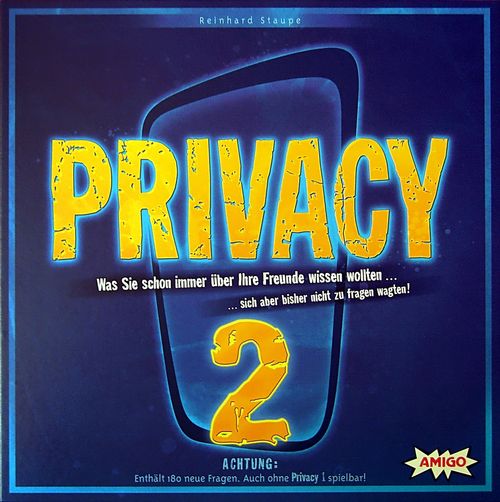
Privacy 2
Privacy 2 Rulebook
Table of Contents
Table of Contents
Overview
Players: 5-12. Age: 16 and up. Duration: about 45 minutes.
Game Material
- 90 question cards
- 12 playing pieces
- 1 game board
- 12 "I" discs (Ich-Scheiben)
- 12 "We" discs (Wir-Scheiben)
Before the first game: On all 12 "We" discs, the three parts (two discs and one envelope) are assembled as shown in the three illustrations: (1) slide disc 1 (left) and disc 2 (right) into the envelope; (2) remove the protective foil; (3) fold in the flap and glue it down.
Game Preparation
The game board is placed in the middle of the table. Each player takes a playing piece and puts it on the Start/Finish space (0/30) of the board. Each player also receives a "We" disc and an "I" disc. The 90 question cards are shuffled and placed as a face-down draw pile on the space with the numbers 1, 2, 3, 4. On the space next to it, a discard pile of already used question cards will build up during the game. Leftover pieces, "I" discs and "We" discs are not needed and are put back in the box.
Recommendation: If couples take part in the game, it is better that they do not sit directly next to each other.
Course of Play
For each round there is a game leader (Spielleiter). He watches attentively that no unwanted outing occurs during play and that the secret answers stay secret. He is also responsible for the correct distribution of points. Otherwise, the game leader takes part in the game as normal.
The oldest player is the first game leader. In the following rounds the game leader changes clockwise. Each round consists of the following six actions, which are carried out one after the other.
1st Action: Read a question aloud
The game leader begins the round by taking the top question card from the draw pile. He reads aloud the question that corresponds to the number now visible on top of the draw pile. Then he places the card on the discard pile next to it.
Example: Six people are playing. Linus is game leader. He draws the top question card from the pile. The next card of the pile shows the number "3". Linus reads the third question from the drawn card and then puts it on the discard pile. The question is: "How many hours per day do you spend privately on the internet?"
Note: If the game leader or the group does not like the question or finds it too delicate, a different question may be chosen.
2nd Action: Answer with the "I" disc
Each player answers the question honestly, but secretly. Each takes his "I" disc in hand. The octagonal disc is pulled out of the sleeve far enough that it can be turned comfortably, so that the desired number for the answer is visible in the small window of the sleeve after pushing it back in. Then each player places his "I" disc in its sleeve, question-mark side up, on the answer area of the game board.
Caution: Each player should take good care that nobody can see which number he selects.
Whoever has done/experienced the thing asked not at all, or once, twice, three times or four times, pushes the disc back into the sleeve so that the "0" or the corresponding number is visible in the small window. If the player has done/experienced the thing asked five to nine times, he pushes the disc back so that "5+" is visible in the window. If the player has done/experienced the thing asked ten times or more often, "10+" is visible in the window.
Example: Linus is privately on the internet three hours a day. He takes his "I" disc and pushes it into the sleeve so that the number "3" can be seen in the window. Then he places it, question-mark side up, on the game board with the "I" discs of the other players.
As soon as all players have placed their "I" disc on the game board, the action is finished.
3rd Action: Guess with the "We" disc
Before the "I" discs are revealed in the next action, each player must now take his "We" disc in hand and guess. Each player guesses the sum of all numbers that the players have set in total on their "I" discs. For this, the "We" disc is set so that the desired guess is visible in the window.
Now too, each player should take good care that nobody can see which number he has set. Then he places his "We" disc face down in front of him.
Game tip: When in doubt, one should rather set a somewhat lower number, because whoever estimates the sum of the answers too high gets no points.
Example: Linus estimates all six players so that they are on the internet a total of 17 hours a day. So he sets the number "17" on his "We" disc.
4th Action: Add up the answers
When all players have placed their "We" discs face down in front of them, the game leader takes the "I" discs from the game board. First he shuffles them, so that it cannot be seen which disc comes from which player. Then he reveals the "I" discs and adds up the numbers. The values "5+" and "10+" are counted as the numbers "5" and "10" respectively.
Example: After Linus, as game leader, has shuffled all six "I" discs, he reveals them. The numbers "1", "3", "3", "4", "3" and "5+" are visible in the windows. The sum of the answers is 19 (hours).
5th Action: Distribute points and move pieces
The game leader now carries out the distribution of points. First he asks whether anyone guessed exactly the right number. The players concerned (and only these!) reveal their "We" discs. Then he asks whether a player guessed a number that is exactly "1" lower, exactly "2" lower, etc. After each question the players concerned reveal their "We" discs. The game leader continues this until players have revealed their "We" discs for three different guesses, or until he would have to ask for the "0".
Caution: The game leader does not ask for the "0". A player who has set the "0" on his "We" disc therefore receives no points. Exception: If the total result of all answers on the "I" discs is "0", the players who guessed the result correctly reveal their "We" discs.
The players who have now revealed their "We" discs receive points as follows:
- The one who guessed the sum of the answers exactly right, or whose guess is closest, receives 3 points.
- The one whose guess is second closest to the sum receives 2 points.
- The one whose guess is third closest to the sum receives 1 point.
If several players gave the same guess, all these players receive the corresponding points.
Players whose guesses were too low receive no points. Likewise, players who guessed a higher number than the sum of the answers receive no points. All these players leave their "We" discs face down; their guesses stay secret.
Note: Whoever does not want to reveal his "We" disc because he fears outing himself is not forced to. But then he also receives no points.
The game leader moves the players' pieces forward on the game board by as many spaces as they have received points. All other pieces stay where they are.
Example: The sum of all answers is "19". Linus as game leader now asks in turn whether someone guessed "19", "18", "17", "16", etc. At "19", Beate (Pink) turns over her "We" disc. She guessed exactly right and gets 3 points. At "17", Linus (Grey) and Hanna (Yellow) turn over their "We" discs. They are second closest and each get 2 points. At "14", finally, Felix (Red) turns over his "We" disc. He is third closest and gets 1 point. Manuela (Green) guessed "21"; she gets no point, because her guess was too high. Finn (Violet) guessed "11"; he likewise gets no point. Both do not reveal their "We" discs in this scoring.
6th Action: End of the round
Each player takes any "I" disc from the middle again and places it in front of him. The game leader changes clockwise to the next player. In the following round, actions 1 to 6 are carried out again.
End of the Game
The game ends when, at the end of a round, a player's piece has reached or passed the finish space. The player who now has the most points wins. In case of a tie there are several winners.
Notes
Especially with the very delicate questions, care should be taken that players do not announce their answer aloud. In this game nobody is exposed or forced into an outing. Otherwise there can, should and of course will be discussions about the questions and their answers. This makes up a not inconsiderable part of the fun. Apart from that, players will experience many a surprise about what others have already experienced or how often others have already done something.
In a game with five it is sometimes advisable not to ask one or another delicate question, because otherwise suppositions are very quickly made about who in this manageable group might have given which answer.
If the group agrees, the respective game leader can of course also simply choose one of the four questions on a card and read it aloud. We recommend playing one complete game with the given questions, and immediately afterwards one with free choice of questions.
Editorial note: With the wording of the questions we do not wish to express any opinion of our own on any topic. It is also far from our intention to judge actions, outlooks on life or experiences. The questions serve solely to encourage players to form their own thoughts about the topics asked. Many questions in this game were submitted by "Privacy" fans. The respective submitter is named under the question. We have partly edited the questions editorially. If several submitters sent in the same question, the one who sent it in first was printed on the card.